
Likelihood ratios — MCQs

A researcher is trying to determine whether a newly discovered substance X can be useful in promoting wound healing after surgery. She conducts this study by enrolling the next 100 patients that will be undergoing this surgery and separating them into 2 groups. She decides which patient will be in which group by using a random number generator. Subsequently, she prepares 1 set of syringes with the novel substance X and 1 set of syringes with a saline control. Both of these sets of syringes are unlabeled and the substances inside cannot be distinguished. She gives the surgeon performing the surgery 1 of the syringes and does not inform him nor the patient which syringe was used. After the study is complete, she analyzes all the data that was collected and performs statistical analysis. This study most likely provides which level of evidence for use of substance X?
A 26-year-old medical student comes to the physician with a 3-week history of night sweats and myalgias. During this time, he has also had a 3.6-kg (8-lb) weight loss. He returned from a 6-month tropical medicine rotation in Cambodia 1 month ago. A chest x-ray (CXR) shows reticulonodular opacities suggestive of active tuberculosis (TB). The student is curious about his likelihood of having active TB. He reads a study that compares sputum testing results between 2,800 patients with likely active TB on a basis of history, clinical symptoms, and CXR pattern and 2,400 controls. The results are shown: Sputum testing positive for TB Sputum testing negative for TB Total Active TB likely on basis of history, clinical symptoms, and CXR pattern 700 2100 2,800 Active TB not likely on basis of history, clinical symptoms, and CXR pattern 300 2100 2,400 Total 1000 4200 5,200 Which of the following values reflects the probability that a patient with a diagnosis of active TB on the basis of history, clinical symptoms, and CXR pattern actually has active TB?
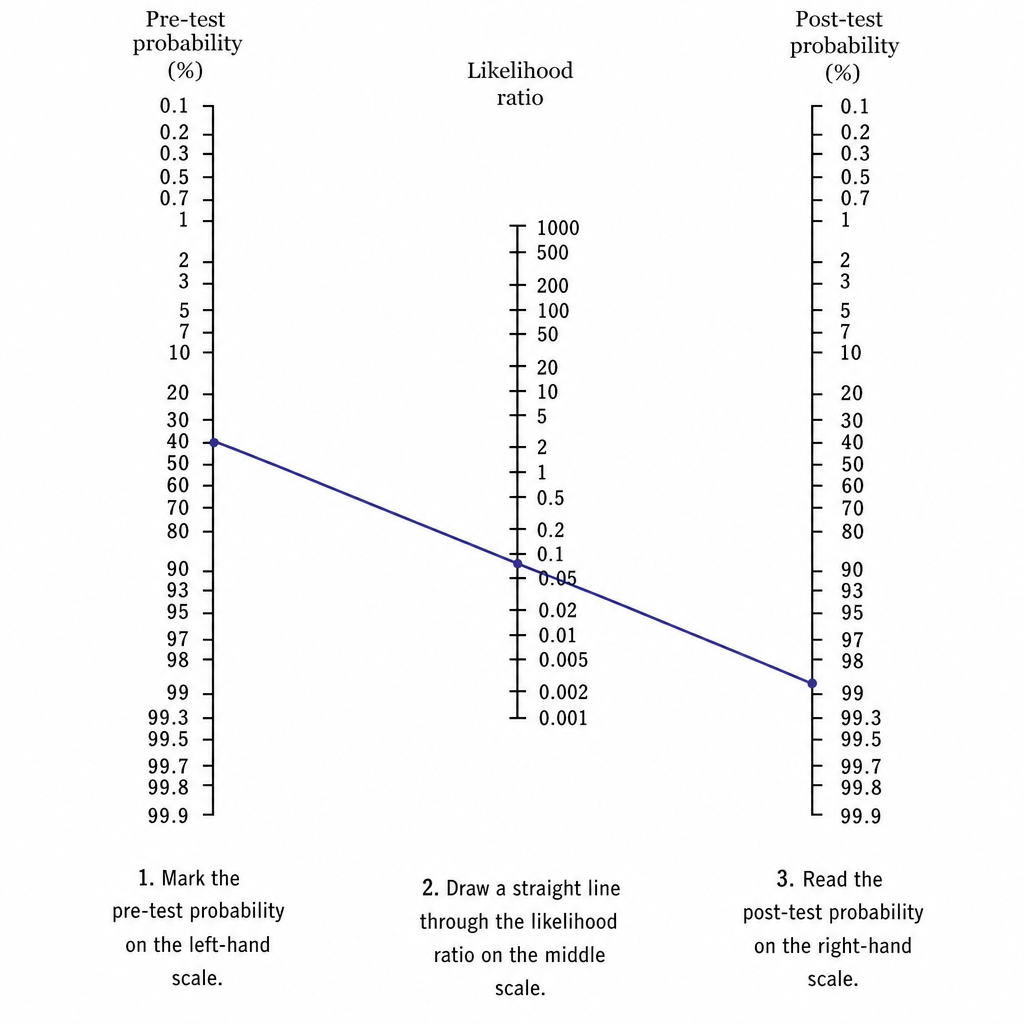
A 14-month-old Caucasian boy is admitted to the pediatric clinic with an 8-month history of diarrhea, abdominal tenderness and concomitant failure to thrive. One of the possibilities that may cause these symptoms is Crohn’s disease, and on the basis of the attending pediatrician’s experience, the pre-test probability of this diagnosis was estimated at 40%. According to Fagan’s diagram (picture), if the likelihood ratio of a negative test result (LR-) is 0.04, what is the chance that this is the right diagnosis?
A research group wants to assess the safety and toxicity profile of a new drug. A clinical trial is conducted with 20 volunteers to estimate the maximum tolerated dose and monitor the apparent toxicity of the drug. The study design is best described as which of the following phases of a clinical trial?
A 14-month-old boy is brought in by his parents with an 8-month history of diarrhea, abdominal tenderness and concomitant failure to thrive. The pediatric attending physician believes that Crohn’s disease is the best explanation of this patient’s symptoms. Based on the pediatric attending physician’s experience, the pretest probability of this diagnosis is estimated at 40%. According to Fagan nomogram (see image). If the likelihood ratio of a negative test result (LR-) for Crohn’s disease is 0.04, what is the chance that this is the correct diagnosis in this patient with a negative test result?
In 2013 the national mean score on the USMLE Step 1 exam was 227 with a standard deviation of 22. Assuming that the scores for 15,000 people follow a normal distribution, approximately how many students scored above the mean but below 250?
You are reviewing raw data from a research study performed at your medical center examining the effectiveness of a novel AIDS screening examination. The study enrolled 250 patients with confirmed AIDS, and 240 of these patients demonstrated a positive screening examination. The control arm of the study enrolled 250 patients who do not have AIDS, and only 5 of these patients tested positive on the novel screening examination. What is the NPV of this novel test?
A 45-year-old man presents for his annual checkup. The patient has a past medical history of diabetes mellitus (DM) type 2 that is well-controlled with diet. In addition, he was admitted to this hospital 1-year ago for a myocardial infarction (MI). The patient reports a 40-pack-year smoking history. However, after his MI, his doctors informed him about how detrimental smoking was to his heart condition. Since then, he has made efforts to cut down and now, for the past seven months, has stopped smoking. He says he used to use smoking as a means of dealing with his work and family stresses. He now attends wellness sessions at work and meditates early every morning before the family wakes up. Which of the following stages of the transtheoretical model is this patient most likely in?
A 7-year-old girl presents for a follow-up visit after recent discharge from the hospital. She was admitted about 4 months ago for symptoms of seizures, altered mental status, and fever. She was diagnosed during that admission with herpes encephalitis and recovered well after being treated with acyclovir. However, at this visit, her parents complain of some “strange behaviors” that have developed over the past several weeks. For example, she seems to be snacking uncontrollably and eats significantly more than she did before. Her teacher has also sent home notes stating that she has been chewing on art supplies such as crayons and glue and that she has been sent to the principal twice for rubbing her genitals inappropriately during class. The pediatric neurologist decides to get a follow-up MRI. Which of the following parts of the brain is most likely to have abnormal findings?
A pharmaceutical company develops a sequential testing protocol for a rare genetic disorder (prevalence 0.01%). Initial screening test has sensitivity 95% and specificity 90%. Positive results undergo confirmatory testing with sensitivity 99% and specificity 99.5%. The company claims this approach achieves PPV >80% for the final positive result. Evaluate this claim and the rationale for sequential testing in this context.
Want unlimited practice?
Get full access to all questions, explanations, and performance tracking.
Scan to download app