
Variations in circle of Willis — MCQs

A previously healthy 10-year-old boy is brought to the emergency department for the evaluation of one episode of vomiting and severe headache since this morning. His mother says he also had difficulty getting dressed on his own. He has not had any trauma. The patient appears nervous. His temperature is 37°C (98.6°F), pulse is 100/min, and blood pressure is 185/125 mm Hg. He is confused and oriented only to person. Ophthalmic examination shows bilateral optic disc swelling. There is an abdominal bruit that is best heard at the right costovertebral angle. A complete blood count is within normal limits. Which of the following is most likely to confirm the diagnosis?
A 3-year-old boy is brought to the emergency department after losing consciousness. His parents report that he collapsed and then had repetitive, twitching movements of the right side of his body that lasted approximately one minute. He recently started to walk with support. He speaks in bisyllables and has a vocabulary of almost 50 words. Examination shows a large purple-colored patch over the left cheek. One week later, he dies. Which of the following is the most likely finding on autopsy of the brain?
A 59-year-old man is brought to the emergency department by his wife for a 1-hour history of sudden behavior changes. They were having lunch together when, at 1:07 PM, he suddenly dropped his sandwich on the floor. Since then, he has been unable to use his right arm. She also reports that he is slurring his speech and dragging his right foot when he walks. Nothing like this has ever happened before. The vital signs include: pulse 95/min, blood pressure 160/90 mm Hg, and respiratory rate 14/min. The physical exam is notable for an irregularly irregular rhythm on cardiac auscultation. On neurological exam, he has a facial droop on the right half of his face but is able to elevate his eyebrows symmetrically. He has 0/5 strength in his right arm, 2/5 strength in his right leg, and reports numbness throughout the right side of his body. Angiography of the brain will most likely show a lesion in which of the following vessels?
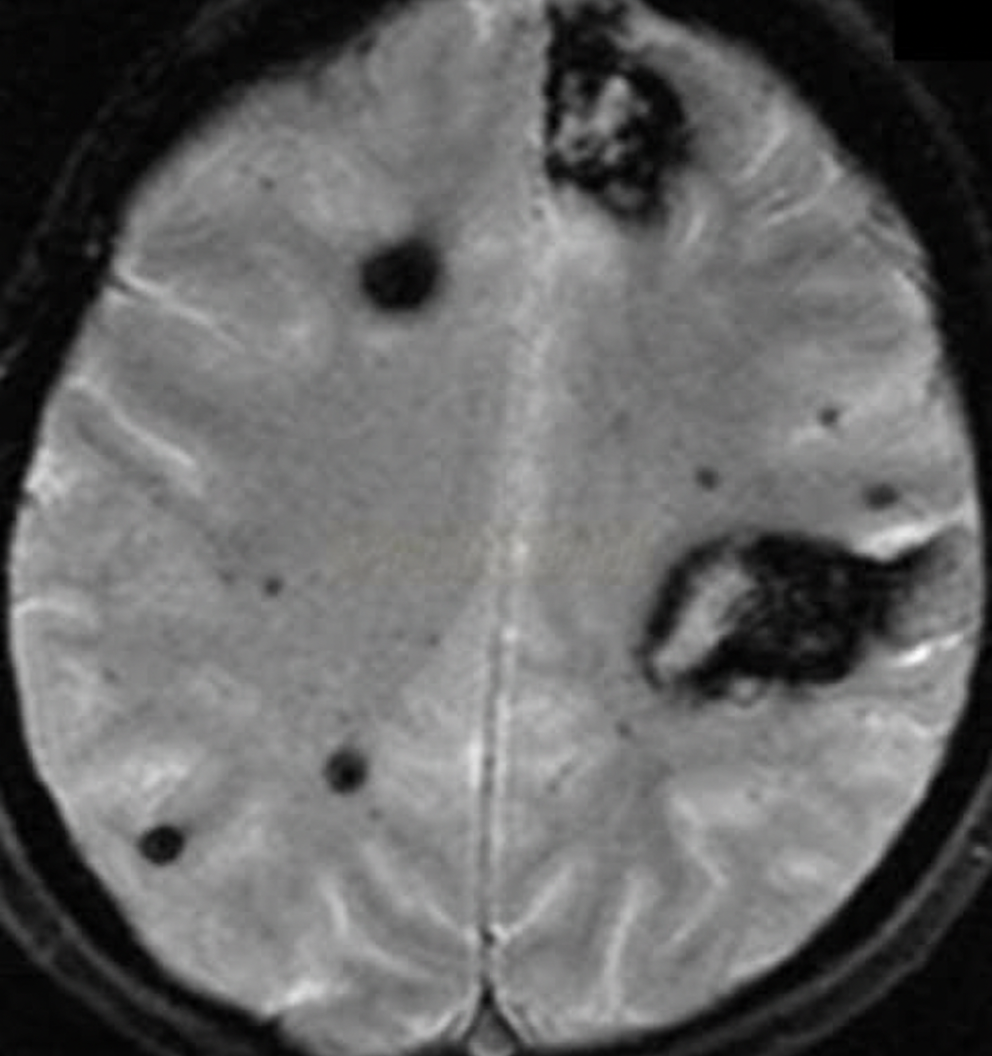
An 88-year-old woman with no significant medical history is brought to the emergency room by her daughter after a fall, where the woman lightly hit her head against a wall. The patient is lucid and complains of a mild headache. The daughter indicates that her mother did not lose consciousness after the fall. On exam, there are no focal neurological deficits, but you decide to perform a CT scan to be sure there is no intracranial bleeding. The CT scan is within normal limits and head MRI is performed (shown). Which of the following conditions has the most similar risk factor to this patient's condition?
A 72-year-old woman presents to the emergency department for vision loss. She was reading a magazine this afternoon when she started having trouble seeing out of her left eye. Her vision in that eye got progressively darker, eventually becoming completely black over the course of a few minutes. It then returned to normal after about 10 minutes; she reports she can see normally now. She had no pain and no other symptoms then or now. Past medical history is notable for hypertension and hyperlipidemia. A high-pitched sound is heard when the diaphragm of the stethoscope is placed on her left neck, but her physical exam is otherwise unremarkable; vision is currently 20/30 bilaterally. The etiology of her symptoms most likely localizes to which of the following anatomic locations?
A 38-year-old woman with moyamoya disease undergoes cerebral angiography showing bilateral progressive stenosis of distal internal carotid arteries with extensive collateral formation. She has had multiple TIAs despite medical management. CT perfusion shows reduced flow in bilateral MCA territories. The neurosurgery team debates between direct bypass (STA-MCA) versus indirect revascularization (EDAS). Evaluate the optimal approach considering Circle of Willis pathophysiology.
A 70-year-old man undergoes elective clipping of an unruptured basilar tip aneurysm. Preoperative angiography shows bilateral fetal-type posterior cerebral arteries (PCAs arising from internal carotid arteries) with hypoplastic P1 segments. The aneurysm involves both posterior communicating artery origins. Synthesize an approach to surgical planning that optimally preserves cerebral perfusion.
A 42-year-old woman presents with progressive cognitive decline, early-onset dementia, and recurrent subcortical strokes. Genetic testing reveals CADASIL (Cerebral Autosomal Dominant Arteriopathy with Subcortical Infarcts and Leukoencephalopathy). MR angiography shows no large vessel abnormalities but extensive white matter changes. Her sister, also affected, is considering pregnancy. Evaluate the counseling regarding Circle of Willis anatomy and implications for disease manifestations.
A 55-year-old man with diabetes and hypertension undergoes carotid endarterectomy for critical left internal carotid stenosis. Postoperatively, he develops right homonymous hemianopia without motor deficits. Intraoperative transcranial Doppler had shown reduced flow in the ipsilateral middle cerebral artery but preserved anterior cerebral artery flow. Analyze the most likely mechanism for this specific deficit pattern.
A 28-year-old woman presents with bilateral lower extremity weakness worse than upper extremity weakness, abulia, and urinary incontinence. MRI reveals bilateral anterior cerebral artery territory infarcts. Angiography shows an azygos anterior cerebral artery variant. Analyze the anatomical basis for this patient's bilateral deficits from a presumed single vascular occlusion.
Want unlimited practice?
Get full access to all questions, explanations, and performance tracking.
Scan to download app