
Internal carotid artery anatomy — MCQs

A 42-year-old woman presents to her primary care provider with vision loss. She reports that twice over the last 2 weeks she has had sudden “black out” of the vision in her right eye. She notes that both episodes were painless and self-resolved over approximately a minute. The patient’s past medical history is significant for hypertension, diet-controlled diabetes mellitus, and hypothyroidism. Her family history is notable for coronary artery disease in the patient’s father and multiple sclerosis in her mother. Ophthalmologic and neurologic exam is unremarkable. Which of the following is the best next step in management?
A 60-year-old male is admitted to the ICU for severe hypertension complicated by a headache. The patient has a past medical history of insulin-controlled diabetes, hypertension, and hyperlipidemia. He smokes 2 packs of cigarettes per day. He states that he forgot to take his medications yesterday and started getting a headache about one hour ago. His vitals on admission are the following: blood pressure of 160/110 mmHg, pulse 95/min, temperature 98.6 deg F (37.2 deg C), and respirations 20/min. On exam, the patient has an audible abdominal bruit. After administration of antihypertensive medications, the patient has a blood pressure of 178/120 mmHg. The patient reports his headache has increased to a 10/10 pain level, that he has trouble seeing, and he can't move his extremities. After stabilizing the patient, what is the best next step to diagnose the patient's condition?
A 50-year-old man presents to his primary care provider complaining of double vision and trouble seeing out of his right eye. His vision started worsening about 2 months ago and has slowly gotten worse. It is now severely affecting his quality of life. Past medical history is significant for poorly controlled hypertension and hyperlipidemia. He takes amlodipine, atorvastatin, and a baby aspirin every day. He smokes 2–3 cigarettes a day and drinks a glass of wine with dinner every night. Today, his blood pressure is 145/85 mm Hg, heart rate is 90/min, respiratory rate is 14/min, and temperature is 37.0°C (98.6°F). On physical exam, he appears pleasant and talkative. His heart has a regular rate and rhythm and his lungs are clear to auscultation bilaterally. Examination of the eyes reveals a dilated right pupil that is positioned inferolateral with ptosis. An angiogram of the head and neck is performed and he is referred to a neurologist. The angiogram reveals a 1 cm berry aneurysm at the junction of the posterior communicating artery and the posterior cerebral artery compressing the oculomotor nerve. Which of the following statements best describes the mechanism behind the oculomotor findings seen in this patient?
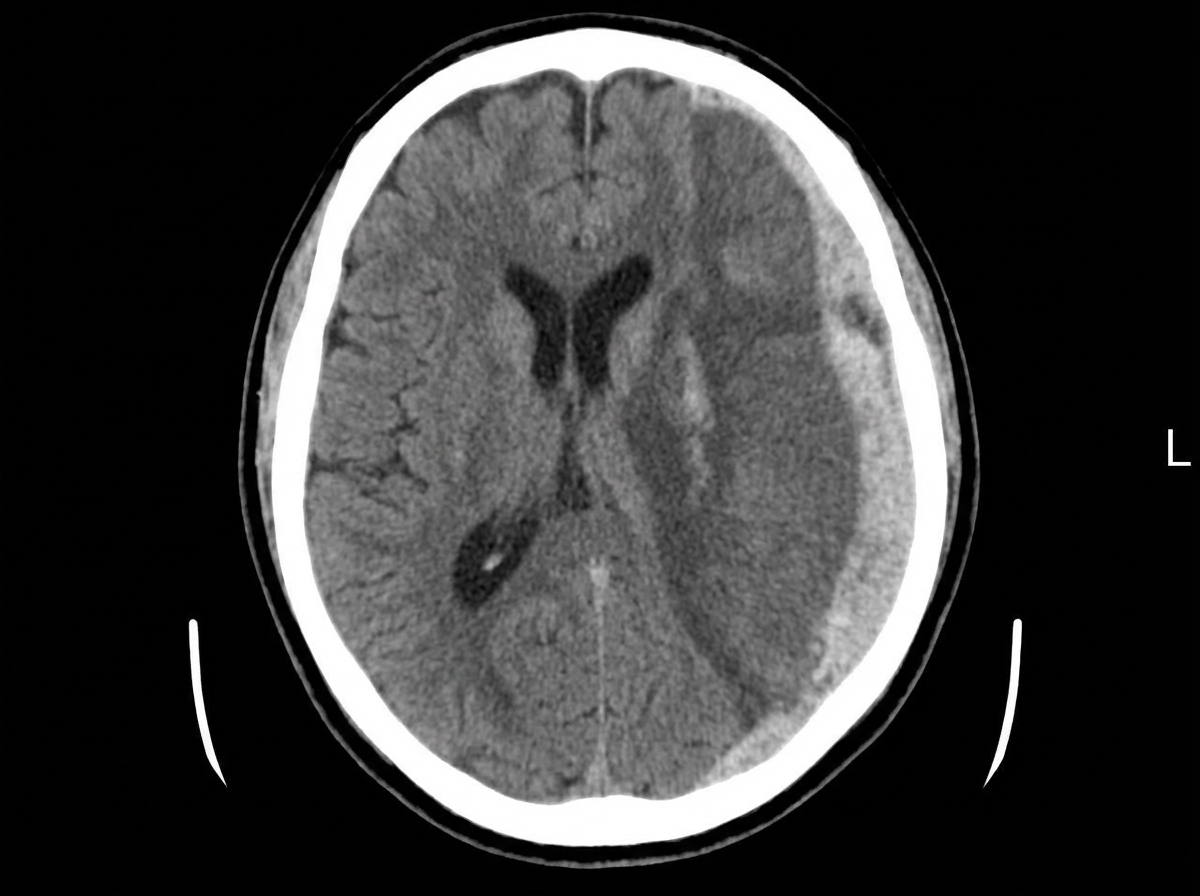
A 68-year-old man is brought to the emergency department by his wife because of a 2-week history of progressive disorientation and a 1-day history of left-sided weakness and difficulty speaking. The wife reports that the patient had a minor fall 4 months ago, during which he may have hit his head. He has hypertension and hyperlipidemia. He drinks 3–4 bottles of beer daily. He is only oriented to person. Neurological examination shows moderate spastic weakness, decreased sensation, and increased deep tendon reflexes in the left upper and lower extremities. A CT scan of the head is shown. Which of the following is the most likely cause of this patient's condition?
Where does the only cranial nerve without a thalamic relay nucleus enter the skull?
A 75-year-old man is brought to the emergency room after being found unresponsive in his home. His medical history is unknown. On physical examination he does not demonstrate any spontaneous movement of his extremities and is unable to respond to voice or painful stimuli. You notice that he is able blink and move his eyes in the vertical plane. Based on these physical exam findings, you expect that magnetic resonance angiogram will most likely reveal an occlusion in which of the following vessels?
A 78-year-old left-handed woman with hypertension and hyperlipidemia is brought to the emergency room because of sudden-onset right leg weakness and urinary incontinence. Neurologic examination shows decreased sensation over the right thigh. Muscle strength is 2/5 in the right lower extremity and 4/5 in the right upper extremity. Strength and sensation in the face are normal but she has difficulty initiating sentences and she is unable to write her name. The most likely cause of this patient’s condition is an occlusion of which of the following vessels?
An 80-year-old woman is brought to the emergency department for left hip pain 30 minutes after she fell while walking around in her room. Examination shows left groin tenderness. The range of motion of the left hip is limited because of pain. An x-ray of the hip shows a linear fracture of the left femoral neck with slight posterior displacement of the femur. Which of the following arteries was most likely damaged in the patient's fall?
A 71-year-old woman presents to the emergency department with a headache for the past 30 minutes. She says that this is the worst headache of her life and that it came on suddenly after she hit her head. She says that she has also been experiencing visual problems with double vision when she looks to the left or the right. Visual examination reveals that her right eye cannot move right past the midline and her left eye cannot move left past the midline. Which of the following is most likely responsible for this patient's visual defects?
A 72-year-old woman presents to the emergency department for vision loss. She was reading a magazine this afternoon when she started having trouble seeing out of her left eye. Her vision in that eye got progressively darker, eventually becoming completely black over the course of a few minutes. It then returned to normal after about 10 minutes; she reports she can see normally now. She had no pain and no other symptoms then or now. Past medical history is notable for hypertension and hyperlipidemia. A high-pitched sound is heard when the diaphragm of the stethoscope is placed on her left neck, but her physical exam is otherwise unremarkable; vision is currently 20/30 bilaterally. The etiology of her symptoms most likely localizes to which of the following anatomic locations?
Want unlimited practice?
Get full access to all questions, explanations, and performance tracking.
Scan to download app