
Communicating arteries — MCQs

A 59-year-old man is brought to the emergency department by his wife for a 1-hour history of sudden behavior changes. They were having lunch together when, at 1:07 PM, he suddenly dropped his sandwich on the floor. Since then, he has been unable to use his right arm. She also reports that he is slurring his speech and dragging his right foot when he walks. Nothing like this has ever happened before. The vital signs include: pulse 95/min, blood pressure 160/90 mm Hg, and respiratory rate 14/min. The physical exam is notable for an irregularly irregular rhythm on cardiac auscultation. On neurological exam, he has a facial droop on the right half of his face but is able to elevate his eyebrows symmetrically. He has 0/5 strength in his right arm, 2/5 strength in his right leg, and reports numbness throughout the right side of his body. Angiography of the brain will most likely show a lesion in which of the following vessels?
A 76-year-old woman with hypertension and coronary artery disease is brought to the emergency department after the sudden onset of right-sided weakness. Her pulse is 83/min and blood pressure is 156/90 mm Hg. Neurological examination shows right-sided facial drooping and complete paralysis of the right upper and lower extremities. Tongue position is normal and she is able to swallow liquids without difficulty. Knee and ankle deep tendon reflexes are exaggerated on the right. Sensation to vibration, position, and light touch is normal bilaterally. She is oriented to person, place, and time, and is able to speak normally. Occlusion of which of the following vessels is the most likely cause of this patient's current symptoms?
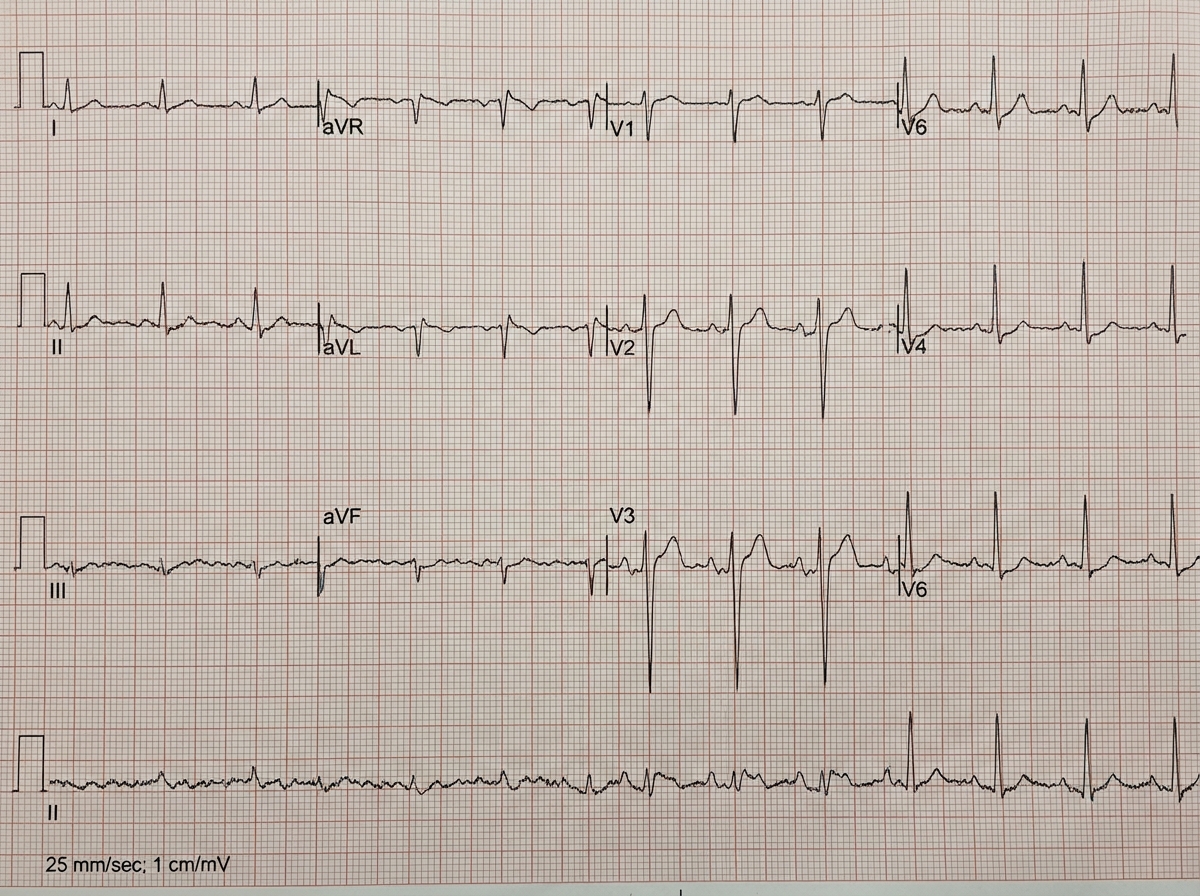
An 81-year-old woman comes to the emergency department due to a left-sided paralysis for the past 2 hours. Her husband says her symptoms began suddenly, and she is also unable to speak. Her pulse is 90/min, respirations are 18/min, temperature is 36.8°C (98.2°F), and blood pressure is 150/98 mm Hg. An ECG is obtained and is shown below. Which of the following is the most probable cause of the patient's paralysis?
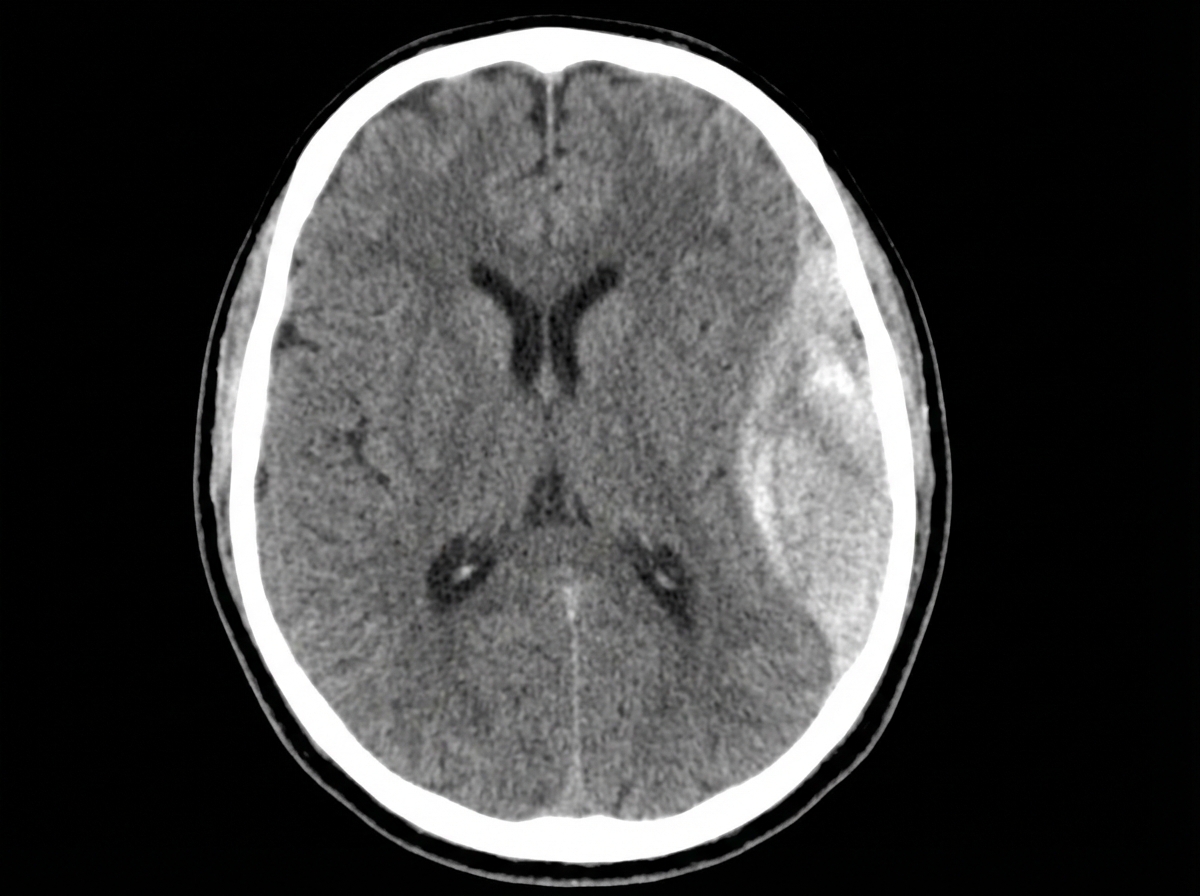
A 28-year-old man is brought to the emergency department by ambulance after developing an altered mental state following blunt trauma to the head. The patient was competing at a local mixed martial arts competition when he was struck in the head and lost consciousness. A few minutes later, upon regaining consciousness, he had a progressive decline in mental status. Past medical history is noncontributory. Upon arrival at the hospital, the temperature is 37.0°C (98.6°F), the blood pressure is 145/89 mm Hg, the pulse is 66/min, the respiratory rate is 14/min, and the oxygen saturation is 99% on room air. He is alert now. A noncontrast CT scan is performed, and the result is provided in the image. Which of the following structures is most likely affected in this patient?
A 72-year-old woman presents to the emergency department for vision loss. She was reading a magazine this afternoon when she started having trouble seeing out of her left eye. Her vision in that eye got progressively darker, eventually becoming completely black over the course of a few minutes. It then returned to normal after about 10 minutes; she reports she can see normally now. She had no pain and no other symptoms then or now. Past medical history is notable for hypertension and hyperlipidemia. A high-pitched sound is heard when the diaphragm of the stethoscope is placed on her left neck, but her physical exam is otherwise unremarkable; vision is currently 20/30 bilaterally. The etiology of her symptoms most likely localizes to which of the following anatomic locations?
A 75-year-old man is brought to the emergency room after being found unresponsive in his home. His medical history is unknown. On physical examination he does not demonstrate any spontaneous movement of his extremities and is unable to respond to voice or painful stimuli. You notice that he is able blink and move his eyes in the vertical plane. Based on these physical exam findings, you expect that magnetic resonance angiogram will most likely reveal an occlusion in which of the following vessels?
A 45-year-old woman presents with headaches. She says the headaches started about a month ago, and although initially, they were intermittent, over the past 2 weeks, they have progressively worsened. She describes the pain as severe, worse on the left than the right, and relieved somewhat by non-steroidal anti-inflammatory drugs (NSAIDs). The headaches are usually associated with nausea, vomiting, and photophobia. She denies any changes in vision, seizures, similar past symptoms, or focal neurologic deficits. Past medical history is significant for a posterior communicating artery aneurysm, status post-clipping 10 years ago. Her vital signs include: blood pressure 135/90 mm Hg, temperature 36.7°C (98.0°F), pulse 80/min, and respiratory rate 14/min. Her body mass index (BMI) is 36 kg/m2. On physical examination, the patient is alert and oriented. Her pupils are 3 mm on the right and mid-dilated on the left with subtle left-sided ptosis. Ophthalmic examination reveals a cup-to-disc ratio of 0.4 on the right and 0.5 on the left. The remainder of her cranial nerves are intact. She has 5/5 strength and 2+ reflexes in her upper extremities bilaterally and her left leg; her right leg has 3/5 strength with 1+ reflexes at the knee and ankle. The remainder of the physical examination is unremarkable. Which of the following findings in this patient most strongly suggests a further diagnostic workup?
An 80-year-old woman is brought to the emergency department for left hip pain 30 minutes after she fell while walking around in her room. Examination shows left groin tenderness. The range of motion of the left hip is limited because of pain. An x-ray of the hip shows a linear fracture of the left femoral neck with slight posterior displacement of the femur. Which of the following arteries was most likely damaged in the patient's fall?
A 68-year-old man comes to the physician because of double vision and unilateral right eye pain that began this morning. His vision improves when he covers either eye. He has hypertension, mild cognitive impairment, and type 2 diabetes mellitus. The patient has smoked two packs of cigarettes daily for 40 years. His current medications include lisinopril, donepezil, metformin, and insulin with meals. His temperature is 37°C (98.6°F), pulse is 85/minute, respirations are 12/minute, and blood pressure is 132/75 mm Hg. His right eye is abducted and depressed with slight intorsion. He can only minimally adduct the right eye. Visual acuity is 20/20 in both eyes. Extraocular movements of the left eye are normal. An MRI of the head shows no abnormalities. His fingerstick blood glucose concentration is 325 mg/dL. Further evaluation is most likely to show which of the following?
A 26-year-old man is brought to the emergency department by ambulance after being involved in a motor vehicle collision. He does not open his eyes on command or respond to verbal cues. A CT scan of the head shows a hyperdense fluid collection in the right medial temporal lobe with medial displacement of the uncus and parahippocampal gyrus of the temporal lobe. Which of the following cranial nerves is most likely to be injured as a result of this patient's lesion?
Want unlimited practice?
Get full access to all questions, explanations, and performance tracking.
Scan to download app