
Anterior cerebral artery territory — MCQs

A 65-year-old male presents to the emergency room complaining of a severe headache. He developed a sudden-onset severe throbbing headache while watching a football game on television. His past medical history is significant for migraines and hypertension; however, he states that this headache is different from his normal migraine headaches. He has a 30 pack-year smoking history. His family history is notable for stroke in his mother and father. His temperature is 98.9°F (37.2°C), blood pressure is 150/90 mmHg, pulse is 100/min, and respirations are 14/min. On examination, he is oriented to person, place, and time. Neck motion is limited due to pain. Strength is 5/5 bilaterally in both the upper and the lower extremities and sensation is grossly intact across all the dermatomal distributions. Patellar, brachioradialis, and Achilles reflexes are 2+ bilaterally. The vessel that is most commonly involved in this patient's likely condition directly branches off which of the following vessels?
A 72-year-old man with longstanding history of diabetes mellitus and hypertension presents to the emergency department with sudden-onset numbness. On your neurological exam, you note that he has loss of sensation on the left side of his face, arm, and leg. His motor strength exam is normal, as are his cranial nerves. Which of the following is the most likely explanation for his presentation?
A 35-year-old man who suffered a motor vehicle accident 3 months ago presents to the office for a neurological evaluation. He has no significant past medical history and takes no current medications. He has a family history of coronary artery disease in his father and Alzheimer’s disease in his mother. On physical examination, his blood pressure is 110/60 mm Hg, the pulse is 85/min, the temperature is 37.0°C (98.6°F), and the respiratory rate is 20/min. Neurological examination is suggestive of a lesion in the anterior spinal artery that affects the anterior two-thirds of the spinal cord, which is later confirmed with angiography. Which of the following exam findings would have suggested this diagnosis?
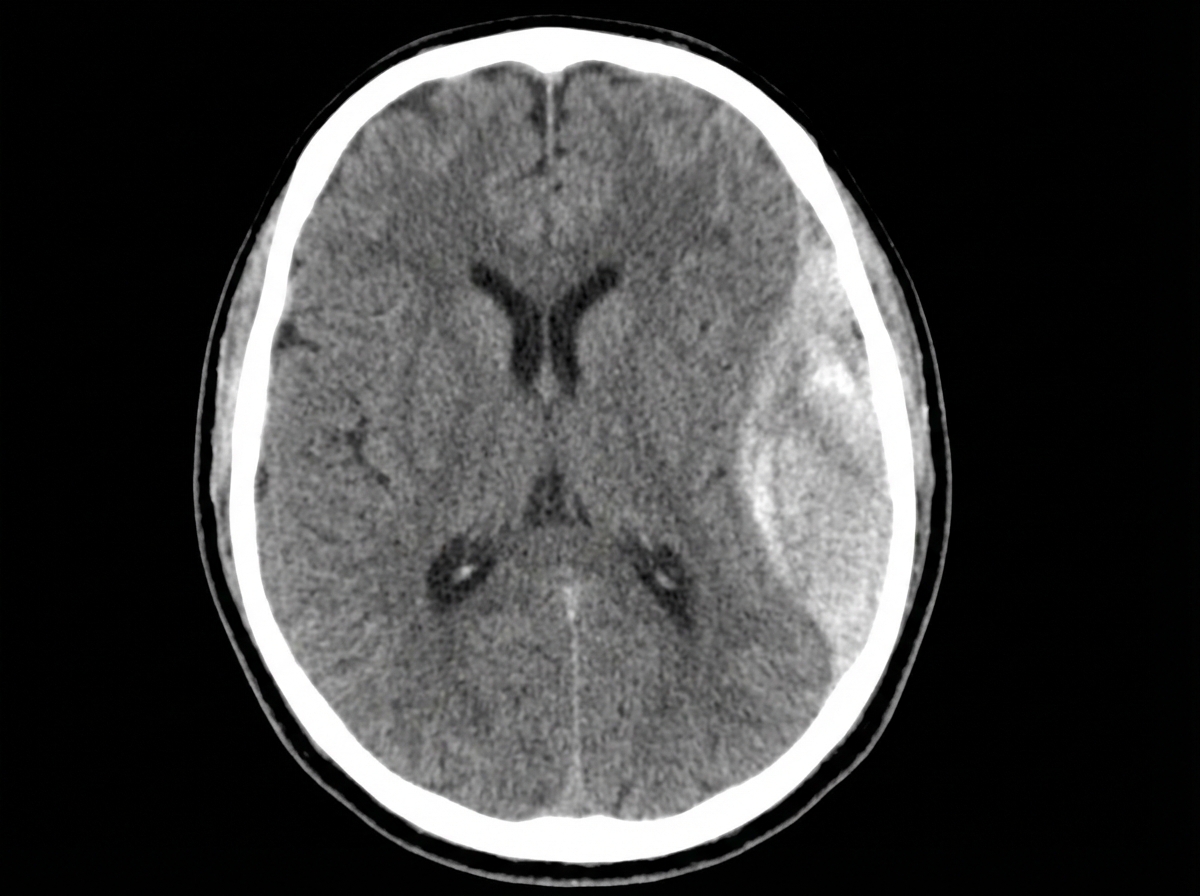
A 28-year-old man is brought to the emergency department by ambulance after developing an altered mental state following blunt trauma to the head. The patient was competing at a local mixed martial arts competition when he was struck in the head and lost consciousness. A few minutes later, upon regaining consciousness, he had a progressive decline in mental status. Past medical history is noncontributory. Upon arrival at the hospital, the temperature is 37.0°C (98.6°F), the blood pressure is 145/89 mm Hg, the pulse is 66/min, the respiratory rate is 14/min, and the oxygen saturation is 99% on room air. He is alert now. A noncontrast CT scan is performed, and the result is provided in the image. Which of the following structures is most likely affected in this patient?
A 78-year-old left-handed woman with hypertension and hyperlipidemia is brought to the emergency room because of sudden-onset right leg weakness and urinary incontinence. Neurologic examination shows decreased sensation over the right thigh. Muscle strength is 2/5 in the right lower extremity and 4/5 in the right upper extremity. Strength and sensation in the face are normal but she has difficulty initiating sentences and she is unable to write her name. The most likely cause of this patient’s condition is an occlusion of which of the following vessels?
A 50-year-old man undergoes parathyroidectomy for treatment-resistant hyperparathyroidism. The procedure is complicated by brisk bleeding from the superior thyroid artery near the external branch of the superior laryngeal nerve. To stop the bleeding, the artery is ligated at its origin. Which of the following is most likely the origin of the artery that was injured in this patient?
A 68-year-old man is brought to the emergency department by ambulance after he was found to be altered at home. Specifically, his wife says that he fell and was unable to get back up while walking to bed. When she approached him, she found that he was unable to move his left leg. His past medical history is significant for hypertension, atrial fibrillation, and diabetes. In addition, he has a 20-pack-year smoking history. On presentation, he is found to still have difficulty moving his left leg though motor function in his left arm is completely intact. The cause of this patient's symptoms most likely occurred in an artery supplying which of the following brain regions?
A 36-year-old woman, gravida 1, para 1, has back pain and numbness in her lower extremities after an emergency cesarean delivery of a healthy 3856-g (8-lb, 8-oz) newborn male. She had a placental abruption and lost approximately 2000 ml of blood. During the procedure, she received two units of packed red blood cells and intravenous fluids. She has no history of serious illness and takes no medications. She is sexually active with one male partner, and they use condoms inconsistently. She is alert and oriented to person, place, and time. Her temperature is 37.2°C (98.9°F), pulse is 90/min, respirations are 15/min, and blood pressure is 94/58 mm Hg. Examination shows decreased sensation to temperature and pinprick below her waist and 0/5 muscle strength in her lower extremities. She feels the vibrations of a tuning fork placed on both of her great toes. Deep tendon reflexes are absent in the lower extremities and 2+ in the upper extremities. Which of the following is the most likely diagnosis?
A 65-year-old man presents with facial weakness. He says he noticed that his face appeared twisted when he looked in the bathroom mirror this morning. He is otherwise well and does not have any other complaints. He denies any facial pain or paresthesia. No significant past medical history. The patient is afebrile and vital signs are within normal limits. Neurological examination reveals difficulty shutting the right eye tight and inability to bring up the right corner of his mouth when asked to smile. Remainder of the exam, including the left side of the face, is unremarkable. Which of the following is the most likely diagnosis in this patient?
A 38-year-old man comes to the physician for a follow-up examination. He has quadriparesis as a result of a burst fracture of the cervical spine that occurred after a fall from his roof 1 month ago. He has urinary and bowel incontinence. He appears malnourished. His temperature is 37.1°C (98.8°F), pulse is 88/min, and blood pressure is 104/60 mm Hg. Examination shows spasticity in all extremities. Muscle strength is decreased in proximal and distal muscle groups bilaterally. Deep tendon reflexes are 4+ bilaterally. Plantar reflex shows extensor response bilaterally. Sensation to pinprick and temperature is absent below the neck. Sensation to vibration, position, and light touch is normal bilaterally. Rectal tone is decreased. There is a 1-cm area of erythema over the sacrum. Which of the following is the most likely cause of this patient's symptoms?
Want unlimited practice?
Get full access to all questions, explanations, and performance tracking.
Scan to download app