A 31-year-old woman with multiple sclerosis comes to the physician because of a 4-day history of cramps in her left leg. Physical examination shows flexion of the left hip and increased tone in the thigh muscles. A local anesthetic block of which of the following nerves would most likely improve this patient's condition the most?
Q52
A 28-year-old woman presents to the emergency department with lateral knee pain that started this morning. The patient is a college student who is currently on the basketball team. She states her pain started after she twisted her knee. Her current medications include albuterol and ibuprofen. The patient's vitals are within normal limits and physical exam is notable for tenderness to palpation over the lateral right knee. When the patient lays on her left side and her right hip is extended and abducted it does not lower to the table in a smooth fashion and adduction causes discomfort. The rest of her exam is within normal limits. Which of the following is the most likely diagnosis?
Q53
A 23-year-old woman presents to the emergency department with an acute exacerbation of her 3-month history of low back and right leg pain. She says she has had similar symptoms in the past, but this time the pain was so excruciating, it took her breath away. She describes the pain as severe, shock-like, and localized to her lower back and radiating straight down the back of her right thigh and to her calf, stopping at the ankle. Her pain is worse in the morning, and, sometimes, the pain wakes her up at night with severe buttock and posterior thigh pain but walking actually makes the pain subside somewhat. The patient reports no smoking history or alcohol or drug use. She has been working casually as a waitress and does find bending over tables a strain. She is afebrile, and her vital signs are within normal limits. On physical examination, her left straight leg raise test is severely limited and reproduces her buttock pain at 20° of hip flexion. Pain is worsened by the addition of ankle dorsiflexion. The sensation is intact. Her L4 and L5 reflexes are normal, but her S1 reflex is absent on the right side. A CT of the lumbar spine shows an L5–S1 disc protrusion with right S1 nerve root compression. Which of the following muscle-nerve complexes is involved in producing an S1 reflex?
Q54
A 37-year-old obese woman presents to the neurology clinic complaining of severe pain in her left wrist and tingling sensation in her left thumb, index finger, and middle finger, and some part of her ring finger. The pain started as an occasional throb and she could ignore it or takes analgesics but now the pain is much worse and wakes her up at night. She is also concerned that these fingers are occasionally numb and sometimes tingle. She works as a typist and her pain mostly increases after typing all day. Her right wrist and fingers are fine. Nerve conduction studies reveal nerve compression. Which of the following additional clinical findings would most likely be present in this patient?
Q55
A 24-year-old professional soccer player presents to the clinic with discomfort and pain while walking. He says that he has an unstable knee joint that started after an injury during a match last week. He adds that he heard a popping sound at the time of the injury. Physical examination of the knee reveals swelling of the knee joint with a positive anterior drawer test. Which of the following structures is most likely damaged in this patient?
Q56
A 25-year-old man comes to the physician because of a 2-week history of numbness in his left lower extremity. One month ago, he sustained a fracture of the neck of the left fibula during soccer practice that was treated with immobilization in a plaster cast. Physical examination of the left lower extremity is most likely to show which of the following findings?
Q57
A 32-year-old man comes to the emergency department because of a wound in his foot. Four days ago, he stepped on a nail while barefoot at the beach. Examination of the plantar surface of his right foot shows a purulent puncture wound at the base of his second toe with erythema and tenderness of the surrounding skin. The afferent lymphatic vessels from the site of the lesion drain directly into which of the following groups of regional lymph nodes?
Q58
A 52-year-old man comes to the physician because of right shoulder pain that began after he repainted his house 1 week ago. Physical examination shows right subacromial tenderness. The pain is reproduced when the patient is asked to abduct the shoulder against resistance with the arm flexed forward by 30° and the thumb pointing downwards. The tendon of which of the following muscles is most likely to be injured in this patient?
Q59
A 33-year-old woman presents to the emergency department with pain in her right wrist. She says she was walking on the sidewalk a few hours ago when she suddenly slipped and landed forcefully on her outstretched right hand with her palm facing down. The patient is afebrile, and vital signs are within normal limits. Physical examination of her right wrist shows mild edema and tenderness on the lateral side of the right hand with a decreased range of motion. Sensation is intact. The patient is able to make a fist and OK sign with her right hand. A plain radiograph of her right wrist is shown in the image. Which of the following bones is most likely fractured in this patient?
Q60
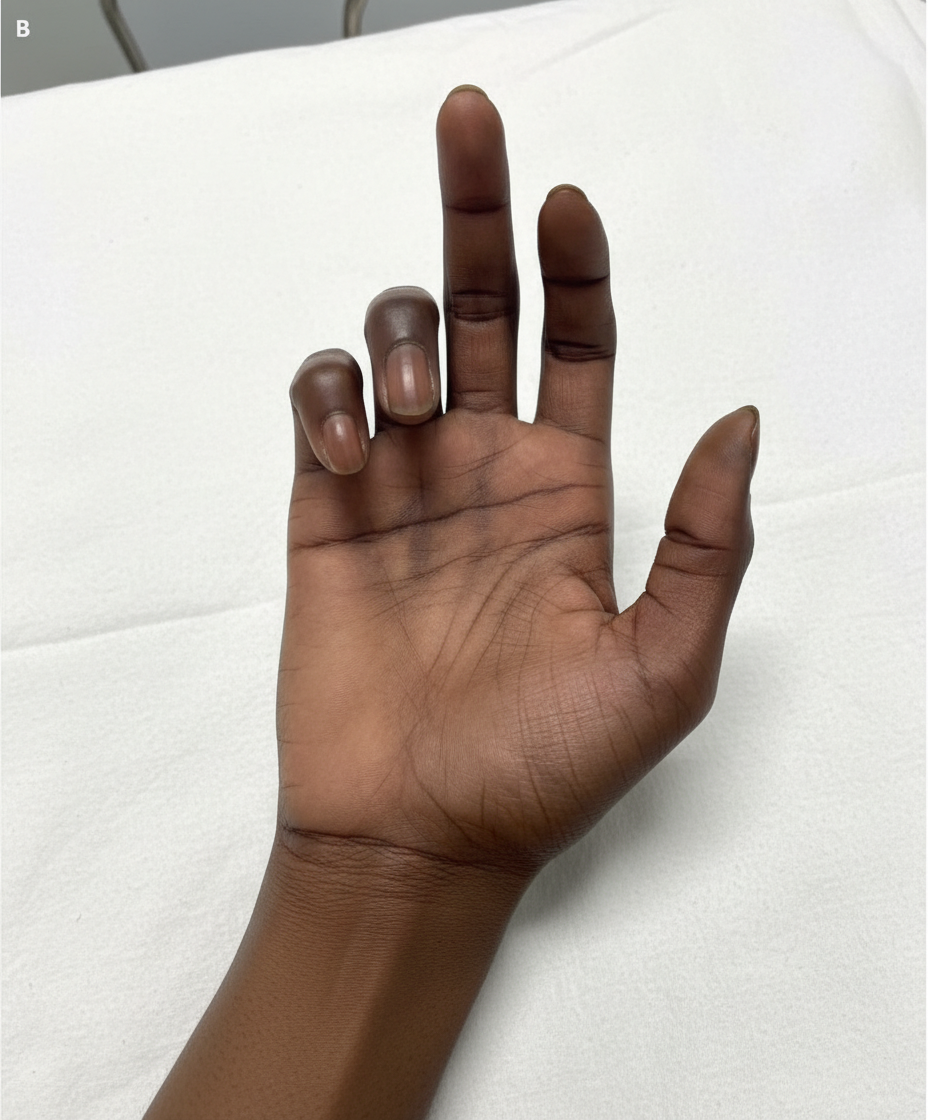
A 41-year-old woman comes to the doctor because of gradually progressive weakness in her right hand over the past few weeks. She goes to the gym to lift weights 5 times a week. With the dorsum of the right hand on a flat surface, the patient is unable to move her thumb to touch a pen held 2 cm above the interphalangeal joint of the thumb. An MRI of the right arm shows compression of a nerve that passes through the pronator teres muscle. Based on the examination findings, loss of innervation of which of the following muscles is most likely in this patient?
Upper/Lower Limb US Medical PG Practice Questions and MCQs
Question 51: A 31-year-old woman with multiple sclerosis comes to the physician because of a 4-day history of cramps in her left leg. Physical examination shows flexion of the left hip and increased tone in the thigh muscles. A local anesthetic block of which of the following nerves would most likely improve this patient's condition the most?
A. Inferior gluteal nerve
B. Superior gluteal nerve
C. Femoral nerve (Correct Answer)
D. Sciatic nerve
E. Obturator nerve
Explanation: ***Femoral nerve***
- The **femoral nerve** innervates the **iliacus** (a primary hip flexor) and the **rectus femoris** (part of the quadriceps that assists in hip flexion), as well as the entire **quadriceps femoris group** (responsible for knee extension and contributing to increased thigh muscle tone).
- In this patient with spasticity, **hip flexion** is caused by hypertonicity of iliopsoas and rectus femoris, while **increased tone in thigh muscles** reflects quadriceps involvement.
- Blocking the femoral nerve would relax these muscles, thereby improving the **cramps, hip flexion, and increased thigh tone**.
*Inferior gluteal nerve*
- The **inferior gluteal nerve** primarily innervates the **gluteus maximus muscle**, which is involved in hip extension and external rotation, not hip flexion.
- Blocking this nerve would not directly address the symptoms of increased thigh muscle tone and hip flexion.
*Superior gluteal nerve*
- The **superior gluteal nerve** mainly innervates the **gluteus medius, gluteus minimus**, and **tensor fasciae latae muscles**, which are involved in hip abduction and internal rotation.
- Its blockade would not relieve hip flexion or thigh muscle cramps.
*Sciatic nerve*
- The **sciatic nerve** innervates the **hamstring muscles** (hip extension, knee flexion) and all muscles below the knee.
- While it affects leg muscles, it does not directly control the muscles causing **hip flexion and increased thigh tone** in this context.
*Obturator nerve*
- The **obturator nerve** primarily innervates the **adductor muscles** of the thigh (adductor longus, brevis, magnus, gracilis), leading to hip adduction.
- Blocking this nerve would not address hip flexion or the increased tone in the quadriceps muscles described.
Question 52: A 28-year-old woman presents to the emergency department with lateral knee pain that started this morning. The patient is a college student who is currently on the basketball team. She states her pain started after she twisted her knee. Her current medications include albuterol and ibuprofen. The patient's vitals are within normal limits and physical exam is notable for tenderness to palpation over the lateral right knee. When the patient lays on her left side and her right hip is extended and abducted it does not lower to the table in a smooth fashion and adduction causes discomfort. The rest of her exam is within normal limits. Which of the following is the most likely diagnosis?
A. Musculoskeletal strain
B. Pes anserine bursitis
C. Lateral collateral ligament injury
D. Patellofemoral syndrome
E. Iliotibial band syndrome (Correct Answer)
Explanation: ***Iliotibial band syndrome***
- This condition is characterized by **lateral knee pain** in athletes, exacerbated by activity, and often associated with a positive **Ober's test** (inability of the abducted leg to lower to the table smoothly).
- The patient's history of **twisting her knee** during basketball and the specific physical exam finding are highly indicative of IT band irritation.
*Musculoskeletal strain*
- While a strain could cause pain, it typically wouldn't present with the specific **Ober's test findings** that point towards IT band pathology.
- A strain would generally exhibit diffuse tenderness rather than localized tenderness over the **lateral epicondyle** or IT band insertion.
*Pes anserine bursitis*
- This condition causes pain on the **medial side of the knee**, not the lateral side as described in the patient's presentation.
- It involves inflammation of the bursa located below the knee on the inner aspect, where the **sartorius, gracilis, and semitendinosus tendons** insert.
*Lateral collateral ligament injury*
- An LCL injury typically results from a **varus stress** to the knee and presents with pain and instability on the **lateral aspect of the knee**.
- While there might be lateral tenderness, an LCL injury would not typically cause the **tightness and discomfort noted with hip adduction** and a positive Ober's test.
*Patellofemoral syndrome*
- This condition causes **anterior knee pain** around or behind the kneecap, often worsened by activities like climbing stairs or prolonged sitting.
- The patient's pain is specifically described as **lateral knee pain**, and the physical exam findings are not typical for patellofemoral syndrome.
Question 53: A 23-year-old woman presents to the emergency department with an acute exacerbation of her 3-month history of low back and right leg pain. She says she has had similar symptoms in the past, but this time the pain was so excruciating, it took her breath away. She describes the pain as severe, shock-like, and localized to her lower back and radiating straight down the back of her right thigh and to her calf, stopping at the ankle. Her pain is worse in the morning, and, sometimes, the pain wakes her up at night with severe buttock and posterior thigh pain but walking actually makes the pain subside somewhat. The patient reports no smoking history or alcohol or drug use. She has been working casually as a waitress and does find bending over tables a strain. She is afebrile, and her vital signs are within normal limits. On physical examination, her left straight leg raise test is severely limited and reproduces her buttock pain at 20° of hip flexion. Pain is worsened by the addition of ankle dorsiflexion. The sensation is intact. Her L4 and L5 reflexes are normal, but her S1 reflex is absent on the right side. A CT of the lumbar spine shows an L5–S1 disc protrusion with right S1 nerve root compression. Which of the following muscle-nerve complexes is involved in producing an S1 reflex?
A. Adductors-obturator nerve
B. Gastrocnemius/soleus-tibial nerve (Correct Answer)
C. Sartorius-femoral nerve
D. Tibialis posterior-tibial nerve
E. Quadriceps femoris-femoral nerve
Explanation: ***Gastrocnemius/soleus-tibial nerve***
- The S1 reflex (also known as the **Achilles reflex**) tests the integrity of the **S1 nerve root**.
- This reflex arc involves the **gastrocnemius and soleus muscles**, which are innervated by the **tibial nerve** (derived primarily from S1).
*Adductors-obturator nerve*
- The **adductor muscles** of the thigh are primarily innervated by the **obturator nerve** (L2-L4).
- This complex is not involved in generating the **Achilles reflex**.
*Sartorius-femoral nerve*
- The **sartorius muscle** is innervated by the **femoral nerve** (L2-L4).
- This muscle and nerve are not part of the **S1 reflex arc**.
*Tibialis posterior-tibial nerve*
- The **tibialis posterior muscle** is innervated by the **tibial nerve** (L4-S3), but its primary role is in ankle inversion and plantarflexion, not the main component of the **Achilles reflex**.
- While the tibial nerve is involved in the S1 reflex, the **gastrocnemius and soleus** are the primary muscles for this reflex.
*Quadriceps femoris-femoral nerve*
- The **quadriceps femoris muscle** is responsible for the **patellar reflex** (knee jerk reflex), which tests the integrity of the **L3-L4 nerve roots**.
- It is innervated by the **femoral nerve** and is not involved in the **S1 reflex**.
Question 54: A 37-year-old obese woman presents to the neurology clinic complaining of severe pain in her left wrist and tingling sensation in her left thumb, index finger, and middle finger, and some part of her ring finger. The pain started as an occasional throb and she could ignore it or takes analgesics but now the pain is much worse and wakes her up at night. She is also concerned that these fingers are occasionally numb and sometimes tingle. She works as a typist and her pain mostly increases after typing all day. Her right wrist and fingers are fine. Nerve conduction studies reveal nerve compression. Which of the following additional clinical findings would most likely be present in this patient?
A. Inability to adduct the little finger
B. Paresthesia over the thenar eminence
C. Atrophied adductor pollicis muscle
D. Inability to oppose thumb to other digits (Correct Answer)
E. Flattened hypothenar eminence
Explanation: ***Inability to oppose thumb to other digits***
- The patient's symptoms (pain and tingling in the thumb, index, middle, and part of the ring finger, worse with typing, nocturnal worsening) are highly suggestive of **carpal tunnel syndrome**, which involves compression of the **median nerve**.
- The median nerve innervates the **thenar muscles**, including the **opponens pollicis**, which is responsible for thumb opposition. Weakness or atrophy of this muscle can lead to an inability to oppose the thumb.
*Inability to adduct the little finger*
- The **adduction of the little finger** is primarily controlled by the **palmar interossei muscles** and the **abductor digiti minimi**, which are innervated by the **ulnar nerve**.
- This symptom would suggest **ulnar nerve compression** or damage, which is not consistent with the patient's described sensory distribution in the hand.
*Paresthesia over the thenar eminence*
- The **thenar eminence** (the fleshy base of the thumb) receives its sensory innervation from the **palmar cutaneous branch of the median nerve**, which typically branches off *before* the carpal tunnel.
- Therefore, in carpal tunnel syndrome, the sensation over the thenar eminence is usually preserved, making paresthesia in this area less likely.
*Atrophied adductor pollicis muscle*
- The **adductor pollicis muscle** is primarily innervated by the **ulnar nerve**.
- Atrophy of this muscle would suggest **ulnar nerve pathology**, not median nerve compression as seen in carpal tunnel syndrome.
*Flattened hypothenar eminence*
- The **hypothenar eminence** (the fleshy mound at the base of the little finger) consists of muscles (abductor digiti minimi, flexor digiti minimi brevis, opponens digiti minimi) that are innervated by the **ulnar nerve**.
- A flattened hypothenar eminence would indicate **ulnar nerve dysfunction**, not median nerve compression.
Question 55: A 24-year-old professional soccer player presents to the clinic with discomfort and pain while walking. He says that he has an unstable knee joint that started after an injury during a match last week. He adds that he heard a popping sound at the time of the injury. Physical examination of the knee reveals swelling of the knee joint with a positive anterior drawer test. Which of the following structures is most likely damaged in this patient?
A. Lateral collateral ligament
B. Ligamentum patellae
C. Anterior cruciate ligament (Correct Answer)
D. Medial collateral ligament
E. Posterior cruciate ligament
Explanation: ***Anterior cruciate ligament***
- The **"popping sound"** at the time of injury, associated with knee **instability** and a **positive anterior drawer test**, are classic signs of an **ACL tear**.
- The **anterior drawer test** specifically assesses the integrity of the ACL by checking for excessive anterior translation of the tibia relative to the femur.
*Lateral collateral ligament*
- Injury to the LCL typically results from a **varus stress** to the knee and is less commonly associated with a distinct "popping" sound or significant instability.
- While it causes pain and instability, the **anterior drawer test** would likely be negative, and a **varus stress test** would be more indicative.
*Ligamentum patellae*
- Damage to the patellar ligament usually presents as pain and difficulty with knee extension, often following a forceful quadriceps contraction.
- It does not typically cause the described popping sensation or knee instability assessed by the anterior drawer test.
*Medial collateral ligament*
- MCL injuries commonly result from a **valgus stress** (force to the outside of the knee) and are diagnosed with a **valgus stress test**, not the anterior drawer test.
- While it can cause instability, the "popping" sound and specific findings of the anterior drawer test point away from an isolated MCL injury.
*Posterior cruciate ligament*
- A PCL injury is often associated with a **posteriorly directed force** to the tibia, such as a dashboard injury, and would present with a **positive posterior drawer test**.
- The clinical presentation of a **positive anterior drawer test** and significant anterior instability rules out isolated PCL damage.
Question 56: A 25-year-old man comes to the physician because of a 2-week history of numbness in his left lower extremity. One month ago, he sustained a fracture of the neck of the left fibula during soccer practice that was treated with immobilization in a plaster cast. Physical examination of the left lower extremity is most likely to show which of the following findings?
A. Loss of sensation over the medial calf
B. Impaired dorsiflexion of the foot (Correct Answer)
C. Loss of sensation on the sole of the foot
D. Inability to stand on tiptoes
E. Decreased ankle reflex
Explanation: ***Impaired dorsiflexion of the foot***
- A fracture of the **neck of the left fibula** can damage the **common fibular (peroneal) nerve**, which wraps around the fibular neck.
- Damage to the common fibular nerve specifically affects its deep branch, leading to weakness of the **tibialis anterior muscle** and **impaired dorsiflexion** (foot drop).
*Loss of sensation over the medial calf*
- **Sensation over the medial calf** is supplied by the **saphenous nerve**, a branch of the femoral nerve, which is not typically injured with a fibular neck fracture.
- Injury to the common fibular nerve primarily affects sensation over the **dorsum of the foot** and **lateral aspect of the leg**.
*Loss of sensation on the sole of the foot*
- **Sensation on the sole of the foot** is primarily mediated by the **tibial nerve** and its branches (medial and lateral plantar nerves).
- Trauma to the fibular neck is unlikely to directly compromise the tibial nerve to this extent.
*Inability to stand on tiptoes*
- The **ability to stand on tiptoes** is controlled by the **gastrocnemius and soleus muscles**, which are innervated by the **tibial nerve**.
- Injury to the common fibular nerve, rather than the tibial nerve, is associated with a fibular neck fracture.
*Decreased ankle reflex*
- The **ankle reflex** (Achilles reflex) is primarily mediated by the **S1 spinal nerve** via the **tibial nerve**.
- While severe fibular nerve compression could potentially have some indirect effects, a decreased ankle reflex is not a primary or direct symptom of common fibular nerve palsy.
Question 57: A 32-year-old man comes to the emergency department because of a wound in his foot. Four days ago, he stepped on a nail while barefoot at the beach. Examination of the plantar surface of his right foot shows a purulent puncture wound at the base of his second toe with erythema and tenderness of the surrounding skin. The afferent lymphatic vessels from the site of the lesion drain directly into which of the following groups of regional lymph nodes?
A. Popliteal
B. Deep inguinal
C. Anterior tibial
D. Superficial inguinal (Correct Answer)
E. External iliac
Explanation: ***Superficial inguinal***
- Lymph from the **plantar surface of the foot** (including the base of the toes) drains into the **superficial inguinal lymph nodes**.
- The **medial and central plantar surfaces** specifically follow the medial superficial lymphatic vessels that accompany the great saphenous vein system to reach these nodes.
- These nodes are the **primary drainage site** and crucial in the initial immune response to infections of the lower limb.
*Popliteal*
- The **popliteal lymph nodes** primarily drain lymph from the **lateral foot and heel**, posterior leg, and knee.
- They are located within the popliteal fossa and would not be the direct drainage site for a wound on the plantar surface of the second toe.
*Deep inguinal*
- **Deep inguinal lymph nodes** receive lymph from the superficial inguinal nodes, as well as from deeper structures of the thigh and glans penis/clitoris.
- They are considered a **secondary drainage site** and not the primary destination for superficial foot infections.
*Anterior tibial*
- There are no well-defined major lymph nodes specifically termed "anterior tibial" that serve as a primary drainage site for the foot.
- Lymphatics generally follow venous drainage patterns, and the anterior tibial vessels drain superiorly, not to a specific nodal group at this level.
*External iliac*
- **External iliac lymph nodes** receive lymph primarily from the deep inguinal nodes and pelvic organs.
- They are a more **proximal group** in the lymphatic chain and not the direct initial drainage site for a foot infection.
Question 58: A 52-year-old man comes to the physician because of right shoulder pain that began after he repainted his house 1 week ago. Physical examination shows right subacromial tenderness. The pain is reproduced when the patient is asked to abduct the shoulder against resistance with the arm flexed forward by 30° and the thumb pointing downwards. The tendon of which of the following muscles is most likely to be injured in this patient?
A. Teres minor
B. Deltoid
C. Supraspinatus (Correct Answer)
D. Subscapularis
E. Infraspinatus
Explanation: ***Supraspinatus***
- The patient's presentation with **right shoulder pain** after painting (an overhead activity), subacromial tenderness, and pain reproduced by the described maneuver (the **"empty can" test**) is highly indicative of a **supraspinatus tendon injury**.
- The supraspinatus is the most commonly injured rotator cuff muscle because its tendon passes through the **subacromial space**, making it vulnerable to impaction and degeneration.
*Teres minor*
- The teres minor is primarily involved in **external rotation** and adduction of the shoulder, not typically tested by the "empty can" maneuver.
- Injury to the teres minor is less common than supraspinatus tears and usually presents with weakness in **external rotation**.
*Deltoid*
- The deltoid is a powerful muscle responsible for **shoulder abduction** (especially beyond the initial 15 degrees) and flexion, but it is less commonly involved in isolated tendonitis or tears from repetitive overhead activity.
- Deltoid pain is usually diffuse and does not localize to the **subacromial space** in the same way as supraspinatus pathology.
*Subscapularis*
- The subscapularis is responsible for **internal rotation** and adduction of the shoulder.
- Injuries typically present with weakness in internal rotation and may be tested with specific maneuvers like the **lift-off test** or **belly-press test**.
*Infraspinatus*
- The infraspinatus is a primary **external rotator** of the shoulder.
- While it can be injured in conjunction with the supraspinatus or in isolation, its primary function is external rotation, and specific tests for it involve assessing resistance to **external rotation**.
Question 59: A 33-year-old woman presents to the emergency department with pain in her right wrist. She says she was walking on the sidewalk a few hours ago when she suddenly slipped and landed forcefully on her outstretched right hand with her palm facing down. The patient is afebrile, and vital signs are within normal limits. Physical examination of her right wrist shows mild edema and tenderness on the lateral side of the right hand with a decreased range of motion. Sensation is intact. The patient is able to make a fist and OK sign with her right hand. A plain radiograph of her right wrist is shown in the image. Which of the following bones is most likely fractured in this patient?
A. Bone labeled 'A'
B. Bone labeled 'D' (Correct Answer)
C. Bone labeled 'C'
D. Bone labeled 'E'
E. Bone labeled 'B'
Explanation: ***Bone labeled 'D'***
- The clinical presentation of a fall on an **outstretched hand (FOOSH)** with pain on the **lateral aspect** of the wrist suggests a **scaphoid fracture**.
- Bone 'D' is the **scaphoid bone**, which is commonly fractured in this mechanism due to its position and poor blood supply, making it prone to **avascular necrosis** if untreated.
*Bone labeled 'A'*
- Bone 'A' is the **ulna**, which is less commonly fractured due to FOOSH injuries unless there is a direct impact or significant rotational force.
- While it articulates with the wrist, a fracture of the ulna would typically present with pain more medially and potentially forearm instability.
*Bone labeled 'C'*
- Bone 'C' is the first **metacarpal**, part of the thumb, which is distal to the wrist joint.
- A fracture here would cause pain more specifically localised to the thumb base rather than the general wrist area as described.
*Bone labeled 'E'*
- Bone 'E' is the **hamate bone**, located in the distal carpal row.
- Fractures of the hamate are less common than scaphoid fractures via FOOSH and are often associated with direct impact (e.g., from a golf club) or forceful gripping.
*Bone labeled 'B'*
- Bone 'B' represents the **radius**, specifically its distal portion. While a **Colles fracture** of the distal radius is common with FOOSH, the tenderness being on the "lateral side of the right hand" specifically points away from a general distal radius fracture and more towards the carpal bones, particularly the scaphoid.
- A Colles fracture often results in a **"dinner fork" deformity**, which is not mentioned in the presentation, and tenderness would be more widespread over the distal forearm.
Question 60: A 41-year-old woman comes to the doctor because of gradually progressive weakness in her right hand over the past few weeks. She goes to the gym to lift weights 5 times a week. With the dorsum of the right hand on a flat surface, the patient is unable to move her thumb to touch a pen held 2 cm above the interphalangeal joint of the thumb. An MRI of the right arm shows compression of a nerve that passes through the pronator teres muscle. Based on the examination findings, loss of innervation of which of the following muscles is most likely in this patient?
A. Opponens pollicis
B. First dorsal interosseus
C. Flexor pollicis longus
D. Adductor pollicis
E. Abductor pollicis brevis (Correct Answer)
Explanation: ***Abductor pollicis brevis***
- The patient's inability to move her thumb to touch a pen 2 cm above the interphalangeal joint, while the dorsum of the hand is flat, indicates a deficit in **thumb abduction**. The **abductor pollicis brevis** is the primary muscle responsible for this action and is innervated by the **median nerve**.
- Compression of the **median nerve** at the **pronator teres** is consistent with an injury affecting the innervation of the abductor pollicis brevis, leading to the observed weakness.
*Opponens pollicis*
- The **opponens pollicis** is also innervated by the **median nerve** and is responsible for **thumb opposition** (bringing the thumb across the palm to touch other fingertips).
- While opposition might be impaired in median nerve compression, the specific test described (lifting the thumb off a flat surface) directly assesses abduction, not opposition.
*First dorsal interosseus*
- The **first dorsal interosseus** muscle is responsible for **finger abduction**, specifically abducting the index finger away from the middle finger. It is innervated by the **ulnar nerve**.
- The patient's symptoms are focused on the thumb and the median nerve distribution, making ulnar nerve involvement less likely.
*Flexor pollicis longus*
- The **flexor pollicis longus** muscle is responsible for **flexion of the interphalangeal joint of the thumb**. It is innervated by the **anterior interosseous nerve**, a branch of the median nerve.
- While median nerve compression can affect this muscle, the described test specifically targets thumb abduction, not interphalangeal joint flexion.
*Adductor pollicis*
- The **adductor pollicis** muscle is responsible for **thumb adduction** (bringing the thumb towards the palm). It is innervated by the **ulnar nerve**.
- The patient's symptom is one of weakness in lifting the thumb (abduction), not adduction, and points away from ulnar nerve pathology.