
Bones and joints of upper limb — MCQs

A 16-year-old boy is brought to the emergency department after being tackled at a football game. Per his mom, he is the quarterback of his team and was head-butted in the left shoulder region by the opposing team. Shortly after, the mother noticed that his left arm was hanging by his torso and his hand was “bent backwards and facing the sky.” The patient denies head trauma, loss of consciousness, sensory changes, or gross bleeding. A physical examination demonstrates weakness in abduction, lateral rotation, flexion, and supination of the left arm and tenderness of the left shoulder region with moderate bruising. Radiograph of the left shoulder and arm is unremarkable. Which of the following is most likely damaged in this patient?
A 16-year-old boy presents to the emergency room with severe right shoulder pain following a painful overhead swing during a competitive volleyball match. On physical examination, the patient has limited active range of motion of the right shoulder and significant pain with passive motion. Suspecting a rotator cuff injury, the physician obtains an MRI, which indicates a minor tear in the tendon of the rotator cuff muscle that is innervated by the axillary nerve. Which of the following muscles was affected?
A 61-year-old woman comes to the physician for a follow-up examination 1 week after undergoing right-sided radical mastectomy and axillary lymph node dissection for breast cancer. She says that she has been unable to comb her hair with her right hand since the surgery. Physical examination shows shoulder asymmetry. She is unable to abduct her right arm above 90 degrees. When she pushes against a wall, there is protrusion of the medial aspect of the right scapula. Injury to which of the following nerves is the most likely cause of this patient's condition?
A 52-year-old man comes to the physician because of right shoulder pain that began after he repainted his house 1 week ago. Physical examination shows right subacromial tenderness. The pain is reproduced when the patient is asked to abduct the shoulder against resistance with the arm flexed forward by 30° and the thumb pointing downwards. The tendon of which of the following muscles is most likely to be injured in this patient?
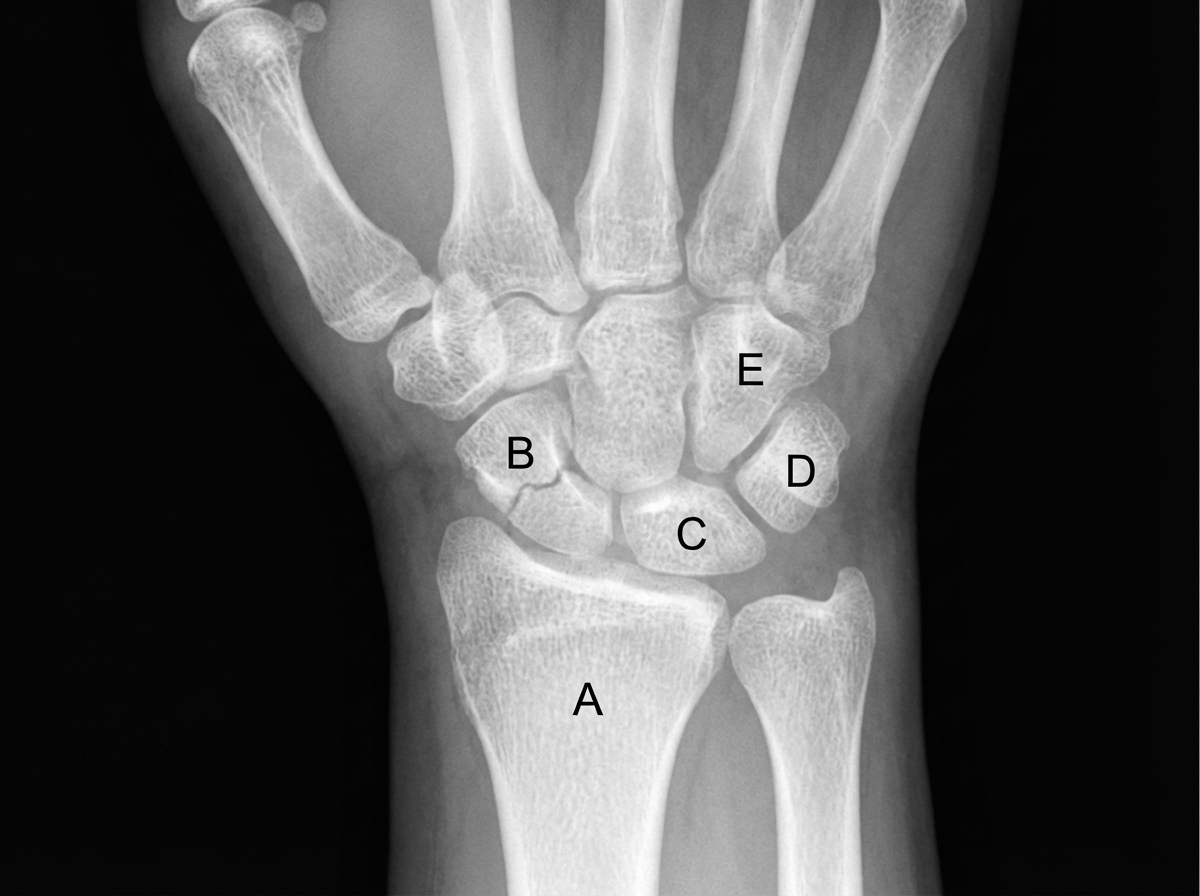
A 33-year-old woman presents to the emergency department with pain in her right wrist. She says she was walking on the sidewalk a few hours ago when she suddenly slipped and landed forcefully on her outstretched right hand with her palm facing down. The patient is afebrile, and vital signs are within normal limits. Physical examination of her right wrist shows mild edema and tenderness on the lateral side of the right hand with a decreased range of motion. Sensation is intact. The patient is able to make a fist and OK sign with her right hand. A plain radiograph of her right wrist is shown in the image. Which of the following bones is most likely fractured in this patient?
A 7-year-old child is brought to the emergency room by his parents in severe pain. They state that he fell on his outstretched right arm while playing with his friends. He is unable to move his right arm which is being supported by his left. On exam, his vitals are normal. His right extremity reveals normal pulses without swelling in any compartments, but there is crepitus above the elbow upon movement. The child is able to flex and extend his wrist, but this is limited by pain. The child has decreased sensation along his thumb and is unable to make the "OK" sign with his thumb and index finger. What is the most likely diagnosis?
A previously healthy 2-year-old boy is brought to the emergency room by his mother because of persistent crying and refusal to move his right arm. The episode began 30 minutes ago after the mother lifted him up by the arms. He appears distressed and is inconsolable. On examination, his right arm is held close to his body in a flexed and pronated position. Which of the following is the most likely diagnosis?
A 4-year-old boy is brought to the pediatrician by his mother for a routine medical examination. His medical history is relevant for delayed gross motor milestones. The mother is concerned about a growth delay because both of his brothers were twice his size at this age. Physical examination reveals a well-groomed and healthy boy with a prominent forehead and short stature, in addition to shortened upper and lower extremities with a normal vertebral column. The patient’s vitals reveal: temperature 36.5°C (97.6°F); pulse 60/min; and respiratory rate 17/min and a normal intelligence quotient (IQ). A mutation in which of the following genes is the most likely cause underlying the patient’s condition?
A 42-year-old woman comes to the physician because of increasing pain in the right hip for 2 months. The pain is intermittent, presenting at the lateral side of the hip and radiating towards the thigh. It is aggravated while climbing stairs or lying on the right side. Two weeks ago, the patient was treated with a course of oral prednisone for exacerbation of asthma. Her current medications include formoterol-budesonide and albuterol inhalers. Vital signs are within normal limits. Examination shows tenderness to palpation over the upper lateral part of the right thigh. There is no swelling. The patient is placed in the left lateral decubitus position. Abducting the extended right leg against the physician's resistance reproduces the pain. The remainder of the examination shows no abnormalities. An x-ray of the pelvis shows no abnormalities. Which of the following is the most likely diagnosis?
A 44-year-old woman comes to the physician for the evaluation of right knee pain for 1 week. The pain began after the patient twisted her knee during basketball practice. At the time of the injury, she felt a popping sensation and her knee became swollen over the next few hours. The pain is exacerbated by walking up or down stairs and worsens throughout the day. She also reports occasional locking of the knee. She has been taking acetaminophen during the past week, but the pain is worse today. Her mother has rheumatoid arthritis. The patient is 155 cm (4 ft 11 in) tall and weighs 75 kg (165 lb); BMI is 33 kg/m2. Vital signs are within normal limits. Examination shows effusion of the right knee; range of motion is limited by pain. There is medial joint line tenderness. Knee extension with rotation results in an audible snap. Further evaluation is most likely to show which of the following?
Want unlimited practice?
Get full access to all questions, explanations, and performance tracking.
Scan to download app