A researcher is investigating the blood supply of the adrenal gland. While performing an autopsy on a patient who died from unrelated causes, he identifies a vessel that supplies oxygenated blood to the inferior aspect of the right adrenal gland. Which of the following vessels most likely gave rise to the vessel in question?
Q12
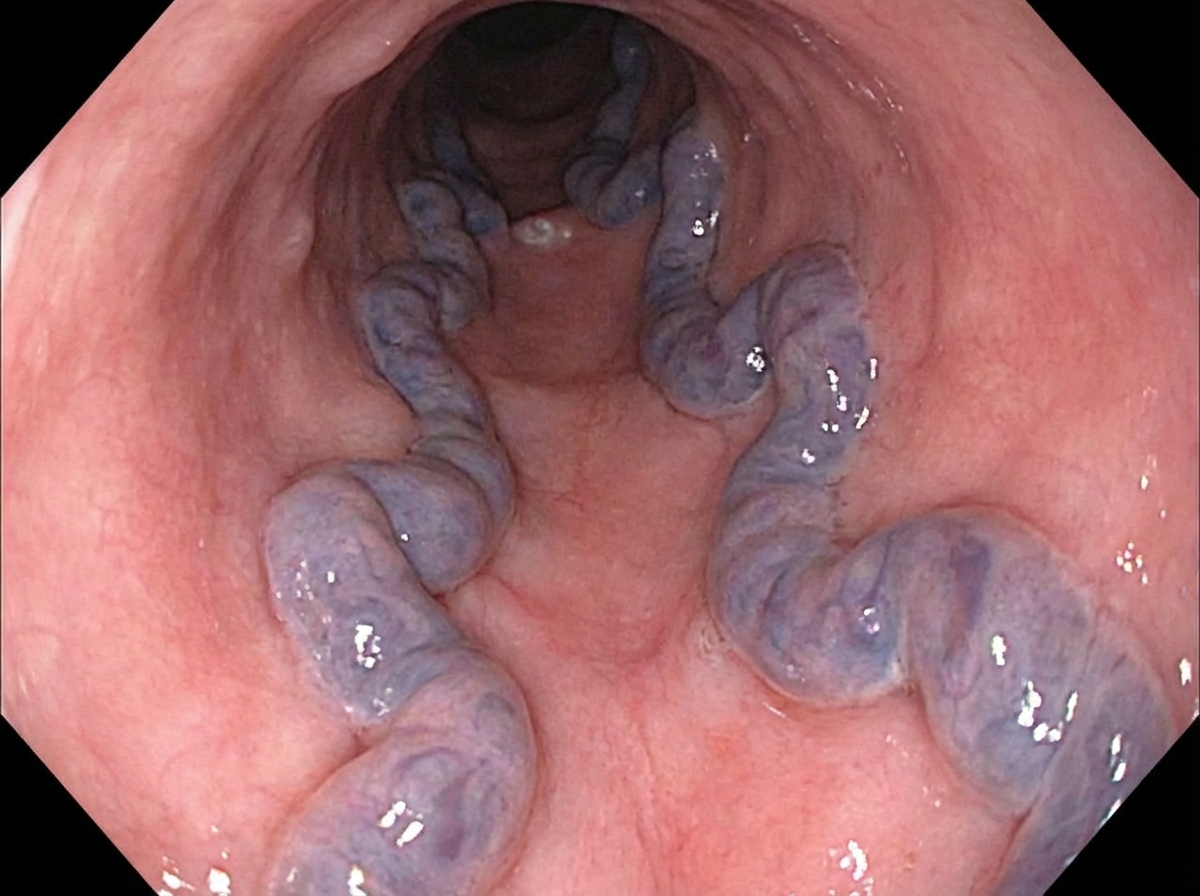
A 55-year-old man is brought to the emergency department by his friends after he was found vomiting copious amounts of blood. According to his friends, he is a chronic alcoholic and lost his family and job because of his drinking. The admission vital signs were as follows: blood pressure is 100/75 mm Hg, heart rate is 95/min, respiratory rate is 15/min, and oxygen saturation is 97% on room air. He is otherwise alert and oriented to time, place, and person. The patient was stabilized with intravenous fluids and a nasogastric tube was inserted. He is urgently prepared for endoscopic evaluation. An image from the procedure is shown. Which of the following sets of pathologies with the portacaval anastomoses is paired correctly?
Q13
A 45-year-old bank manager presents to the emergency department with abdominal pain for the last 2 weeks. The patient also vomited a few times, and in the last hour, he vomited blood as well. His pain was mild in the beginning but now he describes the pain as 8/10 in intensity, stabbing, and relentless. Ingestion of food makes it better as does the consumption of milk. He has a heart rate of 115/min. His blood pressure is 85/66 mm Hg standing, and 96/83 mm Hg lying down. He appears pale and feels dizzy. An intravenous line is started and a bolus of fluids is administered, which improved his vital signs. After stabilization, an esophagogastroduodenoscopy (EGD) is performed. There is a fair amount of blood in the stomach but after it is washed away, there are no abnormalities. A bleeding duodenal ulcer is seen located on the posteromedial wall of the duodenal bulb. Which artery is at risk from this ulcer?
Q14
A 65-year-old woman with atrial fibrillation comes to the emergency department because of sudden-onset severe abdominal pain, nausea, and vomiting for the past 2 hours. She has smoked a pack of cigarettes daily for the past 25 years. Her pulse is 110/min and blood pressure is 141/98 mm Hg. Abdominal examination shows diffuse abdominal tenderness without guarding or rebound. A CT angiogram of the abdomen confirms an acute occlusion in the inferior mesenteric artery. Which of the following structures of the gastrointestinal tract is most likely to be affected in this patient?
Q15
A 2-year-old girl is brought to the emergency department by her mother because the girl has had a cough and shortness of breath for the past 2 hours. Her symptoms began shortly after she was left unattended while eating watermelon. She appears anxious and mildly distressed. Examination shows intercostal retractions and unilateral diminished breath sounds with inspiratory wheezing. Flexible bronchoscopy is most likely to show a foreign body in which of the following locations?
Q16
A 45-year-old male is brought to the emergency department by emergency medical services after sustaining a gunshot wound to the abdomen. He is unresponsive. His temperature is 99.0°F (37.2°C), blood pressure is 95/58 mmHg, pulse is 115/min, and respirations are 20/min. Physical examination reveals an entry wound in the left abdominal quadrant just inferior to the left lateral costal border. Abdominal CT shows the bullet trajectory through the left abdominal cavity. Which of the following structures has the bullet most likely penetrated?
Q17
A 42-year-old woman presents to the emergency department complaining of abdominal pain, nausea, and vomiting for the last 4 hours. She says that symptoms onset right after she had 2 generous portions of pizza. She notes that she had prior similar episodes which resolved spontaneously within an hour. However, the pain today has persisted for 5 hours and is much more severe. She says the pain is located in the right upper quadrant of her abdomen and radiates to her upper back. She describes the pain as dull and cramping. She has had hypertension for the past 10 years, managed medically. Her vital signs are a blood pressure of 148/96 mm Hg, a pulse of 108/min, a respiratory rate of 18/min, and a temperature of 37.7°C (99.9°F). Her BMI is 28 kg/m2. On physical examination, the patient appears uncomfortable and is clutching her abdomen in pain. Abdominal exam reveals severe tenderness to palpation in the right upper quadrant with guarding. A positive Murphy’s sign is present. Her serum chemistry levels, including amylase, lipase, bilirubin, and liver function tests and urinalysis are normal. Urine hCG level is < 0.5 IU/L. Abdominal ultrasound reveals a large stone lodged in the neck of the gallbladder. Which of the following is the most likely pathway for referred pain in this patient?
Q18
A 68-year-old man with atrial fibrillation comes to the emergency department with acute-onset severe upper abdominal pain. He takes no medications. He is severely hypotensive. Despite maximal resuscitation efforts, he dies. Autopsy shows necrosis of the proximal portion of the greater curvature of the stomach caused by an embolic occlusion of an artery. The embolus most likely passed through which of the following vessels?
Q19
A 63-year-old man comes to the physician because of a 1-month history of difficulty swallowing, low-grade fever, and weight loss. He has smoked one pack of cigarettes daily for 30 years. An esophagogastroduodenoscopy shows an esophageal mass just distal to the upper esophageal sphincter. Histological examination confirms the diagnosis of locally invasive squamous cell carcinoma. A surgical resection is planned. Which of the following structures is at greatest risk for injury during this procedure?
Q20
A 68-year-old man comes to the physician because of a 4-month history of difficulty swallowing. During this time, he has also had a 7-kg (15-lb) weight loss. Esophagogastroduodenoscopy shows an exophytic mass in the distal third of the esophagus. Histological examination of a biopsy specimen shows a well-differentiated adenocarcinoma. The patient is scheduled for surgical resection of the tumor. During the procedure, the surgeon damages a structure that passes through the diaphragm along with the esophagus at the level of the tenth thoracic vertebra (T10). Which of the following structures was most likely damaged?
Thorax/Abdomen US Medical PG Practice Questions and MCQs
Question 11: A researcher is investigating the blood supply of the adrenal gland. While performing an autopsy on a patient who died from unrelated causes, he identifies a vessel that supplies oxygenated blood to the inferior aspect of the right adrenal gland. Which of the following vessels most likely gave rise to the vessel in question?
A. Inferior phrenic artery
B. Abdominal aorta
C. Renal artery (Correct Answer)
D. Superior mesenteric artery
E. Common iliac artery
Explanation: ***Renal artery***
- The **inferior suprarenal artery**, which supplies the inferior part of the adrenal gland, typically arises from the **renal artery**.
- The adrenal glands receive a rich blood supply from three main arterial sources: superior, middle, and inferior suprarenal arteries.
*Inferior phrenic artery*
- The **superior suprarenal arteries** typically arise from the **inferior phrenic arteries** and supply the superior aspect of the adrenal glands.
- While critical for adrenal blood supply, they do not typically contribute to the inferior aspect directly.
*Abdominal aorta*
- The **middle suprarenal artery** usually arises directly from the **abdominal aorta**.
- This vessel supplies the central part of the adrenal gland, but not primarily the inferior aspect.
*Superior mesenteric artery*
- The **superior mesenteric artery** primarily supplies structures of the midgut (e.g., small intestine, ascending colon) and does not typically give rise to vessels supplying the adrenal glands.
- It is located inferior to the origin of the renal arteries and the adrenal glands.
*Common iliac artery*
- The **common iliac arteries** supply the lower limbs and pelvic organs, originating from the abdominal aorta bifurcation.
- These arteries are located much too far inferior to supply the adrenal glands, which are retroperitoneal structures in the upper abdomen.
Question 12: A 55-year-old man is brought to the emergency department by his friends after he was found vomiting copious amounts of blood. According to his friends, he is a chronic alcoholic and lost his family and job because of his drinking. The admission vital signs were as follows: blood pressure is 100/75 mm Hg, heart rate is 95/min, respiratory rate is 15/min, and oxygen saturation is 97% on room air. He is otherwise alert and oriented to time, place, and person. The patient was stabilized with intravenous fluids and a nasogastric tube was inserted. He is urgently prepared for endoscopic evaluation. An image from the procedure is shown. Which of the following sets of pathologies with the portacaval anastomoses is paired correctly?
A. Caput medusae | Caval (systemic): epigastric veins | Portal (hepatic): paraumbilical vein
B. External hemorrhoids | Caval (systemic): middle and inferior rectal veins | Portal (hepatic): superior rectal vein
E. Esophageal varices | Caval (systemic): azygos vein | Portal (hepatic): left gastric vein (Correct Answer)
Explanation: ***Esophageal varices | Caval (systemic): azygos vein | Portal (hepatic): left gastric vein***
- The clinical presentation of a **chronic alcoholic with hematemesis** and findings on **endoscopy** is classic for **esophageal varices** due to portal hypertension from cirrhosis.
- **Esophageal varices** form when the **left gastric vein** (portal system) becomes engorged and anastomoses with **esophageal tributaries** that drain into the **azygos and hemiazygos veins** (systemic circulation).
- This is one of the most clinically significant portacaval anastomoses, as rupture leads to life-threatening upper GI bleeding.
*Caput medusae | Caval (systemic): epigastric veins | Portal (hepatic): paraumbilical vein*
- **Caput medusae** results from dilation of **paraumbilical veins** (portal) anastomosing with **superficial and inferior epigastric veins** (systemic) around the umbilicus.
- While this pairing is anatomically correct, it presents as **visible dilated periumbilical veins** on physical exam, not hematemesis.
- This does not match the clinical scenario of acute upper GI bleeding.
*External hemorrhoids | Caval (systemic): middle and inferior rectal veins | Portal (hepatic): superior rectal vein*
- **External hemorrhoids** involve the **inferior rectal veins** draining into the internal pudendal vein (systemic → systemic).
- These are **not a true portacaval anastomosis** and would present with rectal bleeding or perianal discomfort, not hematemesis.
*Internal hemorrhoids | Caval (systemic): retroperitoneal veins | Portal (hepatic): colic veins*
- **Internal hemorrhoids** (anorectal varices) involve the **superior rectal vein** (portal) anastomosing with **middle and inferior rectal veins** (systemic).
- The vessels listed here (retroperitoneal veins and colic veins) are **incorrect** for this anastomosis.
- Would present with hematochezia (lower GI bleeding), not hematemesis.
*Anorectal varices | Caval (systemic): inferior rectal vein | Portal (hepatic): middle rectal vein*
- **Anorectal varices** involve the **superior rectal vein** (portal) anastomosing with **middle and inferior rectal veins** (systemic).
- The pairing here is **incorrect**: the middle rectal vein is part of the systemic circulation (drains to internal iliac vein), not portal.
- This would present with rectal bleeding, not hematemesis.
Question 13: A 45-year-old bank manager presents to the emergency department with abdominal pain for the last 2 weeks. The patient also vomited a few times, and in the last hour, he vomited blood as well. His pain was mild in the beginning but now he describes the pain as 8/10 in intensity, stabbing, and relentless. Ingestion of food makes it better as does the consumption of milk. He has a heart rate of 115/min. His blood pressure is 85/66 mm Hg standing, and 96/83 mm Hg lying down. He appears pale and feels dizzy. An intravenous line is started and a bolus of fluids is administered, which improved his vital signs. After stabilization, an esophagogastroduodenoscopy (EGD) is performed. There is a fair amount of blood in the stomach but after it is washed away, there are no abnormalities. A bleeding duodenal ulcer is seen located on the posteromedial wall of the duodenal bulb. Which artery is at risk from this ulcer?
A. Superior pancreaticoduodenal artery
B. Gastroduodenal artery (Correct Answer)
C. Right gastroepiploic artery
D. Inferior pancreaticoduodenal artery
E. Dorsal pancreatic artery
Explanation: **Gastroduodenal artery**
- The **gastroduodenal artery (GDA)** runs immediately posterior to the **duodenal bulb** and is the most common artery eroded by posterior duodenal ulcers.
- **Bleeding** from a posterior duodenal ulcer can be severe and life-threatening due to the proximity and size of the GDA.
*Superior pancreaticoduodenal artery*
- The superior pancreaticoduodenal artery branches off the GDA and supplies the head of the pancreas and duodenum.
- While it contributes to the duodenal blood supply, it is less commonly directly eroded by a duodenal bulb ulcer compared to its parent artery, the GDA.
*Right gastroepiploic artery*
- The right gastroepiploic artery (right gastroomental artery) branches from the GDA and runs along the greater curvature of the stomach.
- It is unlikely to be affected by an ulcer in the duodenal bulb due to its anatomical location away from the posterior duodenal wall.
*Inferior pancreaticoduodenal artery*
- The inferior pancreaticoduodenal artery branches from the superior mesenteric artery and supplies the head of the pancreas and duodenum.
- It is anatomically located inferior and posterior to the duodenal bulb, making it less vulnerable to direct erosion by an ulcer in the duodenal bulb, which is typically supplied by branches of the GDA.
*Dorsal pancreatic artery*
- The dorsal pancreatic artery is a branch of the splenic artery or hepatic artery, supplying the body and tail of the pancreas.
- It is anatomically situated away from the duodenal bulb and would not be at risk from a duodenal bulb ulcer.
Question 14: A 65-year-old woman with atrial fibrillation comes to the emergency department because of sudden-onset severe abdominal pain, nausea, and vomiting for the past 2 hours. She has smoked a pack of cigarettes daily for the past 25 years. Her pulse is 110/min and blood pressure is 141/98 mm Hg. Abdominal examination shows diffuse abdominal tenderness without guarding or rebound. A CT angiogram of the abdomen confirms an acute occlusion in the inferior mesenteric artery. Which of the following structures of the gastrointestinal tract is most likely to be affected in this patient?
A. Hepatic flexure
B. Rectosigmoid colon (Correct Answer)
C. Ascending colon
D. Transverse colon
E. Lower rectum
Explanation: ***Rectosigmoid colon***
- The **inferior mesenteric artery (IMA)** supplies the distal third of the transverse colon, descending colon, sigmoid colon, and superior part of the rectum, which includes the **rectosigmoid colon**.
- The **rectosigmoid region** is entirely dependent on IMA branches (sigmoid arteries and superior rectal artery) and represents a classic watershed area vulnerable to ischemia.
- An occlusion in the IMA would compromise blood flow to these structures, leading to ischemia and symptoms like severe abdominal pain, bloody diarrhea, and peritoneal signs.
*Hepatic flexure*
- The **hepatic flexure** is primarily supplied by branches of the **superior mesenteric artery (SMA)**, specifically the middle colic artery.
- An occlusion in the IMA would generally spare the hepatic flexure, as its blood supply comes from a different major arterial system.
*Ascending colon*
- The **ascending colon** receives its blood supply from the **superior mesenteric artery (SMA)** via the ileocolic and right colic arteries.
- Therefore, an occlusion in the IMA would not directly affect the blood supply to the ascending colon.
*Transverse colon*
- While the **IMA** supplies the **distal one-third of the transverse colon** via the left colic artery, the term "transverse colon" as an anatomical structure includes both IMA and SMA territories.
- The proximal two-thirds are supplied by the **superior mesenteric artery (SMA)** via the middle colic artery, with robust collateral circulation through the marginal artery of Drummond.
- The rectosigmoid colon is the more specific and entirely IMA-dependent structure, making it the most likely to be affected.
*Lower rectum*
- The **lower rectum** receives its blood supply primarily from the **internal iliac arteries** via the middle and inferior rectal arteries.
- The IMA supplies the superior part of the rectum, but the lower rectum has a separate and robust blood supply, making it less likely to be affected by an isolated IMA occlusion.
Question 15: A 2-year-old girl is brought to the emergency department by her mother because the girl has had a cough and shortness of breath for the past 2 hours. Her symptoms began shortly after she was left unattended while eating watermelon. She appears anxious and mildly distressed. Examination shows intercostal retractions and unilateral diminished breath sounds with inspiratory wheezing. Flexible bronchoscopy is most likely to show a foreign body in which of the following locations?
A. Left upper lobe bronchus
B. Left lower lobe bronchus
C. Right middle lobe bronchus
D. Left main bronchus
E. Right intermediate bronchus (Correct Answer)
Explanation: ***Right intermediate bronchus***
- Due to the **anatomy of the tracheobronchial tree**, aspirated foreign bodies preferentially enter the **right bronchial tree** because the right main bronchus is wider, shorter, and more vertically oriented than the left.
- In the right bronchial tree, foreign bodies most commonly lodge in the **right lower lobe bronchus or right intermediate bronchus region** (the intermediate bronchus is the segment between the right upper lobe takeoff and the middle/lower lobe bifurcation).
- Among the options provided, the **right intermediate bronchus** is the most anatomically accurate location, as it represents the pathway through which most aspirated foreign bodies travel in the right lung.
- Classic presentation includes sudden onset **cough, shortness of breath, inspiratory wheezing**, and **unilateral diminished breath sounds**.
*Left upper lobe bronchus*
- The **left main bronchus** is narrower and branches at a more acute angle (40-60°) from the trachea compared to the right (20-30°), making aspiration into the left side significantly less common.
- The left upper lobe bronchus branches superiorly and is even less likely to receive aspirated material due to its upward trajectory.
*Left lower lobe bronchus*
- While the **left lower lobe bronchus** is more vertically oriented than the left upper lobe, the entire left bronchial tree receives aspirated foreign bodies much less frequently than the right side.
- If aspiration occurs on the left, this would be the more likely site than the upper lobe, but right-sided aspiration predominates (approximately 60-80% of cases).
*Right middle lobe bronchus*
- The **right middle lobe bronchus** branches anterolaterally from the intermediate bronchus and takes a horizontal course, making it less likely to receive aspirated foreign bodies compared to the more vertical right lower lobe pathway.
- Foreign bodies following gravity tend to bypass this horizontal branch and continue into the lower lobe.
*Left main bronchus*
- While a foreign body could lodge in the **left main bronchus**, this is much less common than right-sided aspiration due to the **more acute angle** (40-60°) at which the left main bronchus branches from the trachea.
- The right main bronchus is the preferential pathway in approximately 60-80% of aspiration cases in young children.
Question 16: A 45-year-old male is brought to the emergency department by emergency medical services after sustaining a gunshot wound to the abdomen. He is unresponsive. His temperature is 99.0°F (37.2°C), blood pressure is 95/58 mmHg, pulse is 115/min, and respirations are 20/min. Physical examination reveals an entry wound in the left abdominal quadrant just inferior to the left lateral costal border. Abdominal CT shows the bullet trajectory through the left abdominal cavity. Which of the following structures has the bullet most likely penetrated?
A. Transverse colon
B. Ascending colon
C. Descending colon (Correct Answer)
D. Sigmoid colon
E. Superior duodenum
Explanation: ***Descending colon***
- The **descending colon** is located in the left abdominal cavity, specifically in the left upper quadrant and extending into the left lower quadrant, making it highly susceptible to injury from a gunshot wound in the **left abdominal quadrant** just inferior to the left lateral costal border.
- Its position aligns directly with the described entry point and bullet trajectory.
*Transverse colon*
- The **transverse colon** lies more centrally in the upper abdomen, spanning from the right to the left upper quadrants.
- While possible to be hit by a left-sided entry wound, the trajectory described as "inferior to the left lateral costal border" makes the descending colon a more direct and likely target.
*Ascending colon*
- The **ascending colon** is located in the **right abdominal cavity**, specifically in the right upper and lower quadrants.
- A wound inferior to the left lateral costal border would be on the opposite side of the abdomen and thus unlikely to penetrate the ascending colon.
*Sigmoid colon*
- The **sigmoid colon** is located more inferiorly in the **left lower quadrant** and pelvis.
- While on the left side, the entry wound described as "inferior to the left lateral costal border" is generally higher than the typical location of the sigmoid colon.
*Superior duodenum*
- The **superior duodenum** is located in the **right upper quadrant** of the abdomen, anterior to the head of the pancreas.
- Its position on the right side makes it highly unlikely to be penetrated by a gunshot wound to the left abdominal quadrant.
Question 17: A 42-year-old woman presents to the emergency department complaining of abdominal pain, nausea, and vomiting for the last 4 hours. She says that symptoms onset right after she had 2 generous portions of pizza. She notes that she had prior similar episodes which resolved spontaneously within an hour. However, the pain today has persisted for 5 hours and is much more severe. She says the pain is located in the right upper quadrant of her abdomen and radiates to her upper back. She describes the pain as dull and cramping. She has had hypertension for the past 10 years, managed medically. Her vital signs are a blood pressure of 148/96 mm Hg, a pulse of 108/min, a respiratory rate of 18/min, and a temperature of 37.7°C (99.9°F). Her BMI is 28 kg/m2. On physical examination, the patient appears uncomfortable and is clutching her abdomen in pain. Abdominal exam reveals severe tenderness to palpation in the right upper quadrant with guarding. A positive Murphy’s sign is present. Her serum chemistry levels, including amylase, lipase, bilirubin, and liver function tests and urinalysis are normal. Urine hCG level is < 0.5 IU/L. Abdominal ultrasound reveals a large stone lodged in the neck of the gallbladder. Which of the following is the most likely pathway for referred pain in this patient?
A. Right thoraco-abdominal intercostal nerves
B. The phrenic nerve
C. Greater splanchnic nerves to the spinal cord (Correct Answer)
D. Left greater splanchnic nerve
E. The pain endings of the visceral peritoneum
Explanation: ***Greater splanchnic nerves to the spinal cord***
- The **greater splanchnic nerves** (T5-T9) carry **visceral afferent fibers** from the gallbladder, transmitting pain to the spinal cord segments corresponding to the upper back (T5-T9).
- This explains the **dull, cramping right upper quadrant pain** that **radiates to the upper back**, characteristic of visceral pain from the gallbladder.
*Right thoraco-abdominal intercostal nerves*
- These nerves primarily innervate the **parietal peritoneum** and abdominal wall, responsible for sharp, localized somatic pain.
- While they could be involved in localized pain, they don't typically account for the **referred dull, cramping pain to the back** originating from a visceral organ like the gallbladder.
*The phrenic nerve*
- The **phrenic nerve** innervates the diaphragm and carries pain from the **diaphragmatic pleura and peritoneum**, often resulting in referred pain to the shoulder tip.
- Gallbladder pain can sometimes irritate the diaphragm, but the primary referral to the **upper back** is more characteristic of splanchnic nerve involvement.
*Left greater splanchnic nerve*
- The **left greater splanchnic nerve** primarily innervates organs on the left side of the upper abdomen, such as the stomach and spleen.
- Since the gallbladder is on the **right side**, its afferent pain signals travel via the right greater splanchnic nerves.
*The pain endings of the visceral peritoneum*
- The **visceral peritoneum** itself is generally insensitive to pain from cutting or burning; it senses stretch and inflammation.
- However, the pain signals from the stretched or inflamed gallbladder are transmitted via **visceral afferent fibers within the splanchnic nerves**, not directly by the visceral peritoneum's own pain endings.
Question 18: A 68-year-old man with atrial fibrillation comes to the emergency department with acute-onset severe upper abdominal pain. He takes no medications. He is severely hypotensive. Despite maximal resuscitation efforts, he dies. Autopsy shows necrosis of the proximal portion of the greater curvature of the stomach caused by an embolic occlusion of an artery. The embolus most likely passed through which of the following vessels?
A. Superior mesenteric artery
B. Left gastric artery
C. Right gastroepiploic artery
D. Splenic artery (Correct Answer)
E. Inferior mesenteric artery
Explanation: ***Splenic artery***
- The splenic artery supplies the **fundus** and **greater curvature** of the stomach via the **short gastric arteries** and the **left gastroepiploic artery**.
- An embolic occlusion of the splenic artery would lead to **necrosis** in these regions of the stomach as described in the vignette.
*Superior mesenteric artery*
- The superior mesenteric artery primarily supplies the **midgut** (from the distal duodenum to the proximal two-thirds of the transverse colon) and **pancreas**.
- An occlusion would typically cause symptoms related to **small intestinal ischemia** and not primarily the stomach's greater curvature.
*Left gastric artery*
- The left gastric artery supplies the **lesser curvature** and **cardia** of the stomach.
- Its occlusion would affect these areas, not the greater curvature.
*Right gastroepiploic artery*
- The right gastroepiploic artery, a branch of the **gastroduodenal artery**, supplies the **distal portion of the greater curvature** of the stomach.
- While it supplies the greater curvature, the question states necrosis of the "proximal portion," making the splenic artery (via short gastrics/left gastroepiploic) a more direct and proximal supply to that region
*Inferior mesenteric artery*
- The inferior mesenteric artery supplies the **hindgut** (distal transverse colon to the superior rectum).
- Its occlusion would cause symptoms related to **large intestinal ischemia**, distinct from gastric involvement.
Question 19: A 63-year-old man comes to the physician because of a 1-month history of difficulty swallowing, low-grade fever, and weight loss. He has smoked one pack of cigarettes daily for 30 years. An esophagogastroduodenoscopy shows an esophageal mass just distal to the upper esophageal sphincter. Histological examination confirms the diagnosis of locally invasive squamous cell carcinoma. A surgical resection is planned. Which of the following structures is at greatest risk for injury during this procedure?
A. Bronchial branch of thoracic aorta
B. Left gastric artery
C. Left inferior phrenic artery
D. Esophageal branch of thoracic aorta
E. Inferior thyroid artery (Correct Answer)
Explanation: **Inferior thyroid artery**
- The esophageal mass is located just distal to the **upper esophageal sphincter**, which is in the neck, close to the **thyroid gland**.
- During surgery for an esophageal tumor in this region, the **inferior thyroid artery**, which supplies the thyroid and adjacent structures, is at the greatest risk of injury due to its proximity.
*Bronchial branch of thoracic aorta*
- The **bronchial branches** of the thoracic aorta primarily supply the bronchi and lungs.
- These vessels are located deeper in the thorax, away from the **upper esophageal sphincter** and the initial surgical field for an upper esophageal tumor.
*Left gastric artery*
- The **left gastric artery** supplies the stomach and is a branch of the celiac trunk.
- This artery is located in the **abdomen**, far from the surgical site involving an esophageal mass near the upper esophageal sphincter.
*Left inferior phrenic artery*
- The **left inferior phrenic artery** primarily supplies the diaphragm.
- This vessel originates from the aorta in the **abdominal region**, which is distant from the upper esophageal sphincter.
*Esophageal branch of thoracic aorta*
- **Esophageal branches** directly supply the esophagus; however, the question refers to the **thoracic aorta branches**.
- Tumors near the **upper esophageal sphincter** are usually accessed via a cervical incision, making thoracic branches less likely to be injured compared to arteries located in the neck.
Question 20: A 68-year-old man comes to the physician because of a 4-month history of difficulty swallowing. During this time, he has also had a 7-kg (15-lb) weight loss. Esophagogastroduodenoscopy shows an exophytic mass in the distal third of the esophagus. Histological examination of a biopsy specimen shows a well-differentiated adenocarcinoma. The patient is scheduled for surgical resection of the tumor. During the procedure, the surgeon damages a structure that passes through the diaphragm along with the esophagus at the level of the tenth thoracic vertebra (T10). Which of the following structures was most likely damaged?
A. Azygos vein
B. Vagus nerve (Correct Answer)
C. Right phrenic nerve
D. Inferior vena cava
E. Thoracic duct
Explanation: ***Vagus nerve***
- The **esophagus** passes through the diaphragm at the level of the **T10 vertebra**, accompanied by the **anterior and posterior vagal trunks**. Damage to these nerves is a known complication of esophageal surgery.
- The vagus nerves provide **parasympathetic innervation** to the gastrointestinal tract, and their close proximity to the esophagus makes them vulnerable during tumor resection.
*Azygos vein*
- The **azygos vein** typically passes through the diaphragm at the level of **T12** through the **aortic hiatus**, not with the esophagus at T10.
- It drains into the superior vena cava and is located more posteriorly in the mediastinum.
*Right phrenic nerve*
- The **right phrenic nerve** passes through the diaphragm with the **inferior vena cava** at the level of **T8**, innervating the diaphragm.
- It is located more anteriorly and laterally to the esophagus, making direct damage during esophageal surgery less likely than the vagus nerves.
*Inferior vena cava*
- The **inferior vena cava (IVC)** passes through its own opening in the central tendon of the diaphragm at the level of **T8**, not with the esophagus at T10.
- Damage to the IVC would result in significant hemorrhage and is typically a separate surgical concern.
*Thoracic duct*
- The **thoracic duct** passes through the **aortic hiatus** at the level of **T12** along with the aorta, collecting lymph from most of the body.
- Its location makes it less likely to be damaged during a standard esophageal resection at T10 compared to the vagus nerves.