
Pulse points and vascular access — MCQs

A 47-year-old woman comes to the emergency department after coughing up 2 cups of bright red blood. A CT angiogram of the chest shows active extravasation from the right bronchial artery. A coil embolization is planned to stop the bleeding. During this procedure, a catheter is first inserted into the right femoral artery. Which of the following represents the correct subsequent order of the catheter route?
A 14-year-old boy is brought to the emergency department because of acute left-sided chest pain and dyspnea following a motor vehicle accident. His pulse is 122/min and blood pressure is 85/45 mm Hg. Physical examination shows distended neck veins and tracheal displacement to the right side. The left chest is hyperresonant to percussion and there are decreased breath sounds. This patient would most benefit from needle insertion at which of the following anatomical sites?
A 41-year-old man with a history of hypertension and hyperlipidemia is brought to the emergency department by his wife for difficulty breathing after choking on food at dinner. He is unconscious and pulseless on arrival. Despite appropriate life-saving measures, he dies. Examination of the heart shows a necrotic, pale yellow plaque in the left circumflex artery. Similar lesions are most likely to be found in which of the following locations?
A 35-year-old male is brought into the emergency department for a trauma emergency. The emergency medical services states that the patient was wounded with a knife on his upper left thigh near the inguinal ligament. Upon examination in the trauma bay, the patient is awake and alert. His physical exam and FAST exam is normal other than the knife wound. Large bore intravenous lines are inserted into the patient for access and fluids are being administered. Pressure on the knife wound is being held by one of the physicians with adequate control of the bleeding, but the physician notices the blood was previously extravasating in a pulsatile manner. His vitals are BP 100/50, HR 110, T 97.8, RR 22. What is the next best step for this patient?
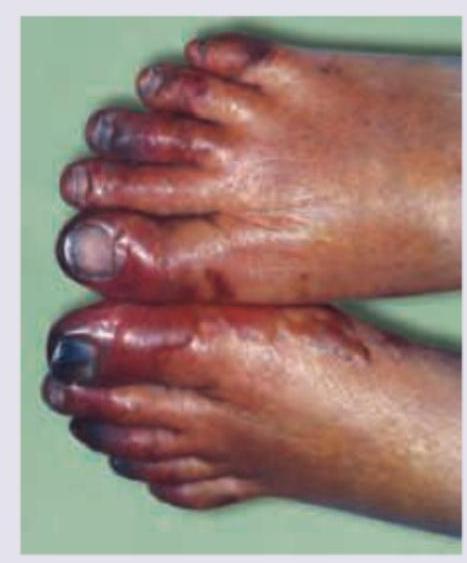
A 72-year-old man comes to the emergency department because of severe, acute, right leg pain for 2 hours. The patient's symptoms started suddenly while he was doing household chores. He has no history of leg pain at rest or with exertion. Yesterday, he returned home after a 6-hour bus ride from his grandson's home. He has hypertension treated with ramipril. He appears uncomfortable. His temperature is 37.4°C (99.3°F), pulse is 105/min and irregular, and blood pressure is 146/92 mm Hg. The right lower extremity is cool and tender to touch. A photograph of the limb is shown. Femoral pulses are palpable bilaterally; popliteal and pedal pulses are decreased on the right side. Sensation to pinprick and light touch and muscle strength are decreased in the right lower extremity. Which of the following is most likely to confirm the underlying source of this patient's condition?
A 55-year-old man comes to the emergency department because of left-sided chest pain and difficulty breathing for the past 30 minutes. His pulse is 88/min. He is pale and anxious. Serum studies show increased cardiac enzymes. An ECG shows ST-elevations in leads I, aVL, and V5-V6. A percutaneous coronary intervention is performed. In order to localize the site of the lesion, the catheter must pass through which of the following structures?
A 58-year-old man presents to the emergency department with severe right leg pain accompanied by tingling and weakness. His condition started suddenly 3 hours ago when he was watching a movie. His medical history is remarkable for type 2 diabetes mellitus and hypertension. He has been smoking 20–30 cigarettes per day for the past 35 years. His vital signs include a blood pressure of 149/85 mm Hg, a temperature of 36.9°C (98.4°F), and an irregular pulse of 96/min. On physical examination, his right popliteal and posterior tibial pulses are absent. His right leg is pale and cold. Which of the following is the most likely diagnosis?
A 33-year-old pregnant woman at 38 weeks gestation requires emergency cesarean section. The obstetrician must perform a perimortem procedure due to maternal cardiac arrest. She makes a Pfannenstiel incision but encounters significant bleeding. The patient has a history of previous cesarean section with documented bladder injury. Considering the surface anatomy and previous surgery, evaluate the most likely source of bleeding and the anatomical relationship that increases risk in this scenario.
A 71-year-old man with atrial fibrillation presents with sudden onset of severe abdominal pain out of proportion to physical findings. He has mild diffuse tenderness but no peritoneal signs. His lactate is 4.5 mmol/L. CT angiography shows occlusion of a major mesenteric vessel. The surgeon explains that the occluded vessel supplies the midgut from just distal to the second part of the duodenum to the proximal two-thirds of the transverse colon. Based on surface anatomy, at what vertebral level does this vessel originate?
A 25-year-old motorcyclist presents after a high-speed collision with facial trauma. Clinical examination reveals cerebrospinal fluid rhinorrhea, periorbital ecchymosis, and numbness over the cheek and upper teeth. CT shows a fracture extending through a foramen at the apex of the orbit. Based on the clinical presentation and surface anatomy, which foramen is most likely involved?
Want unlimited practice?
Get full access to all questions, explanations, and performance tracking.
Scan to download app