
Neural crest contribution to pharyngeal arches — MCQs

A 7-year-old boy is brought to the emergency department with a high fever and oxygen desaturation. He had a tracheostomy placed as an infant and has been placed on mechanical ventilation intermittently. Since then, he has had several bouts of pneumonia similar to his current presentation. In addition, he has been deaf since birth but is able to communicate through sign language. He attends school and performs above average for his grade. Physical exam reveals underdeveloped cheekbones, hypoplasia of the mandible, and malformed ears. Abnormal development of which of the following structures is most likely responsible for this patient's symptoms?
A 10-year-old boy comes for a post-operative clinic visit with his ENT surgeon three months after airway reconstruction surgery and placement of a tracheostomy tube. Since the surgery, he says that he has been able to breathe better and is now getting used to tracheostomy care and tracheostomy tube changes. In addition to this surgery, he has had over twenty surgeries to implant hearing aids, reconstruct his cheekbones, and support his jaw to enable him to swallow. He was born with these abnormalities and had difficult breathing, hearing, and eating throughout his childhood. Fortunately, he is now beginning to feel better and is able to attend public school where he is one of the best students in the class. Abnormal development of which of the following structures is most likely responsible for this patient's malformations?
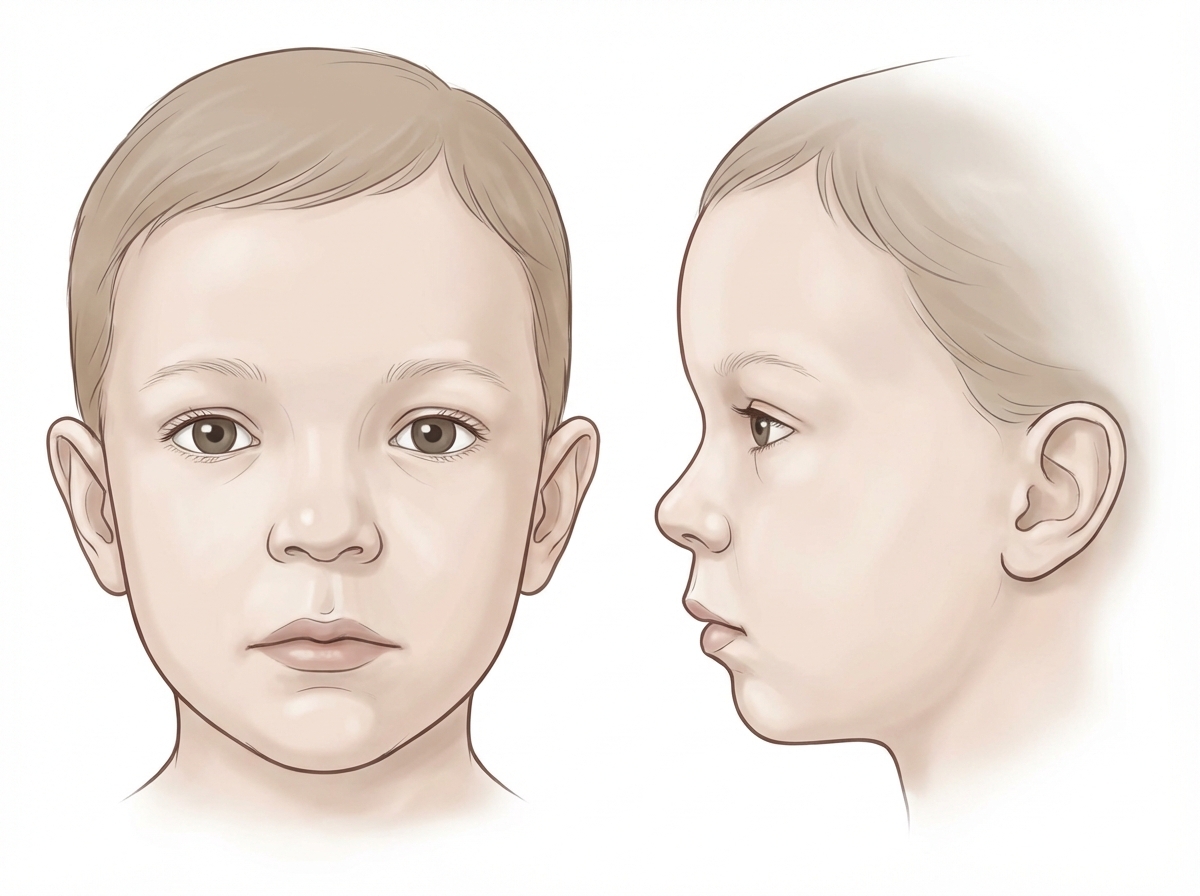
A syndrome caused by chromosomal anomalies is being researched in the immunology laboratory. Several congenital conditions are observed among the participating patients, mostly involving the thymus and the heart. Common facial features of affected individuals are shown in the image below. Flow cytometry analysis of patient samples reveals a CD19+ and CD3- result. What kind of congenital anomaly is generally observed in these patients, specifically in the thymus?
A 23-year-old man comes to the physician for evaluation of decreased hearing, dizziness, and ringing in his right ear for the past 6 months. Physical examination shows multiple soft, yellow plaques and papules on his arms, chest, and back. There is sensorineural hearing loss and weakness of facial muscles bilaterally. His gait is unsteady. An MRI of the brain shows a 3-cm mass near the right internal auditory meatus and a 2-cm mass at the left cerebellopontine angle. The abnormal cells in these masses are most likely derived from which of the following embryological structures?
A 25-year-old man presents to the clinic with a midline swelling in his neck. He is unsure about when it appeared. He denies any difficulty with swallowing or hoarseness. His past medical history is insignificant. On physical examination, there is a 1 cm x 2 cm firm mildly tender nodule on the anterior midline aspect of the neck which moves with deglutition and elevates with protrusion of the tongue. Which of the following is the most likely embryologic origin of the nodule in this patient?
A 35-year-old man comes to the physician for evaluation of a neck mass and hoarseness. He has no history of major medical illness. Physical examination shows a 2.5-cm fixed, irregular thyroid nodule. His serum calcitonin concentration is elevated. The nodule is most likely comprised of cells that are embryologically derived from which of the following structures?
A 59-year-old man comes to the physician for evaluation of a progressively enlarging, 8-mm skin lesion on the right shoulder that developed 1 month ago. The patient has a light-skinned complexion and has had several dysplastic nevi removed in the past. A photograph of the lesion is shown. The lesion is most likely derived from cells that are also the embryological origin of which of the following tumors?
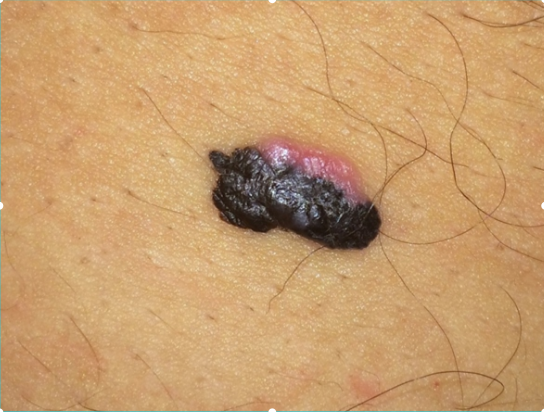
A 52-year-old woman sees you in your office with a complaint of new-onset headaches over the past few weeks. On exam, you find a 2 x 2 cm dark, irregularly shaped, pigmented lesion on her back. She is concerned because her father recently passed away from skin cancer. What tissue type most directly gives rise to the lesion this patient is experiencing?
A 78-year-old man comes to the physician because of a change in his voice. His wife says his voice has progressively become higher pitched, and he has had a 5.4-kg (11.9-lb) weight loss over the past 4 months. He has smoked half a pack of cigarettes daily for the past 40 years. Direct laryngoscopy shows an irregular, nodular glottic mass. A biopsy specimen of the mass shows poorly differentiated squamous cells with nuclear atypia, hyperkeratosis, and disruption of the basement membrane. Involvement of a muscle derived from which of the following branchial arches is the most likely cause of his symptoms?
A 29-year-old mother brings in her 2-week-old baby boy to a pediatrician because he has been having difficulty feeding. The mother reveals that she had no prenatal care during her pregnancy and gave birth at home without complications. She says that her son seems to be having difficulty sucking, and she occasionally sees breast milk coming out of the infant’s nose. Physical exam reveals that this patient has a gap between his oral and nasal cavities behind the incisive foramen. He is therefore prescribed specialized bottles and his mom is taught positional techniques to ensure better feeding. Failure to fuse which of the following structures is most likely responsible for this patient's disorder?
Want unlimited practice?
Get full access to all questions, explanations, and performance tracking.
Scan to download app