
Congenital anomalies of pharyngeal arch derivatives — MCQs

A 4-year-old girl is brought to the physician for a painless lump on her neck. She has no history of serious illness and her vital signs are within normal limits. On examination, there is a firm, 2-cm swelling at the midline just below the level of the hyoid bone. The mass moves cranially when she is asked to protrude her tongue. Which of the following is the most likely diagnosis?
A 20-year-old man presents with a painless neck mass that has gradually increased in size. The mass is anteromedial to the right sternocleidomastoid muscle and has been present for 3 years. The mass increased in size and became more tender following an upper respiratory infection. An ultrasound of the neck identifies a single, round cystic mass with uniform, low echogenicity, and no internal septations. A contrast-enhanced CT scan of the neck shows a homogeneous mass with low attenuation centrally and with smooth rim enhancement. Which of the following is the most likely diagnosis?
A 1-year-old boy presents to pediatrics clinic for a well-child visit. He has no complaints. He has a cleft palate and an abnormal facial appearance. He has been riddled with recurrent infections and is followed by cardiology for a ventricular septal defect (VSD). Vital signs are stable, and the patient's physical exam is benign. If this patient's medical history is part of a larger syndrome, what might one also discover that is consistent with the manifestations of this syndrome?
A 10-year-old boy comes for a post-operative clinic visit with his ENT surgeon three months after airway reconstruction surgery and placement of a tracheostomy tube. Since the surgery, he says that he has been able to breathe better and is now getting used to tracheostomy care and tracheostomy tube changes. In addition to this surgery, he has had over twenty surgeries to implant hearing aids, reconstruct his cheekbones, and support his jaw to enable him to swallow. He was born with these abnormalities and had difficult breathing, hearing, and eating throughout his childhood. Fortunately, he is now beginning to feel better and is able to attend public school where he is one of the best students in the class. Abnormal development of which of the following structures is most likely responsible for this patient's malformations?
A six year-old female presents for evaluation of dry skin, fatigue, sensitivity to cold and constipation. The patient’s mother recalls that the patient had surgery to remove a “benign mass” at the base of her tongue 3 months ago because of trouble swallowing. What was the likely cause of the surgically removed mass?
A 2850-g (6-lb 5-oz) newborn is delivered at term to a 19-year-old primigravid woman via normal spontaneous vaginal delivery. The mother has had no prenatal care. Examination of the newborn in the delivery room shows malformed external ears, facial nerve palsy, and absence of the stapes bone on audiological testing. This patient's condition is most likely caused by abnormal development of the structure that also gives rise to which of the following?
A group of investigators studying embryological defects in mice knock out a gene that is responsible for the development of the ventral wing of the third branchial pouch. A similar developmental anomaly in a human embryo is most likely to result in which of the following findings after birth?
A 25-year-old woman gives birth to a male child at 30 weeks of gestation. Pregnancy was complicated by polyhydramnios diagnosed on ultrasonography at 26 weeks of gestation. The baby is born vaginally weighing 1.2 kg (2.64 lb). Because he does not cry immediately after birth, endotracheal intubation is attempted to secure the airway. However, the vocal cords cannot be visualized because there is only a single opening corresponding to the esophagus. He is transferred to the NICU under bag and mask ventilation, where intubation is attempted once again by passing the endotracheal tube in the visualized opening, after which his oxygen saturation begins to improve. His temperature is 37.0ºC (98.6°F), pulse is 120/min, and respiratory rate is 42/min. On physical examination, no abnormalities are noted. Chest radiography is suggestive of respiratory distress syndrome. Which of the following most likely failed to develop in this patient?
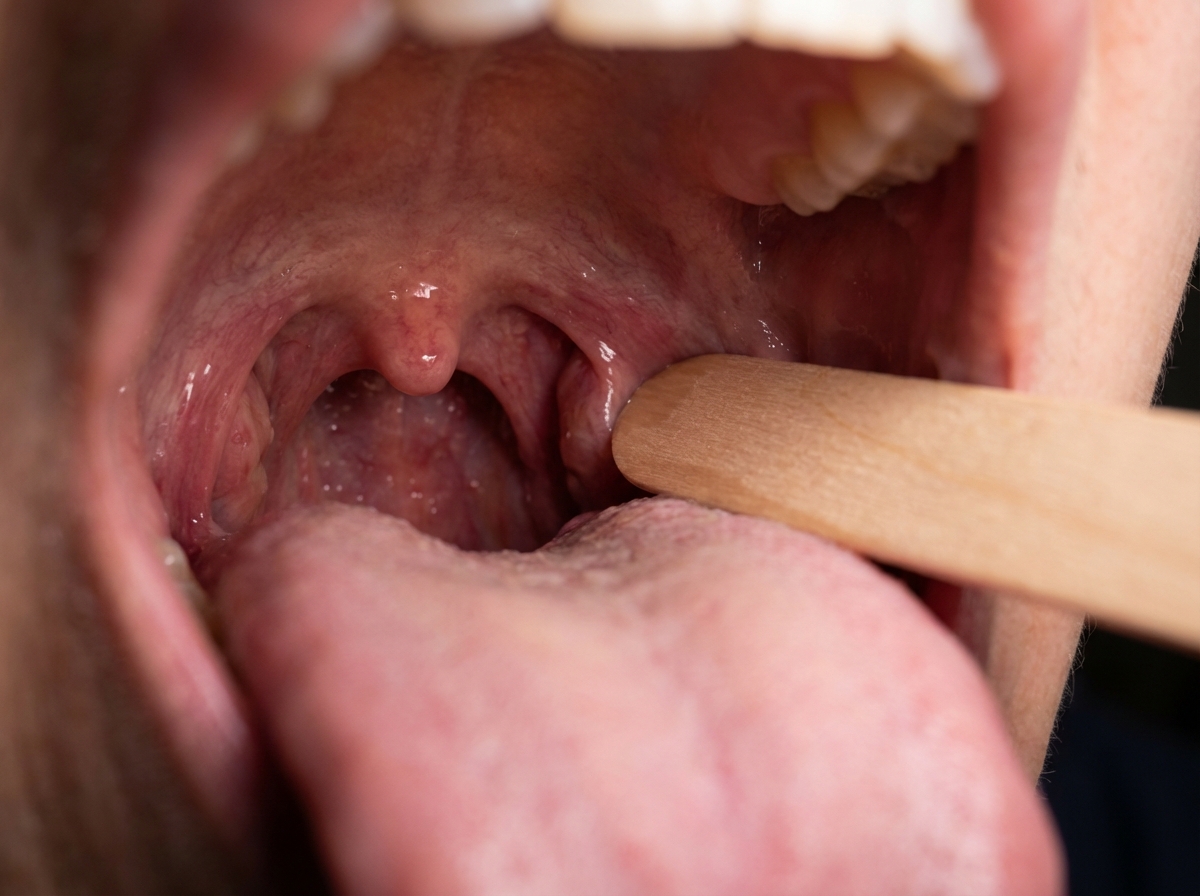
A patient was admitted with skull base trauma. The doctor was testing the marked structure in the pharyngeal region. Which of the following nerves was being tested?
A 29-year-old mother brings in her 2-week-old baby boy to a pediatrician because he has been having difficulty feeding. The mother reveals that she had no prenatal care during her pregnancy and gave birth at home without complications. She says that her son seems to be having difficulty sucking, and she occasionally sees breast milk coming out of the infant’s nose. Physical exam reveals that this patient has a gap between his oral and nasal cavities behind the incisive foramen. He is therefore prescribed specialized bottles and his mom is taught positional techniques to ensure better feeding. Failure to fuse which of the following structures is most likely responsible for this patient's disorder?
Want unlimited practice?
Get full access to all questions, explanations, and performance tracking.
Scan to download app