An 11-year-old girl is brought in to her pediatrician by her parents due to developmental concerns. The patient developed normally throughout childhood, but she has not yet menstruated and has noticed that her voice is getting deeper. The patient has no other health issues. On exam, her temperature is 98.6°F (37.0°C), blood pressure is 110/68 mmHg, pulse is 74/min, and respirations are 12/min. The patient is noted to have Tanner stage I breasts and Tanner stage II pubic hair. On pelvic exam, the patient is noted to have a blind vagina with slight clitoromegaly as well as two palpable testes. Through laboratory workup, the patient is found to have 5-alpha-reductase deficiency. Which of the following anatomic structures are correctly matched homologues between male and female genitalia?
A 47-year-old woman comes to the physician because of involuntary leakage of urine for the past 4 months, which she has experienced when bicycling to work and when laughing. She has not had any dysuria or urinary urgency. She has 4 children that were all delivered vaginally. She is otherwise healthy and takes no medications. The muscles most likely affected by this patient's condition receive efferent innervation from which of the following structures?
A 56-year-old man undergoes a cystoscopy for the evaluation of macroscopic hematuria. During the procedure, an opening covered with a mucosal flap is visualized at the base of the trigone. Which of the following best describes this structure?
A 45-year-old man is brought to the emergency department following a motor vehicle collision. He reports right hip pain and numbness along the right thigh. Physical examination shows decreased sensation to light touch over a small area of the proximal medial thigh. X-rays of the pelvis show a displaced pelvic ring fracture. Further evaluation of this patient is most likely to show which of the following findings?
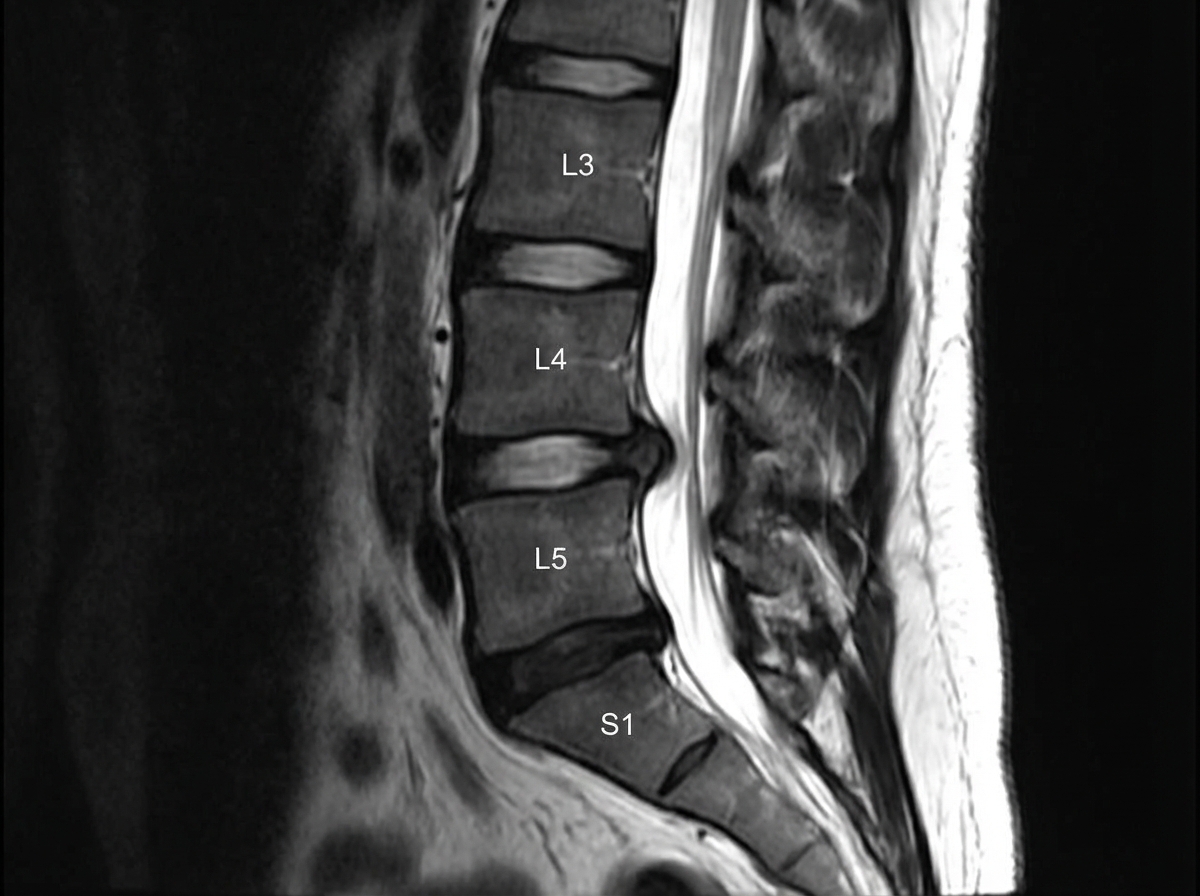
A 59-year-old woman presents to the emergency room with severe low back pain. She reports pain radiating down her left leg into her left foot. She also reports intermittent severe lower back spasms. The pain started after lifting multiple heavy boxes at her work as a grocery store clerk. She denies bowel or bladder dysfunction. Her past medical history is notable for osteoporosis and endometrial cancer. She underwent a hysterectomy 20 years earlier. She takes alendronate. Her temperature is 99°F (37.2°C), blood pressure is 135/85 mmHg, pulse is 85/min, and respirations are 22/min. Her BMI is 21 kg/m^2. On exam, she is unable to bend over due to pain. Her movements are slowed to prevent exacerbating her muscle spasms. A straight leg raise elicits severe radiating pain into her left lower extremity. The patient reports that the pain is worst along the posterior thigh and posterolateral leg into the fourth and fifth toes. Palpation along the lumbar vertebral spines demonstrates mild tenderness. Patellar reflexes are 2+ bilaterally. The Achilles reflex is decreased on the left. Which nerve root is most likely affected in this patient?
A 68-year-old man presents to his primary care physician complaining of a bulge in his scrotum that has enlarged over the past several months. He is found to have a right-sided inguinal hernia and undergoes elective hernia repair. At his first follow-up visit, he complains of a tingling sensation on his scrotum. Which of the following nerve roots communicates with the injured tissues?
A previously healthy 20-year-old man comes to the physician because of a 6-month history of a painless mass in his left groin that has been gradually increasing in size. Physical examination shows a 3x3-cm oval, non-tender left inguinal mass and a fluctuant, painless left scrotal swelling that increase in size with coughing. Which of the following is the most likely cause of this patient's symptoms?
A 29-year-old man presents to his primary care provider complaining of testicular pain. He reports a four-day history of dull chronic pain in his left testicle that is worse with standing. His past medical history is notable for asthma and major depressive disorder. He takes inhaled albuterol as needed and sertraline. He is sexually active with a single female partner and always uses barrier protection. His temperature is 99.2°F (37.3°C), blood pressure is 125/75 mmHg, pulse is 85/min, and respirations are 17/min. Physical examination reveals a non-tender twisted mass along the left spermatic cord that disappears when the patient lies supine. This patient’s condition most likely stems from decreased laminar flow at which of the following vascular junctions?
A 59-year-old truck driver presents to the emergency department after returning from his usual week-long trucking trip with excruciating pain around his anus. The patient admits to drinking beer when not working and notes that his meals usually consist of fast food. He has no allergies, takes no medications, and his vital signs are normal. On examination, he was found to have a tender lump on the right side of his anus that measures 1 cm in diameter. The lump is bluish and surrounded by edema. It is visible without the aid of an anoscope. It is soft and tender with palpation. The rest of the man’s history and physical examination are unremarkable. Which vein drains the vessels responsible for the formation of this lump?
During a humanitarian mission to southeast Asia, a 42-year-old man is brought to the outpatient clinic for a long history (greater than 2 years) of progressive, painless, enlargement of his scrotum. The family history is negative for malignancies and inheritable diseases. The personal history is relevant for cigarette smoking (up to 2 packs per day for the last 20 years) and several medical consultations for an episodic fever that resolved spontaneously. The physical examination is unremarkable, except for an enlarged left hemiscrotum that transilluminates. Which of the following accounts for the underlying mechanism in this patient's condition?
Explanation: ***Scrotum and the labia majora*** - Both the **scrotum** in males and the **labia majora** in females develop from the **labioscrotal folds**. - These structures serve to protect the underlying reproductive organs and are homologous due to their shared embryonic origin. *Corpus spongiosum and the clitoral crura* - The **corpus spongiosum** in males forms the glans penis and surrounds the urethra, while the **clitoral crura** are part of the corpus cavernosum homologues. - The clitoral crura are homologous to the penile crura (part of the corpus cavernosum), not the corpus spongiosum. *Corpus spongiosum and the greater vestibular glands* - The **corpus spongiosum** is erectile tissue, while the **greater vestibular glands** (Bartholin's glands) are secretory glands. - Greater vestibular glands are homologous to the **bulbourethral glands (Cowper's glands)** in males, which are also secretory. *Corpus cavernosum of the penis and the vestibular bulbs* - The **corpus cavernosum of the penis** is erectile tissue that forms the shaft of the penis and is homologous to the **corpus cavernosum of the clitoris (clitoral crura and body)**. - The **vestibular bulbs** are masses of erectile tissue surrounding the vaginal opening, which are homologous to the **corpus spongiosum** in males, specifically the bulb of the penis. *Bulbourethral glands and the urethral/paraurethral glands* - The **bulbourethral glands** (Cowper's glands) are exocrine glands that secrete pre-ejaculate and are homologous to the **greater vestibular glands (Bartholin's glands)** in females. - The **urethral/paraurethral glands (Skene's glands)** in females are homologous to the **prostate gland** in males.
Explanation: ***S3–S4 nerve roots*** - The patient's symptoms of **involuntary urine leakage** during physical activity (**stress incontinence**) and a history of multiple vaginal deliveries strongly suggest **pelvic floor muscle weakness**. - The **levator ani muscles**, which are crucial for maintaining urinary continence, receive their primary innervation from the **pudendal nerve**, which originates from the **S2-S4 spinal nerves** (though contributions from S3-S4 are often highlighted for pelvic floor efferent innervation). *Obturator nerve* - The **obturator nerve** primarily innervates the **adductor muscles of the thigh** (e.g., adductor longus, magnus, brevis, gracilis), as well as the obturator externus muscle. - It does not significantly contribute to the innervation of the **pelvic floor muscles** responsible for urinary continence. *Superior hypogastric plexus* - The **superior hypogastric plexus** is part of the **autonomic nervous system** and primarily carries **sympathetic innervation** to the pelvic organs. - While it plays a role in bladder function (e.g., bladder relaxation and internal urethral sphincter contraction), it does not provide **somatic efferent innervation** to the skeletal muscles of the pelvic floor. *Superior gluteal nerve* - The **superior gluteal nerve** innervates the **gluteus medius**, **gluteus minimus**, and **tensor fasciae latae muscles**. - These muscles are involved in **hip abduction** and **medial rotation** and are not directly involved in maintaining urinary continence through the pelvic floor. *S1-S2 nerve roots* - While the **S1-S2 nerve roots** contribute to the innervation of various lower limb muscles and sensory pathways, their primary efferent contributions related to pelvic floor continence are not as direct as S3-S4. - The **pudendal nerve**, critical for pelvic floor muscle function, originates predominantly from **S2-S4**, with S3-S4 being particularly important for the motor components.
Explanation: ***Ureteric orifice*** - The description of an opening covered with a **mucosal flap** specifically at the **base of the trigone** is characteristic of a normal ureteric orifice, which prevents reflux of urine. - The trigone is a triangular area at the base of the bladder formed by the two ureteric orifices and the internal urethral orifice. *Ejaculatory duct opening* - The ejaculatory ducts open into the **prostatic urethra**, not directly into the bladder trigone. - They are typically located on the **verumontanum** within the prostatic urethra, posterior to the bladder neck. *Diverticular opening* - A diverticulum is an **outpouching** of the bladder wall, and its opening can appear anywhere, not specifically at the base of the trigone with a mucosal flap. - While it's an opening, it would represent a pathological condition, not a normal anatomical structure. *Prostatic utricle* - The prostatic utricle is a small blind-ending pouch located in the **prostatic urethra**, often on the verumontanum. - It is an embryonic remnant and is not found at the base of the bladder trigone. *Internal urethral orifice* - This is the opening of the **urethra** from the bladder, located at the **apex of the trigone**, not covered by a mucosal flap in the same way as a ureteric orifice. - It marks the junction between the bladder and the urethra.
Explanation: ***Impaired adduction of the hip*** - The patient's **numbness along the right thigh** and **decreased sensation to light touch over the proximal medial thigh**, combined with a **pelvic ring fracture**, points to probable injury of the **obturator nerve**. - The **obturator nerve** innervates the **adductor muscles** of the hip, and its injury would result in impaired hip adduction and sensory deficits in the medial thigh. *Sensory deficit of the dorsal foot* - A sensory deficit on the **dorsal foot** is typically associated with injury to the **peroneal nerve**, which is less likely to be affected by a pelvic ring fracture leading to medial thigh numbness. - Peroneal nerve injury often results from trauma to the **lateral knee** or prolonged compression. *Absent cremasteric reflex* - An absent **cremasteric reflex** suggests injury to the **ilioinguinal** or **genitofemoral nerves**, or spinal cord injury at the L1-L2 level. - While these nerves can be affected by pelvic trauma, the specific sensory deficit described (proximal medial thigh) aligns more with obturator nerve involvement. *Impaired hip extension* - **Hip extension** is primarily controlled by the **gluteus maximus** and **hamstrings**, which are innervated by the **inferior gluteal nerve** and **sciatic nerve**, respectively. - Injury to these nerves or muscles would not typically cause numbness in the proximal medial thigh. *Impaired extension of the knee* - **Knee extension** is mediated by the **quadriceps femoris** muscle group, innervated by the **femoral nerve**. - While the femoral nerve can be injured in severe pelvic trauma, the sensory distribution described does not match the typical sensory deficits of femoral nerve injury (anterior and medial thigh, medial leg).
Explanation: ***S1*** - Pain radiating to the **posterior thigh**, **posterolateral leg**, and into the **fourth and fifth toes** is characteristic of **S1 dermatome involvement**. - A **decreased Achilles reflex** (ankle jerk reflex) specifically points to compromise of the **S1 nerve root**. *L5* - **L5 radiculopathy** typically causes pain and sensory deficits in the **dorsum of the foot** and into the **first, second, and third toes**. - Motor weakness often affects **foot dorsiflexion** and **toe extension**, not primarily the Achilles reflex. *S2* - **S2 radiculopathy** would primarily affect sensation along the **posterior thigh** and **calf**, with possible involvement of the **plantar aspect of the foot**. - It does not typically cause a decrease in the **Achilles reflex**, which is predominantly S1. *L3* - **L3 radiculopathy** typically presents with pain and sensory changes along the **anterior thigh** and possibly the **medial knee**. - It can affect the **patellar reflex**, which is intact in this patient, and does not cause pain in the posterior leg or foot. *L4* - **L4 radiculopathy** typically causes pain and sensory changes over the **anterior thigh**, **medial leg**, and potentially the **medial malleolus**. - It often presents with weakness in **quadriceps muscle** and can cause a diminished **patellar reflex**, which is normal in this patient.
Explanation: ***L1-L2*** - The **ilioinguinal nerve** and **genitofemoral nerve**, which are commonly injured during inguinal hernia repair, arise from the **L1 and L2 spinal nerves**. - These nerves provide sensory innervation to the **scrotum**, **inguinal region**, and **medial thigh**, explaining the patient's tingling sensation. *S1-S3* - These nerve roots typically contribute to the **sciatic nerve** and innervate the posterior thigh, leg, and foot, and are not directly involved in scrotal sensation relevant to an inguinal hernia repair. - They also contribute to the **pudendal nerve**, which primarily supplies the perineum and external genitalia, but injury to this nerve is less common in routine inguinal hernia repair. *S2-S4* - These nerve roots primarily form the **pudendal nerve**, which innervates the **perineum** and external genitalia (including some scrotal sensation), but injury to these specific nerves is not a typical complication of routine inguinal hernia repair. - They also contribute to the **pelvic splanchnic nerves**, controlling bladder and bowel function, which are unrelated to the described sensory deficit. *L4-L5* - These nerve roots primarily contribute to nerves supplying the **lower limb**, such as the **femoral nerve** and **sciatic nerve**, and do not directly innervate the scrotum. - Injury to these roots would typically result in motor or sensory deficits of the **thigh and leg**, not isolated scrotal tingling. *L2-L3* - While L2 contributes to nerves supplying the inguinal region and scrotum (genitofemoral nerve), the **ilioinguinal nerve** originates from L1. - The **lateral femoral cutaneous nerve**, which originates from L2-L3, innervates the **lateral thigh**, and its injury would cause tingling there, not in the scrotum.
Explanation: ***Failure of processus vaginalis to close*** - The combination of a left inguinal mass and a scrotal swelling that both **increase in size with coughing** (suggesting **reducibility** and a connection to the abdominal cavity) in a young man points towards an **indirect inguinal hernia**. - Indirect inguinal hernias occur due to the **persistence of the processus vaginalis**, which normally obliterates, allowing abdominal contents to herniate through the **deep inguinal ring** into the inguinal canal and potentially the scrotum. *Weakening of transversalis fascia* - This typically leads to a **direct inguinal hernia**, where abdominal contents protrude directly through the **posterior wall of the inguinal canal** through **Hesselbach's triangle**, medial to the inferior epigastric vessels. - While it can cause an inguinal mass, it is less common to have an associated scrotal swelling that increases with coughing in the same manner as an indirect hernia, especially in a young, previously healthy individual without risk factors for fascial weakening. *Widening of femoral ring* - Widening of the femoral ring is the underlying cause of a **femoral hernia**. - Femoral hernias typically present as a mass **below the inguinal ligament** and medial to the femoral vein, and are more common in women due to a wider pelvis. *Reduced fluid reabsorption at tunica vaginalis* - This pathology results in a **hydrocele**, which is an accumulation of fluid within the **tunica vaginalis**. - While it presents as a **painless scrotal swelling**, a hydrocele typically does not involve an inguinal mass, nor does it increase in size with coughing (unless it's a **communicating hydrocele**, which means the processus vaginalis is still patent, essentially linking it back to the correct answer). *Obstruction of left spermatic vein* - Obstruction of the left spermatic vein usually leads to a **varicocele**, which is a dilation of the **pampiniform venous plexus**. - A varicocele typically presents as a "bag of worms" sensation in the scrotum, often on the left side, and usually **decreases in size when lying down**, which is different from the symptoms described.
Explanation: ***Left testicular vein – Left renal vein*** - This clinical presentation of a **nontender, twisted mass along the spermatic cord** that disappears when supine is classic for a **varicocele**. Varicoceles are more common on the left side due to the **anatomic drainage of the left testicular vein** into the left renal vein at a **perpendicular angle**. - This perpendicular angle, along with the **increased length of the left testicular vein** and its drainage into the higher-pressure left renal vein, creates conditions for **increased hydrostatic pressure** and **decreased laminar flow**, leading to venous engorgement and varicocele formation. *Descending aorta – Left testicular artery* - This junction involves an **artery**, not a vein. Varicoceles are caused by **venous insufficiency and dilatation**, not arterial issues. - The left testicular artery branches directly from the aorta and supplies blood to the testicle; problems with this junction would typically manifest as **ischemia or arterial insufficiency**, not venous congestion. *Left testicular vein – Left suprarenal vein* - While the left suprarenal vein also drains into the left renal vein, the **left testicular vein does not directly connect to the left suprarenal vein**. - This junction is not anatomically relevant to the direct drainage pathway causing a varicocele. *Left testicular vein – Inferior vena cava* - The **right testicular vein drains directly into the inferior vena cava**, explaining why varicoceles are less common on the right side. - The left testicular vein typically drains into the left renal vein, not directly into the inferior vena cava. *Left testicular vein – Left internal iliac vein* - The **left internal iliac vein primarily drains pelvic structures** and has no direct anatomical connection or primary drainage role for the left testicular vein. - The testicular veins follow a retroperitoneal course and do not typically involve the internal iliac venous system in their main drainage.
Explanation: ***Inferior rectal*** - The description of a tender, bluish, edematous lump on the right side of the anus, visible externally, is characteristic of a **thrombosed external hemorrhoid**. - **External hemorrhoids** develop in the inferior hemorrhoidal plexus, which is drained by the **inferior rectal veins**. These veins ultimately drain into the **internal iliac system**. *Inferior mesenteric* - The **inferior mesenteric vein** drains part of the large intestine, specifically the **descending colon, sigmoid colon, and superior rectum**. - It drains into the **splenic vein** and is part of the **portal system**, not directly involved in draining external hemorrhoids. *Middle rectal* - The **middle rectal veins** drain the middle portion of the rectum and connect to the **internal iliac veins**. - While they drain part of the rectum, they are primarily associated with the **internal hemorrhoidal plexus** (located proximal to the dentate line) or the rectal walls, not the external perianal area. *Internal pudendal* - The **internal pudendal vein** drains structures of the **perineum and external genitalia**. - While it is located in the perineal region, it is not the primary drainage pathway for hemorrhoids, especially external ones which relate more to rectal venous plexuses. *Superior rectal* - The **superior rectal vein** drains the **superior part of the rectum** and the **internal hemorrhoidal plexus**. - It is part of the **portal system**, draining into the **inferior mesenteric vein**, and is primarily associated with **internal hemorrhoids**, which are typically asymptomatic unless prolapsed or thrombosed and are located above the dentate line.
Explanation: ***Decreased lymphatic fluid absorption*** - The patient's history of **episodic fever** in Southeast Asia strongly suggests **filariasis**, an endemic parasitic infection that can cause **lymphatic obstruction**. - **Chronic lymphatic obstruction** leads to decreased lymphatic fluid absorption, causing **hydrocele** (fluid accumulation in the scrotum) and **lymphedema**, which explains the **progressive, painless scrotal enlargement** that **transilluminates**. *Idiopathic* - While some hydroceles are idiopathic, the patient's history of **episodic fever** and residence in an **endemic area** for filariasis suggests a specific underlying cause, making it less likely to be idiopathic. - Idiopathic hydroceles typically lack a clear precipitating event or association with systemic symptoms like recurrent fevers. *Invasive neoplasm* - An **invasive neoplasm** would typically present as a **solid, non-transilluminating mass** and often be associated with other symptoms like weight loss or pain. - The **transillumination** of the scrotal enlargement indicates a fluid collection, making a solid tumor less likely. *Autoimmune* - Autoimmune conditions rarely present with isolated, progressive, painless scrotal enlargement and transillumination. - Systemic autoimmune diseases typically involve multiple organ systems and present with a different constellation of symptoms, such as joint pain, rash, or fatigue. *Patent processus vaginalis* - A **patent processus vaginalis** is a common cause of **communicating hydrocele**, typically presenting in **infancy or early childhood**. - In adults, it is a less common cause of new-onset hydrocele, and it would not explain the history of **episodic fevers** in an endemic region suggesting a parasitic infection.
Explanation: ***Pelvic splanchnic nerves*** - Urinary retention with overflow incontinence and lower extremity weakness following a pelvic trauma suggests damage to the **sacral spinal segments** or the **pelvic splanchnic nerves**. - These nerves carry **parasympathetic fibers** that stimulate bladder contraction (detrusor muscle) and relaxation of the internal urethral sphincter, which are crucial for normal micturition. *Ilioinguinal nerve* - This nerve supplies sensory innervation to the **genitalia** and part of the inner thigh, and motor innervation to the internal oblique and transversus abdominis muscles. - Damage to this nerve would primarily cause sensory deficits or abdominal muscle weakness, not urinary retention or lower extremity weakness. *Obturator nerve* - The obturator nerve primarily innervates the **adductor muscles of the thigh** and provides sensory innervation to the medial thigh. - Injury would result in difficulty with hip adduction and sensory loss in the medial thigh, not bladder dysfunction or diffuse lower extremity weakness. *Genitofemoral nerve* - This nerve provides sensory innervation to the **anterior compartment of the thigh** and the external genitalia, and motor innervation to the cremaster muscle. - Damage would typically manifest as altered sensation in these areas or an absent cremasteric reflex, without directly affecting bladder function. *Superior gluteal nerve* - The superior gluteal nerve innervates the **gluteus medius, gluteus minimus, and tensor fasciae latae muscles**, which are crucial for hip abduction and stabilization during walking. - Injury would lead to a characteristic **Trendelenburg gait**, but would not directly cause urinary incontinence or retention.
Explanation: ***Adductor longus*** - The **obturator nerve** passes through the obturator foramen and innervates the **adductor muscles** of the thigh, including the **adductor longus**. - Injury to the obturator nerve would therefore directly affect the function of the adductor longus, leading to impaired thigh adduction. *Obturator internus* - The **obturator internus** muscle is innervated by the **nerve to obturator internus**, which arises from the sacral plexus (L5-S2). - This nerve does not pass through the obturator foramen, making injury to this muscle unlikely in this specific scenario. *Tensor fascia latae* - The **tensor fascia latae** is innervated by the **superior gluteal nerve** (L4-S1). - The superior gluteal nerve is located deeper in the gluteal region and does not traverse the obturator foramen. *Semitendinosus* - The **semitendinosus** is one of the hamstring muscles and is innervated by the **tibial division of the sciatic nerve** (L5-S2). - The sciatic nerve is located posteriorly in the thigh and does not pass through the obturator foramen. *Transversus abdominis* - The **transversus abdominis** muscle is innervated by the **thoracoabdominal nerves** (T7-T11) and the **subcostal nerve** (T12). - These nerves supply the abdominal wall and are anatomically distant from the obturator foramen, hence injury is not expected.
Explanation: ***Uterine artery*** - The paired fibrous structures described are the **cardinal ligaments (transverse cervical ligaments)**, which contain the **uterine arteries** as they course towards the uterus. - The uterine artery, a branch of the **internal iliac artery**, crosses over the **ureter** within the cardinal ligament—a critical anatomical relationship during gynecological surgery ("water under the bridge"). - This is the primary vessel within the cardinal ligament and the key vascular structure at risk during hysterectomy. *Vaginal artery* - The vaginal artery typically branches from the **uterine artery** or directly from the **internal iliac artery**, but it is not the main vessel found within the cardinal ligament. - It primarily supplies the **vagina**, not contained within the cardinal ligament support structure. *Superior vesical artery* - The superior vesical artery supplies the **upper part of the bladder** and originates from the **umbilical artery** (a branch of the internal iliac artery). - It is not anatomically associated with the cardinal ligament or uterine support structures. *Artery of Sampson* - The Artery of Sampson is a branch of the **uterine artery** that anastomoses with the **ovarian artery** within the **broad ligament**, not the cardinal ligament. - It is a minor vessel involved in the dual blood supply to the ovaries and uterus, not a primary structure within the cardinal ligament. *Ovarian artery* - The ovarian artery originates directly from the **abdominal aorta** and travels within the **suspensory ligament of the ovary (infundibulopelvic ligament)**, not the cardinal ligament. - It supplies the **ovaries and fallopian tubes**, with a trajectory that is anatomically distinct from structures within the cardinal ligament.
Explanation: ***Medication side effect*** - The patient's inability to ejaculate while maintaining normal libido, erections, and morning erections is highly suggestive of **ejaculatory dysfunction** caused by the **citalopram**, a selective serotonin reuptake inhibitor (SSRI). - SSRIs, like citalopram, are known to commonly cause sexual side effects, including **delayed ejaculation** and **anorgasmia**, by increasing serotonin levels, which can inhibit the ejaculatory reflex. *Testosterone deficiency* - Testosterone deficiency usually presents with **decreased libido**, **erectile dysfunction**, and a reduction in **morning erections**, which are not reported by this patient. - While it can impact sexual function, the specific symptom of inability to ejaculate with preserved erections points away from low testosterone. *Autonomic neuropathy secondary to systemic disease* - **Autonomic neuropathy**, often seen in patients with **diabetes**, can lead to ejaculatory dysfunction, including **retrograde ejaculation**. - However, the patient's normal erections and libido, along with the recent onset coinciding with a stressful event and medication use, make medication a more likely primary cause in this scenario. *Psychological stress* - **Psychological stress** can certainly contribute to sexual dysfunction, leading to decreased libido or erectile difficulties. - However, the patient explicitly states his erections and libido are normal, and he only experiences an inability to ejaculate, which is less commonly the sole manifestation of stress. *Damage to the pudendal nerve* - **Pudendal nerve damage** typically results in issues with **erectile function**, sensation in the perineum, and potentially urinary or fecal incontinence. - This patient's preserved erections and specific issue with ejaculation make pudendal nerve damage an unlikely primary cause.
Explanation: ***S2-S4*** - The **pudendal nerve** originates from the **sacral plexus**, specifically from the ventral rami of spinal nerves **S2, S3, and S4**. - Its origin from these segments is crucial for its function in innervating structures of the **perineum**, **external genitalia**, and the **anal and urethral sphincters**, making it highly relevant for procedures like **pudendal nerve blocks** during childbirth. *L4-L5* - Nerve roots **L4-L5** contribute significantly to the **lumbar plexus** and subsequently to nerves like the **femoral nerve** and portions of the **sciatic nerve**. - These roots are primarily involved in innervating the **lower limbs** (e.g., quadriceps, tibialis anterior) and are not the primary origin of the pudendal nerve. *L3-L4* - The **L3-L4** nerve roots are also part of the **lumbar plexus**, chiefly contributing to the **femoral nerve**. - They are essential for motor innervation of the **anterior thigh muscles** and sensation in this area, distinct from the pudendal nerve's role in the perineum. *L5-S2* - While **S2** is part of the pudendal nerve's origin, the inclusion of **L5** and **S1** primarily characterizes the origin of the **sciatic nerve** (which is formed by L4-S3) and its branches, such as the common fibular and tibial nerves. - These roots are primarily concerned with the **posterior thigh** and **leg innervation**, not the perineum, which differentiates it from the pudendal nerve. *L5-S1* - The nerve roots **L5-S1** are key components of the **lumbosacral plexus** and contribute significantly to the **sciatic nerve**, particularly its innervation of the **hamstrings** and certain lower leg muscles. - This origin does not align with the known roots of the **pudendal nerve** which stems from S2-S4.
Explanation: ***Hypertrophy of middle prostatic lobe tissue*** - This patient's symptoms of **difficulty initiating urination** and **nocturia** are classic for **benign prostatic hyperplasia (BPH)**. - The **middle lobe** enlargement is particularly significant because it can **protrude into the bladder neck**, directly causing **urethral obstruction** and the obstructive voiding symptoms seen here. - The digital rectal exam finding of a **symmetrically enlarged, nontender prostate** with a **rubbery consistency** is characteristic of BPH. - The **normal PSA level** (2.1 ng/mL) supports a benign process. *Lymphocytic infiltration of anterior prostatic lobe stroma* - **Lymphocytic infiltration** of the prostate is consistent with **prostatitis**, which would typically present with **pain, fever, and dysuria**, not just obstructive symptoms. - The **nontender prostate** on examination argues against prostatitis. *Hyperplasia of lateral prostatic lobe tissue* - While **lateral lobe hyperplasia** (transition zone) is the **most common finding in BPH**, this option is less specific to the obstructive symptoms described. - BPH typically involves both lateral and middle lobes, but **middle lobe** enlargement more directly causes **bladder outlet obstruction** by protruding into the bladder neck. - Lateral lobe hyperplasia causes obstruction by compressing the prostatic urethra but is less likely to cause the severe obstructive symptoms without middle lobe involvement. *Infiltrating dysplasia of posterior prostatic lobe epithelium* - **Dysplasia** in the posterior lobe (peripheral zone) suggests a **premalignant condition** or **early prostate cancer**, which would more likely cause an **asymmetric, firm, or nodular prostate** on DRE. - The **normal PSA** and **benign examination findings** do not suggest malignancy. *Infiltrating neoplasia of bladder urothelium* - **Bladder cancer** typically presents with **painless hematuria** as its primary symptom, which is not mentioned here. - The **DRE findings** of prostatic enlargement point to prostatic, not bladder, pathology.
Explanation: ***Internal pudendal*** - The **internal pudendal artery** is the primary arterial supply to the **perineum** and structures of the **anus**, including the external hemorrhoidal plexus via its **inferior rectal artery** branches. - A **thrombosed external hemorrhoid**, presenting as a painful, bulging perianal nodule with bright red blood, receives its blood supply from branches of this artery. - External hemorrhoids occur **below the dentate line** and are supplied by the internal pudendal system, distinguishing them from internal hemorrhoids. *Inferior gluteal* - The **inferior gluteal artery** primarily supplies the **gluteal muscles** and posterior thigh, not the perianal region. - Injury to this artery typically results in deep buttock or thigh hematomas, not perianal bleeding. *Median sacral* - The **median sacral artery** originates from the aorta and supplies the posterior vertebral column and rectum but does not supply the **external hemorrhoidal plexus** or anal rim directly. - Bleeding from this artery is rare and would typically be associated with deep retroperitoneal or sacral injury. *Superior rectal* - The **superior rectal artery** supplies the **proximal rectum** and contributes to the internal hemorrhoidal plexus, which involves internal hemorrhoids **above the dentate line**. - The described mass is an **external hemorrhoid** at the anal rim, fed by the internal pudendal artery branches, not the superior rectal artery. *Deep circumflex iliac* - The **deep circumflex iliac artery** supplies the **abdominal wall** and iliac crest, not the perianal region. - Bleeding from this artery would manifest as a hematoma in the flank or inguinal region.
Explanation: ***Superior rectal vein → inferior mesenteric vein → hepatic portal vein*** - A mass located above the **dentate line** indicates a malignancy originating from the **superior rectum**. The venous drainage of this region is primarily via the **superior rectal vein**. - The superior rectal vein drains into the **inferior mesenteric vein**, which then joins the **splenic vein** to form the **hepatic portal vein**, the most common route for **hematogenous spread** of colorectal cancers to the **liver**. *Inferior rectal vein → inferior mesenteric vein → splenic vein* - The **inferior rectal vein** drains the area below the **dentate line**, which is not the location of the described mass. - While the destination (hepatic portal system via splenic vein) is suitable for liver metastasis, the origin (inferior rectal vein) is incorrect for a lesion above the dentate line. *Inferior rectal vein → internal pudendal vein → external iliac vein* - This pathway describes the venous drainage of the **anal canal below the dentate line**. The malignancy is located above the dentate line, rendering this route incorrect. - This pathway would typically lead to systemic circulation through the **inferior vena cava**, not directly to the liver via the portal system. *Inferior rectal vein → internal pudendal vein → internal iliac vein* - This route originates from the **anal canal below the dentate line**, which is inconsistent with the tumor's location above the dentate line. - The internal iliac vein drainage ultimately leads to the **inferior vena cava**, bypassing the hepatic portal system directly. *Superior rectal vein → middle colic vein → hepatic portal vein* - While the **superior rectal vein** is the correct origin, it drains into the **inferior mesenteric vein**, not the middle colic vein. - The **middle colic vein** drains the transverse colon and empties into the superior mesenteric vein, not the inferior mesenteric vein.
Explanation: ***Right superior gluteal nerve*** - The **Trendelenburg sign**, characterized by the sagging of the contralateral hip when the affected leg is lifted, indicates weakness or paralysis of the **gluteus medius** and **minimus muscles**. - These muscles are innervated by the **superior gluteal nerve**, and damage to the right superior gluteal nerve would cause the left hip to sag when the right leg is bearing weight. *Left femoral nerve* - Injury to the **femoral nerve** would primarily affect the **quadriceps femoris muscles**, leading to weakness in knee extension and possibly sensory deficits on the anterior thigh. - It would not typically cause a **Trendelenburg gait**, which is specific to gluteal muscle weakness. *Left superior gluteal nerve* - Damage to the left superior gluteal nerve would cause the **right pelvis to sag** when the left leg is weight-bearing. - The patient presents with sagging of the **left pelvis** when the **right leg** is weight-bearing, indicating a right-sided gluteal muscle weakness. *Left inferior gluteal nerve* - The **inferior gluteal nerve** primarily innervates the **gluteus maximus muscle**, which is responsible for hip extension. - Injury would cause difficulty in climbing stairs or standing up from a seated position, but not typically the **Trendelenburg sign**. *Right femoral nerve* - Similar to left femoral nerve injury, damage to the right femoral nerve would result in weakness of the **right quadriceps femoris** and impaired knee extension. - This injury does not explain the **Trendelenburg sign** observed in the patient.
Explanation: ***Internal iliac*** - The **cervix** is an organ of the **pelvis**, and its primary lymphatic drainage is to the **internal iliac lymph nodes**. - These nodes are located along the **internal iliac artery** and drain structures supplied by its branches, including the cervix and upper vagina. *Left supraclavicular* - **Left supraclavicular lymph node** (Virchow's node) enlargement suggests metastasis from **abdominal** or **pelvic malignancies**, but it indicates a very advanced stage, not the primary drainage. - This typically occurs when cancer cells have spread widely and reached the **thoracic duct** before ascending to the supraclavicular region. *Right supraclavicular* - **Right supraclavicular lymph node** involvement is typically associated with malignancies of the **mediastinum**, **lungs**, or **esophagus**. - It is not a primary drainage site for cervical cancer and would represent distant, advanced metastatic disease. *Inferior mesenteric* - The **inferior mesenteric lymph nodes** primarily drain structures supplied by the **inferior mesenteric artery**, such as the **descending colon**, **sigmoid colon**, and **rectum**. - They are not involved in the direct lymphatic drainage of the cervix. *Superficial inguinal* - The **superficial inguinal lymph nodes** primarily drain the **external genitalia** (vulva, lower vagina), **perineum**, and lower limbs. - While cervical cancer can metastasize to these nodes in advanced stages, they are not the primary, first-order drainage for the cervix itself.
Explanation: ***Internal iliac*** - Cancers of the **anal canal above the pectinate line** drain primarily to the **internal iliac lymph nodes**. - The superior portion of the anal canal (above the pectinate line) shares lymphatic drainage with the middle and lower rectum, which drains directly to the internal iliac nodes via lymphatics following the middle rectal vessels. - This is the most direct and primary drainage pathway for tumors in this anatomic location. *External iliac* - The external iliac nodes primarily drain organs such as the **bladder, prostate, and lower limb lymphatics**, not the anal canal above the pectinate line. - While they can be involved in advanced disease, they are not the primary drainage site for anal canal carcinoma in this region. *Inferior mesenteric* - The inferior mesenteric lymph nodes primarily drain the **descending colon, sigmoid colon, and upper rectum**. - While the upper rectum does drain to these nodes, tumors specifically located in the **anal canal** (even above the pectinate line) are in a more distal position where **internal iliac drainage predominates** via the middle rectal lymphatics. - Inferior mesenteric nodes would be more relevant for upper rectal lesions rather than anal canal lesions. *Para-aortic* - The para-aortic lymph nodes receive drainage from organs such as the **kidneys, testes/ovaries, and parts of the gastrointestinal tract**, and represent distant nodal stations for anal canal cancers. - Involvement of para-aortic nodes would signify advanced metastatic disease rather than primary regional drainage. *Deep inguinal* - The deep inguinal lymph nodes primarily drain the **anal canal below the pectinate line**, which is derived from ectoderm and drains like other skin structures of the perineum. - The tumor is located **above the pectinate line**, which has visceral lymphatic drainage (via internal iliac nodes), making deep inguinal nodes an unlikely primary site.
Explanation: ***Inferior rectal vein*** - The patient's symptoms (bloody stool, anal mass, engorged vessels on anoscopy) are classic for **external hemorrhoids**. - **External hemorrhoids** are distended veins located **below the dentate line** in the anal canal, which are drained by the **inferior rectal veins**. - The inferior rectal veins drain into the **internal pudendal vein**, then to the **internal iliac vein** (part of the **systemic venous circulation**). *Internal pudendal vein* - The **internal pudendal vein** drains structures in the perineum and external genitalia, but it is not the **primary/direct drainage** for hemorrhoids. - It receives blood from the inferior rectal veins but is one step removed from the hemorrhoidal plexus itself. *Left colic vein* - The **left colic vein** typically drains the distal transverse colon and descending colon. - It is part of the **inferior mesenteric venous system** and is anatomically distant from the anorectal region, not involved in draining hemorrhoids. *Middle rectal vein* - The **middle rectal vein** drains the middle part of the rectum and connects both portal and systemic circulations. - It drains the **muscularis layer** of the rectum but is not the primary drainage for the external hemorrhoidal plexus below the dentate line. *Superior rectal vein* - The **superior rectal vein** drains the upper part of the rectum and anal canal **above the dentate line**. - Distention of these veins leads to **internal hemorrhoids**, which are typically painless unless prolapsed or thrombosed. - It drains into the **inferior mesenteric vein** (part of the **portal venous circulation**).
Pelvic girdle and ligaments
Practice Questions
Pelvic floor muscles
Practice Questions
Male reproductive organs
Practice Questions
Female reproductive organs
Practice Questions
Urinary bladder and urethra
Practice Questions
Rectum and anal canal
Practice Questions
Perineum and ischioanal fossa
Practice Questions
Pudendal nerve and internal pudendal vessels
Practice Questions
Pelvic vasculature and lymphatics
Practice Questions
Clinical correlations in pelvis/perineum
Practice Questions
Get full access to all questions, explanations, and performance tracking.
Start For Free