
Respiratory system histology — MCQs

A 10-year-old boy is brought to the physician by his mother because of a 2-day history of fever and productive cough. He has had similar episodes sporadically in the past with frequent episodes of thick, discolored nasal discharge. Physical examination shows diffuse crackles and rhonchi. The most likely cause of recurrent infections in this patient is a dysfunction of which of the following cell types?
A baby is born after the 32nd gestational week by cesarean delivery. The mother suffered from gestational diabetes; however, she had no other pregnancy-related diseases and was otherwise healthy. The baby has a blood pressure of 100/58 mm Hg, heart rate of 104/min, and oxygen saturation of 88%. The child has tachypnea, subcostal and intercostal retractions, nasal flaring, and cyanosis. The cyanosis is responding well to initial administration of oxygen. The nasogastric tube was positioned without problems. Which of the following is the most likely diagnosis?
In which of the following pathological states would the oxygen content of the trachea resemble the oxygen content in the affected alveoli?
A 21-year-old lacrosse player comes to the doctor for an annual health assessment. She does not smoke or drink alcohol. She is 160 cm (5 ft 3 in) tall and weighs 57 kg (125 lb); BMI is 22 kg/m2. Pulmonary function tests show an FEV1 of 90% and an FVC of 3600 mL. Whole body plethysmography is performed to measure airway resistance. Which of the following structures of the respiratory tree is likely to have the highest contribution to total airway resistance?
A 44-year-old man comes to the physician because of a 5-month history of persistent cough productive of thick, yellow sputum and worsening shortness of breath. One year ago, he had similar symptoms that lasted 4 months. He has smoked two packs of cigarettes daily for the past 20 years. Physical examination shows scattered expiratory wheezing and rhonchi throughout both lung fields. Microscopic examination of a lung biopsy specimen is most likely to show which of the following findings?
A 38-year-old man comes to the clinic complaining of recurrent abdominal pain for the past 2 months. He reports a gnawing, dull pain at the epigastric region that improves with oral ingestion. He has been taking calcium carbonate for the past few weeks; he claims that “it used to help a lot but it’s losing its effects now.” Laboratory testing demonstrated increased gastrin levels after the administration of secretin. A push endoscopy visualized several ulcers at the duodenum and proximal jejunum. What characteristics distinguish the jejunum from the duodenum?
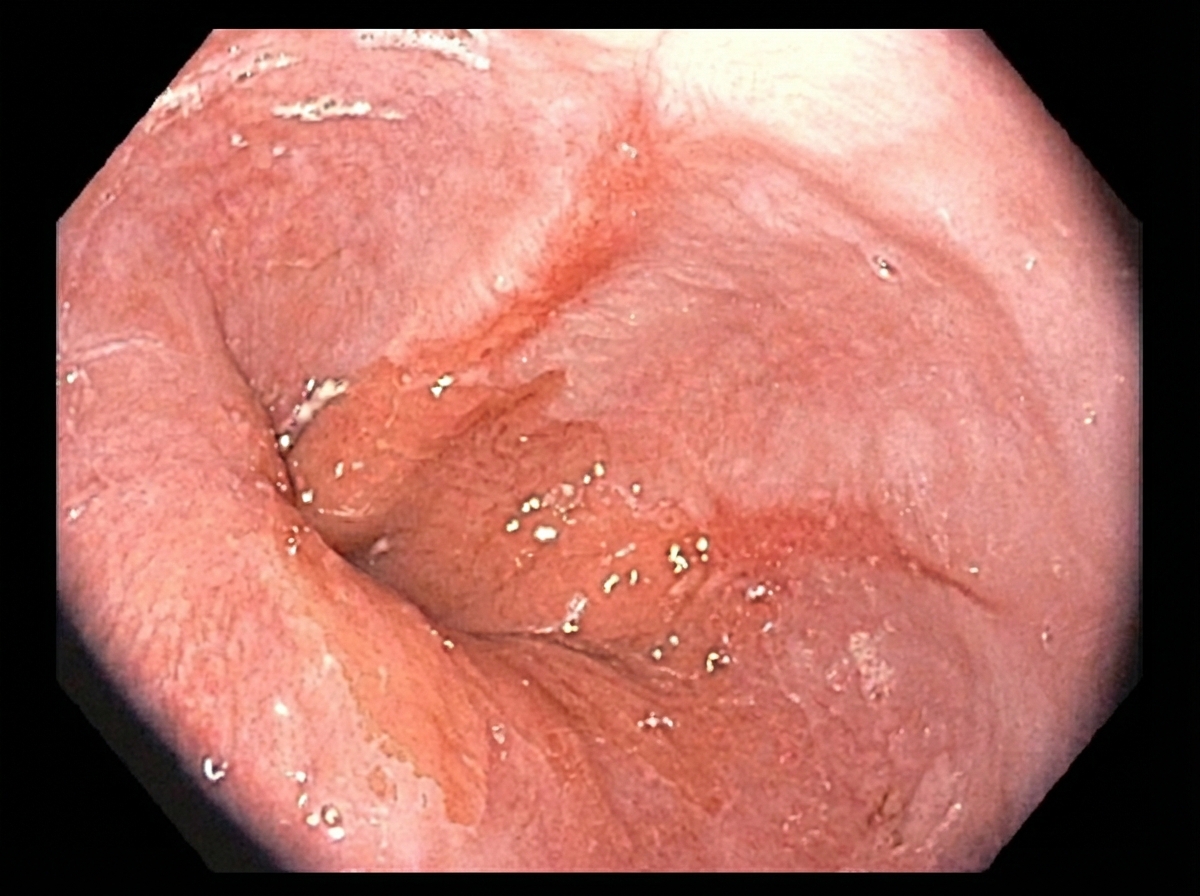
A 55-year-old man comes to the physician because of heartburn for the past 2 years. He has no chest pain, dysphagia, weight loss, or fever. He has no history of any serious illnesses. He takes omeprazole daily. Vital signs are within normal limits. Body mass index (BMI) is 34 kg/m2. Physical exam shows no abnormalities. An endoscopic image of the lower esophageal sphincter is shown. Which of the following is the most important next step in management?
A 35-year-old woman presents to a pre-operative evaluation clinic prior to an elective cholecystectomy. She has a 5 pack-year smoking history. The anesthesiologist highly recommends to discontinue smoking for at least 8 weeks prior to the procedure for which she is compliant. What is the most likely histology of her upper respiratory tract's epithelial lining at the time of her surgery?
A 26-year-old woman comes to the physician because she has not had a menstrual period for 5 weeks. Menarche was at the age of 14 years and menses occurred at regular 30-day intervals. She reports having unprotected sexual intercourse 3 weeks ago. A urine pregnancy test is positive. Which of the following best describes the stage of development of the embryo at this time?
A 4-week-old boy is brought to the emergency department with a 2-day history of projectile vomiting after feeding. His parents state that he is their firstborn child and that he was born healthy. He developed normally for several weeks but started to eat less 1 week ago. Physical exam reveals a small, round mass in the right upper quadrant of the abdomen close to the midline. The infant throws up in the emergency department, and the vomitus is observed to be watery with no traces of bile. Which of the following is associated with the most likely cause of this patient's symptoms?
Want unlimited practice?
Get full access to all questions, explanations, and performance tracking.
Scan to download app