
Functional neuroanatomy of hearing and balance — MCQs

A 55-year-old woman presents to the physician with repeated episodes of dizziness for the last 3 months, which are triggered by rising from a supine position and by lying down. The episodes are sudden and usually last for less than 30 seconds. During the episode, she feels as if she is suddenly thrown into a rolling spin. She has no symptoms in the period between episodes. The patient denies having headaches, vomiting, deafness, ear discharge or ear pain. There is no history of a known medical disorder or prolonged consumption of a specific drug. The vital signs are within normal limits. On physical examination, when the physician asks the woman to turn her head 45° to the right, and then to rapidly move from the sitting to the supine position, self-limited rotatory nystagmus is observed following her return to the sitting position. The rest of the neurological examination is normal. Which of the following is the treatment of choice for the condition of this patient?
A 69-year-old man comes to the physician with a 2-year history of progressive hearing loss. His hearing is worse in crowded rooms, and he has noticed that he has more difficulty understanding women than men. He has no history of serious illness and does not take any medications. A Rinne test shows air conduction is greater than bone conduction bilaterally. This condition is most likely associated with damage closest to which of the following structures?
A 75-year-old woman with hypertension presents to your office for a routine health exam. Her medications include hydrochlorothiazide and a multivitamin. She has been feeling well; however, she mentions that her family has been complaining about the volume of the television. She also reports difficulty hearing when others have called her name. On physical examination, her temperature is 99°F (37.2°C), blood pressure is 120/85 mmHg, pulse is 70/min, respirations are 17/min, and pulse oximetry is 99% on room air. The tympanic membrane is gray with no drainage or granulation tissue. Audiometry is consistent with high frequency sensorineural hearing loss. Which of the following is the most likely physiology behind this patient’s presentation?
A 45-year-old male presents to his primary care physician for complaints of dizziness. The patient reports he experiences room-spinning dizziness lasting several hours at a time, approximately 2-3 times a month, starting 3 months ago. Upon questioning, the patient also reports right sided diminished hearing, tinnitus, and a sensation of ear fullness. His temperature is 99 deg F (37.2 deg C), pulse 70/min, respirations 12, blood pressure 130 mmHg/85 mmHg, SpO2 99%. You decide to order an audiometric evaluation. What is the most likely finding of the audiogram?
A 56-year-old woman presents to the emergency department with several episodes in which she felt "dizzy." She has had these symptoms on and off for the past year and can recall no clear exacerbating factor or time of day when her symptoms occur. She has a perpetual sensation of fullness in her ear but otherwise has no symptoms currently. Her temperature is 97.6°F (36.4°C), blood pressure is 122/77 mmHg, pulse is 85/min, respirations are 13/min, and oxygen saturation is 98% on room air. Cardiopulmonary exam is unremarkable. The patient's gait is stable. Which of the following is also likely to be found in this patient?
Where does the only cranial nerve without a thalamic relay nucleus enter the skull?
A 67-year-old female patient is brought to the emergency department after her daughter noticed she has been having meaningless speech. When assessing the patient, she calls the chair a table, and at times would make up new words. She does not appear to be aware of her deficit, and is carrying on an empty conversation. Her speech is fluent, but with paraphasic errors. Her repetition is impaired. On physical examination, a right upper quadrant field-cut is appreciated, with impairment in comprehension and repetition. Which of the following structures is most likely involved in this patient’s presentation?
A 55-year-old woman presents to her family physician with a 1-week history of dizziness. She experiences spinning sensations whenever she lies down and these sensations increase when she turns her head to the right. These episodes are transient, intermittent, last for less than a minute, occur multiple times in a day, and are associated with nausea. Between the episodes, she is fine and is able to perform her routine activities. She denies fever, hearing disturbances, diplopia, tinnitus, and recent flu or viral illness. Past medical history is significant for diabetes mellitus type 2, hypertension, and hypercholesterolemia. She does not use tobacco or alcohol. Her blood pressure is 124/78 mm Hg, the heart rate is 79/min, and the respiratory rate is 13/min. During the examination, when she is asked to lie supine from a sitting position with her head rotated towards the right side at 45°, horizontal nystagmus is observed. What is the next best step in the management of this patient?
An 82-year-old right-handed woman is brought in by ambulance after being found down in her home. On presentation, she is found to be awake but does not follow directions or respond to questions. She is able to speak and produces a fluent string of nonsensical words and sounds. She does not appear to be bothered by her deficits. Subsequent neurologic exam finds that the patient is unable to comprehend any instructions and is also unable to repeat phrases. CT scan reveals an acute stroke to her left hemisphere. Damage to which of the following structures would be most likely to result in this pattern of deficits?
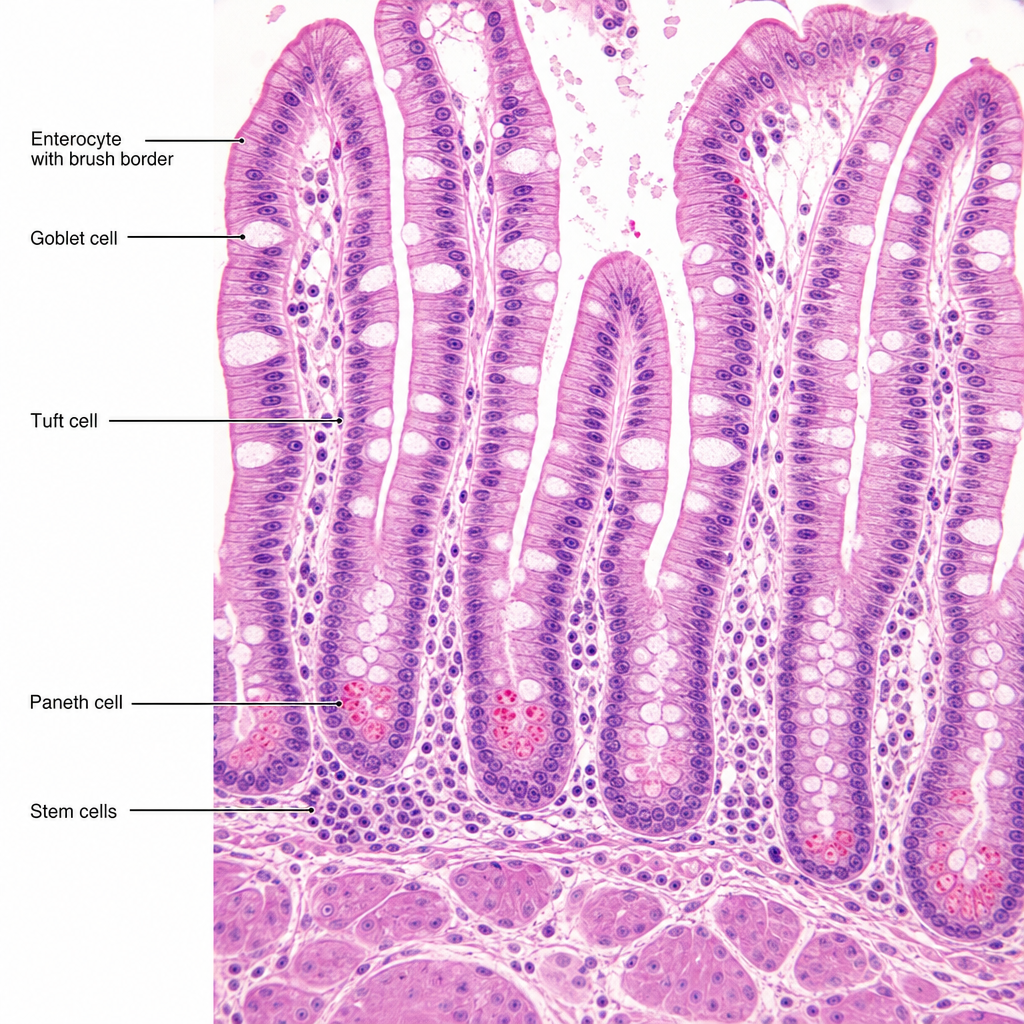
A histology slide from a surgical biopsy of the small intestine reveals tall columnar cells with a prominent brush border, interspersed with flask-shaped cells containing apical mucin granules, and occasional triangular cells wedged at the base of the crypts with eosinophilic granules. A separate population of undifferentiated cells is clustered at the base of the crypts. Based on this architecture, which cell type is responsible for the eosinophilic granules and what is its primary functional role?
Want unlimited practice?
Get full access to all questions, explanations, and performance tracking.
Scan to download app