
Basal ganglia — MCQs

A 38-year-old woman comes to the physician because of a 3-week history of involuntary movements of her extremities. One year ago, she was fired from her position as an elementary school teacher because she had stopped preparing lessons and was frequently absent without notice. She now lives with her mother. She appears emaciated and malodorous. Examination shows rapid, nonrepetitive jerks of her limbs and face that frequently end with the patient covering her face and yawning. She has an unsteady gait. Genetic testing shows a mutation on chromosome 4. This patient's condition is most likely associated with increased levels of which of the following substances?
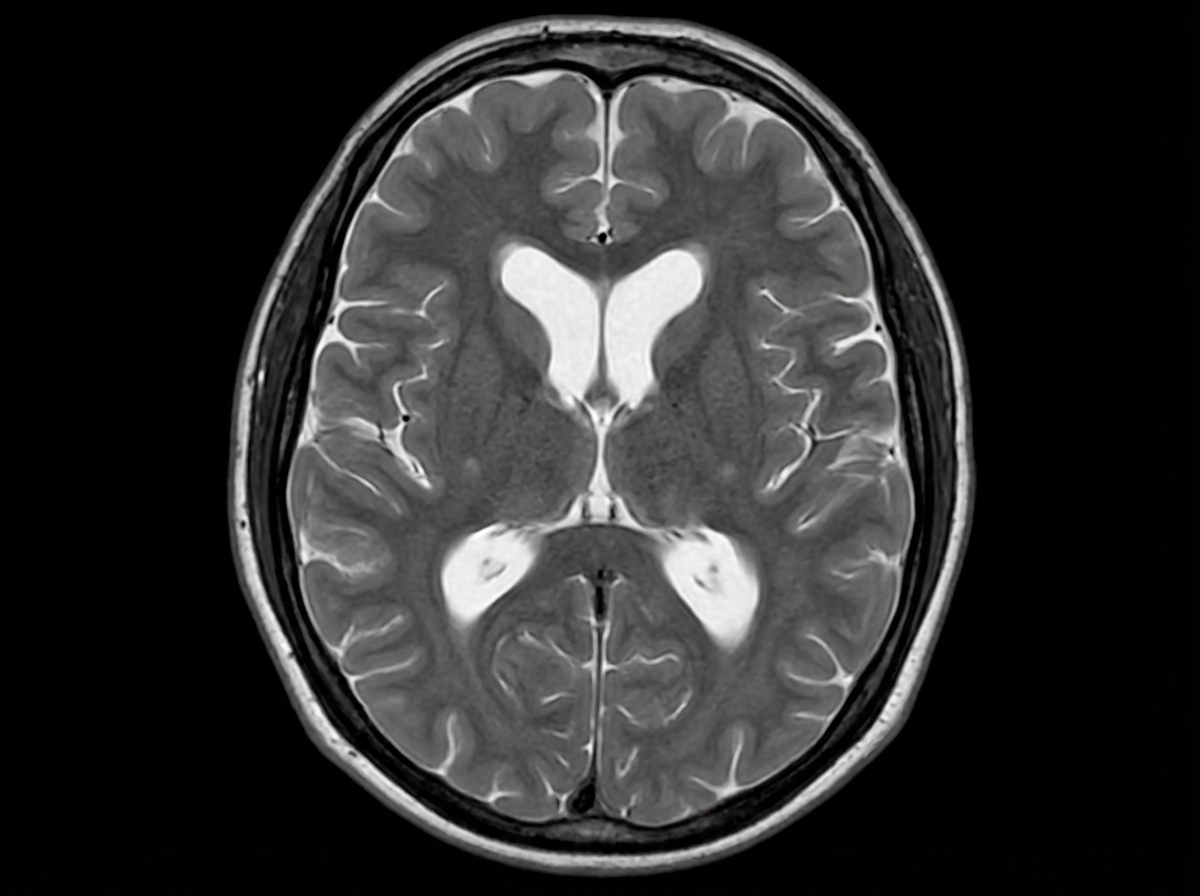
A 74-year-old man is brought to the physician by his wife for progressively worsening confusion and forgetfulness. Vital signs are within normal limits. Physical examination shows a flat affect and impaired short-term memory. An MRI of the brain is shown. Further evaluation of this patient is most likely to show which of the following findings?
A 73-year-old man presents to your office accompanied by his wife. He has been experiencing a tremor in his right hand for the last several months that seems to be worsening. He does not have any other complaints and says he’s “fine.” His wife thinks that he has also had more difficulty walking. His history is significant for hypertension and an ischemic stroke of the right middle cerebral artery 2 years ago. His medications include hydrochlorothiazide and daily aspirin. On physical exam you note that the patient speaks with a soft voice and has decreased facial expressions. He has a resting tremor that is worse on the right side. He has increased resistance to passive movement when you flex and extend his relaxed wrist. He has 5/5 strength bilaterally. Neuronal degeneration in which of the following locations is most likely responsible for the progression of this disease?
A 40-year-old man is brought to the emergency department after sustaining multiple lacerations during a bar fight. The patient’s wife says that he has been showing worsening aggression and has been involved in a lot of arguments and fights for the past 2 years. The patient has no significant past medical or psychiatric history and currently takes no medications. The patient cannot provide any relevant family history since he was adopted as an infant. His vitals are within normal limits. On physical examination, the patient looks apathetic and grimaces repeatedly. Suddenly, his arms start to swing by his side in an uncontrolled manner. Which area of the brain is most likely affected in this patient?
A 22-year-old man is brought to the physician by his mother because of concerns about his recent behavior. Three months ago, the patient first reported hearing loud voices coming from the ceiling of his room. During this time, he has also become increasingly worried that visitors to the house were placing secret surveillance cameras. Mental status examination shows tangential speech with paranoid thoughts. Treatment for this patient's condition predominantly targets which of the following dopaminergic pathways?
A 42-year-old woman is brought to the physician by her husband because of a 1-year history of abnormal behavior. During this time she has been irritable, restless, and has had multiple episodes of hearing voices. Over the past month, she has also had difficulty swallowing. She has a 2-year history of depression. She was let go by her employer 6 months ago because she could no longer handle all her tasks and often forgot about assignments. Her father committed suicide at the age of 50. The patient has smoked one pack of cigarettes daily over the past 20 years. She has a history of smoking cocaine for 8 years but stopped 1 year ago. Vital signs are within normal limits. On mental status examination, she is confused and oriented to person and place only. Neurologic examination shows a delayed return to neutral ankle position after triggering the plantar reflex. Physical examination shows irregular, nonrepetitive, and arrhythmic movements of the neck and head. The patient has poor articulation. Which of the following is the most likely diagnosis?
A 80-year-old man is brought to the emergency department with complaints that he "can't control his left leg". His symptoms started a few hours ago. He was outside taking a walk with his wife when suddenly his leg shot out and kicked her. His past medical history is notable for diabetes, hypertension, and a myocardial infarction 5 years ago. He smokes 1-2 cigarettes/day. He does not use alcohol or illicit drugs. On exam, the patient has intermittent wide, flinging movements that affect his proximal left arm and left leg. Which of the following parts of his brain is most likely damaged?
A 62-year-old man is referred to neurology by his primary care physician. He is accompanied by his wife. The patient reports having a resting tremor in his left hand for over a year and some “stiffness” in his left arm. His wife notes that he has started to walk "funny" as well. He has a history of hypertension and hyperlipidemia. He takes aspirin, amlodipine, and rosuvastatin. On physical examination, you notice a repetitive circular movement of his left index finger and thumb that resolves with active movement of the hand. Passive motion of the left upper extremity is partially limited by rigidity. Gait is slow and shuffling. The patient is prescribed the most effective treatment for his disorder. Which of the following is the mechanism of a second drug given to prevent adverse effects of this therapy?
Arrange in sequence the structures involved in the direct pathway (1=Striatum, 2=GPi, 3=Thalamus, 4=Cortex output, 5=Cortex input):-
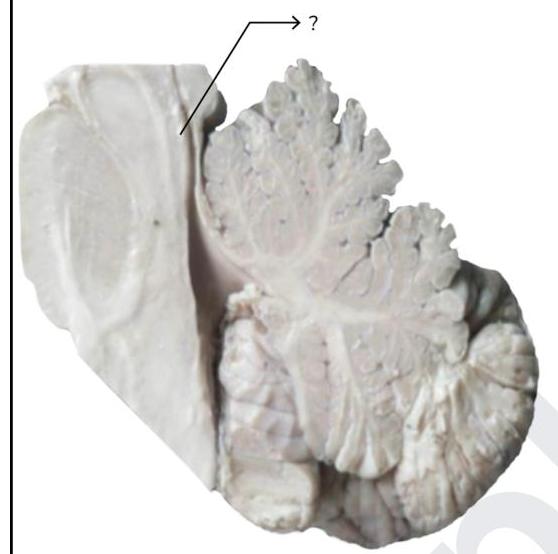
Fibers from the marked structure terminate at which of the following?
Want unlimited practice?
Get full access to all questions, explanations, and performance tracking.
Scan to download app