
Breast lymphatic drainage — MCQs

A 64-year-old woman presents to the surgical oncology clinic as a new patient for evaluation of recently diagnosed breast cancer. She has a medical history of type 2 diabetes mellitus for which she takes metformin. Her surgical history is a total knee arthroplasty 7 years ago. Her family history is insignificant. Physical examination is notable for an irregular nodule near the surface of her right breast. Her primary concern today is which surgical approach will be chosen to remove her breast cancer. Which of the following procedures involves the removal of a portion of a breast?
A 32-year-old man comes to the emergency department because of a wound in his foot. Four days ago, he stepped on a nail while barefoot at the beach. Examination of the plantar surface of his right foot shows a purulent puncture wound at the base of his second toe with erythema and tenderness of the surrounding skin. The afferent lymphatic vessels from the site of the lesion drain directly into which of the following groups of regional lymph nodes?
A 39-year-old man presents with painless swelling of the right testis and a sensation of heaviness. The physical examination revealed an intra-testicular solid mass that could not be felt separately from the testis. After a thorough evaluation, he was diagnosed with testicular seminoma. Which of the following group of lymph nodes are most likely involved?
A 52-year-old woman visits your office complaining about discharge from her left nipple for the past 3 months. The discharge looks like gray greenish and its amount is progressively increasing. She appears to be anxious and extremely uncomfortable with this situation as it is embarrassing for her when it occurs outdoors. Past medical history is insignificant. Her family history is negative for breast and ovarian disorders. She tries to stay active by running for 30 minutes every day on a treadmill, staying away from smoking, and by eating a balanced diet. She drinks alcohol occasionally. During physical examination you find a firm, stable mass under an inverted nipple in her left breast; while on the right breast, dilated subareolar ducts can be noted. There is no lymphadenopathy and remaining of the physical exam is normal. A mammogram is performed which reveals tubular calcifications. Which of the following is the most likely diagnosis?
A 62-year-old woman presents to her physician with a painless breast mass on her left breast for the past 4 months. She mentions that she noticed the swelling suddenly one day and thought it would resolve by itself. Instead, it has been slowly increasing in size. On physical examination of the breasts, the physician notes a single non-tender, hard, and fixed nodule over left breast. An ultrasonogram of the breast shows a solid mass, and a fine-needle aspiration biopsy confirms the mass to be lobular carcinoma of the breast. When the patient asks about her prognosis, the physician says that the prognosis can be best determined after both grading and staging of the tumor. Based on the current diagnostic information, the physician says that they can only grade, but no stage, the neoplasm. Which of the following facts about the neoplasm is currently available to the physician?
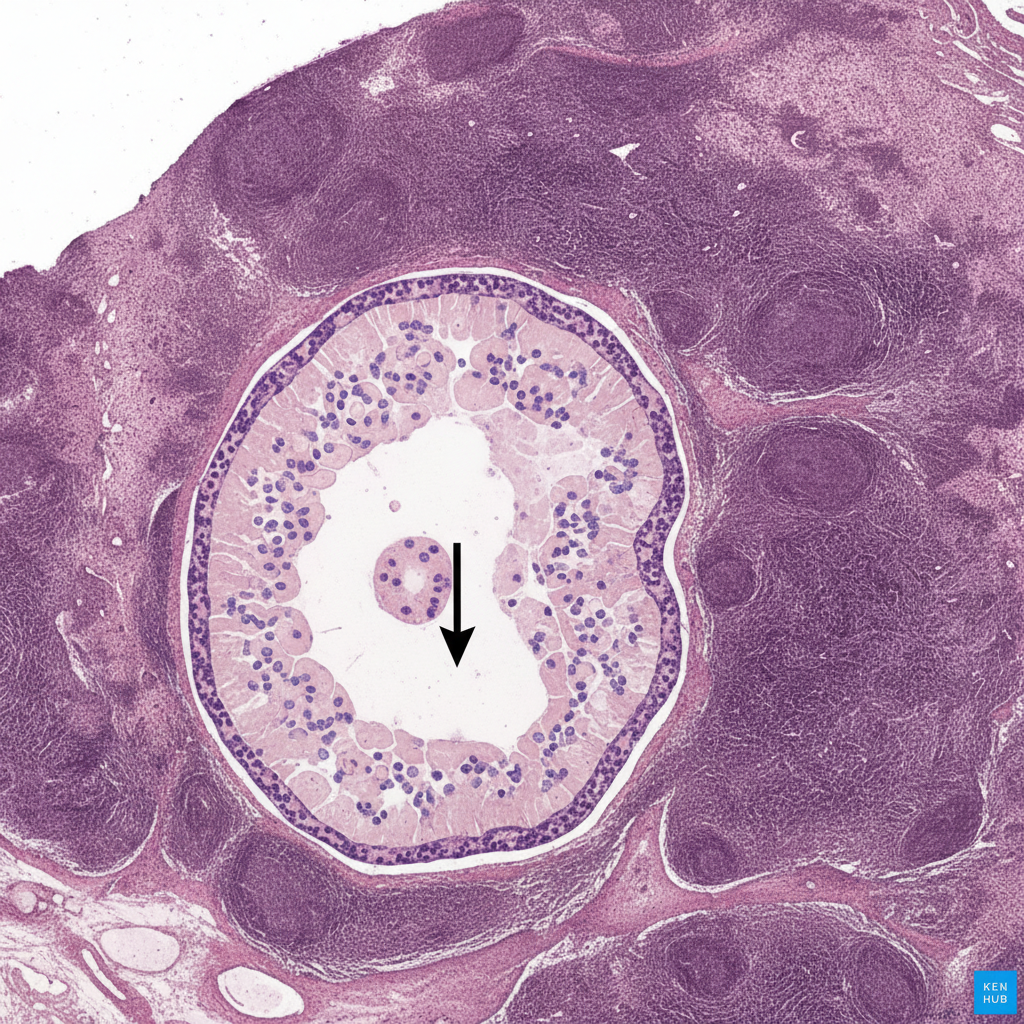
The image shows a cross-section of the appendix with prominent gut-associated lymphoid follicles surrounding the lumen, which is marked by the arrow. Within the germinal centers of these secondary lymphoid follicles, activated B cells receive CD40 signaling from T follicular helper cells and express activation-induced cytidine deaminase (AID). Which immunologic process occurs in these B cells?
A 55-year-old woman comes to the physician with concerns about swelling and pain in her right breast. Physical examination shows erythema and prominent pitting of the hair follicles overlying the upper and lower outer quadrants of the right breast. There are no nipple changes or discharge. A core needle biopsy shows invasive carcinoma of the breast. Which of the following is the most likely explanation for this patient's skin findings?
A 59-year-old woman presents to the family medicine clinic with a lump in her breast for the past 6 months. She states that she has been doing breast self-examinations once a month. She has a medical history significant for generalized anxiety disorder and systemic lupus erythematosus. She takes sertraline and hydroxychloroquine for her medical conditions. The heart rate is 102/min, and the rest of the vital signs are stable. On physical examination, the patient appears anxious and tired. Her lungs are clear to auscultation bilaterally. Capillary refill is 2 seconds. There is no axillary lymphadenopathy present. Palpation of the left breast reveals a 2 x 2 cm mass. What is the most appropriate next step given the history of the patient?
A 34-year-old Ethiopian woman who recently moved to the United States presents for evaluation to a surgical outpatient clinic with painful ulceration in her right breast for the last 2 months. She is worried because the ulcer is increasing in size. On further questioning, she says that she also has a discharge from her right nipple. She had her 2nd child 4 months ago and was breastfeeding the baby until the pain started getting worse in the past few weeks, and is now unbearable. According to her health records from Africa, her physician prescribed antimicrobials multiple times with a diagnosis of mastitis, but she did not improve significantly. Her mother and aunt died of breast cancer at 60 and 58 years of age, respectively. On examination, the right breast is enlarged and firm, with thickened skin, diffuse erythema, edema, and an ulcer measuring 3 × 3 cm. White-gray nipple discharge is present. The breast is tender with axillary and cervical adenopathy. Mammography is ordered, which shows a mass with a large area of calcifications, parenchymal distortion, and extensive soft tissue and trabecular thickening in the affected breast. The patient subsequently undergoes core-needle and full-thickness skin punch biospies. The pathology report states a clear dermal lymphatic invasion by tumor cells. Which of the following is the most likely diagnosis?
A 28-year-old male presents to his primary care physician with complaints of intermittent abdominal pain and alternating bouts of constipation and diarrhea. His medical chart is not significant for any past medical problems or prior surgeries. He is not prescribed any current medications. Which of the following questions would be the most useful next question in eliciting further history from this patient?
Want unlimited practice?
Get full access to all questions, explanations, and performance tracking.
Scan to download app