A 27-year-old G2P1 female gives birth to a baby girl at 33 weeks gestation. The child is somnolent with notable difficulty breathing. Pulse pressure is widened. She is profusely cyanotic. Auscultation is notable for a loud single S2. An echocardiogram demonstrates an enlarged heart and further studies show blood from the left ventricle entering the pulmonary circulation as well as the systemic circulation. Which of the following processes was most likely abnormal in this patient?
Q12
Shortly after delivery, a female newborn develops bluish discoloration of the lips, fingers, and toes. She was born at term to a 38-year-old primigravid woman. Pregnancy was complicated by maternal diabetes mellitus. Pulse oximetry on room air shows an oxygen saturation of 81%. Echocardiography shows immediate bifurcation of the vessel arising from the left ventricle; the vessel emerging from the right ventricle gives out coronary, head, and neck vessels. An abnormality in which of the following developmental processes most likely accounts for this patient's condition?
Q13
A 2-year-old girl is brought to the emergency department by her mother after an episode of turning blue on the playground. The mother states that the girl starting crying, and her fingers and hands turned blue. On examination, the patient is playful and in no apparent distress. She is afebrile and the vital signs are stable. The lungs are clear to auscultation bilaterally with no evidence of respiratory distress. There is a fixed, split S2 heart sound on cardiac exam without the presence of a S3 or S4. The peripheral pulses are equal bilaterally. What is the underlying cause of this patient’s presentation?
Q14
A 56-year-old man is brought to the emergency department 25 minutes after the sudden onset of severe pain in the middle of his chest. He describes the pain as tearing in quality; it radiates to his jaw. He has hypertension. He has smoked one pack of cigarettes daily for the 25 years. Current medications include enalapril. His blood pressure is 154/95 mm Hg in his right arm and 181/105 mm Hg in his left arm. A CT scan of the chest is shown. The structure indicated by the arrow is a derivative of which of the following?
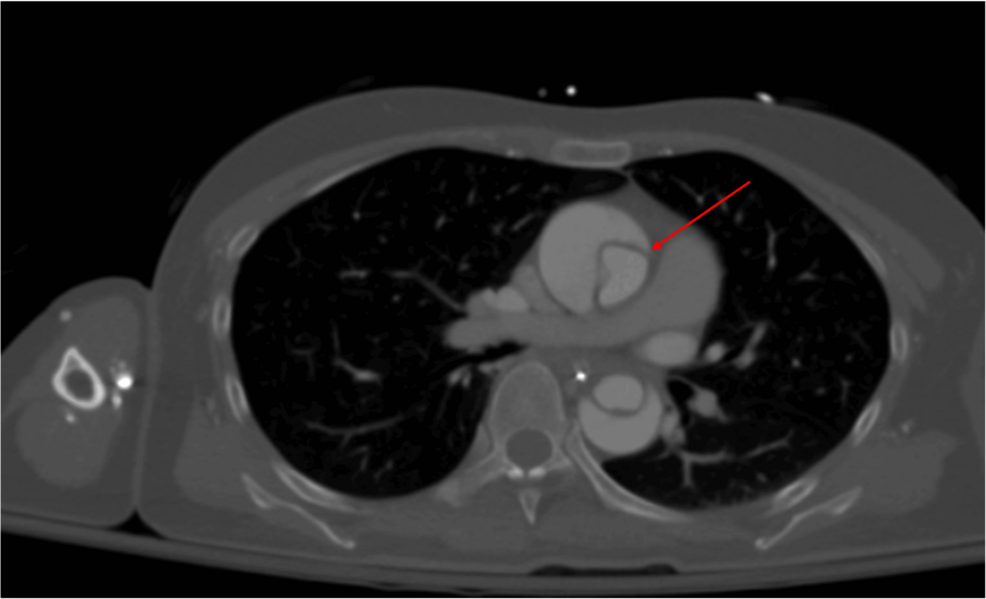
Q15
The parents of a 4-year-old present to the pediatrician because they are concerned about the poor growth and odd behavior of their son. Their son has been at the 10th percentile for growth since birth and they have noticed that his skin seems to have a bluish hue to it whenever he cries or is agitated. Recently, they have noticed that when he squats it seems to relieve these symptoms. What was the embryologic cause of this patient's current symptoms?
Q16
A newborn is rushed to the neonatal ICU after becoming cyanotic shortly after birth. An ultrasound is performed which shows the aorta coming off the right ventricle and lying anterior to the pulmonary artery. The newborn is given prostaglandin E1 and surgery is planned to correct the anatomic defect. Which of the following developmental processes failed to occur in the newborn?
Q17
A 5-day-old boy is brought to the emergency department by his mother because of a 2-day history of difficulty feeding and multiple episodes of his lips turning blue. He was born at home via spontaneous vaginal delivery and Apgar scores were 7 and 8 at 1 and 5 minutes, respectively. Physical examination shows grunting and moderate intercostal and subcostal retractions. Echocardiography shows a single vessel exiting from the heart. Which of the following is the most likely underlying cause of this patient's condition?
Q18
A patient in the neonatal intensive care unit develops severe cyanosis. Cardiac exam reveals a single loud S2 with a right ventricular heave. Echocardiography reveals an aorta lying anterior and right of the pulmonary artery. Which of the following processes failed during fetal development?
Heart development US Medical PG Practice Questions and MCQs
Question 11: A 27-year-old G2P1 female gives birth to a baby girl at 33 weeks gestation. The child is somnolent with notable difficulty breathing. Pulse pressure is widened. She is profusely cyanotic. Auscultation is notable for a loud single S2. An echocardiogram demonstrates an enlarged heart and further studies show blood from the left ventricle entering the pulmonary circulation as well as the systemic circulation. Which of the following processes was most likely abnormal in this patient?
A. Formation of the interatrial septum
B. Formation of the aorticopulmonary septum (Correct Answer)
C. Closure of an aorticopulmonary shunt
D. Formation of an atrioventricular valve
E. Spiraling of the truncal and bulbar ridges
Explanation: ***Formation of the aorticopulmonary septum***
- The symptoms described, such as **cyanosis**, widened pulse pressure, and a loud single S2, are classic signs of **truncus arteriosus**, a congenital heart defect.
- Truncus arteriosus results from the **failure of the aorticopulmonary septum to form**, leading to a single great artery overriding a ventricular septal defect, allowing blood to shunt from the left ventricle into both pulmonary and systemic circulations.
*Formation of the interatrial septum*
- Defects in the formation of the interatrial septum lead to **atrial septal defects (ASDs)**, which typically cause a left-to-right shunt and are associated with a fixed split S2 and potential for pulmonary hypertension, but not the severe cyanosis and single S2 seen here.
- While an enlarged heart can occur, the primary problem in ASDs is not the mixing of ventricular blood into both circulations in the manner described.
*Closure of an aorticopulmonary shunt*
- An aorticopulmonary shunt refers to a **patent ductus arteriosus (PDA)**, where the ductus arteriosus fails to close after birth. This typically causes a continuous "machine-like" murmur and pulmonary overcirculation, but not severe cyanosis unless associated with other complex lesions.
- The described findings of a single S2, widened pulse pressure, and severe cyanosis point away from an isolated PDA.
*Formation of an atrioventricular valve*
- Abnormalities in atrioventricular valve formation can lead to conditions like **tricuspid or mitral atresia** or **Ebstein's anomaly**. These often present with cyanosis and heart failure, but the specific description of blood from the left ventricle entering both pulmonary and systemic circulations, along with a single great artery and single S2, does not fit isolated AV valve malformations.
- The characteristic presentation strongly points to a truncal anomaly rather than an isolated AV valve issue.
*Spiraling of the truncal and bulbar ridges*
- Failure of the truncal and bulbar ridges to spiral correctly leads to **transposition of the great arteries (TGA)** or **tetralogy of Fallot**. TGA results in two separate circulations and severe cyanosis, while Tetralogy presents with a VSD, pulmonary stenosis, overriding aorta, and right ventricular hypertrophy.
- While spiraling is part of early septation, the specific findings in the case (single S2, widened pulse pressure, and blood shunting from left ventricle to both circulations) are more specifically indicative of truncus arteriosus (failure of septum formation rather than spiraling) than TGA or Tetralogy.
Question 12: Shortly after delivery, a female newborn develops bluish discoloration of the lips, fingers, and toes. She was born at term to a 38-year-old primigravid woman. Pregnancy was complicated by maternal diabetes mellitus. Pulse oximetry on room air shows an oxygen saturation of 81%. Echocardiography shows immediate bifurcation of the vessel arising from the left ventricle; the vessel emerging from the right ventricle gives out coronary, head, and neck vessels. An abnormality in which of the following developmental processes most likely accounts for this patient's condition?
A. Alignment of infundibular septum
B. Fusion of endocardial cushion
C. Spiraling of aorticopulmonary septum (Correct Answer)
D. Separation of tricuspid valve tissue from myocardium
E. Division of aorta and pulmonary artery
Explanation: ***Spiraling of aorticopulmonary septum***
- The description of a vessel arising from the left ventricle that immediately bifurcates (pulmonary artery) and a vessel from the right ventricle that gives off coronary, head, and neck vessels (aorta) is characteristic of **transposition of the great arteries (TGA)**.
- TGA results from a failure of the **aorticopulmonary septum** to spiral during embryological development, leading to the aorta originating from the right ventricle and the pulmonary artery from the left ventricle.
*Alignment of infundibular septum*
- Abnormal alignment of the infundibular septum is associated with conditions like **tetralogy of Fallot**, which involves a maligned interventricular septum and a shifted aorta, presenting with a different set of echocardiographic findings.
- While also a **cyanotic heart defect**, tetralogy of Fallot's anatomy (e.g., interventricular septal defect, pulmonary stenosis) differs from the described TGA.
*Fusion of endocardial cushion*
- Failure of fusion of the **endocardial cushions** leads to **atrioventricular septal defects**, which involve defects in both the atria and ventricular septa, and often affect the mitral and tricuspid valves.
- These defects typically present with heart failure symptoms and different echocardiographic findings than those described for TGA.
*Separation of tricuspid valve tissue from myocardium*
- An abnormality in the separation of tricuspid valve tissue from the myocardium is the cause of **Ebstein anomaly**, where the tricuspid valve leaflets are displaced downwards into the right ventricle, leading to tricuspid regurgitation.
- Ebstein anomaly is characterized by right atrial enlargement and a largely functional right ventricle, leading to issues with right heart output but not the great artery transposition described.
*Division of aorta and pulmonary artery*
- The division of the truncus arteriosus into the aorta and pulmonary artery is a normal developmental process, which when complete usually produces the correct great artery connections. However, the exact arrangement of these vessels is determined by the **spiraling of the aorticopulmonary septum**, not just the division itself.
- Failure of this division, resulting in a **persistent truncus arteriosus**, would present as a single great artery arising from both ventricles, which is distinct from the two separate but transposed vessels seen in TGA.
Question 13: A 2-year-old girl is brought to the emergency department by her mother after an episode of turning blue on the playground. The mother states that the girl starting crying, and her fingers and hands turned blue. On examination, the patient is playful and in no apparent distress. She is afebrile and the vital signs are stable. The lungs are clear to auscultation bilaterally with no evidence of respiratory distress. There is a fixed, split S2 heart sound on cardiac exam without the presence of a S3 or S4. The peripheral pulses are equal bilaterally. What is the underlying cause of this patient’s presentation?
A. Lithium use by mother during the first trimester
B. Failure of the ductus arteriosus to regress
C. Patent foramen ovale
D. Failed formation of the septum secundum (Correct Answer)
E. Failure of the aorticopulmonary septum to spiral
Explanation: **Failed formation of the septum secundum**
- The described presentation, including **transient cyanosis** during crying spells and a **fixed, split S2**, is highly suggestive of an **atrial septal defect (ASD)**.
- An ASD, particularly a **secundum ASD**, results from inadequate development of the **septum secundum**, leading to a left-to-right shunt.
*Lithium use by mother during the first trimester*
- **Lithium exposure** during pregnancy is associated with **Ebstein's anomaly**, a congenital heart defect affecting the tricuspid valve.
- Ebstein's anomaly typically presents with significant **tricuspid regurgitation** and often right heart failure, which is not seen here.
*Failure of the ductus arteriosus to regress*
- Failure of the ductus arteriosus to close after birth results in a **patent ductus arteriosus (PDA)**, leading to a continuous murmur, often described as "machinery-like."
- While a PDA can cause left-to-right shunting, the specific symptom of **cyanosis with crying** and the **fixed, split S2** are not classic PDA presentations.
*Patent foramen ovale*
- A **patent foramen ovale (PFO)** is a common finding, often asymptomatic, where the foramen ovale fails to close.
- While a PFO can allow for transient right-to-left shunting during periods of increased right atrial pressure, it rarely causes the overt cyanotic episodes and fixed, split S2 characteristic of a significant ASD.
*Failure of the aorticopulmonary septum to spiral*
- Failure of the **aorticopulmonary septum** to spiral results in **transposition of the great arteries (TGA)**.
- TGA presents with severe, persistent **cyanosis** shortly after birth and is a medical emergency, inconsistent with the history of intermittent cyanosis and stable examination in a 2-year-old.
Question 14: A 56-year-old man is brought to the emergency department 25 minutes after the sudden onset of severe pain in the middle of his chest. He describes the pain as tearing in quality; it radiates to his jaw. He has hypertension. He has smoked one pack of cigarettes daily for the 25 years. Current medications include enalapril. His blood pressure is 154/95 mm Hg in his right arm and 181/105 mm Hg in his left arm. A CT scan of the chest is shown. The structure indicated by the arrow is a derivative of which of the following?
A. Right horn of sinus venosus
B. Primitive atrium
C. Right common cardinal vein
D. Truncus arteriosus (Correct Answer)
E. Bulbus cordis
Explanation: ***Truncus arteriosus***
- This clinical scenario describes an **aortic dissection**, suggested by the sudden onset of **tearing chest pain radiating to the jaw**, significant **blood pressure differential** between arms, and presenting in a patient with **hypertension and smoking history**.
- The image likely shows a dilated aorta or an aortic dissection. The **truncus arteriosus** is the embryonic precursor to the **ascending aorta** and the **pulmonary trunk**, making it the correct derivative for the affected structure.
*Right horn of sinus venosus*
- The **right horn of the sinus venosus** primarily contributes to the formation of the **smooth-walled part of the right atrium** (sinus venarum).
- It does not give rise to the aorta, which is the structure involved in the described pathology.
*Primitive atrium*
- The **primitive atrium** develops into the **trabeculated parts** of both the **right and left atria** (atrial appendages).
- It is not involved in the formation of the great arteries like the aorta.
*Right common cardinal vein*
- The **right common cardinal vein** contributes to the formation of the **superior vena cava**.
- It is not a developmental source for the aorta.
*Bulbus cordis*
- The **bulbus cordis** gives rise to the **conus arteriosus** (infundibulum) of the right ventricle, the **aortic vestibule** of the left ventricle, and part of the **right ventricle**.
- While it is a component of the outflow tract, the primary structure from which the ascending aorta develops is the truncus arteriosus.
Question 15: The parents of a 4-year-old present to the pediatrician because they are concerned about the poor growth and odd behavior of their son. Their son has been at the 10th percentile for growth since birth and they have noticed that his skin seems to have a bluish hue to it whenever he cries or is agitated. Recently, they have noticed that when he squats it seems to relieve these symptoms. What was the embryologic cause of this patient's current symptoms?
A. Failure of the aorticopulmonary septum to spiral
B. Partial aorticopulmonary septum development
C. Failure of septum primum and septum secundum to fuse
D. Anterosuperior displacement of aorticopulmonary septum (Correct Answer)
E. Failure of the ductus arteriosus to obliterate
Explanation: ***Anterosuperior displacement of aorticopulmonary septum***
- This describes the **embryologic defect** leading to **Tetralogy of Fallot**, which includes **pulmonary stenosis**, VSD, overriding aorta, and right ventricular hypertrophy.
- The patient's symptoms of **cyanosis** with agitation ("bluish hue"), **poor growth**, and **squatting to relieve symptoms** (which increases systemic vascular resistance, improving pulmonary blood flow) are classic for Tetralogy of Fallot.
*Failure of the aorticopulmonary septum to spiral*
- This embryologic defect results in **transposition of the great arteries**, where the aorta arises from the right ventricle and the pulmonary artery from the left ventricle.
- While it causes **cyanosis** and poor growth, squatting would not typically relieve symptoms as in Tetralogy of Fallot.
*Partial aorticopulmonary septum development*
- This is an imprecise description; specific defects like **persistent truncus arteriosus** or **aorticopulmonary window** are results of incomplete septation, which can cause cyanosis but have different associated clinical findings.
- These conditions often present with signs of **heart failure** earlier due to significant left-to-right shunting or mixing of blood if not corrected.
*Failure of septum primum and septum secundum to fuse*
- This leads to a **patent foramen ovale (PFO)**, which is usually asymptomatic or can cause transient cyanosis in specific situations (e.g., Valsalva maneuver) due to right-to-left shunting.
- It does not explain the severe, activity-related cyanosis, poor growth, or squatting behavior seen in this patient.
*Failure of the ductus arteriosus to obliterate*
- This results in a **patent ductus arteriosus (PDA)**, which typically causes a **left-to-right shunt**, leading to pulmonary overcirculation and symptoms of heart failure rather than cyanosis (unless pulmonary hypertension develops later).
- The characteristic finding is a **continuous machine-like murmur**, and the infant would typically be acyanotic without the squatting behavior.
Question 16: A newborn is rushed to the neonatal ICU after becoming cyanotic shortly after birth. An ultrasound is performed which shows the aorta coming off the right ventricle and lying anterior to the pulmonary artery. The newborn is given prostaglandin E1 and surgery is planned to correct the anatomic defect. Which of the following developmental processes failed to occur in the newborn?
A. Failure of the membranous ventricular septum to fuse with the muscular interventricular septum
B. Failure of the septum primum to fuse with the septum secundum
C. Failure of the aorticopulmonary septum to spiral (Correct Answer)
D. Failure of the ductus venosus to close
E. Failure of the ductus arteriosus to close
Explanation: ***Failure of the aorticopulmonary septum to spiral***
- **Transposition of the great arteries (TGA)**, characterized by the aorta originating from the right ventricle and the pulmonary artery from the left ventricle, results from the **aorticopulmonary septum** failing to spiral properly during embryological development.
- This defect leads to two separate circulatory systems, causing severe **cyanosis** shortly after birth and requiring **prostaglandin E1** to maintain a patent ductus arteriosus for mixing of oxygenated and deoxygenated blood.
- This is a ductal-dependent lesion requiring urgent intervention.
*Failure of the membranous ventricular septum to fuse with the muscular interventricular septum*
- This specific failure leads to a **ventricular septal defect (VSD)**, which allows blood to shunt between ventricles.
- While VSDs can cause cyanosis if large and associated with pulmonary hypertension (Eisenmenger syndrome), the description of **great artery transposition** is not caused by this developmental failure.
*Failure of the septum primum to fuse with the septum secundum*
- This developmental anomaly results in a **patent foramen ovale (PFO)** or an **atrial septal defect (ASD)**.
- These defects typically cause a left-to-right shunt and present with symptoms later in life, not with severe immediate cyanosis.
- In TGA, an ASD may actually be beneficial as it allows some mixing of blood.
*Failure of the ductus venosus to close*
- The **ductus venosus** shunts oxygenated blood from the umbilical vein directly to the inferior vena cava, bypassing the fetal liver during intrauterine life.
- Persistent patency of the ductus venosus after birth is rare and does not cause the severe cyanosis and specific great artery anatomy seen in TGA.
*Failure of the ductus arteriosus to close*
- A **patent ductus arteriosus (PDA)** allows blood to flow from the aorta to the pulmonary artery after birth, which can lead to pulmonary overcirculation.
- In **transposition of the great arteries**, a PDA is actually crucial for survival as it provides a pathway for mixing of oxygenated and deoxygenated blood; maintaining PDA patency with PGE1 is the initial management, not a cause of the condition.
Question 17: A 5-day-old boy is brought to the emergency department by his mother because of a 2-day history of difficulty feeding and multiple episodes of his lips turning blue. He was born at home via spontaneous vaginal delivery and Apgar scores were 7 and 8 at 1 and 5 minutes, respectively. Physical examination shows grunting and moderate intercostal and subcostal retractions. Echocardiography shows a single vessel exiting from the heart. Which of the following is the most likely underlying cause of this patient's condition?
A. Abnormal placement of the infundibular septum
B. Absent fusion of septum primum and septum secundum
C. Failure of neural crest cell migration (Correct Answer)
D. Insufficient growth of endocardial cushions
E. Abnormal cardiac looping
Explanation: ***Failure of neural crest cell migration***
- The echocardiography finding of a **single vessel exiting the heart** is characteristic of **truncus arteriosus**, a congenital heart defect.
- This condition arises from the **failure of neural crest cells** to migrate properly and spiralize the **aortopulmonary septum**, which normally divides the truncus arteriosus into the aorta and pulmonary artery.
*Abnormal placement of the infundibular septum*
- Abnormal placement of the infundibular septum is typically associated with **Tetralogy of Fallot**, leading to an overriding aorta, pulmonary stenosis, ventricular septal defect, and right ventricular hypertrophy.
- While Tetralogy of Fallot is a cyanotic heart disease, it presents with a **bifurcated outflow tract** not a single great vessel.
*Absent fusion of septum primum and septum secundum*
- The absent fusion of the **septum primum** and **septum secundum** results in a **patent foramen ovale** or an **atrial septal defect**.
- These defects primarily cause left-to-right shunting, leading to volume overload in the right heart, but do not explain the presence of a single great vessel.
*Insufficient growth of endocardial cushions*
- Insufficient growth of the **endocardial cushions** can lead to **atrioventricular septal defects** and certain types of **ventricular septal defects**.
- These conditions involve issues with valve formation and septal development but do not directly cause a single great vessel to exit the heart.
*Abnormal cardiac looping*
- Abnormal cardiac looping is associated with conditions like **dextrocardia** or **transposition of the great arteries**.
- While **transposition of the great arteries** also causes cyanosis, it involves **two great vessels** that are improperly connected, not a single great vessel.
Question 18: A patient in the neonatal intensive care unit develops severe cyanosis. Cardiac exam reveals a single loud S2 with a right ventricular heave. Echocardiography reveals an aorta lying anterior and right of the pulmonary artery. Which of the following processes failed during fetal development?
A. Aorticopulmonary septum to spiral (Correct Answer)
B. Reentry of viscera from yolk sac
C. Fusion of the membranous ventricular septum
D. Fusion of septum primum and septum secondum
E. Constriction by ductal tissue
Explanation: ***Aorticopulmonary septum to spiral***
- The clinical presentation describes **transposition of the great arteries (TGA)**, characterized by **severe cyanosis**, a **single loud S2**, and the **aorta lying anterior and right of the pulmonary artery**.
- TGA results from the failure of the **aorticopulmonary septum** to spiral correctly during development, causing the aorta to originate from the right ventricle and the pulmonary artery from the left ventricle.
*Reentry of viscera from yolk sac*
- Failure of this process leads to **omphalocele** or **gastroschisis**, which are abdominal wall defects with extrusion of visceral organs.
- These conditions do not cause severe neonatal cyanosis or specific cardiac malformations like TGA.
*Constriction by ductal tissue*
- This refers to the mechanism of **coarctation of the aorta**, where ectopic ductal tissue causes narrowing of the aortic arch.
- While coarctation can cause cyanosis in the lower body, it does not cause transposition of the great vessels and would not present with the echocardiographic findings described.
*Fusion of the membranous ventricular septum*
- Failure of fusion of the membranous ventricular septum results in a **ventricular septal defect (VSD)**.
- While a VSD can be associated with TGA, it is not the fundamental embryological defect that causes the transposition of the great arteries.
*Fusion of septum primum and septum secondum*
- Failure of fusion between the **septum primum** and **septum secundum** leads to an **atrial septal defect (ASD)**.
- An ASD allows for mixing of blood at the atrial level but is not the primary cause of the transposed great arteries.