A 65-year-old woman with osteoarthritis comes to the physician because of severe lower back and left leg pain. She has chronic lower back pain that is usually well-controlled with ibuprofen, but 3 hours ago her back pain acutely worsened after she picked up her 3-year-old granddaughter. The pain radiates from her lower back over her left outer thigh and knee towards the top of her big toe. Physical examination shows a diminished Achilles reflex on the left side. Muscle strength is 5/5 in all extremities and there are no sensory deficits. Steroid injection into which of the following anatomical locations is most likely to relieve her symptoms?
Q12
A 17-year-old boy is brought to the pediatrician by his mother for fatigue. The patient reports that he was supposed to try out for winter track this year, but he had to quit because his “legs just give up.” He also reports increased difficulty breathing with exercise but denies chest pain or palpitations. He has no chronic medical conditions and takes no medications. He has had no surgeries in the past. The mother reports that he met all his pediatric milestones and is an “average” student. He is up-to-date on all childhood vaccinations, including a recent flu vaccine. On physical examination, there is mild lumbar lordosis. The patient’s thighs appear thin in diameter compared to his lower leg muscles, and he walks on his toes. An electrocardiogram shows 1st degree atrioventricular nodal block. Which of the following is the most likely cause of the patient’s condition?
Q13
A 17-year-old boy is brought to the emergency department by his parents because of crushing chest pain, nausea, and vomiting for the past 2 hours. The pain is constant and radiates to his left shoulder. Over the past year, he has been admitted to the hospital twice for deep vein thrombosis. He has a history of learning disability and has been held back three grades. The patient is at the 99th percentile for length and the 45th percentile for weight. His pulse is 110/min, respirations are 21/min, and blood pressure is 128/84 mm Hg. His fingers are long and slender, and his arm span exceeds his body height. Electrocardiography shows ST-segment elevation in leads V1 and V2. His serum troponin I concentration is 2.0 ng/mL (N ≤ 0.04). Coronary angiography shows 90% occlusion of the proximal left anterior descending artery. Further evaluation of this patient is most likely to show which of the following findings?
Q14
A morbidly obese 43-year-old man presents for elective bariatric surgery after previously failing several non-surgical weight loss plans. After discussing the risks and benefits of several different procedures, a sleeve gastrectomy is performed. During the surgery, the surgeon begins by incising into the right half of the greater curvature of the stomach. Which of the following arteries most likely directly provides the blood supply to this region of the stomach?
Q15
A 24-year-old woman comes to the emergency department because of abdominal pain, fever, nausea, and vomiting for 12 hours. Her abdominal pain was initially dull and diffuse but has progressed to a sharp pain on the lower right side. Two years ago she had to undergo right salpingo-oophorectomy after an ectopic pregnancy. Her temperature is 38.7°C (101.7°F). Physical examination shows severe right lower quadrant tenderness with rebound tenderness; bowel sounds are decreased. Laboratory studies show leukocytosis with left shift. An abdominal CT scan shows a distended, edematous appendix. The patient is taken to the operating room for an appendectomy. During the surgery, the adhesions from the patient's previous surgery make it difficult for the resident physician to identify the appendix. Her attending mentions that she should use a certain structure for guidance to locate the appendix. The attending is most likely referring to which of the following structures?
Q16
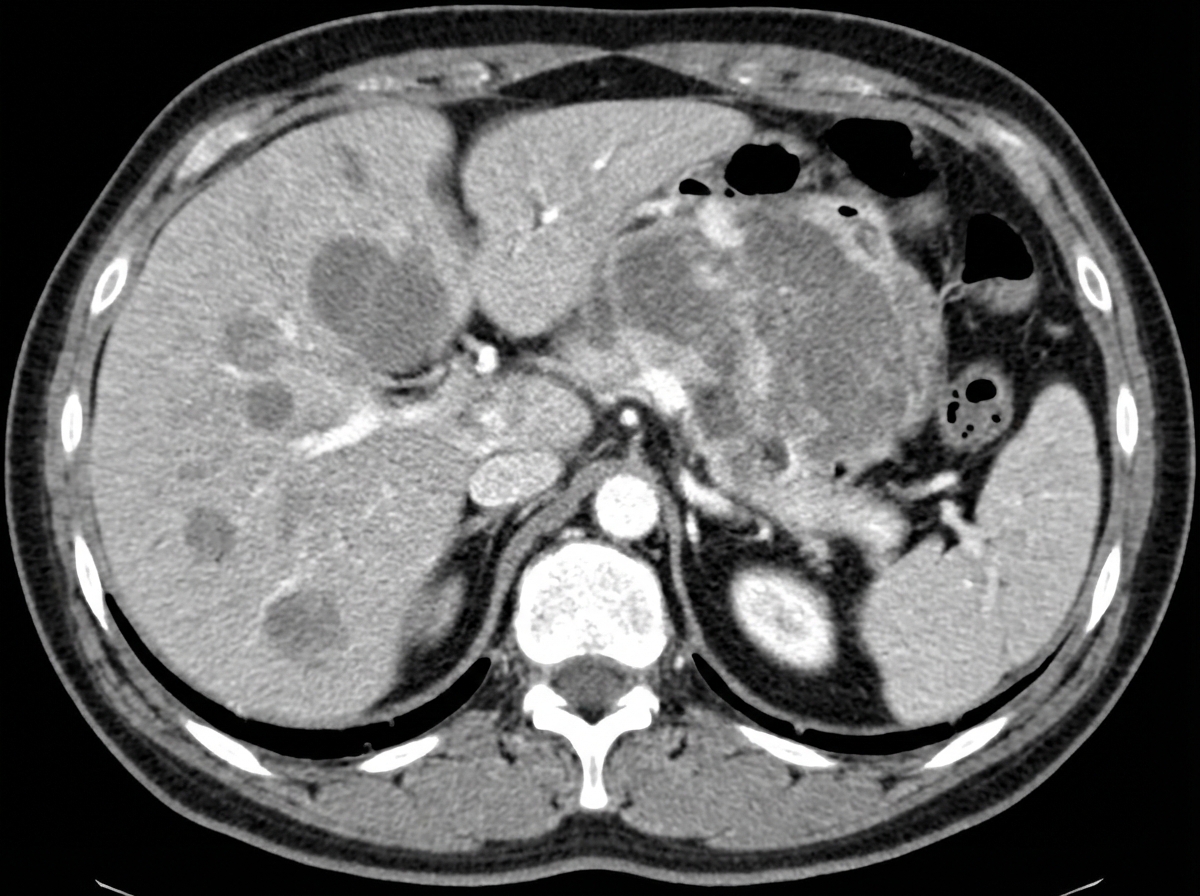
A 40-year-old man presents with severe fatigue, dyspnea on exertion, and weight loss. He reports a weight loss of 15 kg (33.0 lb) over the past 3 months and feels full almost immediately after starting to eat, often feeling nauseous and occasionally vomiting. Past medical history is not significant. However, the patient reports a 10-pack-year smoking history. His temperature is 37.0°C (98.6°F), respiratory rate is 15/min, pulse is 67/min, and blood pressure is 122/98 mm Hg. Physical examination reveals paleness and conjunctival pallor. Abdominal examination reveals an ill-defined nontender mass in the epigastric region along with significant hepatomegaly. Routine laboratory studies show a hemoglobin level of 7.2 g/dL. A contrast CT scan of the abdomen is presented below. Which of the following structures is most helpful in the anatomical classification of gastrointestinal bleeding in this patient?
Q17
A 49-year-old man comes to the physician because of severe, shooting pain in his lower back for the past 2 weeks. The pain radiates down the back of both legs and started after he lifted a concrete manhole cover from the ground. Physical examination shows decreased sensation to light touch bilaterally over the lateral thigh area and lateral calf bilaterally. Patellar reflex is decreased on both sides. The passive raising of either the right or left leg beyond 30 degrees triggers a shooting pain down the leg past the knee. Which of the following is the most likely underlying cause of this patient's current condition?
Gross Anatomy US Medical PG Practice Questions and MCQs
Question 11: A 65-year-old woman with osteoarthritis comes to the physician because of severe lower back and left leg pain. She has chronic lower back pain that is usually well-controlled with ibuprofen, but 3 hours ago her back pain acutely worsened after she picked up her 3-year-old granddaughter. The pain radiates from her lower back over her left outer thigh and knee towards the top of her big toe. Physical examination shows a diminished Achilles reflex on the left side. Muscle strength is 5/5 in all extremities and there are no sensory deficits. Steroid injection into which of the following anatomical locations is most likely to relieve her symptoms?
A. Subarachnoid space
B. Inferior facet joint
C. Intervertebral disc
D. Intervertebral foramen (Correct Answer)
E. Subdural space
Explanation: ***Intervertebral foramen***
- The patient's symptoms, including **radiating lower back and left leg pain** with a diminished **posterior tibial reflex**, are classic for **radiculopathy** due to **spinal nerve root compression**.
- Steroid injection into the intervertebral foramen, where the **nerve root exits the spinal canal**, is directly targeting the site of inflammation and compression, thus being most likely to relieve symptoms.
*Subarachnoid space*
- An injection into the **subarachnoid space** (intrathecal injection) is typically used for **spinal anesthesia** or to administer medications for widespread CNS conditions, not focal nerve root compression.
- While it contains CSF and nerve roots, it is not the most precise or appropriate location for an injection aimed at isolated radicular pain.
*Inferior facet joint*
- The **facet joints** are involved in **axial back pain**, usually worse with extension, and do not typically cause radicular symptoms radiating down the leg to the big toe with a specific dermatomal and myotomal distribution like L5 or S1.
- An injection here would target facet joint arthritis, which presents differently from the described radiculopathy.
*Intervertebral disc*
- An injection into the **intervertebral disc** (discography or disc annuloplasty) is generally a diagnostic procedure to identify pain originating from the disc or a treatment for discogenic pain, which is usually axial and not radicular.
- Injecting steroids directly into the disc is not a standard treatment for nerve root compression.
*Subdural space*
- The **subdural space** is a potential space between the dura mater and arachnoid mater; injections into this space are rarely performed therapeutically and carry significant risks without clear benefit for radiculopathy.
- An inadvertent subdural injection during an epidural procedure can lead to complications such as a **subdural hematoma** or paralysis.
Question 12: A 17-year-old boy is brought to the pediatrician by his mother for fatigue. The patient reports that he was supposed to try out for winter track this year, but he had to quit because his “legs just give up.” He also reports increased difficulty breathing with exercise but denies chest pain or palpitations. He has no chronic medical conditions and takes no medications. He has had no surgeries in the past. The mother reports that he met all his pediatric milestones and is an “average” student. He is up-to-date on all childhood vaccinations, including a recent flu vaccine. On physical examination, there is mild lumbar lordosis. The patient’s thighs appear thin in diameter compared to his lower leg muscles, and he walks on his toes. An electrocardiogram shows 1st degree atrioventricular nodal block. Which of the following is the most likely cause of the patient’s condition?
A. Absent dystrophin
B. Trinucleotide repeats
C. Abnormal dystrophin (Correct Answer)
D. Sarcomere protein dysfunction
E. Peripheral nerve demyelination
Explanation: ***Abnormal dystrophin***
* The patient's presentation with **fatigue**, exercise intolerance, muscular weakness ("legs just give up"), **lumbar lordosis**, **calf pseudohypertrophy** (thighs thin compared to lower legs), and **toe walking** are classic signs of **Becker muscular dystrophy (BMD)**.
* BMD is caused by mutations in the *DMD* gene leading to **abnormally sized or reduced, but still functional, dystrophin protein**. This allows for a milder, later-onset phenotype compared to Duchenne muscular dystrophy.
*Absent dystrophin*
* **Absent dystrophin** is characteristic of **Duchenne muscular dystrophy (DMD)**, which typically presents earlier in childhood with more severe and rapid progression of muscle weakness.
* While both BMD and DMD are X-linked dystrophinopathies, the patient's age (17 years) and milder symptoms are more consistent with the later onset and slower progression seen in BMD.
*Trinucleotide repeats*
* **Trinucleotide repeat disorders** like **myotonic dystrophy** or **Friedreich's ataxia** can cause muscle weakness and cardiac issues but have different clinical presentations.
* Myotonic dystrophy often involves **myotonia** (delayed muscle relaxation), frontal balding, and cataracts, which are not described here.
*Sarcomere protein dysfunction*
* **Sarcomere protein dysfunction** is primarily associated with various forms of **cardiomyopathy** (e.g., hypertrophic cardiomyopathy), which would explain the cardiac findings, but it does not typically cause the specific pattern of limb girdle weakness, calf pseudohypertrophy, and toe walking seen in this patient.
* Conditions like hereditary myopathies can involve sarcomeric proteins, but the overall clinical picture strongly points to a dystrophinopathy.
*Peripheral nerve demyelination*
* **Peripheral nerve demyelination** is characteristic of conditions like **Charcot-Marie-Tooth disease** (CMT), which affects peripheral nerves and causes distal muscle weakness and atrophy, foot deformities (e.g., pes cavus), and sensory loss.
* While CMT can cause toe walking, it typically involves significant distal muscle wasting rather than calf pseudohypertrophy, and the cardiac involvement (1st-degree AV block) is less commonly a prominent feature compared to muscular dystrophies.
Question 13: A 17-year-old boy is brought to the emergency department by his parents because of crushing chest pain, nausea, and vomiting for the past 2 hours. The pain is constant and radiates to his left shoulder. Over the past year, he has been admitted to the hospital twice for deep vein thrombosis. He has a history of learning disability and has been held back three grades. The patient is at the 99th percentile for length and the 45th percentile for weight. His pulse is 110/min, respirations are 21/min, and blood pressure is 128/84 mm Hg. His fingers are long and slender, and his arm span exceeds his body height. Electrocardiography shows ST-segment elevation in leads V1 and V2. His serum troponin I concentration is 2.0 ng/mL (N ≤ 0.04). Coronary angiography shows 90% occlusion of the proximal left anterior descending artery. Further evaluation of this patient is most likely to show which of the following findings?
A. Macroorchidism
B. Bilateral gynecomastia
C. Ascending aortic aneurysm
D. Saccular cerebral aneurysms
E. Downward lens subluxation (Correct Answer)
Explanation: ***Downward lens subluxation***
- This patient's presentation is classic for **homocystinuria**, a metabolic disorder caused by **cystathionine β-synthase deficiency**.
- Key diagnostic features include: **marfanoid habitus** (tall stature, arachnodactyly, arm span > height), **thromboembolic events** (recurrent DVTs and MI at young age), **intellectual disability** (learning disability, held back 3 grades), and **downward and inward lens subluxation (ectopia lentis)**.
- The **recurrent thromboembolism** (2 DVTs in past year + MI at age 17) is the most distinctive feature that differentiates homocystinuria from Marfan syndrome. Elevated homocysteine causes endothelial damage and platelet activation, leading to arterial and venous thrombosis.
- **Downward lens subluxation** is pathognomonic for homocystinuria (vs upward/temporal in Marfan syndrome).
*Macroorchidism*
- **Macroorchidism** (enlarged testes) is characteristic of **fragile X syndrome**, the most common inherited cause of intellectual disability.
- While this patient has learning disability, the **marfanoid habitus** and **thromboembolic events** are not features of fragile X syndrome.
*Ascending aortic aneurysm*
- **Ascending aortic aneurysm** is the classic cardiovascular complication of **Marfan syndrome**, a fibrillin-1 defect.
- While this patient has marfanoid features, **Marfan syndrome does NOT cause thromboembolism or intellectual disability**, which are the key distinguishing features in this case.
- Homocystinuria can mimic Marfan syndrome but is differentiated by thrombosis, mental retardation, and downward (not upward) lens dislocation.
*Saccular cerebral aneurysms*
- **Saccular (berry) aneurysms** are associated with **autosomal dominant polycystic kidney disease** and **Ehlers-Danlos syndrome type IV**.
- Neither condition fits this patient's presentation with marfanoid habitus, thromboembolism, and intellectual disability.
*Bilateral gynecomastia*
- **Bilateral gynecomastia** is seen in **Klinefelter syndrome** (47,XXY), which presents with tall stature, learning difficulties, and **hypogonadism with small, firm testes**.
- The marfanoid features (arachnodactyly, increased arm span) and thromboembolic events are not consistent with Klinefelter syndrome.
Question 14: A morbidly obese 43-year-old man presents for elective bariatric surgery after previously failing several non-surgical weight loss plans. After discussing the risks and benefits of several different procedures, a sleeve gastrectomy is performed. During the surgery, the surgeon begins by incising into the right half of the greater curvature of the stomach. Which of the following arteries most likely directly provides the blood supply to this region of the stomach?
A. Short gastric arteries
B. Right gastric artery
C. Right gastroduodenal artery
D. Right gastroepiploic artery (Correct Answer)
E. Splenic artery
Explanation: ***Right gastroepiploic artery***
- The **right gastroepiploic artery** (also known as the **right gastroomental artery**) is a branch of the **gastroduodenal artery** that runs along the **greater curvature of the stomach** from right to left.
- This artery is the primary blood supply to the **right portion of the greater curvature**, which corresponds to the region where an incision into the right half of the greater curvature would be made during a sleeve gastrectomy.
- It anastomoses with the left gastroepiploic artery along the greater curvature.
*Short gastric arteries*
- The **short gastric arteries** supply the **fundus** and a small portion of the superior body of the stomach, specifically to the left of the midline.
- They originate from the **splenic artery** and supply the left superior portion of the greater curvature, not the right half described in the question.
*Right gastric artery*
- The **right gastric artery** primarily supplies the **pyloric part of the stomach** and a portion of the **lesser curvature**.
- It arises from the **hepatic artery proper** and is not the main supply to the greater curvature.
*Right gastroduodenal artery*
- The **gastroduodenal artery** supplies the **duodenum** and the **head of the pancreas**.
- This artery is located inferior to the stomach and gives rise to the right gastroepiploic artery but does not directly supply the greater curvature itself.
*Splenic artery*
- The **splenic artery** is a large artery that primarily supplies the **spleen** and gives off branches like the **short gastric arteries** and the **left gastroepiploic artery**.
- While it contributes indirectly via its branches to the left portion of the greater curvature, it does not directly supply the right half of the greater curvature.
Question 15: A 24-year-old woman comes to the emergency department because of abdominal pain, fever, nausea, and vomiting for 12 hours. Her abdominal pain was initially dull and diffuse but has progressed to a sharp pain on the lower right side. Two years ago she had to undergo right salpingo-oophorectomy after an ectopic pregnancy. Her temperature is 38.7°C (101.7°F). Physical examination shows severe right lower quadrant tenderness with rebound tenderness; bowel sounds are decreased. Laboratory studies show leukocytosis with left shift. An abdominal CT scan shows a distended, edematous appendix. The patient is taken to the operating room for an appendectomy. During the surgery, the adhesions from the patient's previous surgery make it difficult for the resident physician to identify the appendix. Her attending mentions that she should use a certain structure for guidance to locate the appendix. The attending is most likely referring to which of the following structures?
A. Epiploic appendages
B. Right ureter
C. Deep inguinal ring
D. Ileocolic artery
E. Teniae coli (Correct Answer)
Explanation: ***Teniae coli***
- The **teniae coli** are three distinct longitudinal bands of smooth muscle that run along the length of the cecum and colon, converging at the base of the **appendix**.
- Following these bands inferiorly from the ascending colon or cecum during surgery is a reliable method to locate the **vermiform appendix**, especially in the presence of adhesions.
*Epiploic appendages*
- These are small, fat-filled sacs that protrude from the surface of the **large intestine** but are not directly used as a reliable landmark for locating the appendix.
- While present in the vicinity, they do not consistently lead to the base of the appendix like the teniae coli.
*Right ureter*
- The **right ureter** is located retroperitoneally, deep to the cecum and appendix, and is not a direct anatomical landmark used for identifying the appendix during an appendectomy.
- Identifying the ureter is important to avoid injury, but not for localizing the appendix.
*Deep inguinal ring*
- The **deep inguinal ring** is an opening in the transversalis fascia, involved in the formation of the inguinal canal, and is located far anterior and inferior to the region of the appendix.
- It has no anatomical relationship that would guide a surgeon to locate the appendix.
*Ileocolic artery*
- The **ileocolic artery** branches from the superior mesenteric artery and supplies the terminal ileum, cecum, and appendix. While it provides blood supply to the appendix, it is not a direct or consistent surface landmark for locating the appendix itself, especially in complex cases with adhesions.
- Locating the artery would be more complex and less reliable for initial identification compared to the teniae coli.
Question 16: A 40-year-old man presents with severe fatigue, dyspnea on exertion, and weight loss. He reports a weight loss of 15 kg (33.0 lb) over the past 3 months and feels full almost immediately after starting to eat, often feeling nauseous and occasionally vomiting. Past medical history is not significant. However, the patient reports a 10-pack-year smoking history. His temperature is 37.0°C (98.6°F), respiratory rate is 15/min, pulse is 67/min, and blood pressure is 122/98 mm Hg. Physical examination reveals paleness and conjunctival pallor. Abdominal examination reveals an ill-defined nontender mass in the epigastric region along with significant hepatomegaly. Routine laboratory studies show a hemoglobin level of 7.2 g/dL. A contrast CT scan of the abdomen is presented below. Which of the following structures is most helpful in the anatomical classification of gastrointestinal bleeding in this patient?
A. Ampulla of Vater
B. Hepatoduodenal ligament
C. Ligament of Treitz (Correct Answer)
D. Portal vein
E. Sphincter of Oddi
Explanation: ***Ligament of Treitz***
- The **ligament of Treitz** is a key anatomical landmark that divides the gastrointestinal tract into the upper and lower GI systems.
- Bleeding proximal to this ligament is considered **upper GI bleeding**, while bleeding distal to it is **lower GI bleeding**. This distinction helps narrow down potential causes and guide diagnostic procedures.
*Ampulla of Vater*
- The **Ampulla of Vater** is the junction of the common bile duct and pancreatic duct, emptying into the second part of the duodenum.
- While it can be a source of bleeding (e.g., from an eroded tumor or bleeding peptic ulcer), it is within the upper GI tract and does not serve as a primary dividing line for anatomical classification of GI bleeding as a whole.
*Hepatoduodenal ligament*
- The **hepatoduodenal ligament** contains the portal triad (hepatic artery, portal vein, and common bile duct).
- It does not serve as an anatomical landmark for classifying GI bleeding into upper and lower components.
*Portal vein*
- The **portal vein** carries blood from the GI tract and spleen to the liver.
- It is involved in conditions that can cause GI bleeding (e.g., portal hypertension leading to varices), but it is a blood vessel and not a structural landmark for classifying bleeding into upper vs. lower GI.
*Sphincter of Oddi*
- The **Sphincter of Oddi** controls the flow of bile and pancreatic secretions into the duodenum at the Ampulla of Vater.
- Like the Ampulla of Vater, it is an upper GI structure and does not provide an anatomical classification for differentiating between upper and lower GI bleeding.
Question 17: A 49-year-old man comes to the physician because of severe, shooting pain in his lower back for the past 2 weeks. The pain radiates down the back of both legs and started after he lifted a concrete manhole cover from the ground. Physical examination shows decreased sensation to light touch bilaterally over the lateral thigh area and lateral calf bilaterally. Patellar reflex is decreased on both sides. The passive raising of either the right or left leg beyond 30 degrees triggers a shooting pain down the leg past the knee. Which of the following is the most likely underlying cause of this patient's current condition?
A. Inflammatory reaction in the epidural space
B. Involuntary contraction of the paraspinal muscles
C. Compromised integrity of the vertebral body
D. Inflammatory degeneration of the spine
E. Herniation of nucleus pulposus into vertebral canal (Correct Answer)
Explanation: ***Herniation of nucleus pulposus into vertebral canal***
- The sudden onset of **bilateral lower back pain** radiating down both legs, associated with **lifting a heavy object**, and presenting with **decreased sensation** in dermatomal patterns (lateral thigh/calf) and **diminished patellar reflexes**, is highly consistent with **acute disc herniation**.
- **Positive straight leg raise test** (pain beyond 30 degrees) further implicates **nerve root compression** due to a herniated disc, specifically affecting the L3/L4 or L4/L5 levels given the reflex and sensory findings.
*Inflammatory reaction in the epidural space*
- While an inflammatory reaction can cause pain, it typically wouldn't present with such specific **neurological deficits** (sensory loss, reflex changes) and **mechanical provocation** (lifting, straight leg raise).
- This option does not explain the **radicular symptoms** so precisely or the classic presentation after acute strain.
*Involuntary contraction of the paraspinal muscles*
- **Muscle spasms** can cause severe back pain but usually do not lead to **bilateral radicular pain**, specific **sensory deficits**, or **reflex changes**.
- The symptoms described point to **nerve root impingement**, not just muscular pain.
*Compromised integrity of the vertebral body*
- Conditions like **vertebral fractures** or **tumors** affecting vertebral body integrity might cause severe localized pain, but wouldn't typically manifest as **bilateral radiculopathy** with specific **neurological deficits** and a clear mechanical trigger in this manner.
- While possible, it's not the most likely cause given the classic disc herniation presentation.
*Inflammatory degeneration of the spine*
- **Inflammatory degeneration** (e.g., degenerative disc disease, spondylosis) tends to have a more **chronic, progressive course** rather than the acute onset described after a specific event.
- While degeneration can predispose to herniation, it is not the immediate cause of the acute clinical picture of nerve impingement.