
Cartilage types and structure — MCQs

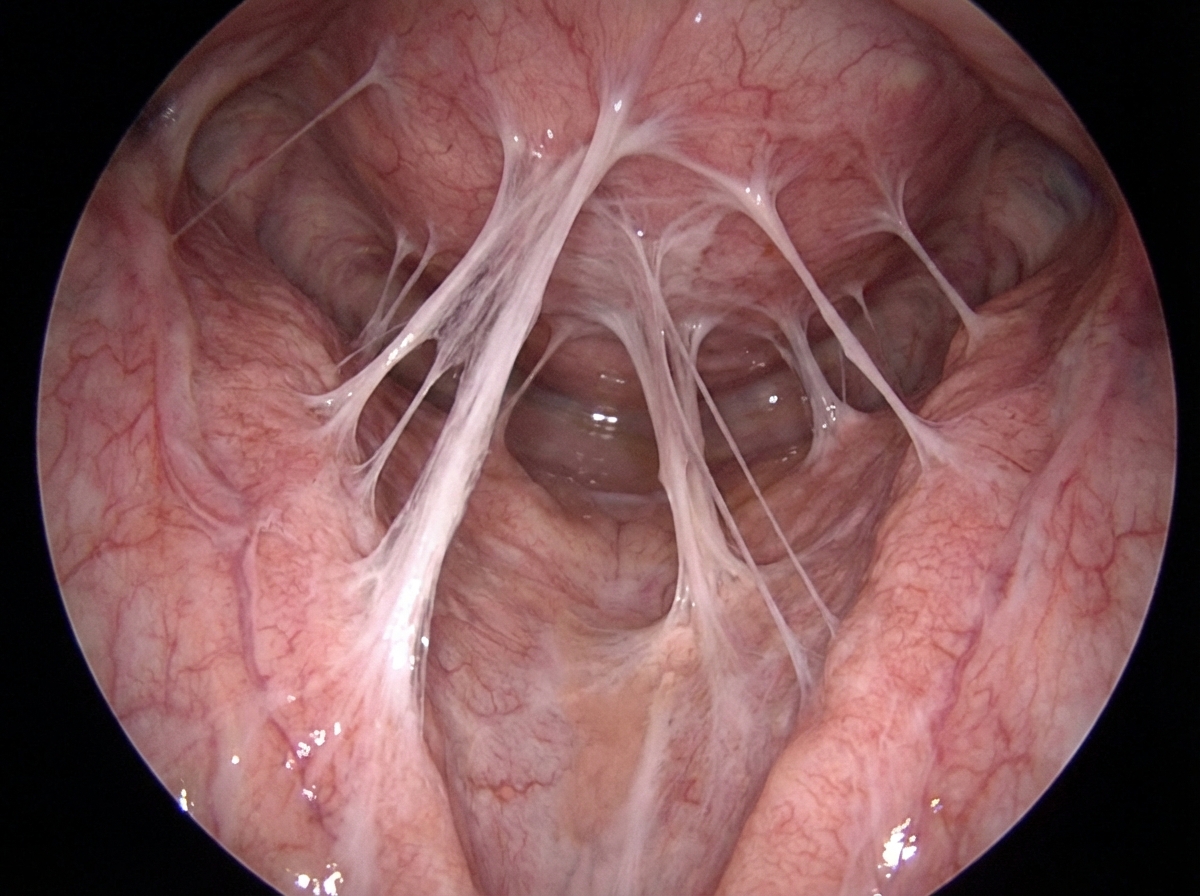
A 28-year-old woman and her husband are admitted to the office due to difficulties conceiving a child for the past year. Her menarche was at the age of 15 years, and her periods have been regular since then. Her medical history is positive for an abortion with curettage 5 years ago. A spermogram on the partner is performed, and it shows motile sperm cells. An ultrasound is performed on the patient and it is unremarkable. The laboratory results show that the FSH, LH, TSH, and prolactin levels are within normal ranges. A hysteroscopy is additionally performed and multiple adhesions are found in the uterus (refer to the image). Which of the following is the most likely composition of the scar tissue present in the uterus?
A 59-year-old woman comes to the physician because of a 1-year history of pain and stiffness in her fingers and knees. The stiffness lasts for about 10 minutes after she wakes up in the morning. She also reports that her knee pain is worse in the evening. She drinks one glass of wine daily. Her only medication is acetaminophen. She is 175 cm (5 ft 9 in) tall and weighs 102 kg (225 lb); BMI is 33 kg/m2. Physical examination shows firm nodules on the distal interphalangeal joints of the index, ring, and little fingers of both hands. Which of the following is the most likely diagnosis?
A 5-year-old girl accompanied by her mother presents to the emergency department after suffering a fall on the elementary school playground. Her mother reports that a child on the playground pushed her daughter who fell on her right side, after which she screamed and was found clutching her right leg. The girl's past medical history is significant for a fracture of the left femur and right radius over the past 2 years and an auditory deficit requiring hearing aid use starting 6 months ago. Inspection reveals a relatively short girl in moderate distress. She has brown opalescent teeth. She refuses to bear weight on her right lower extremity. Radiography of the right lower extremity reveals a femoral midshaft fracture. Which of the following is the most likely etiology of the patient's condition?
A 35-year-old man comes to the physician for evaluation of a neck mass and hoarseness. He has no history of major medical illness. Physical examination shows a 2.5-cm fixed, irregular thyroid nodule. His serum calcitonin concentration is elevated. The nodule is most likely comprised of cells that are embryologically derived from which of the following structures?
Collagen is a very critical structural protein in many of our connective tissues. Defects in collagen produce diseases such as Ehlers-Danlos syndrome, where there is a defective lysyl hydroxylase gene, or osteogenesis imperfecta, where there is a defect in the production of type I collagen. Which of the following represents the basic repeating tripeptide of collagen?
An 11-year-old girl presents to her primary care physician because she has been having difficulty hearing her teachers at school. She says that the difficulty hearing started about a year ago, and it has slowly been getting worse. Her past medical history is significant for multiple fractures in both her upper and lower extremities. She also recently had a growth spurt and says that her friends say she is tall and lanky. A mutation in which of the following genes is most likely associated with this patient's condition?
In which of the following pathological states would the oxygen content of the trachea resemble the oxygen content in the affected alveoli?
An investigator is studying the structural integrity of collagen. Human fibroblasts are cultured on a medium and different enzymes are applied. One of the cultures is supplemented with an enzyme that inhibits lysyl oxidase, preventing the formation of covalent cross-links between collagen α-chains. Which of the following processes is most likely to be impaired as a result?
An MRI of a patient with low back pain reveals compression of the L5 nerve root. Which of the following muscles would most likely show weakness during physical examination?
A 3-month-old infant presents with severe joint hypermobility, skin hyperextensibility, and delayed wound healing. Skin biopsy shows abnormal collagen fibril organization with irregular diameter and reduced tensile strength. Genetic testing reveals a mutation affecting lysyl hydroxylase, an enzyme involved in collagen post-translational modification. The family asks about prognosis and potential complications. Synthesize the biochemical defect with clinical manifestations to determine the most critical pathophysiological mechanism.
Want unlimited practice?
Get full access to all questions, explanations, and performance tracking.
Scan to download app