
Cervical dermatomes and myotomes — MCQs

A 16-year-old boy is brought to the emergency department after being tackled at a football game. Per his mom, he is the quarterback of his team and was head-butted in the left shoulder region by the opposing team. Shortly after, the mother noticed that his left arm was hanging by his torso and his hand was “bent backwards and facing the sky.” The patient denies head trauma, loss of consciousness, sensory changes, or gross bleeding. A physical examination demonstrates weakness in abduction, lateral rotation, flexion, and supination of the left arm and tenderness of the left shoulder region with moderate bruising. Radiograph of the left shoulder and arm is unremarkable. Which of the following is most likely damaged in this patient?
A 53-year-old woman comes to the physician because of a 3-month history of intermittent severe left neck, shoulder, and arm pain and paresthesias of the left hand. The pain radiates to the radial aspect of her left forearm, thumb, and index finger. She first noticed her symptoms after helping a friend set up a canopy tent. There is no family history of serious illness. She appears healthy. Vital signs are within normal limits. When the patient extends and rotates her head to the left and downward pressure is applied, she reports paresthesias along the radial aspect of her left forearm and thumb. There is weakness when extending the left wrist against resistance. The brachioradialis reflex is 1+ on the left and 2+ on the right. The radial pulse is palpable bilaterally. The remainder of the examination shows no abnormalities. Which of the following is the most likely diagnosis?
A 45-year-old man is brought to the emergency department by ambulance after a motor vehicle collision. He is not responsive to verbal commands and is unable to provide any history. His pulse is 108/min and regular. Physical examination shows ecchymoses over the neck and back. Neurological examination indicates damage to the spinal cord at the level shown in the illustration. This patient's injury is most likely located at which of the following levels of the spinal cord?
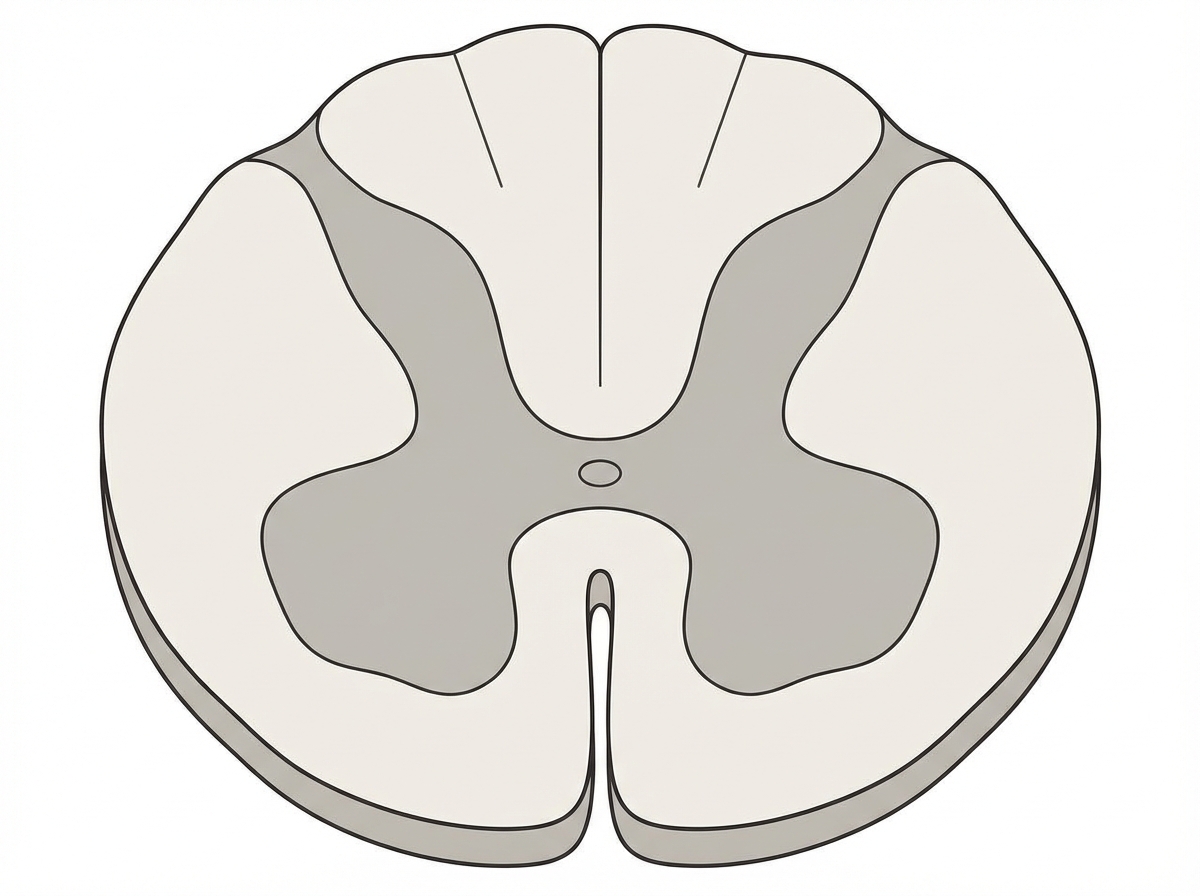
A 52-year-old man comes to the physician because of right shoulder pain that began after he repainted his house 1 week ago. Physical examination shows right subacromial tenderness. The pain is reproduced when the patient is asked to abduct the shoulder against resistance with the arm flexed forward by 30° and the thumb pointing downwards. The tendon of which of the following muscles is most likely to be injured in this patient?
A 51-year-old woman comes to the physician because of progressively worsening lower back pain. The pain radiates down the right leg to the lateral side of the foot. She has had no trauma, urinary incontinence, or fever. An MRI of the lumbar spine shows disc degeneration and herniation at the level of L5–S1. Which of the following is the most likely finding on physical examination?
A 40-year-old male presents to the physician's office complaining of an inability to push doors open. He has had this problem since he was playing football with his children and was tackled underneath his right arm on his lateral chest. On examination, he has a winged scapula on the right side. Which of the following nerves is most likely the cause of this presentation?
A 65-year-old female with a past medical history of hypertension presents to her primary care doctor with a 3 month history of spasmodic facial pain. The pain is located in her right cheek and seems to be triggered when she smiles, chews, or brushes her teeth. The pain is sharp and excruciating, lasts for a few seconds, and occurs up to twenty times per day. She denies headaches, blurry vision, facial weakness, or changes in her memory. She feels rather debilitated and has modified much of her daily activities to avoid triggering the spasms. In the clinic, her physical exam is within normal limits. Her primary care doctor prescribes carbamazepine and asks her to follow up in a few weeks. Which cranial nerve is most likely involved in the patient's disease process?
An 18-year-old man comes to the clinic with his mom for “pins and needles” of both of his arms. He denies any past medical history besides a recent anterior cruciate ligament (ACL) tear that was repaired 1 week ago. The patient reports that the paresthesias are mostly located along the posterior forearms, left more than the right. What physical examination finding would you expect from this patient?
A 59-year-old woman presents to the emergency room with severe low back pain. She reports pain radiating down her left leg into her left foot. She also reports intermittent severe lower back spasms. The pain started after lifting multiple heavy boxes at her work as a grocery store clerk. She denies bowel or bladder dysfunction. Her past medical history is notable for osteoporosis and endometrial cancer. She underwent a hysterectomy 20 years earlier. She takes alendronate. Her temperature is 99°F (37.2°C), blood pressure is 135/85 mmHg, pulse is 85/min, and respirations are 22/min. Her BMI is 21 kg/m^2. On exam, she is unable to bend over due to pain. Her movements are slowed to prevent exacerbating her muscle spasms. A straight leg raise elicits severe radiating pain into her left lower extremity. The patient reports that the pain is worst along the posterior thigh and posterolateral leg into the fourth and fifth toes. Palpation along the lumbar vertebral spines demonstrates mild tenderness. Patellar reflexes are 2+ bilaterally. The Achilles reflex is decreased on the left. Which nerve root is most likely affected in this patient?
A 35-year-old woman, gravida 2, para 1, at 40 weeks' gestation, presents to the hospital with contractions spaced 2 minutes apart. Her past medical history is significant for diabetes, which she has controlled with insulin during this pregnancy. Her pregnancy has otherwise been unremarkable. A baby boy is born via a spontaneous vaginal delivery. Physical examination shows he weighs 4.5 kg (9 lb), the pulse is 140/min, the respirations are 40/min, and he has good oxygen saturation on room air. His left arm is pronated and medially rotated. He is unable to move it away from his body. The infant’s right arm functions normally and he is able to move his wrists and all 10 digits. Which of the following nerve roots were most likely damaged during delivery?
Want unlimited practice?
Get full access to all questions, explanations, and performance tracking.
Scan to download app