
Upper abdominal cross-sections — MCQs

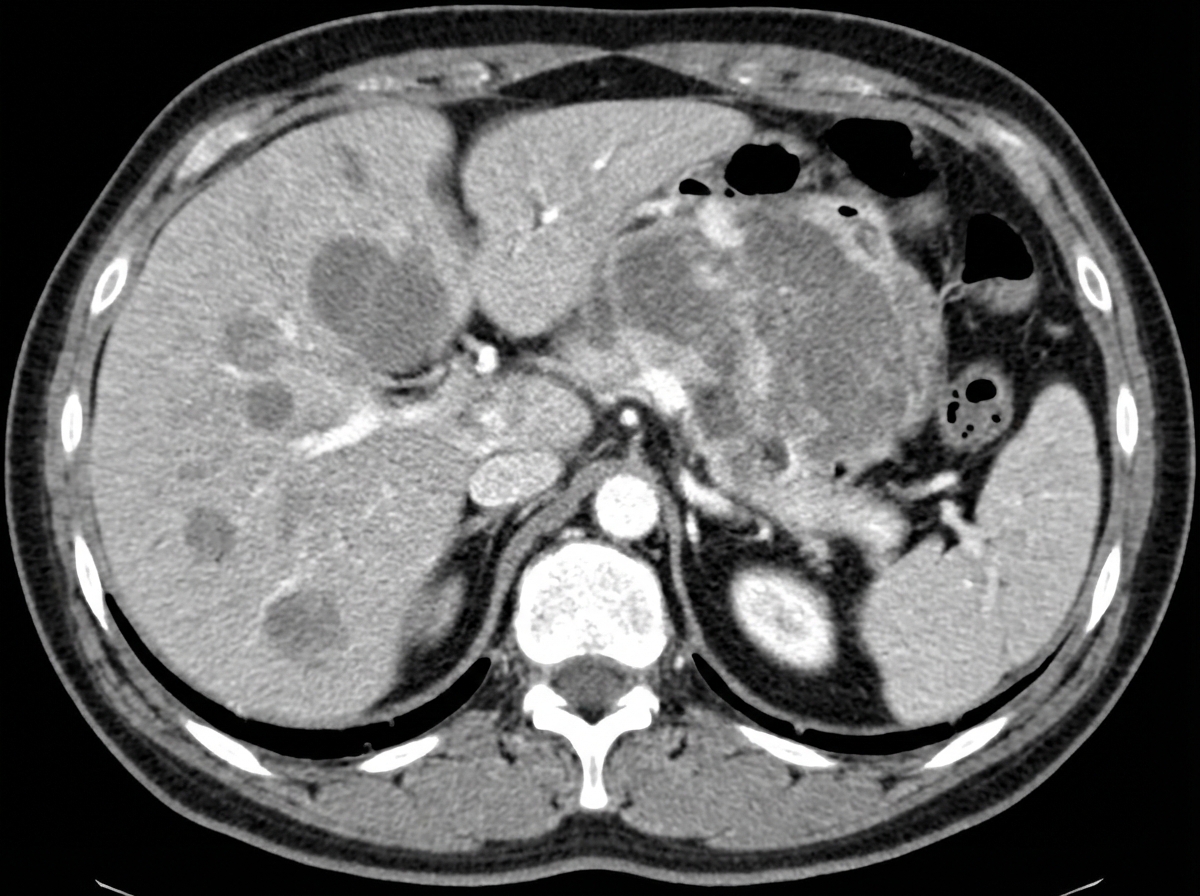
A 40-year-old man presents with severe fatigue, dyspnea on exertion, and weight loss. He reports a weight loss of 15 kg (33.0 lb) over the past 3 months and feels full almost immediately after starting to eat, often feeling nauseous and occasionally vomiting. Past medical history is not significant. However, the patient reports a 10-pack-year smoking history. His temperature is 37.0°C (98.6°F), respiratory rate is 15/min, pulse is 67/min, and blood pressure is 122/98 mm Hg. Physical examination reveals paleness and conjunctival pallor. Abdominal examination reveals an ill-defined nontender mass in the epigastric region along with significant hepatomegaly. Routine laboratory studies show a hemoglobin level of 7.2 g/dL. A contrast CT scan of the abdomen is presented below. Which of the following structures is most helpful in the anatomical classification of gastrointestinal bleeding in this patient?
A 32-year-old man presents to his primary care physician complaining of pain accompanied by a feeling of heaviness in his scrotum. He is otherwise healthy except for a broken arm he obtained while skiing several years ago. Physical exam reveals an enlarged “bag of worms” upon palpation of the painful scrotal region. Shining a light over this area shows that the scrotum does not transilluminate. Which of the following statements is true about the most likely cause of this patient's symptoms?
A 53-year-old woman presents to the office complaining of an extreme, nonradiating stabbing pain in the epigastric region after having a meal. She states that it has happened several times in the past week approximately 30 minutes after eating and spontaneously resolves. A day before, the patient went to urgent care with the same complaint, but the abdominal X-ray was normal. Surgical history is remarkable for a total knee arthroplasty procedure 6 months ago. She has lost 34 kg (75 lb) since the operation because of lifestyle changes. The vital signs are normal. Laparoscopic surgical scars are well healed. Endoscopy shows benign mucosa to the proximal duodenum. A barium swallow study reveals an extremely narrowed duodenum. Which of the following structures is most likely responsible for this patient’s current symptoms?
A researcher is investigating the blood supply of the adrenal gland. While performing an autopsy on a patient who died from unrelated causes, he identifies a vessel that supplies oxygenated blood to the inferior aspect of the right adrenal gland. Which of the following vessels most likely gave rise to the vessel in question?
A 28-year-old male presents to his primary care physician with complaints of intermittent abdominal pain and alternating bouts of constipation and diarrhea. His medical chart is not significant for any past medical problems or prior surgeries. He is not prescribed any current medications. Which of the following questions would be the most useful next question in eliciting further history from this patient?
A 51-year-old homeless man presents to the emergency department with severe abdominal pain and cramping for the past 3 hours. He endorses radiation to his back. He adds that he vomited multiple times. He admits having been hospitalized repeatedly for alcohol intoxication and abdominal pain. His temperature is 103.8° F (39.8° C), respiratory rate is 15/min, pulse is 107/min, and blood pressure is 100/80 mm Hg. He refuses a physical examination due to severe pain. Blood work reveals the following: Serum: Albumin: 3.2 gm/dL Alkaline phosphatase: 150 U/L Alanine aminotransferase: 76 U/L Aspartate aminotransferase: 155 U/L Gamma-glutamyl transpeptidase: 202 U/L Lipase: 800 U/L What is the most likely diagnosis of this patient?
A 30-year-old man comes to the physician because of an episode of bloody vomiting this morning and a 1-week history of burning upper abdominal pain. Two weeks ago, he sustained a head injury and was in a coma for 3 days. An endoscopy shows multiple, shallow hemorrhagic lesions predominantly in the gastric fundus and greater curvature. Biopsies show patchy loss of epithelium and an acute inflammatory infiltrate in the lamina propria that does not extend beyond the muscularis mucosa. Which of the following is the most likely diagnosis?
A 22-year-old Caucasian male is stabbed in his left flank, injuring his left kidney. As the surgeon undertakes operative repair, she reviews relevant renal anatomy. All of the following are correct regarding the left kidney EXCEPT?
A 45-year-old male is brought to the emergency department by emergency medical services after sustaining a gunshot wound to the abdomen. He is unresponsive. His temperature is 99.0°F (37.2°C), blood pressure is 95/58 mmHg, pulse is 115/min, and respirations are 20/min. Physical examination reveals an entry wound in the left abdominal quadrant just inferior to the left lateral costal border. Abdominal CT shows the bullet trajectory through the left abdominal cavity. Which of the following structures has the bullet most likely penetrated?
A 55-year-old man comes to the physician because of a 3-week history of intermittent burning epigastric pain. His pain improves with antacid use and eating but returns approximately 2 hours following meals. He has a history of chronic osteoarthritis and takes ibuprofen daily. Upper endoscopy shows a deep ulcer located on the posterior wall of the duodenal bulb. This ulcer is most likely to erode into which of the following structures?
Want unlimited practice?
Get full access to all questions, explanations, and performance tracking.
Scan to download app