
Principles of cross-sectional imaging — MCQs

A 57-year-old man presents to his family physician for a routine exam. He feels well and reports no new complaints since his visit last year. Last year, he had a colonoscopy which showed no polyps, a low dose chest computerized tomography (CT) scan that showed no masses, and routine labs which showed a fasting glucose of 93 mg/dL. He is relatively sedentary and has a body mass index (BMI) of 24 kg/m^2. He has a history of using methamphetamines, alcohol (4-5 drinks per day since age 30), and tobacco (1 pack per day since age 18), but he joined Alcoholics Anonymous and has been in recovery, not using any of these for the past 7 years. Which of the following is indicated at this time?
During a surgical procedure to repair an abdominal aortic aneurysm, the surgeon must be careful to avoid injury to which of the following arterial structures that originates near the level of the renal vessels?
A 36-year-old male is taken to the emergency room after jumping from a building. Bilateral fractures to the femur were stabilized at the scene by emergency medical technicians. The patient is lucid upon questioning and his vitals are stable. Pain only at his hips was elicited. Cervical exam was not performed. What is the best imaging study for this patient?
A 65-year-old Caucasian man visits the nephrology outpatient clinic for a follow-up appointment. He was previously diagnosed with stage G3a chronic kidney disease (CKD) and albuminuria stage A2. He follows strict dietary recommendations and takes enalapril. He has a history of benign prostatic hyperplasia which has been complicated by urinary tract obstruction. His vitals are stable, and his blood pressure is within the recommended limits. His most recent laboratory studies are as follows: Serum sodium 140 mEq/L Serum potassium 5.8 mEq/L Serum chloride 102 mEq/L Serum phosphate 4.0 mg/dL Hemoglobin 11.5 mg/dL Albumin excretion rate (AER) 280 mg/day Which of the following is the best strategy in the management of this patient?
A patient undergoes spinal surgery at the L4-L5 level. During the procedure, which of the following ligaments must be divided first to access the spinal canal?
A cardiologist is studying how a new virus that infects the heart affects the electrical conduction system of the cardiac myocytes. He decides to obtain electrocardiograms on patients with this disease in order to see how the wave patterns and durations change over time. While studying these records, he asks a medical student who is working with him to interpret the traces. Specifically, he asks her to identify the part that represents initial ventricular depolarization. Which of the following characteristics is most consistent with this feature of the electrocardiogram?
An investigator is studying the relationship between fetal blood oxygen saturation and intrauterine growth restriction using MRI studies. The magnetic resonance transverse relaxation time (T2) is inversely related to the concentration of deoxyhemoglobin so that high concentrations of deoxyhemoglobin produce a low signal intensity on T2-weighted MRI. In a normal fetus, the T2 signal is most likely to be the highest in which of the following vessels?
A CT scan of the abdomen reveals a mass in the pancreatic uncinate process. Which of the following structures is most likely to be compressed by this mass?
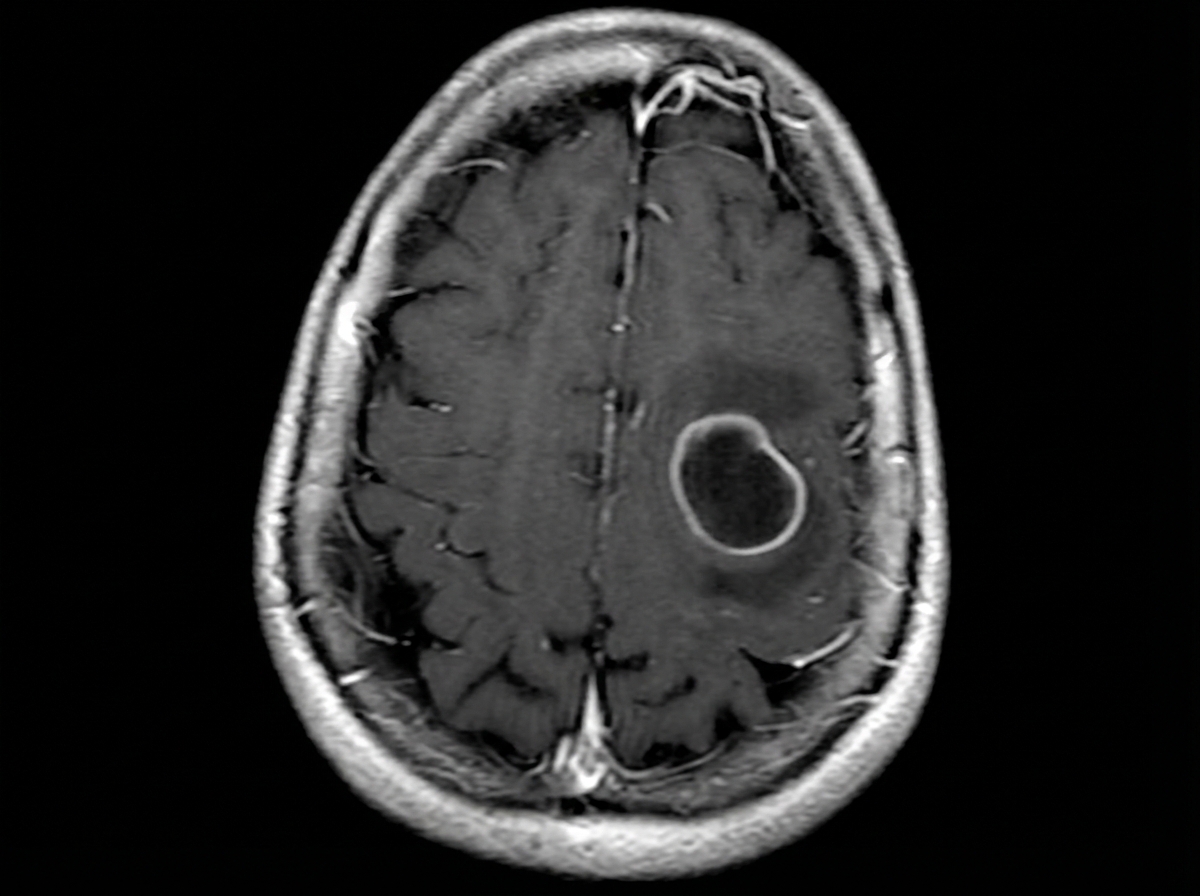
A 61-year-old woman visits the clinic with a complaint of new-onset episodic abnormal body movements. She says her husband noticed it twice in the past week. There were jerky movements for roughly 15 seconds during her last episode. She denies any recent trauma or fever. Her vital signs include: blood pressure 114/74 mm Hg, pulse 81/min, temperature 36.7°C (98.1°F) and respiratory rate 10/min. On physical examination, there is no evidence of focal neurological deficits. A basic metabolic panel is ordered which shows: Sodium 141 mEq/L Potassium 5.1 mEq/L Chloride 101 mEq/L Bicarbonate 24 mEq/L Albumin 4.3 mg/dL Urea nitrogen 11 mg/dL Creatinine 1.0 mg/dL Uric Acid 6.8 mg/dL Calcium 8.9 mg/dL Glucose 111 mg/dL A contrast magnetic resonance imaging (MRI) of the head is shown in the provided image. Which of the following cells is the origin of the lesion seen in this patient’s MRI?
A 34-year-old woman presents to her primary care provider after intermittently passing bright pink urine over several days. She is concerned this discoloration is due to blood. Her medical history is unremarkable, she denies being sick in the past weeks and has only taken a couple of diclofenac capsules for pelvic pain associated to her menstrual period. She does not drink alcohol or smoke cigarettes. At the doctor’s office, her blood pressure is 150/90 mm Hg, pulse is 80/min, respiratory rate is 18/min, and temperature is 36.5°C (97.7°F). On physical exam, she has 2+ pitting edema up to her knees. A urinalysis is taken which shows red blood cells, red blood cell casts, and acanthocytes. No proteinuria was detected. Her serum creatinine is 2.4 mg/dL, blood urea nitrogen 42 mg/dL, serum potassium 4.8 mEq/L, serum sodium 140 mEq/L, serum chloride 102 mEq/L. Which of the following is the most appropriate next step in the management of this case?
Want unlimited practice?
Get full access to all questions, explanations, and performance tracking.
Scan to download app