A 46-year-old man comes to the physician because of a 2-month history of hoarseness and drooling. Initially, he had difficulty swallowing solid food, but now he has difficulty swallowing foods like oatmeal as well. During this period, he also developed weakness in both arms and has had an 8.2 kg (18 lb) weight loss. He appears ill. His vital signs are within normal limits. Examination shows tongue atrophy and pooled oral secretions. There is diffuse muscle atrophy in all extremities. Deep tendon reflexes are 3+ in all extremities. Sensation to pinprick, light touch, and vibration is intact. An esophagogastroduodenoscopy shows no abnormalities. Which of the following is the most likely cause of this patient's symptoms?
Q12
A 45-year-old woman comes to the physician’s office with complaints of clumsiness. She feels like she is tripping over her feet more often, and she recently fell and sprained her wrist. Her medical history is significant for well-controlled diabetes. She has been a strict vegan for over 20 years. She lives at home with her husband and two children. On exam, she appears well-nourished. She has diminished proprioception and vibration sense in both her feet. She has a positive Romberg sign. She has diminished Achilles reflexes bilaterally. Which of the following tracts are most likely damaged in this patient?
Q13
A 34-year-old man presents to the emergency department with leg weakness that significantly impairs and slows down his walking ability. He has noticed that he has been getting progressively weaker over the past 3 months. He has also experienced spontaneous twitching in his arms and thighs that is becoming more frequent. On physical examination, moderate atrophy of his arm and thigh muscles is observed. Significant thenar atrophy is noted bilaterally, and deep tendon reflexes are increased. His lower limbs have resistance to movement and feel rigid. Pupillary light and accommodation reflexes are both normal. The patient can maintain his balance upon closing his eyes. Considering this case presentation, which of the following is the likely site of the lesion?
Q14
A 39-year-old woman is brought to the emergency department following a stab wound to the neck. Per the patient, she was walking her dog when she got robbed and was subsequently stabbed with a knife. Vitals are stable. Strength examination reveals 2/5 right-sided elbow flexion and extension, wrist extension, and finger motions. Babinski sign is upward-going on the right. There is decreased sensation to light touch and vibration on the patient's right side up to her shoulder. She also reports decreased sensation to pinprick and temperature on her left side, including her lower extremities, posterior forearm, and middle finger. The patient's right pupil is 2 mm smaller than the left with drooping of the right upper eyelid. Which of the following is the most likely cause of the patient’s presentation?
Q15
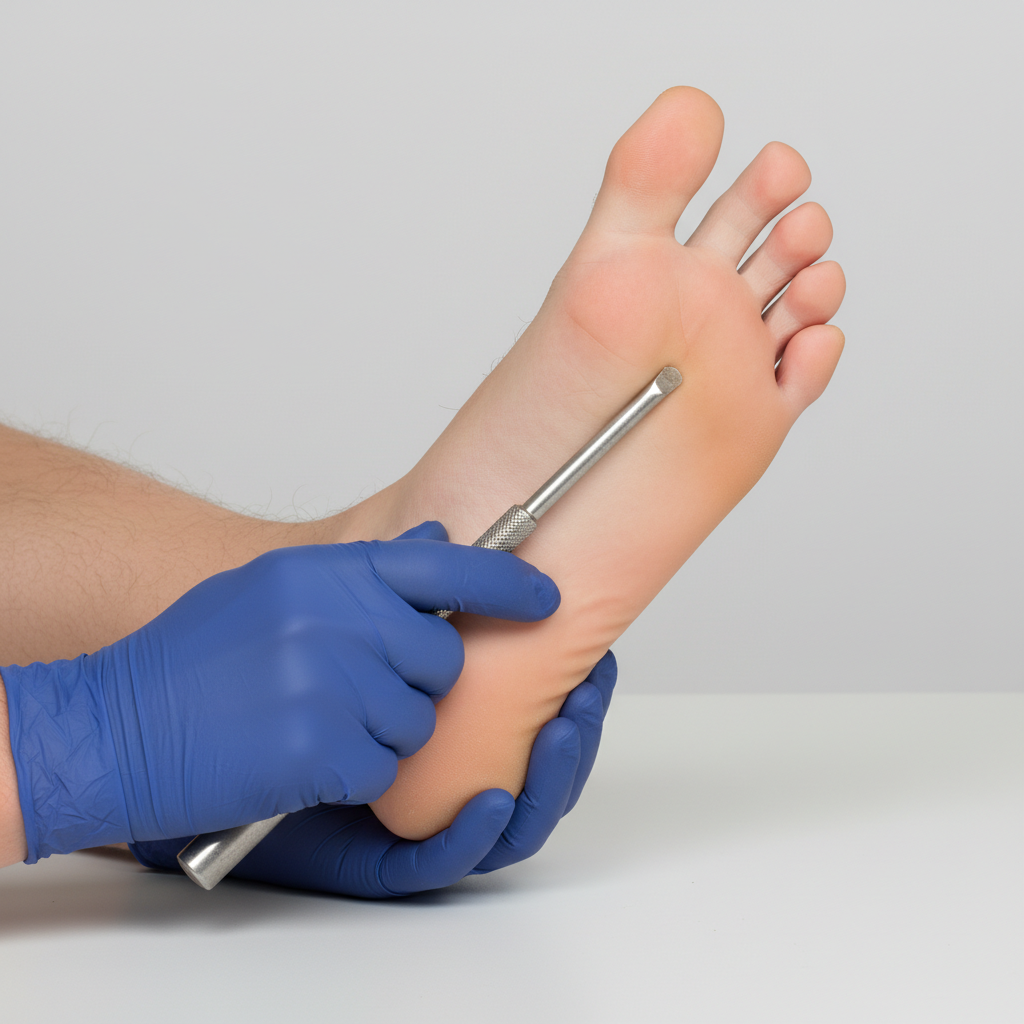
You are seeing a patient in clinic who presents with complaints of weakness. Her physical exam is notable for right sided hyperreflexia, as well as the reflex finding shown in the image below. Where is the most likely location of this patient's lesion?
Q16
A 61-year-old man is brought to the emergency department because of increasing weakness of his right arm and leg that began when he woke up that morning. He did not notice any weakness when he went to bed the night before. He has hypertension and hypercholesterolemia. Current medications include hydrochlorothiazide and atorvastatin. He is alert and oriented to person, time, place. His temperature is 36.7°C (98°F), pulse is 91/min, and blood pressure is 132/84 mm Hg. Examination shows drooping of the right side of the face. Muscle strength is decreased in the right upper and lower extremities. Deep tendon reflexes are 4+ on the right side. Sensation is intact. His speech is normal in rate and rhythm. The remainder of the examination shows no abnormalities. An infarction of which of the following sites is the most likely cause of this patient's symptoms?
Q17
A 61-year-old man is brought to the emergency department by his son after collapsing to the ground while at home. His son immediately performed cardiopulmonary resuscitation and later the patient underwent successful defibrillation after being evaluated by the emergency medical technician. The patient has a medical history of hypertension, hyperlipidemia, and type II diabetes mellitus. He has smoked one-half pack of cigarettes for approximately 30 years. The patient was admitted to the cardiac intensive care unit, and after a few days developed acute onset right upper extremity weakness. His temperature is 99°F (37.2°C), blood pressure is 145/91 mmHg, pulse is 102/min and irregularly irregular, and respirations are 16/min. On physical examination, the patient is alert and orientated to person, place, and time. His language is fluent and he is able to name, repeat, and read. His strength is 5/5 throughout except in the right hand, wrist, and arm, which is 2/5. Based on this patient's clinical presentation, the affected neuronal fibers decussate at which level of the central nervous system?
Corticospinal tracts US Medical PG Practice Questions and MCQs
Question 11: A 46-year-old man comes to the physician because of a 2-month history of hoarseness and drooling. Initially, he had difficulty swallowing solid food, but now he has difficulty swallowing foods like oatmeal as well. During this period, he also developed weakness in both arms and has had an 8.2 kg (18 lb) weight loss. He appears ill. His vital signs are within normal limits. Examination shows tongue atrophy and pooled oral secretions. There is diffuse muscle atrophy in all extremities. Deep tendon reflexes are 3+ in all extremities. Sensation to pinprick, light touch, and vibration is intact. An esophagogastroduodenoscopy shows no abnormalities. Which of the following is the most likely cause of this patient's symptoms?
A. Destruction of upper and lower motor neurons (Correct Answer)
B. Autoimmune destruction of acetylcholine receptors
C. Multiple cerebral infarctions
D. Dilation of the central spinal canal
E. Demyelination of peripheral nerves
Explanation: ***Destruction of upper and lower motor neurons***
- This patient's presentation with **hoarseness, drooling, dysphagia, diffuse muscle atrophy**, and **hyperreflexia (3+ deep tendon reflexes)** points to both **upper motor neuron (UMN)** and **lower motor neuron (LMN)** signs.
- The combination of UMN and LMN involvement, particularly bulbar symptoms (hoarseness, drooling, dysphagia), diffuse muscle atrophy, and progressive weakness, is highly characteristic of **amyotrophic lateral sclerosis (ALS)**, which involves the progressive destruction of UMNs and LMNs.
*Autoimmune destruction of acetylcholine receptors*
- This describes **myasthenia gravis**, which typically presents with **fluctuating muscle weakness** that worsens with activity and improves with rest.
- While it can cause dysphagia and hoarseness, it usually spares deep tendon reflexes, and diffuse muscle atrophy is not a primary feature, nor are UMN signs like hyperreflexia.
*Multiple cerebral infarctions*
- Multiple cerebral infarctions, or **multi-infarct dementia**, can cause various neurological deficits depending on their location, but they rarely present with a diffuse, progressive picture of both UMN and LMN signs.
- The patient's symptoms are more consistent with a **neurodegenerative disease** rather than acute or subacute vascular events affecting widespread motor pathways in this specific, combined fashion.
*Dilation of the central spinal canal*
- This refers to **syringomyelia**, which typically causes **cape-like sensory loss** (loss of pain and temperature sensation across the shoulders and arms) due to damage to the spinothalamic tracts, often with **LMN weakness** in the upper extremities.
- It would not explain the prominent UMN signs (hyperreflexia), diffuse muscle atrophy in all extremities, or bulbar symptoms like hoarseness and drooling.
*Demyelination of peripheral nerves*
- This is characteristic of **peripheral neuropathies** such as **Guillain-Barré syndrome** or chronic inflammatory demyelinating polyneuropathy (CIDP).
- These conditions primarily cause **LMN signs** like **flaccid paralysis**, **hyporeflexia or areflexia**, and sensory loss, which is inconsistent with the prominent hyperreflexia seen in this patient.
Question 12: A 45-year-old woman comes to the physician’s office with complaints of clumsiness. She feels like she is tripping over her feet more often, and she recently fell and sprained her wrist. Her medical history is significant for well-controlled diabetes. She has been a strict vegan for over 20 years. She lives at home with her husband and two children. On exam, she appears well-nourished. She has diminished proprioception and vibration sense in both her feet. She has a positive Romberg sign. She has diminished Achilles reflexes bilaterally. Which of the following tracts are most likely damaged in this patient?
A. Fasciculus gracilis (Correct Answer)
B. Vestibulospinal
C. Rubrospinal
D. Anterior spinothalamic tract
E. Fasciculus cuneatus
Explanation: ***Fasciculus gracilis***
- The patient's symptoms of **clumsiness**, **diminished proprioception**, **vibration sense**, and a **positive Romberg sign** all point to a deficit in **dorsal column function**.
- The **fasciculus gracilis** carries sensory information (proprioception, vibration, fine touch) from the **lower limbs** and lower trunk, which aligns with her symptoms predominantly affecting her feet.
*Vestibulospinal*
- The **vestibulospinal tract** is involved in maintaining **postural balance** and head position by influencing antigravity muscles, but its damage typically presents with more pronounced gait ataxia and vertigo rather than the specific sensory deficits seen here.
- While balance is affected, the primary sensory loss points away from a sole vestibulospinal issue.
*Rubrospinal*
- The **rubrospinal tract** plays a role in **motor control**, particularly of the upper limbs, involved in fine motor skills and muscle tone.
- Damage would primarily result in motor deficits, such as **flexor muscle spasticity**, not the sensory complaints described.
*Anterior spinothalamic tract*
- The **anterior spinothalamic tract** transmits crude touch and pressure sensation.
- Damage to this tract would lead to deficits in **crude touch** rather than the fine proprioception and vibration sense observed.
*Fasciculus cuneatus*
- The **fasciculus cuneatus** carries sensory information (proprioception, vibration, fine touch) from the **upper limbs** and upper trunk.
- While it is part of the dorsal column system, the patient's symptoms are primarily in her feet and lower limbs, making fasciculus gracilis the more likely affected tract.
Question 13: A 34-year-old man presents to the emergency department with leg weakness that significantly impairs and slows down his walking ability. He has noticed that he has been getting progressively weaker over the past 3 months. He has also experienced spontaneous twitching in his arms and thighs that is becoming more frequent. On physical examination, moderate atrophy of his arm and thigh muscles is observed. Significant thenar atrophy is noted bilaterally, and deep tendon reflexes are increased. His lower limbs have resistance to movement and feel rigid. Pupillary light and accommodation reflexes are both normal. The patient can maintain his balance upon closing his eyes. Considering this case presentation, which of the following is the likely site of the lesion?
A. Ventral horn (Correct Answer)
B. Fasciculus gracilis
C. Ventral posterolateral nucleus of thalamus
D. Medullary lateral fasciculus
E. Nucleus of Onuf
Explanation: ***Ventral horn***
- The combination of **muscle weakness**, **twitching (fasciculations)**, **atrophy**, and **increased deep tendon reflexes** points to involvement of both **upper motor neurons** (increased reflexes, rigidity) and **lower motor neurons** (weakness, atrophy, fasciculations), which is characteristic of diseases affecting the ventral horn, such as **amyotrophic lateral sclerosis (ALS)**.
- The **ventral horn** contains the cell bodies of lower motor neurons, and their degeneration leads to **flaccid paralysis**, **atrophy**, and **fasciculations**, while damage to neighboring upper motor neuron tracts (e.g., corticospinal tracts) causes **spasticity** and **hyperreflexia**.
*Fasciculus gracilis*
- The **fasciculus gracilis** is part of the **dorsal column-medial lemniscus pathway**, responsible for **fine touch**, **vibration**, and **proprioception** from the lower body.
- Damage to this tract would primarily manifest as **sensory deficits** (e.g., loss of proprioception, positive Romberg's sign), which are not observed in this patient.
*Ventral posterolateral nucleus of thalamus*
- The **ventral posterolateral (VPL) nucleus of the thalamus** is a relay station for **sensory information** from the body to the cerebral cortex.
- Lesions here would result in **contralateral sensory loss** (pain, temperature, touch, proprioception), not motor symptoms.
*Medullary lateral fasciculus*
- The term "medullary lateral fasciculus" is vague; if referring to the **lateral corticospinal tract** in the medulla, its damage would cause **upper motor neuron signs** (spasticity, hyperreflexia, weakness) but not the prominent **lower motor neuron signs** (atrophy, fasciculations) seen in this patient.
- If referring to other tracts in the lateral medulla (e.g., spinothalamic), the symptoms would be primarily sensory or involve other cranial nerves/autonomic functions.
*Nucleus of Onuf*
- The **nucleus of Onuf** is a motor nucleus in the **sacral spinal cord** that innervates the **external anal and urethral sphincters**.
- A lesion here would primarily cause **bladder and bowel incontinence** and sexual dysfunction, not widespread limb weakness, atrophy, and fasciculations.
Question 14: A 39-year-old woman is brought to the emergency department following a stab wound to the neck. Per the patient, she was walking her dog when she got robbed and was subsequently stabbed with a knife. Vitals are stable. Strength examination reveals 2/5 right-sided elbow flexion and extension, wrist extension, and finger motions. Babinski sign is upward-going on the right. There is decreased sensation to light touch and vibration on the patient's right side up to her shoulder. She also reports decreased sensation to pinprick and temperature on her left side, including her lower extremities, posterior forearm, and middle finger. The patient's right pupil is 2 mm smaller than the left with drooping of the right upper eyelid. Which of the following is the most likely cause of the patient’s presentation?
A. Hemisection injury (Correct Answer)
B. Syringomyelia
C. Anterior cord syndrome
D. Posterior cord syndrome
E. Central cord syndrome
Explanation: ***Hemisection injury***
- The combination of **ipsilateral motor weakness** and **dorsal column deficits** (vibration, light touch) along with **contralateral loss of pain and temperature sensation** (spinothalamic tract) is the hallmark of a Brown-Séquard syndrome, which results from a hemisection injury to the spinal cord.
- The presence of **ipsilateral Horner's syndrome** (miosis and ptosis) indicates sympathetic nerve damage, further localizing the injury to the cervical spinal cord and supporting a hemisection.
*Syringomyelia*
- This condition is characterized by a **cavity (syrinx)** within the spinal cord, typically leading to a **cape-like distribution of pain and temperature loss** due to damage to the decussating spinothalamic fibers.
- It usually spares the dorsal columns and motor tracts in early stages, which contradicts the described ipsilateral motor and dorsal column deficits.
*Anterior cord syndrome*
- Results from damage to the **anterior spinal artery**, leading to **bilateral loss of motor function** (corticospinal tracts) and **pain/temperature sensation** (spinothalamic tracts) below the level of injury.
- **Proprioception and vibration sensation** (dorsal columns) are typically preserved in this syndrome, which is inconsistent with the patient's presentation.
*Posterior cord syndrome*
- Involves damage primarily to the **dorsal columns**, resulting in **loss of proprioception, vibration, and light touch** below the level of injury.
- **Motor function, pain, and temperature sensation** are generally preserved, which is not consistent with the motor deficits and contralateral pain/temperature loss described.
*Central cord syndrome*
- Most commonly seen after **hyperextension injuries**, leading to greater **motor weakness in the upper extremities** than the lower extremities.
- It typically causes varying degrees of **sensory loss** and can preserve sacral sensation, but the specific pattern of ipsilateral motor/dorsal column deficits and contralateral spinothalamic loss is not characteristic of central cord syndrome.
Question 15: You are seeing a patient in clinic who presents with complaints of weakness. Her physical exam is notable for right sided hyperreflexia, as well as the reflex finding shown in the image below. Where is the most likely location of this patient's lesion?
A. Postcentral gyrus
B. Neuromuscular junction
C. Lateral geniculate nucleus
D. Internal capsule (Correct Answer)
E. Subthalamic nucleus
Explanation: ***Internal capsule***
- The combination of **right-sided hyperreflexia** (an upper motor neuron sign) and a positive **Babinski sign** (as implied by a video demonstrating this reflex) points to an upper motor neuron lesion.
- The **internal capsule** contains descending motor pathways, and a lesion here would affect the contralateral side of the body, causing **weakness** and upper motor neuron signs.
*Postcentral gyrus*
- The **postcentral gyrus** is the primary somatosensory cortex and primarily deals with sensory processing, not motor output.
- A lesion here would typically cause **contralateral sensory deficits**, such as numbness or loss of proprioception, rather than motor weakness with hyperreflexia.
*Neuromuscular junction*
- Diseases of the **neuromuscular junction**, such as myasthenia gravis, cause **fatigable weakness** without hyperreflexia or other upper motor neuron signs.
- Reflexes are typically normal or decreased in these conditions.
*Lateral geniculate nucleus*
- The **lateral geniculate nucleus** is a thalamic relay center for visual information.
- Lesions here would result in **visual field deficits** (e.g., homonymous hemianopsia), not motor weakness or hyperreflexia.
*Subthalamic nucleus*
- The **subthalamic nucleus** is part of the basal ganglia and is involved in motor control, particularly in regulating movement initiation and stopping.
- Lesions here are classically associated with **hemiballismus**, which is characterized by wild, flinging movements, rather than weakness and hyperreflexia.
Question 16: A 61-year-old man is brought to the emergency department because of increasing weakness of his right arm and leg that began when he woke up that morning. He did not notice any weakness when he went to bed the night before. He has hypertension and hypercholesterolemia. Current medications include hydrochlorothiazide and atorvastatin. He is alert and oriented to person, time, place. His temperature is 36.7°C (98°F), pulse is 91/min, and blood pressure is 132/84 mm Hg. Examination shows drooping of the right side of the face. Muscle strength is decreased in the right upper and lower extremities. Deep tendon reflexes are 4+ on the right side. Sensation is intact. His speech is normal in rate and rhythm. The remainder of the examination shows no abnormalities. An infarction of which of the following sites is the most likely cause of this patient's symptoms?
A. Base of the left pons
B. Left cerebellar vermis
C. Left posterolateral thalamus
D. Posterior limb of the left internal capsule (Correct Answer)
E. Left lateral medulla
Explanation: ***Posterior limb of the left internal capsule***
- The patient presents with sudden onset of **right-sided weakness**, including the face, arm, and leg (hemiparesis), consistent with a **pure motor stroke**.
- The **posterior limb of the internal capsule** contains UMN fibers of the **corticospinal and corticobulbar tracts**, which project to the contralateral side of the body, thus lesions here cause contralateral pure motor deficits.
*Base of the left pons*
- A lesion here would typically cause **contralateral hemiparesis or hemiplegia** (right side in this case).
- However, pontine lesions also often include **cranial nerve palsies** (e.g., abducens or facial nerve) or **ataxia**, which are not described.
*Left cerebellar vermis*
- Damage to the cerebellar vermis primarily results in **truncal ataxia** and disorders of gait and balance.
- It would not cause contralateral hemiparesis or facial droop, as seen in this patient.
*Left posterolateral thalamus*
- An infarct in this area would primarily cause **contralateral sensory deficits**, such as hemianesthesia or dysesthesia.
- While motor deficits can occur, they are typically less prominent than sensory issues and would not be the isolated pure motor syndrome described.
*Left lateral medulla*
- A lesion in the lateral medulla (e.g., Wallenberg syndrome) typically presents with **contralateral pain and temperature loss**, ipsilateral Horner's syndrome, ataxia, and dysphagia.
- It would not manifest as an isolated pure motor hemiparesis.
Question 17: A 61-year-old man is brought to the emergency department by his son after collapsing to the ground while at home. His son immediately performed cardiopulmonary resuscitation and later the patient underwent successful defibrillation after being evaluated by the emergency medical technician. The patient has a medical history of hypertension, hyperlipidemia, and type II diabetes mellitus. He has smoked one-half pack of cigarettes for approximately 30 years. The patient was admitted to the cardiac intensive care unit, and after a few days developed acute onset right upper extremity weakness. His temperature is 99°F (37.2°C), blood pressure is 145/91 mmHg, pulse is 102/min and irregularly irregular, and respirations are 16/min. On physical examination, the patient is alert and orientated to person, place, and time. His language is fluent and he is able to name, repeat, and read. His strength is 5/5 throughout except in the right hand, wrist, and arm, which is 2/5. Based on this patient's clinical presentation, the affected neuronal fibers decussate at which level of the central nervous system?
A. Caudal medulla (Correct Answer)
B. Pons
C. Spinal cord
D. Primary motor cortex
E. Thalamus
Explanation: ***Caudal medulla***
- The patient's **acute right upper extremity weakness** following a cardiac event suggests a **stroke** affecting the left motor pathways.
- The **pyramidal decussation**, where the vast majority of the **corticospinal tracts** cross to the contralateral side, occurs in the **caudal medulla**.
*Pons*
- While the corticospinal tracts pass through the pons, they generally do not decussate at this level.
- Lesions in the pons often present with **ipsilateral cranial nerve** deficits and **contralateral body weakness**.
*Spinal cord*
- Only a small percentage (about 10-15%) of the corticospinal fibers decussate in the spinal cord, and these form the **anterior corticospinal tract**, mainly supplying axial muscles.
- Significant contralateral upper extremity weakness implies a lesion higher up, before the spinal cord.
*Primary motor cortex*
- Lesions in the primary motor cortex would cause contralateral weakness, but the decussation itself occurs in the brainstem, not the cortex.
- The motor cortex is where the motor commands originate, not where they cross over.
*Thalamus*
- The thalamus is a major **sensory relay station** and also plays a role in motor control, but it is not the site of decussation for the corticospinal tracts.
- Thalamic lesions typically cause **sensory deficits** (e.g., contralateral hemianesthesia) and sometimes ataxia or dyskinesias.