
Alternative motor pathways — MCQs

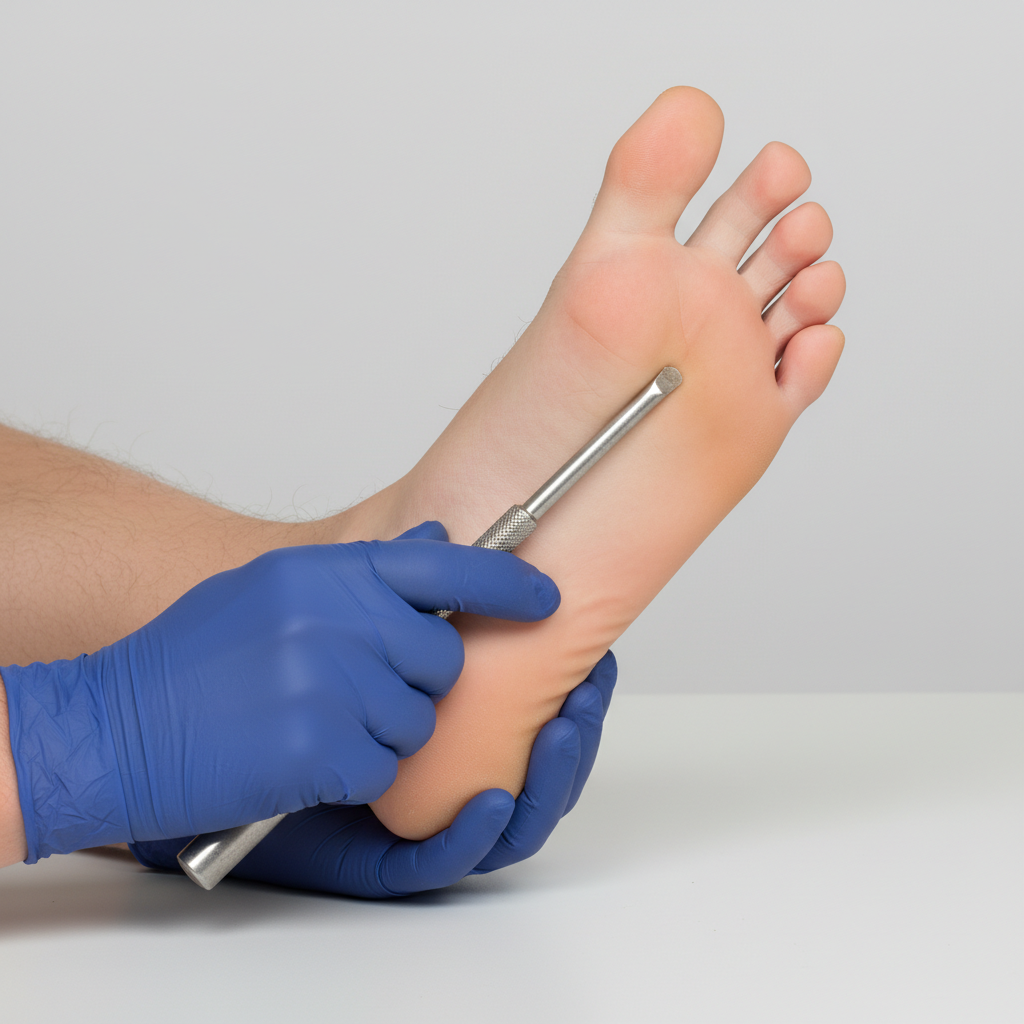
You are seeing a patient in clinic who presents with complaints of weakness. Her physical exam is notable for right sided hyperreflexia, as well as the reflex finding shown in the image below. Where is the most likely location of this patient's lesion?
A 55-year-old woman presents to the physician with repeated episodes of dizziness for the last 3 months, which are triggered by rising from a supine position and by lying down. The episodes are sudden and usually last for less than 30 seconds. During the episode, she feels as if she is suddenly thrown into a rolling spin. She has no symptoms in the period between episodes. The patient denies having headaches, vomiting, deafness, ear discharge or ear pain. There is no history of a known medical disorder or prolonged consumption of a specific drug. The vital signs are within normal limits. On physical examination, when the physician asks the woman to turn her head 45° to the right, and then to rapidly move from the sitting to the supine position, self-limited rotatory nystagmus is observed following her return to the sitting position. The rest of the neurological examination is normal. Which of the following is the treatment of choice for the condition of this patient?
A 71-year-old man presents to his primary care physician because he is increasingly troubled by a tremor in his hands. He says that the tremor is worse when he is resting and gets better when he reaches for objects. His wife reports that he has been slowing in his movements and also has difficulty starting to walk. His steps have been short and unsteady even when he is able to initiate movement. Physical exam reveals rigidity in his muscles when tested for active range of motion. Histology in this patient would most likely reveal which of the following findings?
A 73-year-old man presents to your office accompanied by his wife. He has been experiencing a tremor in his right hand for the last several months that seems to be worsening. He does not have any other complaints and says he’s “fine.” His wife thinks that he has also had more difficulty walking. His history is significant for hypertension and an ischemic stroke of the right middle cerebral artery 2 years ago. His medications include hydrochlorothiazide and daily aspirin. On physical exam you note that the patient speaks with a soft voice and has decreased facial expressions. He has a resting tremor that is worse on the right side. He has increased resistance to passive movement when you flex and extend his relaxed wrist. He has 5/5 strength bilaterally. Neuronal degeneration in which of the following locations is most likely responsible for the progression of this disease?
A 40-year-old man is brought to the emergency department after sustaining multiple lacerations during a bar fight. The patient’s wife says that he has been showing worsening aggression and has been involved in a lot of arguments and fights for the past 2 years. The patient has no significant past medical or psychiatric history and currently takes no medications. The patient cannot provide any relevant family history since he was adopted as an infant. His vitals are within normal limits. On physical examination, the patient looks apathetic and grimaces repeatedly. Suddenly, his arms start to swing by his side in an uncontrolled manner. Which area of the brain is most likely affected in this patient?
A 55-year-old man is brought to the emergency department by his wife after falling down. About 90 minutes ago, they were standing in their kitchen making lunch and chatting when he suddenly complained that he could not see as well, felt weak, and was getting dizzy. He began to lean to 1 side, and he eventually fell to the ground. He did not hit his head. In the emergency department, he is swaying while seated, generally leaning to the right. The general physical exam is unremarkable. The neurologic exam is notable for horizontal nystagmus, 3/5 strength in the right arm, ataxia of the right arm, and absent pinprick sensation in the left arm and left leg. The computed tomography (CT) scan of the head is unremarkable. Which of the following is the most likely single location of this patient's central nervous system lesion?
A 21-year-old man was involved in a motor vehicle accident and died. At autopsy, the patient demonstrated abnormally increased mobility at the neck. A section of cervical spinal cord at C6 was removed and processed into slides. Which of the following gross anatomic features is most likely true of this spinal cord level?
A 27-year-old man presents to a physician for evaluation of 3 months of increased vertigo. He says that occasionally he will experience several seconds of intense vertigo that makes him lose his balance. He came in for evaluation because this symptom is affecting his ability to drive to work. He has also been occasionally experiencing tinnitus. Physical exam reveals rotatory nystagmus that is delayed in onset and stops with visual fixation. The nerve that is most likely causing these symptoms exits the skull at which of the following locations?
A 27-year-old man is brought to the emergency department because of a knife wound to his back. His pulse is 110/min, respirations are 14/min, and blood pressure is 125/78 mm Hg. Examination shows a 5-cm deep stab wound at the level of T9. He withdraws the right foot to pain but is unable to sense vibration or whether his right toe is flexed or extended. Sensation in the left leg is normal. Motor strength is 5/5 in all extremities. Rectal tone is normal. Which of the following spinal column structures was most likely affected?
A man appearing to be in his mid-50s is brought in by ambulance after he was seen walking on railroad tracks. On further questioning, the patient does not recall being on railroad tracks and is only able to provide his name. Later on, he states that he is a railroad worker, but this is known to be false. On exam, his temperature is 99.9°F (37.7°C), blood pressure is 128/86 mmHg, pulse is 82/min, and respirations are 14/min. He appears disheveled, and his clothes smell of alcohol. The patient is alert, is only oriented to person, and is found to have abnormal eye movements and imbalanced gait when attempting to walk. Which of the following structures in the brain likely has the greatest reduction in the number of neurons?
Want unlimited practice?
Get full access to all questions, explanations, and performance tracking.
Scan to download app