
Vital centers in brainstem — MCQs

An otherwise healthy 58-year-old man comes to the physician because of a 1-year history of episodic coughing whenever he cleans his left ear. There is no history of hearing loss, tinnitus, or vertigo. Stimulating his left ear canal with a cotton swab triggers a bout of coughing. The physician informs him that these symptoms are caused by hypersensitivity of a cranial nerve. A peripheral lesion of this nerve is most likely to manifest with which of the following findings on physical examination?
Which of the following physiologic changes decreases pulmonary vascular resistance (PVR)?
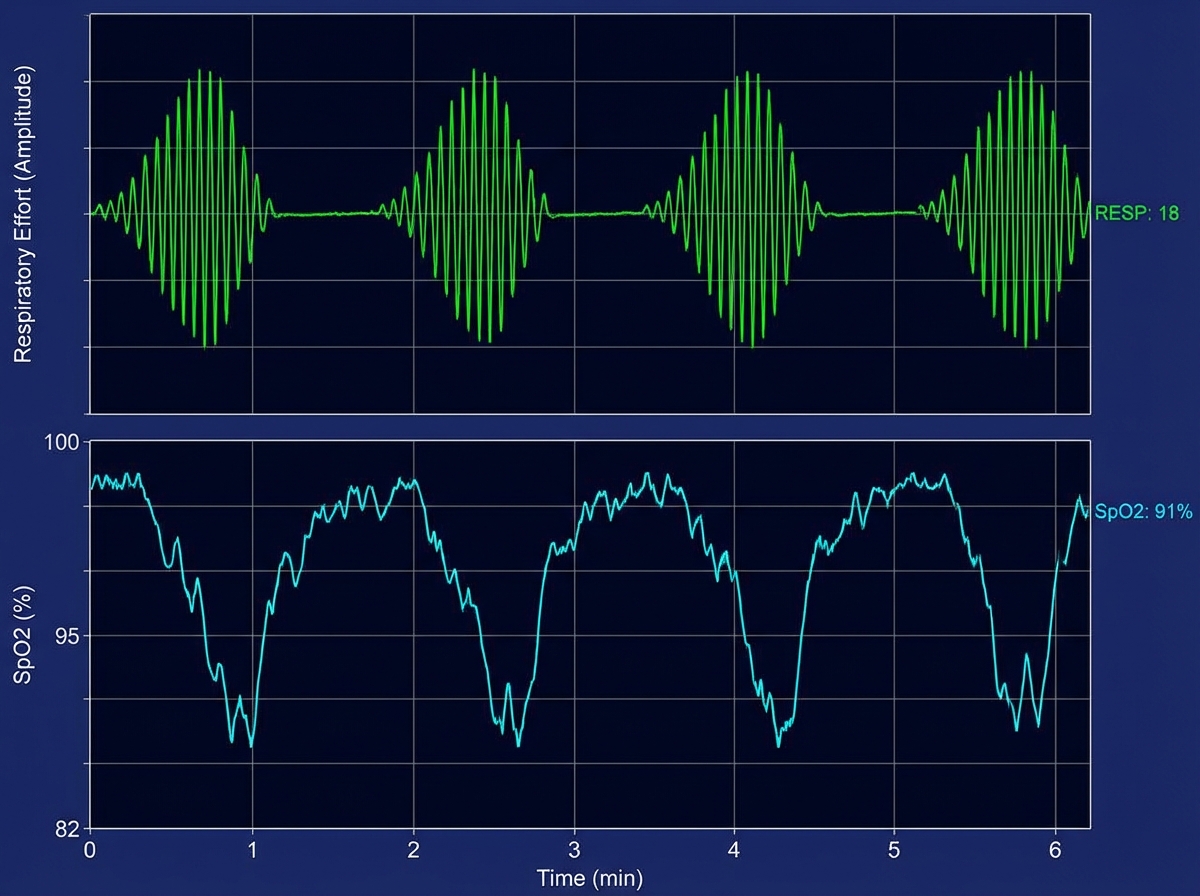
A 66-year-old man is brought to the emergency department because of shortness of breath and confusion. His pulse is 98/min, and blood pressure is 109/73 mm Hg. He is oriented to person but not time or place. A graph of his breathing pattern and oxygen saturation is shown. Which of the following additional findings is most likely present in this patient?
A 35-year-old woman volunteers for a study on respiratory physiology. Pressure probes A and B are placed as follows: Probe A: between the parietal and visceral pleura Probe B: within the cavity of an alveolus The probes provide a pressure reading relative to atmospheric pressure. To obtain a baseline reading, she is asked to sit comfortably and breathe normally. Which of the following sets of values will most likely be seen at the end of inspiration?
A researcher is studying receptors that respond to epinephrine in the body and discovers a particular subset that is expressed in presynaptic adrenergic nerve terminals. She discovers that upon activation, these receptors will lead to decreased sympathetic nervous system activity. She then studies the intracellular second messenger changes that occur when this receptor is activated. She records these changes and begins searching for analogous receptor pathways. Which of the following receptors would cause the most similar set of intracellular second messenger changes?
A 55-year-old man presents with an unremitting cough and swelling of the lower limbs for the past 2 weeks. He says he has had a chronic cough for years, however, he feels it is getting worse. He reports a 30-pack-year smoking history. Physical examination reveals mild central cyanosis and expiratory wheezes throughout the chest. Oxygen therapy is ordered immediately but, soon after administering it, his respiratory rate starts to slow down and he becomes drowsy. Dysfunction of which of the following receptors most likely led to this patient’s current condition?
A 65-year-old female with a past medical history of hypertension presents to her primary care doctor with a 3 month history of spasmodic facial pain. The pain is located in her right cheek and seems to be triggered when she smiles, chews, or brushes her teeth. The pain is sharp and excruciating, lasts for a few seconds, and occurs up to twenty times per day. She denies headaches, blurry vision, facial weakness, or changes in her memory. She feels rather debilitated and has modified much of her daily activities to avoid triggering the spasms. In the clinic, her physical exam is within normal limits. Her primary care doctor prescribes carbamazepine and asks her to follow up in a few weeks. Which cranial nerve is most likely involved in the patient's disease process?
A 22-year-old man presents with a history of lightheadedness, weakness, and palpitations when he assumes an upright position from a supine position. He is otherwise a healthy man without a history of alcohol or other substance abuse. His supine and standing blood pressures (measured at 3-minute intervals) were 124/82 mm Hg and 102/72 mm Hg, respectively. He was advised to perform a Valsalva maneuver while monitoring blood pressure and heart rate to assess the integrity of his baroreflex control. Which of the following statements is correct?
A 28-year-old woman is brought to the emergency department 1 hour after being involved in a motor vehicle collision. She was riding a bike when she lost control and hit a car on the opposite side of the road. On arrival, she is unconscious. She has a history of intravenous heroin use. Her pulse is 56/min, respirations are 8/min and irregular, and blood pressure is 196/102 mm Hg. Examination shows a 2-cm laceration over the left cheek and a 3-cm laceration over the left chest. There are multiple abrasions over her face and chest. She opens her eyes and flexes her extremities to painful stimuli. The pupils are dilated and react sluggishly to light. There are decreased breath sounds over the left lung. The trachea is central. There is no jugular venous distention. Cardiac examination shows no abnormalities. The abdomen is soft and nontender. The left knee and right ankle are swollen; range of motion is limited. Two large-bore peripheral intravenous catheters are inserted. She is intubated and mechanical ventilation is initiated. A focused assessment with sonography in trauma is negative. An occlusive dressing is applied over the left chest wound. She is scheduled for a noncontrast CT scan of the brain. Which of the following is the underlying cause of this patient's hypertension?
A 57-year-old man was brought into the emergency department unconscious 2 days ago. His friends who were with him at that time say he collapsed on the street. Upon arrival to the ED, he had a generalized tonic seizure. At that time, he was intubated and is being treated with diazepam and phenytoin. A noncontrast head CT revealed hemorrhages within the pons and cerebellum with a mass effect and tonsillar herniation. Today, his blood pressure is 110/65 mm Hg, heart rate is 65/min, respiratory rate is 12/min (intubated, ventilator settings: tidal volume (TV) 600 ml, positive end-expiratory pressure (PEEP) 5 cm H2O, and FiO2 40%), and temperature is 37.0°C (98.6°F). On physical examination, the patient is in a comatose state. Pupils are 4 mm bilaterally and unresponsive to light. Cornea reflexes are absent. Gag reflex and cough reflex are also absent. Which of the following is the next best step in the management of this patient?
Want unlimited practice?
Get full access to all questions, explanations, and performance tracking.
Scan to download app