
Vestibular nuclei complex — MCQs

A 55-year-old woman presents to her family physician with a 1-week history of dizziness. She experiences spinning sensations whenever she lies down and these sensations increase when she turns her head to the right. These episodes are transient, intermittent, last for less than a minute, occur multiple times in a day, and are associated with nausea. Between the episodes, she is fine and is able to perform her routine activities. She denies fever, hearing disturbances, diplopia, tinnitus, and recent flu or viral illness. Past medical history is significant for diabetes mellitus type 2, hypertension, and hypercholesterolemia. She does not use tobacco or alcohol. Her blood pressure is 124/78 mm Hg, the heart rate is 79/min, and the respiratory rate is 13/min. During the examination, when she is asked to lie supine from a sitting position with her head rotated towards the right side at 45°, horizontal nystagmus is observed. What is the next best step in the management of this patient?
A 55-year-old woman presents to the physician with repeated episodes of dizziness for the last 3 months, which are triggered by rising from a supine position and by lying down. The episodes are sudden and usually last for less than 30 seconds. During the episode, she feels as if she is suddenly thrown into a rolling spin. She has no symptoms in the period between episodes. The patient denies having headaches, vomiting, deafness, ear discharge or ear pain. There is no history of a known medical disorder or prolonged consumption of a specific drug. The vital signs are within normal limits. On physical examination, when the physician asks the woman to turn her head 45° to the right, and then to rapidly move from the sitting to the supine position, self-limited rotatory nystagmus is observed following her return to the sitting position. The rest of the neurological examination is normal. Which of the following is the treatment of choice for the condition of this patient?
A 25-year-old woman presents to the physician with a complaint of several episodes of headaches in the past 4 weeks that are affecting her school performance. These episodes are getting progressively worse, and over-the-counter medications do not seem to help. She also mentions having to raise her head each time to look at the board while taking notes; she cannot simply glance up with just her eyes. She has no significant past medical or family history and was otherwise well prior to this visit. Physical examination shows an upward gaze palsy and convergence-retraction nystagmus. What structure is most likely to be affected in this patient?
An 82-year-old male visits his primary care physician for a check-up. He reports that he is in his usual state of health. His only new complaint is that he feels as if the room is spinning, which has affected his ability to live independently. He is currently on lisinopril, metformin, aspirin, warfarin, metoprolol, and simvastatin and says that he has been taking them as prescribed. On presentation, his temperature is 98.8°F (37°C), blood pressure is 150/93 mmHg, pulse is 82/min, and respirations are 12/min. On exam he has a left facial droop and his speech is slightly garbled. Eye exam reveals nystagmus with certain characteristics. The type of nystagmus seen in this patient would most likely also be seen in which of the following diseases?
A 70-year-old woman presents to her primary care physician with sudden episodes of dizziness that resolve in certain positions. On further questioning she describes a false sense of motion with occasional spinning sensation consistent with vertigo. She denies any recent illnesses or hearing loss aside from presbycusis. Her vital signs are normal. During the physical exam the patient reports an episode of vertigo after transitioning from sitting to supine and horizontal nystagmus is concurrently noted. What is the most likely diagnosis?
A 59-year-old man presents to the emergency department with a sudden-onset sensation that the room is spinning causing him to experience several episodes of nausea and vomiting. Upon arriving, the patient’s symptoms have resolved. He states his symptoms occurred as he was going to bed. He has never experienced this before, but felt extremely dizzy for roughly 3 minutes. He currently feels at his baseline. The patient is otherwise healthy and only has a history of eczema. His temperature is 97.7°F (36.5°C), blood pressure is 134/85 mmHg, pulse is 85/min, respirations are 13/min, and oxygen saturation is 98% on room air. Physical exam is notable for a healthy man with a normal gait. The patient has a physiologic nystagmus and his cranial nerve exam is unremarkable. The patient’s head is turned to the left and he is laid back on the stretcher, which exacerbates severe symptoms with a nystagmus notable. The patient’s symptoms improve after 2 minutes of being in this position. Which of the following is the most likely diagnosis?
A 22-year-old woman comes to the physician because of hearing loss and unsteadiness while standing and walking for the past 2 months. She needs support from a wall to prevent herself from falling. She has not had any recent injuries and has no history of serious illness. Vital signs are within normal limits. Examination shows an unsteady gait. She sways when asked to stand upright with her feet together. She is unable to hear fingers rubbing next to her ears or repeat words whispered in her ears bilaterally. An MRI of the brain shows a 3-cm tumor in the right cerebellopontine angle and a 4.5-cm tumor in the left cerebellopontine angle. This patient is most likely to develop which of the following in the future?
A previously well 25-year-old woman was brought to the emergency department by her boyfriend because of progressive blurred vision. Examination of the eyes reveals loss of horizontal gaze, intact convergence, and nystagmus. A clinical diagnosis of multiple sclerosis is made and the patient is started on a course of corticosteroids. What is the most likely etiology for her eye examination findings?
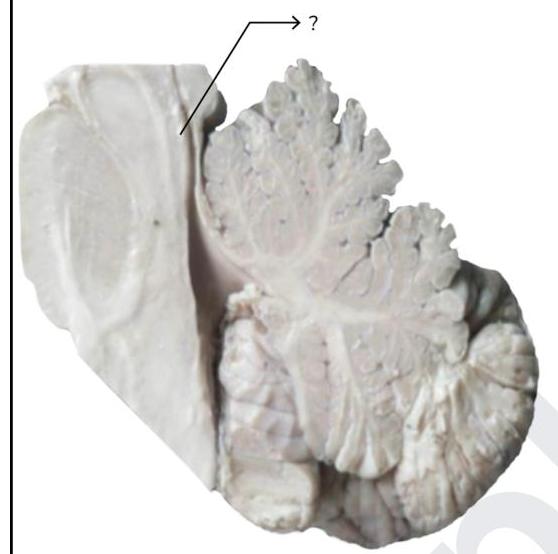
Fibers from the marked structure terminate at which of the following?
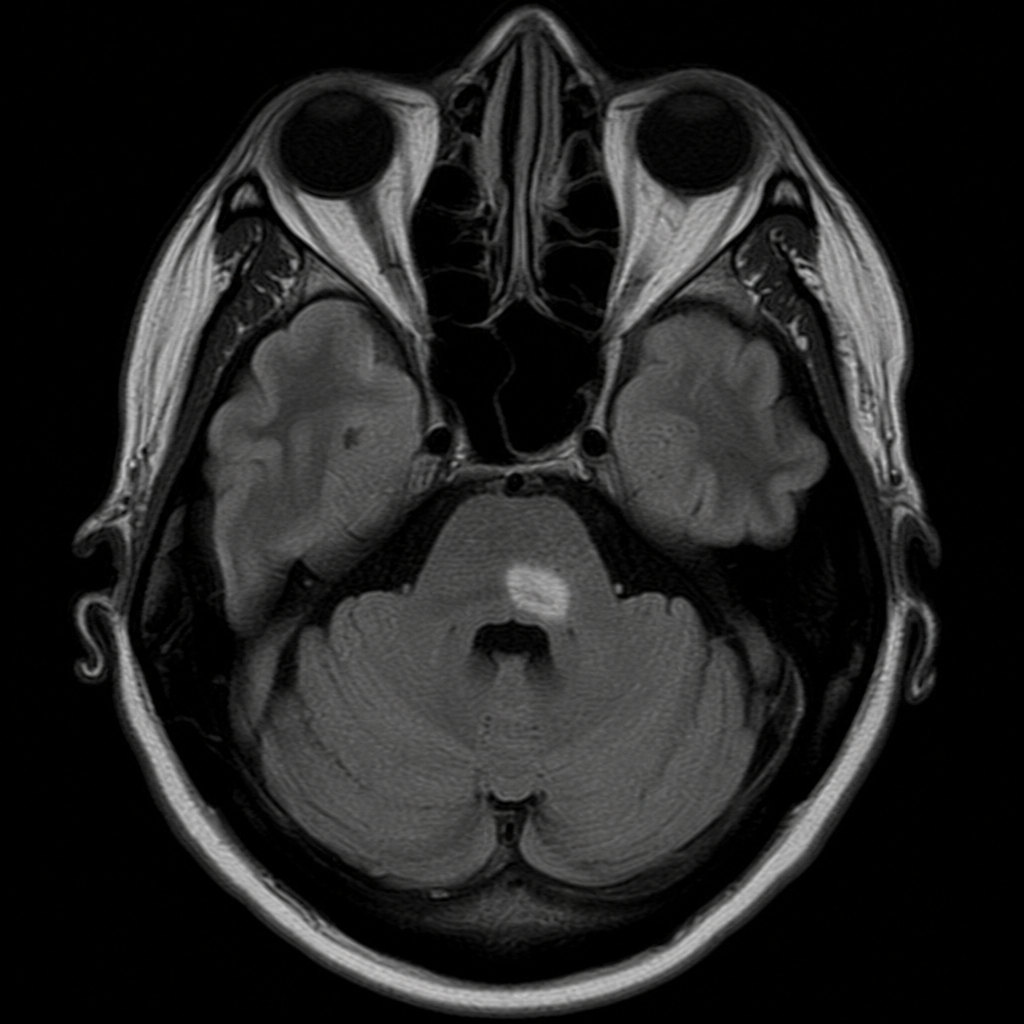
A 67-year-old man with a history of atrial fibrillation presents with sudden onset of right-sided facial droop involving the forehead, inability to conjugately gaze to the right, and left-sided hemiplegia sparing the face. His pupils are equal and reactive. An MRI is obtained. At which axial level and side does the lesion most likely reside?
Want unlimited practice?
Get full access to all questions, explanations, and performance tracking.
Scan to download app