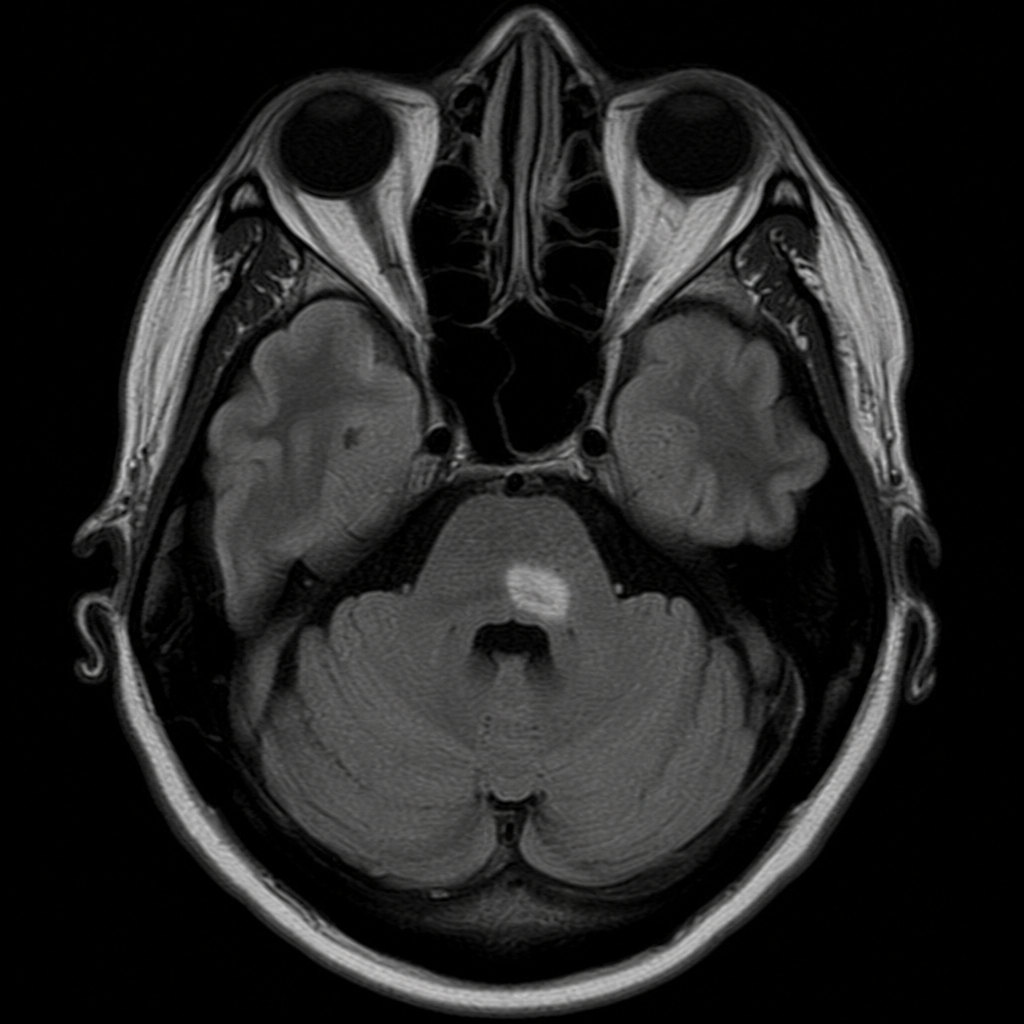
An 86-year-old woman is brought to the emergency department by her niece because the patient felt like she was spinning and about to topple over. This occurred around 4 hours ago, and although symptoms have improved, she still feels like she is being pulled to the right side. The vital signs include: blood pressure 116/75 mm Hg, pulse 90/min, and SpO2 99% on room air. Physical examination reveals right-sided limb ataxia along with hypoalgesia and decreased temperature sensation on the right side of the face and left side of the body. An urgent non-contrast CT scan of the head shows no evidence of hemorrhage. What other finding is most likely to be present in this patient?
Q2
A 60-year-old woman presents with progressive difficulty swallowing solid foods for the past 2 months. She also says her voice has gradually changed, and she has had recent episodes of vertigo associated with nausea and vomiting and oscillating eye movements while reading. She denies any problems with the movement of her face or extremities. Past medical history is significant for hypertension, managed with enalapril, and dyslipidemia, which she is managing with dietary modifications. The patient reports a 40-pack-year smoking history. Vital signs are within normal limits. On physical examination, there is decreased pain and temperature sensation on the right side of her body, and she cannot touch her nose with her eyes closed. Which of the following is the most likely site of vascular occlusion in this patient?
Q3
A 59-year-old woman with a past medical history of atrial fibrillation currently on warfarin presents to the emergency department for acute onset dizziness. She was watching TV in the living room when she suddenly felt the room spin around her as she was getting up to go to the bathroom. She denies any fever, weight loss, chest pain, palpitations, shortness of breath, lightheadedness, or pain but reports difficulty walking and hiccups. A physical examination is significant for rotary nystagmus and decreased pin prick sensation on the left side of her body. A magnetic resonance image (MRI) of the head is obtained and shows ischemic changes of the right lateral medulla. What other symptoms would you expect to find in this patient?
Q4
A 65-year-old man is brought into the emergency department by his wife for slurred speech and right-sided weakness. The patient has a significant past medical history of hypertension and hyperlipidemia. The wife reports her husband went to bed last night normally but woke up this morning with the symptoms mentioned. Physical examination shows right-sided hemiparesis along with the loss of vibration and proprioception. Cranial nerve examination shows a deviated tongue to the left. What is the most likely diagnosis?
Q5
A 56-year-old man with a significant past medical history of diabetes mellitus, hypertension, and hypercholesterolemia is brought to the emergency department by his wife. The wife states the symptoms started 1 hour ago when she noticed that he was having difficulty swallowing his breakfast and that his voice was hoarse. The patient had a recent admission for a transient ischemic attack but was not compliant with his discharge instructions and medication. Examination of the eye shows left-sided partial ptosis and miosis along with diplopia and nystagmus. During the examination, it is noted that the right side of the face and body has markedly more sweating than the left side. An MRI of the brain reveals an ischemic infarct at the level of the left lateral medulla. Which of the following most likely accounts for this patient’s symptoms?
Q6
A 73-year-old woman is brought in by her daughter stating that her mom has become increasingly forgetful and has trouble remembering recent events. Her memory for remote events is remarkably intact. The patient is no longer able to cook for herself as she frequently leaves the stove on unattended. She has recently been getting lost in her neighborhood even though she has lived there for 30 years. Her mood is not depressed. Decreased activity in which of the following areas of the brain is known to be involved in the pathogenesis of Alzheimer's disease?
Q7
A 72-year-old woman is brought in to the emergency department after her husband noticed that she appeared to be choking on her dinner. He performed a Heimlich maneuver but was concerned that she may have aspirated something. The patient reports a lack of pain and temperature on the right half of her face, as well as the same lack of sensation on the left side of her body. She also states that she has been feeling "unsteady" on her feet. On physical exam you note a slight ptosis on the right side. She is sent for an emergent head CT. Where is the most likely location of the neurological lesion?
Q8
A 55-year-old man is brought to the emergency department by his wife after falling down. About 90 minutes ago, they were standing in their kitchen making lunch and chatting when he suddenly complained that he could not see as well, felt weak, and was getting dizzy. He began to lean to 1 side, and he eventually fell to the ground. He did not hit his head. In the emergency department, he is swaying while seated, generally leaning to the right. The general physical exam is unremarkable. The neurologic exam is notable for horizontal nystagmus, 3/5 strength in the right arm, ataxia of the right arm, and absent pinprick sensation in the left arm and left leg. The computed tomography (CT) scan of the head is unremarkable. Which of the following is the most likely single location of this patient's central nervous system lesion?
Q9
A 62-year-old woman presents with sudden onset of vertigo, difficulty walking, sensory changes on the left side of her face and the right side of the body, and left facial drooping. Her past medical history is significant for hypertension and hypercholesterolemia. On physical examination, there is left-sided Horner’s syndrome, hypoesthesia on the left side of the face, hypoesthesia on the right side of the body, left facial paralysis, and left-sided limb ataxia, as well as dysmetria. There is also a loss of taste sensation in the anterior 2/3 of the tongue. Based on the above findings, where is the most likely location of the vascular occlusion in this patient?
Q10
A 67-year-old man is brought to the emergency department by his wife due to dizziness, trouble with walking, and progressively worsening headache. These symptoms began approximately two hours prior to arriving to the hospital and were associated with nausea and one episode of vomiting. Medical history is significant for hypertension, hypercholesterolemia, and type II diabetes mellitus, which is managed with lisinopril, atorvastatin, and metformin. His temperature is 99°F (37.2°C), blood pressure is 182/106 mmHg, pulse is 102/min, and respirations are 20/min. On physical examination, the patient has right-sided dysmetria on finger-to-nose testing and right-sided dysrhythmia on rapid finger tapping. This patient's abnormal physical exam findings are best explained by decreased neuronal input into which of the following nuclei?
Brainstem nuclei US Medical PG Practice Questions and MCQs
Question 1: An 86-year-old woman is brought to the emergency department by her niece because the patient felt like she was spinning and about to topple over. This occurred around 4 hours ago, and although symptoms have improved, she still feels like she is being pulled to the right side. The vital signs include: blood pressure 116/75 mm Hg, pulse 90/min, and SpO2 99% on room air. Physical examination reveals right-sided limb ataxia along with hypoalgesia and decreased temperature sensation on the right side of the face and left side of the body. An urgent non-contrast CT scan of the head shows no evidence of hemorrhage. What other finding is most likely to be present in this patient?
A. Hemiparesis
B. Deviated tongue
C. Hemianopia
D. Absent cough reflex
E. Absent gag reflex (Correct Answer)
Explanation: ***Absent gag reflex***
- The constellation of **vertigo**, **right-sided ataxia**, and **crossed sensory loss** (right face, left body) is characteristic of **Wallenberg syndrome** (lateral medullary infarction).
- This syndrome often involves the **nucleus ambiguus**, which controls the muscles of the **soft palate, pharynx, and larynx**, leading to an absent gag reflex, dysphagia, and hoarseness.
*Hemiparesis*
- **Hemiparesis** (weakness on one side of the body) is typically associated with lesions in the **corticospinal tracts** higher up in the brainstem or cerebral hemispheres.
- While stroke can cause hemiparesis, it is not a primary feature of Lateral Medullary Syndrome, which predominantly affects sensory and cerebellar pathways.
*Deviated tongue*
- **Tongue deviation** is seen with lesions of the **hypoglossal nerve (CN XII)** or its nucleus, which would typically cause the tongue to deviate towards the side of the lesion when protruded.
- Wallenberg syndrome primarily affects structures supplied by the **posterior inferior cerebellar artery (PICA)**, and the hypoglossal nucleus is usually spared.
*Hemianopia*
- **Hemianopia** (loss of half of the visual field) results from damage to the **optic tracts**, optic radiations, or the visual cortex in the occipital lobe.
- Lateral medullary infarction primarily affects the brainstem and cerebellum, far from the visual pathways responsible for hemianopia.
*Absent cough reflex*
- While dysphagia and an absent gag reflex are common in Wallenberg syndrome due to involvement of the nucleus ambiguus, an entirely **absent cough reflex** is a more severe indicator of brainstem dysfunction.
- The cough reflex is complex and involves cranial nerves IX, X, and the respiratory centers; while it can be impaired, an absent gag reflex is more specifically linked to the **nucleus ambiguus** lesion in this syndrome.
Question 2: A 60-year-old woman presents with progressive difficulty swallowing solid foods for the past 2 months. She also says her voice has gradually changed, and she has had recent episodes of vertigo associated with nausea and vomiting and oscillating eye movements while reading. She denies any problems with the movement of her face or extremities. Past medical history is significant for hypertension, managed with enalapril, and dyslipidemia, which she is managing with dietary modifications. The patient reports a 40-pack-year smoking history. Vital signs are within normal limits. On physical examination, there is decreased pain and temperature sensation on the right side of her body, and she cannot touch her nose with her eyes closed. Which of the following is the most likely site of vascular occlusion in this patient?
A. Anterior cerebral artery
B. Anterior inferior cerebellar artery
C. Posterior inferior cerebellar artery (Correct Answer)
D. Middle cerebral artery
E. Anterior spinal artery
Explanation: ***Correct: Posterior inferior cerebellar artery***
- This presentation is classic for **Wallenberg syndrome (lateral medullary syndrome)**, which is most commonly caused by occlusion of the **posterior inferior cerebellar artery (PICA)**.
- Key symptoms like **dysphagia**, **hoarseness (nucleus ambiguus involvement)**, **vertigo, nausea, vomiting, nystagmus (vestibular nuclei)**, **ipsilateral ataxia (inferior cerebellar peduncle/cerebellum)**, and **contralateral pain and temperature loss (spinothalamic tract)** are all present.
*Incorrect: Anterior cerebral artery*
- Occlusion of the anterior cerebral artery typically causes **contralateral leg weakness and sensory loss**, with **gait dysfunction** and **behavioral changes**.
- It does not explain the **brainstem symptoms** like dysphagia, vertigo, or ataxia.
*Incorrect: Anterior inferior cerebellar artery*
- An **anterior inferior cerebellar artery (AICA) stroke** would present with symptoms of lateral pontine syndrome, including **ipsilateral facial weakness and sensory loss**, **tinnitus and hearing loss**, and **ataxia**.
- While some vestibular symptoms can occur, the prominent **dysphagia and hoarseness** point more strongly to medullary involvement.
*Incorrect: Middle cerebral artery*
- A **middle cerebral artery (MCA) stroke** typically results in **contralateral hemiparesis**, **hemianesthesia**, and possibly **aphasia** (if dominant hemisphere affected) or **hemineglect** (if non-dominant hemisphere affected).
- This does not account for the brainstem signs observed in the patient.
*Incorrect: Anterior spinal artery*
- Occlusion of the **anterior spinal artery** primarily affects the spinal cord, causing **bilateral motor weakness, bilateral loss of pain and temperature sensation below the lesion**, and **bladder dysfunction**.
- It does not cause the cerebellar, vestibular, or bulbar symptoms seen in this patient.
Question 3: A 59-year-old woman with a past medical history of atrial fibrillation currently on warfarin presents to the emergency department for acute onset dizziness. She was watching TV in the living room when she suddenly felt the room spin around her as she was getting up to go to the bathroom. She denies any fever, weight loss, chest pain, palpitations, shortness of breath, lightheadedness, or pain but reports difficulty walking and hiccups. A physical examination is significant for rotary nystagmus and decreased pin prick sensation on the left side of her body. A magnetic resonance image (MRI) of the head is obtained and shows ischemic changes of the right lateral medulla. What other symptoms would you expect to find in this patient?
A. Left-sided tongue deviation
B. Language impairment
C. Paralysis of the right lower limb
D. Right-sided facial paralysis
E. Decreased gag reflex (Correct Answer)
Explanation: ***Decreased gag reflex***
- Ischemia of the **right lateral medulla** specifically impacts the **nucleus ambiguus**, which innervates the muscles of the soft palate, pharynx, and larynx, leading to a **decreased gag reflex** and dysphagia.
- The presented symptoms of **dizziness**, **rotary nystagmus**, and **hiccups** are indicative of a lateral medullary (Wallenberg) syndrome, often presenting with **dysphagia** and a decreased gag reflex due to involvement of **cranial nerves IX and X**.
*Left-sided tongue deviation*
- Tongue deviation is associated with **hypoglossal nerve (CN XII) palsy**, which would typically involve an lesion in the **medial medulla** or a more distal nerve lesion.
- The patient's symptoms are consistent with a **lateral medullary syndrome**, where CN XII is usually spared.
*Language impairment*
- **Language impairment (aphasia)** is a cortical symptom, typically associated with lesions in the **dominant cerebral hemisphere** (Broca's or Wernicke's areas), not the brainstem.
- While brainstem strokes can cause communication difficulties, true aphasia is not characteristic of a **lateral medullary infarct**.
*Paralysis of the right lower limb*
- **Motor pathways (corticospinal tracts)** for the limbs decussate in the **pyramids of the medulla**, and a lesion in the lateral medulla typically does not involve these tracts enough to cause significant contralateral limb paralysis.
- Lateral medullary syndrome is characterized by **ipsilateral hemiataxia** and **contralateral sensory loss**, not typically contralateral motor paralysis of the limbs.
*Right-sided facial paralysis*
- **Facial paralysis** is caused by lesions affecting the **facial nerve (CN VII)** nucleus or its peripheral course, which is located more rostrally in the pons, not typically affected in a **lateral medullary infarct**.
- Lateral medullary syndrome often presents with an **ipsilateral Horner's syndrome** and **ipsilateral facial sensory loss** (due to trigeminal nucleus involvement), but not facial motor weakness.
Question 4: A 65-year-old man is brought into the emergency department by his wife for slurred speech and right-sided weakness. The patient has a significant past medical history of hypertension and hyperlipidemia. The wife reports her husband went to bed last night normally but woke up this morning with the symptoms mentioned. Physical examination shows right-sided hemiparesis along with the loss of vibration and proprioception. Cranial nerve examination shows a deviated tongue to the left. What is the most likely diagnosis?
A. Medial pontine syndrome
B. Weber syndrome
C. Lateral pontine syndrome
D. Dejerine syndrome (Correct Answer)
E. Wallenberg syndrome
Explanation: ***Dejerine syndrome***
- This syndrome, also known as **medial medullary syndrome**, presents with **ipsilateral tongue deviation** (due to hypoglossal nerve involvement), **contralateral hemiparesis**, and **contralateral loss of vibration and proprioception**.
- The symptoms described, including slurred speech, right-sided weakness, loss of vibration and proprioception, and a deviated tongue to the left, precisely match the clinical picture of Dejerine syndrome, which is caused by an infarct of the **anterior spinal artery** and/or **vertebral artery** affecting the medulla.
*Medial pontine syndrome*
- This syndrome typically involves the **abducens nucleus or nerve**, causing an ipsilateral **gaze palsy** or diplopia, as well as **contralateral hemiparesis**.
- It does not present with tongue deviation or the specific sensory loss of proprioception/vibration seen in this patient.
*Weber syndrome*
- Weber syndrome is a **midbrain stroke** characterized by ipsilateral **oculomotor nerve palsy** (down-and-out eye, ptosis, pupillary dilation) and contralateral **hemiparesis**.
- The clinical presentation of this patient, specifically the tongue deviation and sensory loss, is not consistent with Weber's syndrome.
*Lateral pontine syndrome*
- Lateral pontine syndrome, also known as **Marie-Foix-Alajouanine syndrome**, typically involves the **trigeminal nerve** (ipsilateral facial numbness), **facial nerve** (ipsilateral facial weakness), and **vestibulocochlear nerve** (ipsilateral deafness/tinnitus, vertigo), along with **ataxia**.
- It would not cause contralateral hemiparesis or tongue deviation as seen in this case.
*Wallenberg syndrome*
- Wallenberg syndrome (lateral medullary syndrome) involves the **posterior inferior cerebellar artery (PICA)** and is characterized by ipsilateral **Horner's syndrome**, **ataxia**, **dysphagia**, and **contralateral loss of pain and temperature sensation**.
- While it affects the medulla, the specific constellation of symptoms, particularly the tongue deviation and specific sensory loss, distinguishes Dejerine syndrome from Wallenberg syndrome.
Question 5: A 56-year-old man with a significant past medical history of diabetes mellitus, hypertension, and hypercholesterolemia is brought to the emergency department by his wife. The wife states the symptoms started 1 hour ago when she noticed that he was having difficulty swallowing his breakfast and that his voice was hoarse. The patient had a recent admission for a transient ischemic attack but was not compliant with his discharge instructions and medication. Examination of the eye shows left-sided partial ptosis and miosis along with diplopia and nystagmus. During the examination, it is noted that the right side of the face and body has markedly more sweating than the left side. An MRI of the brain reveals an ischemic infarct at the level of the left lateral medulla. Which of the following most likely accounts for this patient’s symptoms?
A. Postganglionic sympathetic lesion
B. Injury to the cervical sympathetic ganglia
C. 3rd-order neuron lesion
D. Denervation of the descending sympathetic tract (Correct Answer)
E. Preganglionic lesion at the lateral gray horn
Explanation: ***Denervation of the descending sympathetic tract***
- The patient's symptoms, including **dysphagia**, **hoarseness**, **facial anhidrosis** on the left, **miosis**, **ptosis**, **diplopia**, and **nystagmus**, are classic for **Wallenberg syndrome** (lateral medullary syndrome).
- This syndrome is caused by an infarct in the **lateral medulla**, which damages the **descending sympathetic tracts (1st-order neurons)**, leading to **Horner's syndrome** (miosis, ptosis, anhidrosis) on the ipsilateral side and contralateral hyperhidrosis due to lack of sympathetic tone to the affected side, along with other neurological deficits due to involvement of vital brainstem nuclei.
*Postganglionic sympathetic lesion*
- A postganglionic lesion (also called a **3rd-order neuron lesion**) would typically affect structures supplied by the superior cervical ganglion, such as the eye and face.
- However, it would not explain the other brainstem symptoms like **dysphagia**, **hoarseness**, **diplopia**, or **nystagmus**, which point to a central lesion in the medulla.
*Injury to the cervical sympathetic ganglia*
- An injury here would cause **Horner's syndrome** affecting the eye and face on the ipsilateral side.
- It would not account for the brainstem deficits like **dysphagia**, **hoarseness**, or **nystagmus**, nor the specific finding of an **ischemic infarct in the lateral medulla**.
*3rd-order neuron lesion*
- A 3rd-order neuron lesion is synonymous with a **postganglionic sympathetic lesion** and would cause **Horner's syndrome**.
- This would not explain the additional cranial nerve and brainstem signs found in this patient, which are characteristic of a **lateral medullary infarct** affecting central (1st-order) sympathetic pathways.
*Preganglionic lesion at the lateral gray horn*
- A preganglionic lesion at the lateral gray horn (T1-T2 spinal cord, **2nd-order neurons**) would cause **Horner's syndrome**.
- However, it would not explain the upper brainstem symptoms like **dysphagia**, **hoarseness**, **diplopia**, or **nystagmus**, which result from damage to cranial nerve nuclei and tracts within the medulla, not the spinal cord.
Question 6: A 73-year-old woman is brought in by her daughter stating that her mom has become increasingly forgetful and has trouble remembering recent events. Her memory for remote events is remarkably intact. The patient is no longer able to cook for herself as she frequently leaves the stove on unattended. She has recently been getting lost in her neighborhood even though she has lived there for 30 years. Her mood is not depressed. Decreased activity in which of the following areas of the brain is known to be involved in the pathogenesis of Alzheimer's disease?
A. Raphe nucleus
B. Ventral tegmentum
C. Nucleus basalis (Correct Answer)
D. Locus ceruleus
E. Nucleus accumbens
Explanation: ***Nucleus basalis***
- The **nucleus basalis of Meynert** is a key cholinergic nucleus that projects widely to the cerebral cortex.
- **Loss of cholinergic neurons** in the nucleus basalis is a hallmark of Alzheimer's disease and is associated with cognitive decline, particularly in memory.
*Raphe nucleus*
- The raphe nuclei are the primary source of **serotonin** in the brain, playing a crucial role in mood, sleep, and appetite regulation.
- While serotonin dysregulation can occur in neurodegenerative diseases, core Alzheimer's pathology is not primarily linked to decreased activity here.
*Ventral tegmentum*
- The **ventral tegmental area (VTA)** is a major source of **dopamine** in the brain, involved in the reward system, motivation, and addiction.
- Decreased activity in the VTA is not a primary pathological feature of Alzheimer's disease, though dopaminergic pathways can be indirectly affected.
*Locus ceruleus*
- The **locus ceruleus** is the main source of **norepinephrine** in the brain, involved in arousal, attention, and stress responses.
- While it can be affected in Alzheimer's, especially later in the disease, primary pathogenesis is not attributed to its decreased activity.
*Nucleus accumbens*
- The **nucleus accumbens** is part of the **limbic system** and plays a central role in reward, pleasure, and motivation.
- While brain regions involved in motivation can be affected as dementia progresses, it is not a primary site of degeneration in Alzheimer's pathology.
Question 7: A 72-year-old woman is brought in to the emergency department after her husband noticed that she appeared to be choking on her dinner. He performed a Heimlich maneuver but was concerned that she may have aspirated something. The patient reports a lack of pain and temperature on the right half of her face, as well as the same lack of sensation on the left side of her body. She also states that she has been feeling "unsteady" on her feet. On physical exam you note a slight ptosis on the right side. She is sent for an emergent head CT. Where is the most likely location of the neurological lesion?
A. Pons
B. Internal capsule
C. Cervical spinal cord
D. Medulla (Correct Answer)
E. Midbrain
Explanation: ***Medulla***
- This presentation describes **Wallenberg syndrome** (lateral medullary syndrome), characterized by **ipsilateral facial sensory loss**, **contralateral body sensory loss**, and **ataxia** due to involvement of the spinothalamic tracts, trigeminal nucleus, and cerebellar pathways.
- **Dysphagia** (choking) and **Horner's syndrome** (ptosis, miosis, anhidrosis) are also classic signs, specifically the ptosis seen here, pointing to an infarct in the **lateral medulla**.
*Pons*
- Lesions in the pons typically present with varying degrees of **cranial nerve deficits** (e.g., trigeminal, abducens, facial) and **motor or sensory deficits** affecting both sides of the body due to the decussation of tracts.
- The specific combination of **crossed sensory loss** and other symptoms seen here is not characteristic of isolated pontine lesions.
*Internal capsule*
- A lesion in the internal capsule would primarily cause **contralateral motor weakness (hemiparesis)** and **sensory loss** affecting both the face and body on the same side, without the ipsilateral facial involvement.
- It would not explain the **ataxia** or specific cranial nerve signs like ptosis.
*Cervical spinal cord*
- Spinal cord lesions result in **sensory and motor deficits below the level of the lesion**, affecting both sides of the body symmetrically, or ipsilaterally depending on the tract involved.
- They do not cause **facial sensory disturbances**, **dysphagia**, or **ataxia** in the manner described.
*Midbrain*
- Midbrain lesions typically involve the **oculomotor nerve** (CN III), causing eye movement abnormalities, and can result in **contralateral hemiparesis**.
- They do not produce the **crossed sensory deficits** (ipsilateral face, contralateral body) or **ataxia** characteristic of this case.
Question 8: A 55-year-old man is brought to the emergency department by his wife after falling down. About 90 minutes ago, they were standing in their kitchen making lunch and chatting when he suddenly complained that he could not see as well, felt weak, and was getting dizzy. He began to lean to 1 side, and he eventually fell to the ground. He did not hit his head. In the emergency department, he is swaying while seated, generally leaning to the right. The general physical exam is unremarkable. The neurologic exam is notable for horizontal nystagmus, 3/5 strength in the right arm, ataxia of the right arm, and absent pinprick sensation in the left arm and left leg. The computed tomography (CT) scan of the head is unremarkable. Which of the following is the most likely single location of this patient's central nervous system lesion?
A. Primary motor cortex
B. Thalamus
C. Lateral medulla (Correct Answer)
D. Primary somatosensory cortex
E. Anterior spinal cord
Explanation: ***Lateral medulla***
- The combination of **ipsilateral ataxia** and **weakness** (right arm) along with **contralateral pain and temperature sensory loss** (left arm and leg) is classic for a **lateral medullary syndrome (Wallenberg syndrome)**.
- **Horizontal nystagmus**, vertigo, and leaning to one side are also consistent with involvement of vestibular nuclei and cerebellar pathways in the lateral medulla.
*Primary motor cortex*
- A lesion here would cause **contralateral weakness or paralysis** but would not explain the ipsilateral ataxia, nystagmus, or contralateral pain and temperature loss.
- Sensory deficits would be minimal or absent, and would primarily affect discriminative touch.
*Thalamus*
- A thalamic lesion could cause **contralateral sensory loss** (affecting all modalities) and potentially some motor deficits or ataxia, but it typically does not cause **ipsilateral ataxia** or **nystagmus** in the pattern described.
- The specific combination of ipsilateral motor and contralateral sensory deficits points away from a pure thalamic lesion.
*Primary somatosensory cortex*
- A lesion in this area would primarily result in **contralateral deficits in discriminative touch, proprioception, and stereognosis**, not pain and temperature sensation.
- It would not explain the motor deficits, ataxia, or nystagmus seen in the patient.
*Anterior spinal cord*
- Damage to the anterior spinal cord (e.g., **anterior spinal artery syndrome**) would cause **bilateral motor weakness (paraplegia/quadriplegia)** and **bilateral loss of pain and temperature sensation** below the level of the lesion.
- It would not account for the nystagmus, vertigo, or the specific combination of ipsilateral and contralateral deficits observed in this patient, which are characteristic of brainstem involvement.
Question 9: A 62-year-old woman presents with sudden onset of vertigo, difficulty walking, sensory changes on the left side of her face and the right side of the body, and left facial drooping. Her past medical history is significant for hypertension and hypercholesterolemia. On physical examination, there is left-sided Horner’s syndrome, hypoesthesia on the left side of the face, hypoesthesia on the right side of the body, left facial paralysis, and left-sided limb ataxia, as well as dysmetria. There is also a loss of taste sensation in the anterior 2/3 of the tongue. Based on the above findings, where is the most likely location of the vascular occlusion in this patient?
A. Anterior spinal artery (ASA)
B. Posterior cerebral artery (PCA)
C. Anterior inferior cerebellar artery (AICA) (Correct Answer)
D. Basilar artery
E. Posterior inferior cerebellar artery (PICA)
Explanation: ***Anterior inferior cerebellar artery (AICA)***
- **AICA infarction** leads to a constellation of symptoms including **ipsilateral facial paralysis** (due to involvement of the facial nucleus/nerve), **Horner's syndrome** (sympathetic fibers), **ataxia** (cerebellar peduncle), and **loss of taste from the anterior 2/3 of the tongue** (facial nerve).
- The alternating sensory loss (left face, right body) along with contralateral body hypoesthesia points towards involvement of the **spinothalamic tract** prior to decussation at higher levels and facial nerve involvement at the pontine level.
*Anterior spinal artery (ASA)*
- Blockage of the **ASA** primarily affects the anterior two-thirds of the spinal cord, leading to motor deficits below the lesion and loss of pain and temperature sensation, but **spares proprioception and vibration sense**.
- It does not typically cause cerebellar signs, facial involvement, or Horner's syndrome, as these structures are supplied by other vascular territories.
*Posterior cerebral artery (PCA)*
- **PCA occlusion** typically causes visual field defects (contralateral homonymous hemianopia) due to involvement of the **occipital lobe**.
- It can also affect the **thalamus** (leading to contralateral sensory loss) and hippocampus, but does not usually cause facial paralysis, Horner’s syndrome, or cerebellar ataxia in this combination.
*Basilar artery*
- **Basilar artery occlusion** often presents with severe neurological deficits, including **quadriplegia**, coma, and **locked-in syndrome**, due to widespread involvement of the brainstem.
- While it can cause some of the described symptoms, the specific unilateral facial weakness and alternating sensory loss, coupled with taste disturbance, are not specific to a complete basilar occlusion and an AICA stroke is a more precise fit.
*Posterior inferior cerebellar artery (PICA)*
- **PICA occlusion** (lateral medullary syndrome or Wallenberg syndrome) causes **vertigo**, **nystagmus**, **ipsilateral cerebellar ataxia**, and **Horner's syndrome**, often with **dysphagia** and **dysarthria** (nucleus ambiguus).
- However, it typically spares the facial nerve, thus **facial paralysis** and **loss of taste from the anterior 2/3 of the tongue** are not characteristic features of PICA syndrome.
Question 10: A 67-year-old man is brought to the emergency department by his wife due to dizziness, trouble with walking, and progressively worsening headache. These symptoms began approximately two hours prior to arriving to the hospital and were associated with nausea and one episode of vomiting. Medical history is significant for hypertension, hypercholesterolemia, and type II diabetes mellitus, which is managed with lisinopril, atorvastatin, and metformin. His temperature is 99°F (37.2°C), blood pressure is 182/106 mmHg, pulse is 102/min, and respirations are 20/min. On physical examination, the patient has right-sided dysmetria on finger-to-nose testing and right-sided dysrhythmia on rapid finger tapping. This patient's abnormal physical exam findings are best explained by decreased neuronal input into which of the following nuclei?
A. Dentate and vestibular nuclei
B. Emboliform and fastigial nuclei
C. Vestibular and emboliform nuclei
D. Fastigial and globose nuclei
E. Dentate and interposed nuclei (Correct Answer)
Explanation: ***Dentate and interposed nuclei***
- The patient's symptoms of **dizziness**, **trouble walking**, and **dysmetria** with **dysrhythmia** on the right side indicate a **cerebellar lesion**, most likely a **cerebellar stroke** given the acute onset and vascular risk factors.
- The **dentate nucleus** (largest deep cerebellar nucleus) is primarily involved in motor planning and coordination of voluntary movements, receiving input from the lateral cerebellar hemisphere.
- The **interposed nuclei** (consisting of the globose and emboliform nuclei) are involved in limb coordination, particularly the **distal limbs**. Impaired input to these nuclei would explain the observed dysmetria and dysrhythmia in the extremities.
*Dentate and vestibular nuclei*
- While the **dentate nucleus** is involved in motor coordination, the **vestibular nuclei** are located in the brainstem (not cerebellum) and primarily receive input from the vestibular apparatus.
- Impaired function of the vestibular nuclei would predominantly cause **vertigo** and **nystagmus**, whereas the observed deficits (dysmetria and dysrhythmia) are more specific to cerebellar motor control involving the deep cerebellar nuclei.
*Emboliform and fastigial nuclei*
- The **emboliform nucleus** is one of the interposed nuclei and is involved in limb coordination. However, the **fastigial nucleus** receives input from the cerebellar vermis and is involved in axial and proximal limb coordination and balance.
- While the emboliform nucleus is relevant, this pairing does not include the **dentate nucleus**, which is the principal nucleus affected in lateral cerebellar hemisphere lesions. The fastigial nucleus is more associated with truncal ataxia and gait instability rather than the appendicular dysmetria observed.
*Vestibular and emboliform nuclei*
- The **vestibular nuclei** are brainstem nuclei primarily involved in balance and eye movements, not deep cerebellar nuclei.
- While the **emboliform nucleus** is part of the interposed nuclei and relevant to limb coordination, this pairing omits the **dentate nucleus**, which is the primary nucleus affected in lateral cerebellar lesions causing dysmetria.
*Fastigial and globose nuclei*
- The **fastigial nucleus** receives input primarily from the cerebellar vermis and is involved in axial and proximal limb coordination and balance; lesions here typically cause **truncal ataxia** and gait disturbances.
- The **globose nucleus** is part of the interposed nuclei and is involved in limb coordination, but pairing these two nuclei does not include the **dentate nucleus**, which is critical for the lateral cerebellar signs (dysmetria and dysrhythmia) observed in this patient.