
Autonomic innervation of thoracic organs — MCQs

A 50-year-old male is brought to the dermatologist's office with complaints of a pigmented lesion. The lesion is uniformly dark with clean borders and no asymmetry and has been increasing in size over the past two weeks. He works in construction and spends large portions of his day outside. The dermatologist believes that this mole should be biopsied. To prepare the patient for the biopsy, the dermatologist injects a small amount of lidocaine into the skin around the lesion. Which of the following nerve functions would be the last to be blocked by the lidocaine?
A 59-year-old woman presents to the emergency room with severe low back pain. She reports pain radiating down her left leg into her left foot. She also reports intermittent severe lower back spasms. The pain started after lifting multiple heavy boxes at her work as a grocery store clerk. She denies bowel or bladder dysfunction. Her past medical history is notable for osteoporosis and endometrial cancer. She underwent a hysterectomy 20 years earlier. She takes alendronate. Her temperature is 99°F (37.2°C), blood pressure is 135/85 mmHg, pulse is 85/min, and respirations are 22/min. Her BMI is 21 kg/m^2. On exam, she is unable to bend over due to pain. Her movements are slowed to prevent exacerbating her muscle spasms. A straight leg raise elicits severe radiating pain into her left lower extremity. The patient reports that the pain is worst along the posterior thigh and posterolateral leg into the fourth and fifth toes. Palpation along the lumbar vertebral spines demonstrates mild tenderness. Patellar reflexes are 2+ bilaterally. The Achilles reflex is decreased on the left. Which nerve root is most likely affected in this patient?
A 27-year-old woman develops progressive difficulty breathing after a long day of chores in a dusty house. These chores included brushing the family dog, vacuuming, dusting, and sweeping. She occasionally gets these episodes once or twice a year and has her medication on hand. Her symptoms are reversed by inhaling a β2-adrenergic receptor agonist. Which of the following chemical mediators is responsible for this patient’s breathing difficulties?
A researcher is studying how electrical activity propagates across the heart. In order to do this, he decides to measure the rate at which an action potential moves within various groups of cardiac muscle tissue. In particular, he isolates fibers from areas of the heart with the following characteristics: A) Dysfunction leads to fixed PR intervals prior to a dropped beat B) Dysfunction leads to increasing PR intervals prior to a dropped beat C) Dysfunction leads to tachycardia with a dramatically widened QRS complex D) Dysfunction leads to tachycardia with a sawtooth pattern on electrocardiogram Which of the following is the proper order of these tissues from fastest action potential propagation to slowest action potential propagation.
A 14-year-old boy is brought to the emergency department because of acute left-sided chest pain and dyspnea following a motor vehicle accident. His pulse is 122/min and blood pressure is 85/45 mm Hg. Physical examination shows distended neck veins and tracheal displacement to the right side. The left chest is hyperresonant to percussion and there are decreased breath sounds. This patient would most benefit from needle insertion at which of the following anatomical sites?
A 24-year-old woman presents to the emergency department for chest pain and shortness of breath. She was at home making breakfast when her symptoms began. She describes the pain as sharp and located in her chest. She thought she was having a heart attack and began to feel short of breath shortly after. The patient is a college student and recently joined the soccer team. She has no significant past medical history except for a progesterone intrauterine device which she uses for contraception, and a cyst in her breast detected on ultrasound. Last week she returned on a trans-Atlantic flight from Russia. Her temperature is 98.4°F (36.9°C), blood pressure is 137/69 mmHg, pulse is 98/min, respirations are 18/min, and oxygen saturation is 99% on room air. Physical exam reveals an anxious young woman. Cardiac and pulmonary exam are within normal limits. Deep inspiration and palpation of the chest wall elicits pain. Neurologic exam reveals a stable gait and cranial nerves II-XII are grossly intact. Which of the following best describes the most likely underlying etiology?
A 35-year-old woman volunteers for a study on respiratory physiology. Pressure probes A and B are placed as follows: Probe A: between the parietal and visceral pleura Probe B: within the cavity of an alveolus The probes provide a pressure reading relative to atmospheric pressure. To obtain a baseline reading, she is asked to sit comfortably and breathe normally. Which of the following sets of values will most likely be seen at the end of inspiration?
A 56-year-old man with a significant past medical history of diabetes mellitus, hypertension, and hypercholesterolemia is brought to the emergency department by his wife. The wife states the symptoms started 1 hour ago when she noticed that he was having difficulty swallowing his breakfast and that his voice was hoarse. The patient had a recent admission for a transient ischemic attack but was not compliant with his discharge instructions and medication. Examination of the eye shows left-sided partial ptosis and miosis along with diplopia and nystagmus. During the examination, it is noted that the right side of the face and body has markedly more sweating than the left side. An MRI of the brain reveals an ischemic infarct at the level of the left lateral medulla. Which of the following most likely accounts for this patient’s symptoms?
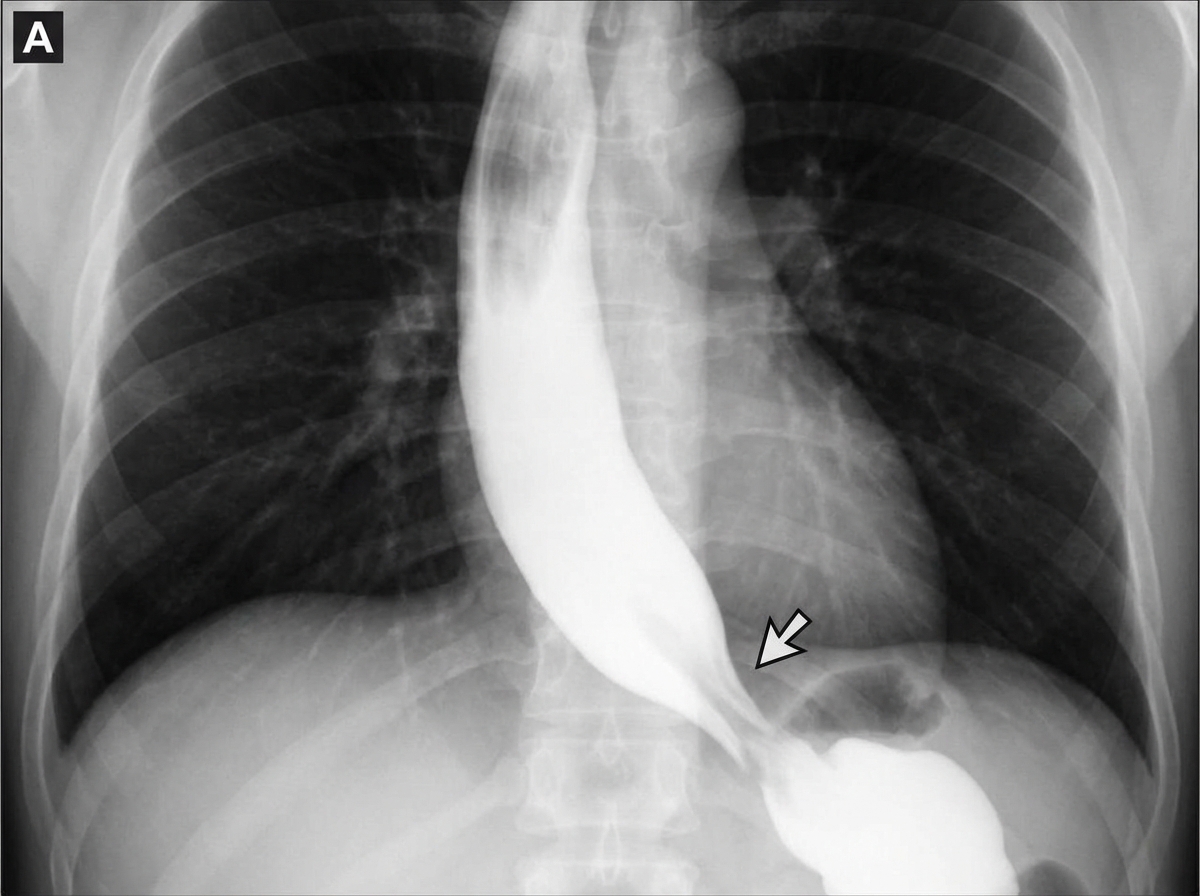
A 45-year-old woman comes to the physician because of progressive difficulty swallowing solids and liquids over the past 4 months. She has lost 4 kg (9 lb) during this period. There is no history of serious illness. She emigrated to the US from Panama 7 years ago. She does not smoke cigarettes or drink alcohol. Cardiopulmonary examination shows a systolic murmur and an S3 gallop. A barium radiograph of the chest is shown. Histopathologic examination of the esophageal wall is most likely to show which of the following?
A 55-year-old man comes to the emergency department because of left-sided chest pain and difficulty breathing for the past 30 minutes. His pulse is 88/min. He is pale and anxious. Serum studies show increased cardiac enzymes. An ECG shows ST-elevations in leads I, aVL, and V5-V6. A percutaneous coronary intervention is performed. In order to localize the site of the lesion, the catheter must pass through which of the following structures?
Want unlimited practice?
Get full access to all questions, explanations, and performance tracking.
Scan to download app