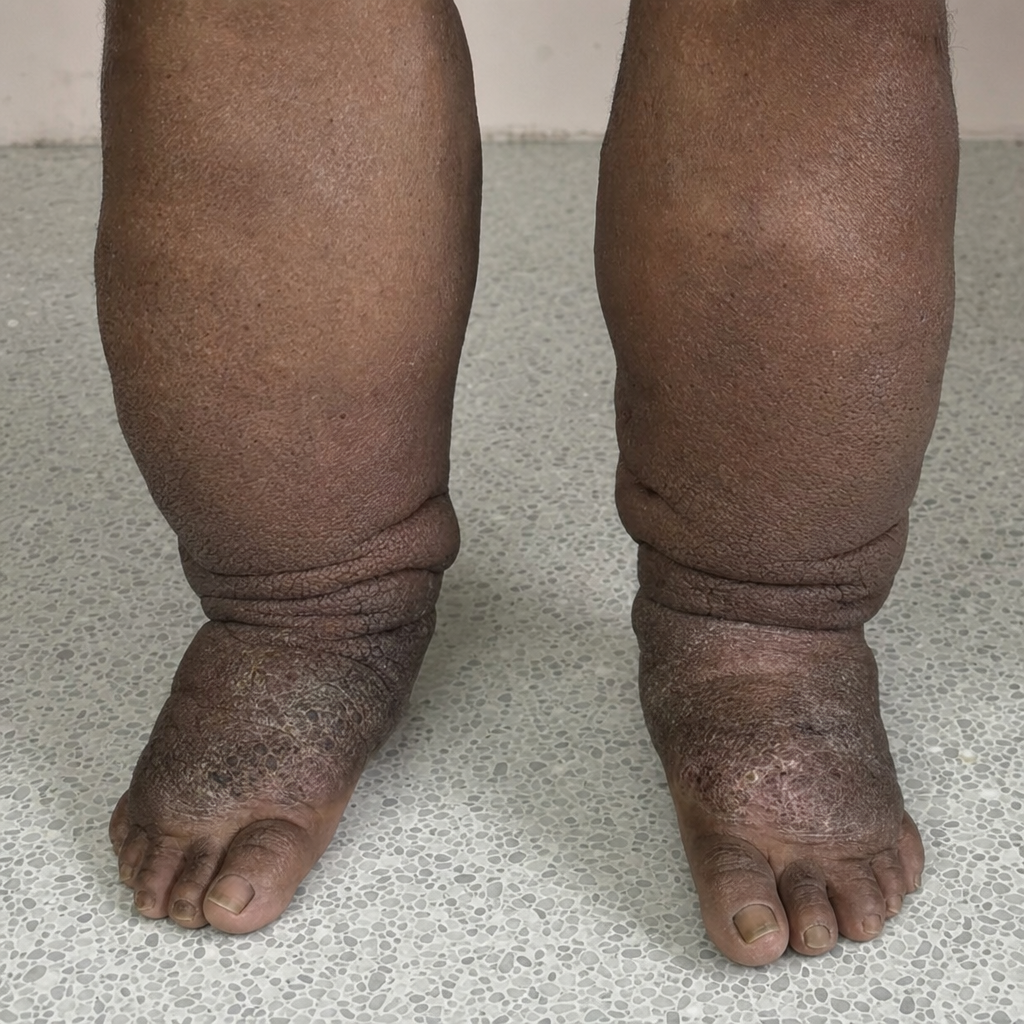
A 30-year-old woman in her last trimester of pregnancy suddenly develops massive swelling of the left lower extremity. Which of the following would be the most appropriate workup and treatment at this time?
Which of the following is false regarding Kasabach syndrome?
Visceral aneurysm is most commonly seen in which of the following locations?
What is the management of a case of iliac artery embolism?
A 50-year-old man with aortic stenosis is exercising for 11 minutes according to the Bruce protocol. Exercise stopped due to fatigue, and the transaortic pressure gradient is 60 mm Hg. What is the best management?
Which statement is true about aortic transaction?
Cirsoid aneurysm affects which of the following arteries?
Obstruction at the bifurcation of the aorta leads to which of the following clinical manifestations?
Which of the following statements about the SEPS procedure is false?
To create a porto-caval shunt in a patient with portal hypertension, which of the following venous anastomoses should be performed?
Explanation: This clinical scenario describes a classic presentation of **Deep Vein Thrombosis (DVT)** in pregnancy. Pregnancy is a hypercoagulable state due to increased clotting factors and venous stasis from the gravid uterus compressing the IVC. ### **1. Why Option B is Correct** * **Diagnosis:** **Duplex Ultrasonography** is the first-line investigation. It is non-invasive, highly sensitive/specific for proximal DVT, and involves no ionizing radiation, making it safe for the fetus. * **Management:** **Heparin** (specifically Low Molecular Weight Heparin - LMWH) is the treatment of choice. Heparin molecules are large and **do not cross the placenta**, ensuring no teratogenic effects or fetal hemorrhage. ### **2. Why Other Options are Incorrect** * **Option A:** **Venography** was once the gold standard but is now avoided in pregnancy due to significant radiation exposure to the fetus and the risk of contrast-induced complications. * **Option C:** A **Vena Caval Filter** is only indicated if there is a contraindication to anticoagulation (e.g., active bleeding) or if pulmonary embolism occurs despite adequate anticoagulation. It is not part of the initial routine workup. * **Option D:** **Warfarin (Coumadin)** is strictly **contraindicated** in pregnancy (especially the 1st and 3rd trimesters). It crosses the placenta and is teratogenic (Warfarin Embryopathy) and can cause fetal intraventricular hemorrhage. ### **3. NEET-PG High-Yield Pearls** * **Left-sided Predominance:** DVT in pregnancy occurs more commonly in the **left leg** (approx. 80%) due to the "May-Thurner" type effect, where the right common iliac artery compresses the left common iliac vein against the pelvic brim. * **Drug of Choice:** LMWH (e.g., Enoxaparin) is preferred over Unfractionated Heparin (UFH) due to a lower risk of Heparin-Induced Thrombocytopenia (HIT) and osteoporosis. * **Post-partum:** Warfarin can be started *after* delivery as it is safe during breastfeeding.
Explanation: **Explanation:** **Kasabach-Merritt Syndrome (KMS)** is a rare, life-threatening condition characterized by the association of a rapidly growing vascular tumor with **consumptive coagulopathy**. **1. Why Option B is the Correct Answer (The False Statement):** The hallmark of Kasabach-Merritt Syndrome is severe **consumptive coagulopathy**. Within the abnormal architecture of the vascular tumor, there is intense platelet sequestration and activation of the clotting cascade. This leads to the depletion of platelets, fibrinogen, and other clotting factors, often resulting in Disseminated Intravascular Coagulation (DIC). Therefore, stating that coagulopathy is absent is medically incorrect. **2. Analysis of Other Options:** * **Options A & C:** KMS typically arises as a complication of specific vascular tumors. While historically associated with "giant hemangiomas," it is now more accurately linked to **Kaposiform hemangioendothelioma** or **Tufted angioma**. * **Option D:** **Thrombocytopenia** is a cardinal feature. Platelets are trapped and destroyed within the tumor (sequestration), leading to profound low platelet counts and a high risk of spontaneous bleeding. **High-Yield Clinical Pearls for NEET-PG:** * **Classic Triad:** Large vascular tumor + Thrombocytopenia + Consumptive Coagulopathy (low fibrinogen, elevated D-dimer). * **Most Common Site:** Trunk and extremities; however, it can occur retroperitoneally. * **Treatment:** The first-line medical therapy is often **Sirolimus** (mTOR inhibitor) or Corticosteroids. Surgery is rarely feasible due to the infiltrative nature and bleeding risk. * **Distinction:** It is *not* usually seen with common infantile (strawberry) hemangiomas.
Explanation: **Explanation:** Visceral artery aneurysms (VAAs) are rare but clinically significant due to their risk of rupture. Among all visceral locations, the **Splenic artery** is the most common site, accounting for approximately **60%** of all visceral aneurysms. **1. Why Splenic Artery is Correct:** Splenic artery aneurysms (SAAs) are most frequently seen in women, particularly during pregnancy, due to hormonal changes (estrogen/progesterone) and increased portal congestion which weaken the arterial wall. Other risk factors include portal hypertension and medial fibromuscular dysplasia. They are often asymptomatic until they rupture, which classically presents as a "double-rupture" phenomenon into the lesser sac and then the peritoneal cavity. **2. Analysis of Incorrect Options:** * **Hepatic Artery (B):** This is the second most common site (approx. 20%). They are often associated with trauma, infection (mycotic), or vasculitis. * **Renal Artery (C):** These account for about 15-20% of cases. While significant, they are less frequent than splenic aneurysms. * **Coronary Artery (D):** These are not classified as "visceral" aneurysms in the standard surgical context; they are cardiac/vascular and are most commonly associated with Kawasaki disease in children or atherosclerosis in adults. **Clinical Pearls for NEET-PG:** * **Rule of 2cm:** Treatment (surgical or endovascular) for SAAs is generally indicated if the aneurysm is **>2 cm**, symptomatic, or if the patient is **pregnant/planning pregnancy** (due to high maternal and fetal mortality rates upon rupture). * **Most common site overall:** Splenic Artery. * **Most common cause of Hepatic Aneurysm:** Historically infection/trauma; currently, iatrogenic causes (post-procedure) are rising. * **Celiac Artery Aneurysms:** These are the rarest among the major visceral branches.
Explanation: **Explanation:** The management of acute limb ischemia caused by an arterial embolism is a surgical emergency. The definitive treatment for an **iliac artery embolism** is an **Embolectomy**, typically performed using a **Fogarty balloon catheter**. **1. Why Embolectomy is Correct:** An embolism causes sudden, complete mechanical obstruction of the vessel. To salvage the limb and prevent irreversible gangrene, the clot must be physically removed to restore distal perfusion. For iliac involvement, a retrograde embolectomy is usually performed via a femoral artery incision (Fogarty technique). This is the gold standard for large-vessel acute embolic events. **2. Why Other Options are Incorrect:** * **Injection of vasodilators:** While they may help reduce associated vasospasm, they cannot bypass or dissolve a large mechanical obstruction like an iliac embolus. * **Hypotensive therapy:** This is contraindicated. Maintaining adequate systemic blood pressure is vital to encourage collateral circulation. Hypotension would worsen ischemia. * **Sympathectomy:** This procedure aims to increase skin blood flow in chronic peripheral vascular disease (Buerger’s disease). It has no role in the acute management of a major arterial embolism. **Clinical Pearls for NEET-PG:** * **The 6 P’s of Acute Ischemia:** Pain, Pallor, Pulselessness, Paresthesia, Paralysis, and Poikilothermia (coldness). * **Fogarty Catheter:** The most important tool in embolectomy. It is usually inflated with saline or air. * **Time Window:** Irreversible muscle damage begins after **6 hours** of total ischemia. * **Source:** The most common source of an iliac embolus is the heart (Atrial Fibrillation or post-MI mural thrombus). * **Post-op:** Always monitor for **Reperfusion Injury** (Hyperkalemia, Myoglobinuria, and Compartment Syndrome).
Explanation: **Explanation:** The management of Aortic Stenosis (AS) is primarily guided by the presence of symptoms and the severity of the stenosis. In this clinical scenario, the patient is **asymptomatic** and has demonstrated high exercise tolerance (11 minutes on the Bruce protocol). **Why Observation is Correct:** According to current guidelines (AHA/ACC), the indications for Aortic Valve Replacement (AVR) in patients with severe AS (defined as a mean gradient ≥40 mmHg or peak velocity ≥4 m/s) are: 1. Presence of symptoms (angina, syncope, or dyspnea). 2. LVEF <50% in asymptomatic patients. 3. Development of symptoms during exercise testing or a drop in blood pressure during exercise. This patient completed 11 minutes of exercise (Stage 4 of Bruce protocol), which is an excellent functional capacity. The exercise was stopped due to **fatigue**, which is a normal physiological response to high-intensity exercise, not a pathological symptom of AS. Since the patient remains asymptomatic even under stress, **Observation** (watchful waiting) is the gold standard. **Why other options are incorrect:** * **Angiogram:** Not indicated unless the patient is being planned for surgery or there is a suspicion of CAD. * **Aortic Valve Replacement (AVR):** Premature in an asymptomatic patient with good exercise tolerance. Surgery carries risks that outweigh the benefits in this specific case. * **Aortic Balloon Valvuloplasty:** This is generally a palliative measure or a "bridge to surgery" in hemodynamically unstable patients or those who are not candidates for surgical/transcatheter replacement. **Clinical Pearls for NEET-PG:** * **Severe AS Criteria:** Jet velocity ≥4 m/s, Mean gradient ≥40 mmHg, or Valve area ≤1.0 cm². * **The "Classic Triad" of AS symptoms:** Dyspnea (worst prognosis), Syncope, and Angina. * **Exercise Testing:** It is contraindicated in *symptomatic* severe AS but is recommended in *asymptomatic* patients to unmask symptoms or assess exercise-induced BP changes.
Explanation: **Explanation:** **Aortic Transection** (Traumatic Aortic Disruption) is a life-threatening emergency typically resulting from blunt chest trauma. **1. Why Option A is correct:** The primary mechanism is a **sudden deceleration injury** (e.g., high-speed motor vehicle accidents or falls from heights). During deceleration, the mobile heart and ascending aorta move forward, while the descending aorta is fixed to the posterior chest wall. This creates a powerful **shearing force** at the **Aortic Isthmus** (the junction between the fixed arch and mobile descending aorta, just distal to the left subclavian artery), which is the most common site of injury (90%). **2. Why other options are incorrect:** * **Option B:** While mortality is high (80% die at the scene), the question asks for the "most true" characteristic regarding its nature/etiology. In modern exams, "High mortality" is considered a clinical outcome rather than a defining diagnostic feature. * **Option C:** While surgery was historically the definitive treatment, **Endovascular Aneurysm Repair (TEVAR)** has now become the preferred first-line management over open surgery due to lower morbidity. * **Option D:** **CT Angiography (CTA)** is now the gold standard and investigation of choice due to its high sensitivity and speed. Conventional aortography is invasive and rarely used today. **Clinical Pearls for NEET-PG:** * **Most common site:** Aortic Isthmus (distal to the origin of the left subclavian artery). * **X-ray findings:** Widened mediastinum (>8cm), loss of aortic knob contour, and deviation of the nasogastric tube to the right. * **Management:** Initial stabilization involves "permissive hypotension" (keeping SBP ~100 mmHg) using Beta-blockers (Esmolol) to prevent complete rupture before definitive TEVAR.
Explanation: **Explanation:** A **Cirsoid aneurysm** is not a true aneurysm but rather a rare, acquired **arteriovenous malformation (AVM)** or fistula occurring in the scalp. It consists of a direct communication between high-pressure arteries and low-pressure veins without an intervening capillary bed. **Why "All of the above" is correct:** The scalp is highly vascular, and these malformations are typically fed by the major branches of the external carotid artery. The **superficial temporal artery** is the most common feeder, but the **occipital artery** and **posterior auricular artery** are frequently involved, often simultaneously. Because these lesions are usually multi-pedicular (supplied by multiple vessels), all the listed arteries can be affected. **Clinical Features & High-Yield Facts:** * **Presentation:** It presents as a pulsatile, "worm-like" swelling under the scalp (hence the name *cirsoid*, meaning "varix-like"). * **Pathognomonic Signs:** Patients often complain of a persistent headache or a "bruit" (rushing sound) in the ear. On examination, a **palpable thrill** and an audible bruit are present. * **Diagnostic Clue:** The swelling characteristically empties on pressing the feeding vessels and refills rapidly upon release. * **Management:** Pre-operative angiography is essential to map the feeders. Treatment involves surgical excision or endovascular embolization. **NEET-PG Pearl:** While the **superficial temporal artery** is the *most common* single artery involved, in the context of a "Which of the following" question, remember that cirsoid aneurysms are typically **multi-arterial** involving any or all branches of the external carotid artery supplying the scalp.
Explanation: This question refers to **Leriche Syndrome** (Aortoiliac Occlusive Disease), a classic high-yield topic in vascular surgery. ### **Explanation of the Correct Answer** Obstruction at the bifurcation of the aorta (where it divides into the common iliac arteries) results in decreased blood flow to the internal and external iliac arteries. * The **internal iliac arteries** supply the pelvic muscles and gluteal region. * Ischemia in these muscle groups during exercise manifests as **claudication of the buttocks and thighs**. The classic **Leriche Syndrome triad** consists of: 1. **Claudication** of the buttocks, hips, or thighs. 2. **Erectile dysfunction** (due to decreased flow in the internal pudendal artery). 3. **Absent or diminished femoral pulses.** ### **Analysis of Incorrect Options** * **B. Retrograde ejaculation:** This is typically a complication of nerve damage (e.g., post-prostatectomy or sympathetic nerve injury during retroperitoneal surgery), not arterial occlusion. Leriche syndrome causes erectile dysfunction (impotence), not retrograde ejaculation. * **C. Gangrene:** While chronic limb-threatening ischemia can lead to gangrene, it is usually a late-stage manifestation of distal disease. Aortoiliac obstruction often presents earlier with proximal claudication due to the development of collateral circulation. * **D. Pallor of the lower limb:** While pallor can occur upon elevation in chronic ischemia (Buerger’s test), it is a non-specific sign of peripheral arterial disease and not as characteristic of aortic bifurcation obstruction as proximal claudication. ### **Clinical Pearls for NEET-PG** * **Level of Obstruction vs. Symptoms:** * Aortoiliac: Buttock/Thigh claudication. * Femoropopliteal: Calf claudication (most common). * Distal (Tibial): Foot claudication. * **Gold Standard Investigation:** Digital Subtraction Angiography (DSA), though CT Angiography is the initial imaging of choice. * **Management:** Risk factor modification (smoking cessation) and exercise are first-line; surgical bypass (Aortobifemoral) or endovascular stenting is indicated for severe symptoms.
Explanation: **Explanation:** **SEPS (Subfascial Endoscopic Perforator Surgery)** is a minimally invasive surgical technique used to treat chronic venous insufficiency (CVI), specifically targeting incompetent perforating veins. **1. Why Option C is the Correct (False) Statement:** The fundamental principle of SEPS is to ligate perforating veins in the **subfascial space** (the space between the deep fascia and the muscle). In this procedure, an endoscope and instruments are inserted beneath the deep fascia. Therefore, the vascular clips are applied to the perforators **below the level of the deep fascia**, not above it. Applying clips above the fascia would fail to address the segment of the vein that connects the superficial and deep systems. **2. Analysis of Other Options:** * **Option A:** This is true. SEPS is specifically indicated for patients with **incompetent perforators**, especially those with advanced venous disease (CEAP classes C4–C6) like venous ulcers or lipodermatosclerosis. * **Option B:** This is true. The procedure utilizes a **laparoscopic-like setup** with a camera (endoscope) and a balloon dissector to create space under the fascia, allowing for visualization and ligation of the veins. **Clinical Pearls for NEET-PG:** * **Indication:** Primarily used for **venous ulcers (CEAP C6)** where traditional open surgery (Linton’s procedure) is avoided due to high wound complication rates in diseased skin. * **Advantage over Linton’s:** SEPS significantly reduces wound infection and skin necrosis because the incisions are made in healthy proximal skin, away from the ulcer site. * **Contraindications:** Arterial insufficiency (ABI < 0.5) and deep vein thrombosis (DVT). * **Key Anatomy:** Perforators connect the superficial system (Great/Small Saphenous) to the deep system (Femoral/Popliteal) by piercing the deep fascia.
Explanation: **Explanation:** The primary goal of a porto-caval shunt is to decompress the portal venous system by diverting blood into the systemic circulation (Inferior Vena Cava - IVC). **Why Option D is Correct:** The **Left splenic vein to left renal vein** anastomosis is known as the **Warren Shunt (Distal Splenorenal Shunt)**. This is a selective shunt where the splenic vein is disconnected from the portal vein and joined to the left renal vein. It selectively decompresses esophageal varices while maintaining portal blood flow to the liver, thereby reducing the risk of hepatic encephalopathy compared to total shunts. **Analysis of Incorrect Options:** * **Option A:** Connecting the superior mesenteric vein to the inferior mesenteric vein is a **porto-portal** anastomosis. It does not provide a systemic outlet and thus cannot decompress the portal system. * **Option B:** The right and left gastric veins are both components of the portal system. Joining them does not create a shunt into the systemic circulation. * **Option C:** While this connects a portal tributary to the IVC, it is not a standard surgical procedure. The right gastric vein is typically too small for a technically feasible or hemodynamically significant shunt. **High-Yield Clinical Pearls for NEET-PG:** * **Non-selective Shunts:** Include the **Eck Shunt** (End-to-side Portacaval) and the **Side-to-side Portacaval Shunt**. These carry a high risk of hepatic encephalopathy. * **TIPS (Transjugular Intrahepatic Portosystemic Shunt):** A radiological procedure connecting the hepatic vein to a branch of the portal vein. It is the preferred treatment for refractory variceal bleeding. * **H-Shunt:** A synthetic graft (usually PTFE) placed between the Superior Mesenteric Vein (SMV) and the IVC.
Atherosclerotic Disease
Practice Questions
Aortic Aneurysms
Practice Questions
Peripheral Arterial Disease
Practice Questions
Carotid Artery Disease
Practice Questions
Venous Thromboembolism
Practice Questions
Chronic Venous Insufficiency
Practice Questions
Mesenteric Vascular Disease
Practice Questions
Vascular Trauma
Practice Questions
Vascular Access for Hemodialysis
Practice Questions
Endovascular Techniques
Practice Questions
Diabetic Foot Vascular Disease
Practice Questions
Vasculitis
Practice Questions
Get full access to all questions, explanations, and performance tracking.
Start For Free