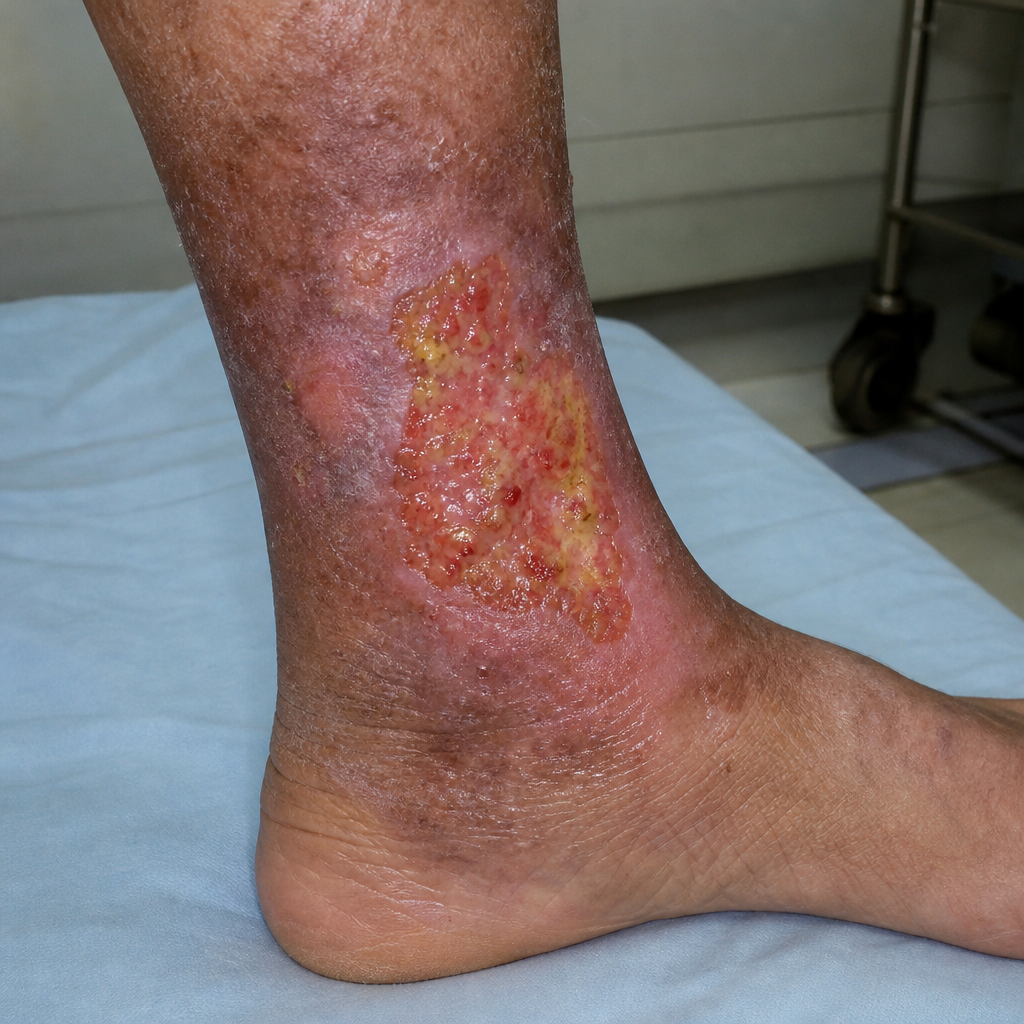
All of the following are true about embolic arterial occlusion except?
What is the most frequent complication after resection of a carotid body tumor?
Which one of the following is the investigation of choice for suspected deep vein thrombosis of the lower extremity?
Which of the following is NOT true about Buerger’s disease?
What is the mortality rate of emergency operations for abdominal aortic aneurysms?
Burger disease is associated with which of the following?
Pulsating varicose veins in a young adult are most commonly due to which of the following?
What is the most common cause of morbidity and mortality in patients undergoing major vascular surgery?
According to Boyd classification of intermittent claudication, in which grade is rest pain observed?
A useful though temporary improvement in a patient's ischaemic foot can be attained by giving intravenously?
Explanation: In acute arterial occlusion caused by an embolus, the sudden cessation of blood flow leads to rapid tissue ischemia. The correct answer is **B (Muscles are unaffected)** because it is a **false** statement; in reality, muscles are highly sensitive to ischemia and are severely affected. ### **Explanation of Options:** * **B. Muscles are unaffected (Correct Answer - False Statement):** Skeletal muscle is the tissue most vulnerable to ischemia in a limb. Within 4–6 hours of occlusion, muscle necrosis begins, leading to paralysis and "woody" hardness. If the occlusion is not relieved, irreversible damage occurs. * **A. No previous history:** Unlike thrombosis (which occurs over pre-existing atherosclerosis/claudication), an embolus is a sudden event. Patients typically have a "silent" vascular history but may have predisposing factors like Atrial Fibrillation. * **C. Pulse is absent:** This is a hallmark of acute limb ischemia. The pulse is absent distal to the site of the embolus (most commonly the femoral artery bifurcation). * **D. Anesthesia is present:** Ischemia affects peripheral nerves early, leading to paresthesia followed by complete anesthesia (loss of sensation). ### **Clinical Pearls for NEET-PG:** * **The 6 P’s of Acute Ischemia:** Pain, Pallor, Pulselessness, Paresthesia, Paralysis, and Poikilothermia (coldness). * **Most Common Source:** The heart (80%), usually due to Atrial Fibrillation or post-MI mural thrombus. * **Most Common Site of Impact:** Femoral artery bifurcation. * **Gold Standard Treatment:** Immediate anticoagulation with Heparin and surgical **Fogarty catheter embolectomy**. * **Time Sensitivity:** The "Golden Period" for limb salvage is **6 hours**. Beyond this, reperfusion injury and compartment syndrome become major risks.
Explanation: **Explanation:** Carotid body tumors (CBTs) are paragangliomas located at the carotid bifurcation. Due to their proximity to several cranial nerves, surgical resection carries a high risk of nerve injury. **Why Superior Laryngeal Nerve (SLN) injury is the most frequent:** The **Superior Laryngeal Nerve (specifically the external branch)** is the most commonly injured nerve during CBT resection. This is because the nerve lies in very close proximity to the superior pole of the tumor and the carotid bifurcation. Injury often occurs during the dissection of the upper limit of the tumor or during the ligation of feeding vessels from the external carotid artery. It manifests clinically as a change in voice pitch (inability to hit high notes) due to cricothyroid muscle paralysis. **Analysis of Incorrect Options:** * **A. First-bite syndrome:** This is a complication characterized by severe pain in the parotid region at the first bite of a meal. While it can occur after carotid or parapharyngeal space surgery (due to sympathetic chain injury), it is less frequent than SLN injury. * **B. Hypoglossal nerve injury:** The hypoglossal nerve (CN XII) is frequently encountered during surgery, but because it is a larger, more identifiable motor nerve, surgeons are often more cautious, making its injury rate lower than the more delicate SLN. * **C. Baroreceptor failure:** This occurs due to denervation of the carotid sinus. While it causes post-operative hypertension and tachycardia, it is a physiological disturbance rather than the most frequent anatomical nerve injury. **NEET-PG High-Yield Pearls:** * **Shamblin Classification:** Used to grade CBTs based on their involvement with the carotid vessels (Grade III is the most difficult to resect). * **Lyre Sign:** Characteristic radiological finding on angiography where the internal and external carotid arteries are splayed apart. * **Fontaine’s Sign:** The tumor is mobile horizontally but fixed vertically (due to its attachment to the carotid bifurcation). * **Pre-operative embolization:** Often performed 24–48 hours before surgery to reduce vascularity and minimize blood loss.
Explanation: **Explanation:** **Duplex Ultrasonography (Option D)** is the investigation of choice (IOC) for suspected Deep Vein Thrombosis (DVT) because it is non-invasive, highly sensitive (>95%), and specific. It combines B-mode imaging (to assess anatomical compressibility) and Doppler (to assess blood flow). The most reliable diagnostic sign of DVT on ultrasound is the **loss of vein compressibility**. **Analysis of Incorrect Options:** * **Radioactive labelled fibrinogen uptake (Option A):** This was historically used to detect forming clots but is no longer used clinically due to high false-positive rates, inability to detect established clots, and risk of blood-borne infections. * **Ascending contrast phlebography (Option B):** This is the **Gold Standard** investigation. However, it is invasive, painful, and carries risks like contrast allergy or inducing "post-venographic thrombosis." It is reserved for cases where Duplex USG is inconclusive. * **D-dimer estimation (Option C):** This is a highly sensitive but non-specific screening test. Its primary clinical utility lies in its **Negative Predictive Value**; a negative D-dimer helps rule out DVT in low-risk patients, but a positive result does not confirm it. **Clinical Pearls for NEET-PG:** * **Initial Screening:** D-dimer (best to rule out). * **Investigation of Choice:** Duplex Ultrasonography. * **Gold Standard:** Contrast Venography (Phlebography). * **Phlegmasia Alba Dolens:** "Milk leg" (early stage, pale limb due to spasm). * **Phlegmasia Cerulea Dolens:** "Blue leg" (advanced stage, cyanosis, risk of gangrene). * **Virchow’s Triad:** Stasis, Hypercoagulability, and Endothelial injury.
Explanation: **Explanation:** **Buerger’s Disease (Thromboangiitis Obliterans)** is a non-atherosclerotic, segmental, inflammatory disease that primarily affects young smokers. **1. Why Option A is the correct answer (The False Statement):** Buerger’s disease typically affects **young males**, usually **under the age of 40-45**. While the incidence in females is rising due to increased smoking, the classic demographic remains young men. Finding these symptoms in a patient over 50 suggests atherosclerosis rather than Buerger’s. **2. Analysis of other options:** * **Option B:** It is a vasculitis that characteristically involves **small and medium-sized arteries and veins** (e.g., radial, ulnar, tibial, and digital vessels). It is unique because it often involves adjacent veins and nerves (neurovascular bundle). * **Option C:** Unlike atherosclerosis, which predominantly affects the lower limbs, Buerger’s disease frequently involves **both upper and lower limbs**. Migratory superficial thrombophlebitis and Raynaud’s phenomenon are common early signs. **Clinical Pearls for NEET-PG:** * **Strongest Risk Factor:** Heavy tobacco use (smoking or chewing). Cessation is the only way to halt disease progression. * **Pathology:** Characterized by a **highly cellular, "organized" thrombus** with microabscesses, but the vessel wall architecture (internal elastic lamina) remains intact. * **Angiographic Finding:** **"Corkscrew collaterals"** (Martorell’s sign) around areas of occlusion. * **Clinical Triad:** Claudication (often of the foot/arch), Raynaud’s phenomenon, and migratory superficial thrombophlebitis. * **Allen’s Test:** Often positive, indicating involvement of the radial or ulnar arteries.
Explanation: **Explanation:** The mortality rate for an emergency operation for a ruptured Abdominal Aortic Aneurysm (AAA) remains high, typically around **50%**. This is due to the catastrophic nature of the event, which involves massive retroperitoneal or intraperitoneal hemorrhage, leading to profound hemorrhagic shock, coagulopathy, and multi-organ dysfunction syndrome (MODS). * **Why 50% is correct:** Despite advancements in vascular surgery and intensive care, the "rule of 50s" often applies to ruptured AAA: approximately 50% of patients die before reaching the hospital, and of those who undergo emergency surgery, approximately 50% do not survive the perioperative period. * **Why A (1%) and B (5%) are incorrect:** These figures represent the mortality rates for **elective (planned)** AAA repairs. Modern elective endovascular aneurysm repair (EVAR) has a mortality rate of ~1%, while open elective repair is approximately 3-5%. * **Why C (20%) is incorrect:** While 20% might represent the mortality of high-risk elective cases or symptomatic (but not yet ruptured) aneurysms, it significantly underestimates the lethality of a true emergency rupture. **Clinical Pearls for NEET-PG:** * **Classic Triad of Ruptured AAA:** Hypotension, pulsatile abdominal mass, and acute abdominal/back pain. * **Screening:** USG is the investigation of choice for screening; CT Angiography is the gold standard for surgical planning. * **Indications for Surgery:** Asymptomatic AAA >5.5 cm in men (>5.0 cm in women), or any aneurysm increasing in size by >0.5 cm in 6 months. * **Permissive Hypotension:** In ruptured AAA, maintaining a lower-than-normal blood pressure (systolic 70-90 mmHg) is often preferred pre-operatively to prevent dislodging a clot until the aorta is clamped.
Explanation: **Explanation:** **Buerger’s Disease (Thromboangiitis Obliterans - TAO)** is a non-atherosclerotic, segmental, inflammatory disease that most commonly affects small and medium-sized arteries and veins of the extremities. 1. **Why Smoking is Correct:** Tobacco use is the **primary etiologic factor** and a prerequisite for diagnosis. The disease is thought to be an immune-mediated hypersensitivity reaction to tobacco constituents. Smoking leads to endothelial dysfunction and inflammatory thrombi that cause vascular occlusion. Continued smoking is the strongest predictor of disease progression and limb loss, while complete cessation is the only effective treatment to prevent amputation. 2. **Why Other Options are Incorrect:** * **Alcoholism:** There is no established causal link between alcohol consumption and the pathogenesis of Buerger’s disease. * **Trauma:** While trauma can cause vascular injury, TAO is an inflammatory condition triggered by tobacco, not mechanical injury. * **Cold Environment:** Exposure to cold can exacerbate symptoms (Raynaud’s phenomenon is common in these patients), but it is a triggering factor for vasospasm rather than the underlying cause of the disease. **High-Yield Clinical Pearls for NEET-PG:** * **Patient Profile:** Typically young males (<45 years) who are heavy smokers. * **Clinical Triad:** Distal ischemia (claudication/rest pain), Raynaud’s phenomenon, and **Migratory Superficial Thrombophlebitis**. * **Angiographic Sign:** "Corkscrew collaterals" (Martorell’s sign) around the areas of occlusion. * **Pathology:** Characterized by "highly cellular, inflammatory thrombi" with relative sparing of the vessel wall (internal elastic lamina remains intact). * **Allen’s Test:** Often positive, indicating involvement of the radial or ulnar arteries.
Explanation: **Explanation:** **Arteriovenous (AV) Fistula** is the correct answer because it involves an abnormal direct communication between an artery and a vein, bypassing the capillary bed. In a young adult, this is often congenital or traumatic. Because arterial blood is under high pressure, it is shunted directly into the low-pressure venous system. This "arterialization" of the veins causes them to dilate (varicosities) and exhibit **visible pulsations** and a palpable thrill/bruit, which are pathognomonic features not seen in simple varicose veins. **Why other options are incorrect:** * **Saphenofemoral Incompetence:** This is the most common cause of standard varicose veins due to valvular failure. While it causes venous engorgement and reflux, the pressure remains venous; therefore, the veins do not pulsate. * **Deep Vein Thrombosis (DVT):** DVT typically leads to secondary varicose veins (post-thrombotic syndrome) due to outflow obstruction and valvular damage. These veins are distended but non-pulsatile. * **Abdominal Tumor:** A tumor (e.g., pelvic mass) can cause varicose veins by compressing the iliac veins or IVC, leading to proximal obstruction. This results in venous hypertension, but not pulsation. **NEET-PG High-Yield Pearls:** * **Nicoladoni-Branham Sign:** Bradycardia occurring upon manual compression of the feeding artery of an AV fistula (due to a sudden increase in peripheral resistance and reflex vagal stimulation). * **Clinical Triad of Congenital AVF:** Port-wine stain, limb hypertrophy, and varicose veins (often associated with **Klippel-Trenaunay Syndrome**). * **Investigation of Choice:** Duplex Ultrasound is the initial screen, but **Digital Subtraction Angiography (DSA)** remains the gold standard for anatomical mapping.
Explanation: **Explanation:** **Cardiac complications** are the leading cause of both perioperative morbidity and mortality in patients undergoing major vascular surgery (e.g., aortic aneurysm repair, carotid endarterectomy, or peripheral bypass). **Why Cardiac Complications are the Correct Answer:** Patients requiring major vascular surgery typically suffer from systemic **atherosclerosis**. The same disease process affecting the peripheral or aortic vessels is almost always present in the coronary arteries. The physiological stress of major surgery—including massive fluid shifts, blood loss, and the hemodynamic "clamping and unclamping" of major vessels—places an immense strain on the myocardium. This often triggers myocardial infarction, arrhythmias, or congestive heart failure, which account for the majority of postoperative deaths. **Why Other Options are Incorrect:** * **Renal complications:** While acute kidney injury (AKI) is a significant risk, especially in aortic surgery due to suprarenal clamping or contrast use, it is less common as a primary cause of death compared to cardiac events. * **Thromboembolic phenomenon:** While DVT and PE are risks in any major surgery, aggressive prophylaxis protocols in vascular units have reduced their contribution to overall mortality. * **Coagulopathies:** These are usually a consequence of massive transfusion or intraoperative blood loss. While they complicate the surgical course, they are generally manageable and rarely the primary cause of long-term morbidity/mortality. **High-Yield Clinical Pearls for NEET-PG:** * **Goldman’s Cardiac Risk Index** or the **Revised Cardiac Risk Index (RCRI)** are used preoperatively to assess these patients. * **Beta-blockers and Statins:** Often continued or initiated perioperatively to reduce the risk of adverse cardiac events. * **Most common cause of late death** (years after surgery) in vascular patients is also Myocardial Infarction.
Explanation: **Explanation:** The **Boyd Classification** is a clinical grading system used to assess the severity of chronic limb-threatening ischemia based on the patient's symptoms, specifically focusing on the progression of claudication to rest pain. * **Grade 1:** The patient experiences mild claudication. They can walk an indefinite distance, but discomfort occurs after a certain point. * **Grade 2:** The patient experiences moderate claudication. They can walk a limited distance (usually 100–200 yards) before pain forces them to stop. * **Grade 3:** The patient experiences severe claudication. The walking distance is significantly limited (less than 50 yards), and the pain is intense. * **Grade 4 (Correct):** This represents the most advanced stage where **rest pain** occurs. The blood supply is so compromised that it cannot meet the metabolic demands of the tissues even at rest. This pain is typically worse at night and may be relieved by hanging the foot over the side of the bed (utilizing gravity). **Why other options are incorrect:** * **Grades 1, 2, and 3** all describe varying degrees of **intermittent claudication** (pain on exercise relieved by rest). In these stages, the collateral circulation is sufficient to maintain tissue viability at rest, thus rest pain is absent. **High-Yield Clinical Pearls for NEET-PG:** * **Fontaine Classification:** A more commonly asked alternative. Stage I (Asymptomatic), Stage II (Claudication), Stage III (Rest pain), Stage IV (Ulceration/Gangrene). * **Rutherford Classification:** Uses a 0-6 scale (Category 4 is rest pain, similar to Boyd Grade 4). * **Rest Pain Location:** Usually felt in the forefoot and toes, not the calf. * **Critical Limb Ischemia (CLI):** Defined by the presence of rest pain for >2 weeks or the presence of ulcers/gangrene.
Explanation: **Explanation:** In patients with acute or chronic limb-threatening ischemia, the primary goal is to improve microcirculatory perfusion. **Dextran 40** (Low Molecular Weight Dextran) is the correct choice because it acts as a **rheological agent**. It improves blood flow through the following mechanisms: 1. **Reduction of Blood Viscosity:** It expands plasma volume and hemodilutes the blood. 2. **Anti-platelet Effect:** It coats platelets and the vascular endothelium, reducing platelet aggregation. 3. **Prevention of Sludging:** It increases the electronegativity of red blood cells (RBCs), causing them to repel each other, which prevents "rouleaux formation" and microvascular plugging. **Analysis of Incorrect Options:** * **10% Mannitol:** An osmotic diuretic used primarily to reduce intracranial or intraocular pressure. While it can reduce tissue edema in compartment syndrome, it does not provide the specific rheological benefits required for ischemic limb salvage. * **10% Dextrose:** A hypertonic glucose solution used for calorie supplementation or treating hypoglycemia. It has no significant effect on microcirculation or blood viscosity. * **Dextran 100:** This is a high molecular weight dextran. Unlike Dextran 40, higher molecular weight dextrans can actually *increase* blood viscosity and promote RBC aggregation, which would worsen ischemia. **Clinical Pearls for NEET-PG:** * **Dextran 40** is also known as **Rheomacrodex**. * **Side Effects:** The most serious side effect of Dextran is **anaphylaxis**. It can also cause acute renal failure (due to tubular plugging) and bleeding diathesis. * **Contraindication:** It should be avoided in patients with congestive heart failure (due to volume overload) and pre-existing renal impairment.
Atherosclerotic Disease
Practice Questions
Aortic Aneurysms
Practice Questions
Peripheral Arterial Disease
Practice Questions
Carotid Artery Disease
Practice Questions
Venous Thromboembolism
Practice Questions
Chronic Venous Insufficiency
Practice Questions
Mesenteric Vascular Disease
Practice Questions
Vascular Trauma
Practice Questions
Vascular Access for Hemodialysis
Practice Questions
Endovascular Techniques
Practice Questions
Diabetic Foot Vascular Disease
Practice Questions
Vasculitis
Practice Questions
Get full access to all questions, explanations, and performance tracking.
Start For Free