A 67-year-old man presents with a 3.0x3.5 cm abdominal aortic aneurysm detected by community ultrasound screening. Physical examination reveals a palpable, pulsatile, nontender abdominal mass just above the umbilicus. The patient has a history of hypertension, hyperlipidemia, and tobacco use. What is the best recommendation for this patient?
Lumbar sympathectomy is of value in the management of which of the following conditions?
Buerger's disease is not associated with which of the following?
A 83-year-old retired navy general shows improvement in claudication following aortoiliac bypass surgery. What is the factor that would cause the greatest concern over the possibility of developing cardiac complications?
Lipodermatosclerosis is most commonly seen at which aspect of the leg?
What is the most common cause of upper limb lymphedema?
What is the treatment of choice in recurrent venous thrombosis leading to pulmonary embolism despite intensive anticoagulation?
An arteriovenous fistula can be safely ligated if which of the following tests is positive?
Which of the following is not a sclerosing agent?
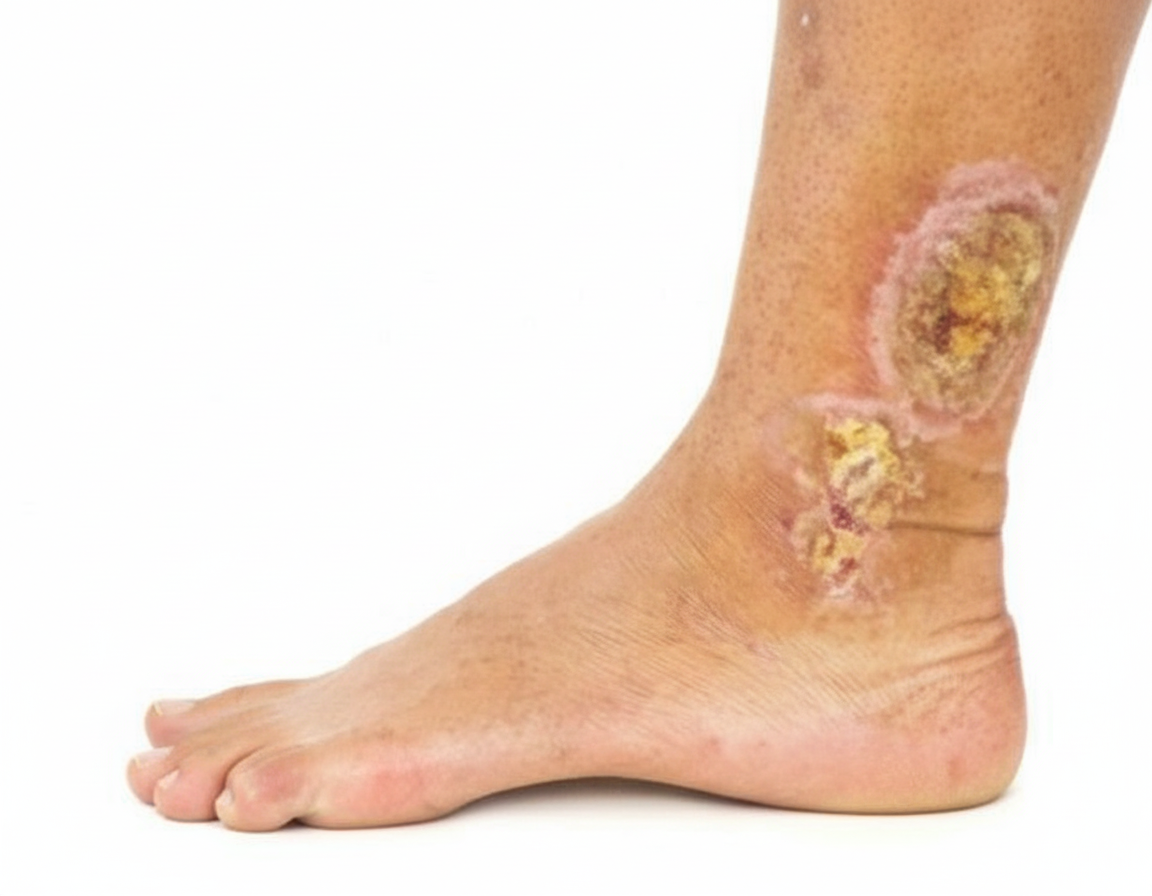
Which of the following is NOT indicated for an arterial leg ulcer?
Explanation: ### Explanation **1. Why Option C is Correct:** The management of an Abdominal Aortic Aneurysm (AAA) is primarily determined by the risk of rupture versus the risk of operative mortality. For asymptomatic patients, the threshold for elective surgical intervention (Open or EVAR) is a **diameter ≥ 5.5 cm in men** (and ≥ 5.0 cm in women). This patient’s aneurysm is **3.5 cm**, which falls into the category of "small AAA." Current guidelines recommend **serial surveillance** via ultrasound or CT. For an aneurysm of 3.0–3.9 cm, ultrasound every 12 months is the standard protocol. **2. Why Other Options are Incorrect:** * **Option A:** Waiting for abdominal pain is dangerous. Pain often signifies expansion or impending rupture, which carries a mortality rate of over 80%. Surgery should be elective before symptoms occur. * **Option B:** Surgery is not indicated for a 3.5 cm aneurysm regardless of risk factors. While tobacco use and hypertension increase the rate of expansion, they do not change the initial size threshold for surgery. * **Option D:** Renal artery involvement (suprarenal vs. infrarenal) dictates the *surgical technique* and complexity, but it is not the *determinant* for whether surgery is indicated. Size and growth rate remain the primary triggers. **3. NEET-PG High-Yield Pearls:** * **Definition:** AAA is a permanent focal dilation of the aorta >1.5 times its normal diameter (usually **>3 cm**). * **Indications for Surgery:** 1. Diameter **≥ 5.5 cm** (Men) or **≥ 5.0 cm** (Women). 2. Rapid expansion: **>0.5 cm in 6 months** or **>1 cm in 1 year**. 3. Any **symptomatic** aneurysm (pain/tenderness) regardless of size. * **Risk Factors:** Smoking is the strongest risk factor for development and expansion. * **Screening:** A one-time USG screening is recommended for men aged 65–75 who have ever smoked.
Explanation: **Explanation:** Lumbar sympathectomy involves the excision of the 2nd, 3rd, and 4th lumbar sympathetic ganglia. This procedure results in the permanent abolition of sympathetic vasoconstrictor tone to the lower limbs, leading to **vasodilation of the cutaneous vessels**. **Why Option B is Correct:** The primary effect of sympathectomy is on the **skin circulation** rather than the muscle. By reducing vasomotor tone, it increases collateral blood flow to the skin. Therefore, it is most effective in managing **rest pain**, superficial ulceration, and **distal ischemia affecting the toes** (pre-gangrenous states), particularly in patients with Buerger’s disease (TAO) or those unsuitable for reconstructive surgery. **Why Other Options are Incorrect:** * **A. Intermittent Claudication:** This is caused by ischemia in the **skeletal muscles** during exercise. Sympathectomy does not increase blood flow to the muscles (which is regulated by metabolites rather than the sympathetic system); hence, it has no role in treating claudication. * **C. Arteriovenous (AV) Fistula:** This is a structural communication between an artery and a vein. Management is surgical (excision or endovascular), and sympathectomy has no physiological basis here. * **D. Back Pain:** Lumbar sympathectomy is not a treatment for musculoskeletal or neurological back pain. **High-Yield Clinical Pearls for NEET-PG:** 1. **Selection Criteria:** A successful outcome can be predicted by a **Chemical Sympathectomy** (Phenol/Alcohol block) or by measuring a rise in skin temperature after a trial block. 2. **Buerger’s Disease:** Lumbar sympathectomy is most frequently indicated in **Thromboangiitis Obliterans (TAO)** where distal vessels are involved. 3. **Key Side Effect:** In males, bilateral excision of the **L1 ganglion** may lead to **loss of ejaculation** (though L2-L4 are usually targeted to avoid this). 4. **Post-sympathectomy Neuralgia:** A common complication involving pain in the groin or thigh, usually resolving spontaneously.
Explanation: **Explanation:** **Buerger’s Disease (Thromboangiitis Obliterans - TAO)** is a non-atherosclerotic, segmental, inflammatory disease that primarily affects the **small and medium-sized arteries** and veins of the upper and lower extremities. 1. **Why Option C is the Correct Answer:** Buerger’s disease characteristically spares large-sized arteries (like the aorta or iliac arteries). It is defined by its involvement of distal vessels, typically starting at the **tibial and radial arteries**. Therefore, the statement that it involves large-sized arteries primarily is incorrect. 2. **Analysis of Other Options:** * **Option A:** It classically affects **young males** (usually <40-45 years, often under 30) who are heavy smokers. * **Option B:** Unlike other vasculitides, TAO involves both arteries and veins. **Migratory superficial thrombophlebitis** is a hallmark clinical finding in about 40% of patients. * **Option C:** On angiography, while the disease is distal, proximal "corrugation" or a "standing wave" appearance can sometimes be seen in the femoral or brachial arteries due to sympathetic overactivity, though the classic finding is "corkscrew collaterals" (Martorell’s sign). **NEET-PG High-Yield Pearls:** * **Strongest Risk Factor:** Tobacco use (smoking or chewing) is essential for diagnosis and progression. * **Pathology:** Characterized by a **highly cellular, "inflammatory" thrombus** with relative sparing of the blood vessel wall (internal elastic lamina remains intact). * **Triad:** Distal ischemia (claudication/gangrene), Raynaud’s phenomenon, and Migratory superficial thrombophlebitis. * **Angiographic Sign:** "Corkscrew" collaterals (vessels of Martorell). * **Treatment:** Absolute smoking cessation is the only way to prevent amputation. Sympathectomy may be used for pain relief.
Explanation: **Explanation** In patients undergoing major vascular surgery (like aortoiliac bypass), the most significant predictor of perioperative cardiac morbidity and mortality is the presence of **congestive heart failure (CHF)**, clinically manifested as signs of left ventricular failure (e.g., S3 gallop, jugular venous distension, or pulmonary edema). **Why Option D is Correct:** According to the **Goldman Index of Cardiac Risk**, clinical signs of heart failure (specifically an S3 gallop or JVD) are the strongest preoperative predictors of life-threatening cardiac complications, carrying more weight than a history of MI or stable angina. Vascular surgery involves significant fluid shifts and "clamping/unclamping" stress, which a failing left ventricle cannot tolerate, leading to acute pulmonary edema or cardiogenic shock. **Analysis of Incorrect Options:** * **Option A:** While a history of MI (especially within 6 months) and angina are significant risk factors, they are statistically less predictive of immediate postoperative mortality than active, symptomatic heart failure. * **Option B:** An ejection fraction (EF) over 50% is considered normal and is actually a protective factor, indicating preserved systolic function. * **Option C:** While significant aortic stenosis is a major risk factor, it ranks lower than clinical signs of LV failure in most validated cardiac risk indices (like the Revised Cardiac Risk Index or Goldman’s). **Clinical Pearls for NEET-PG:** * **Goldman Index:** The highest-scoring (most dangerous) factors are **Signs of CHF (S3 gallop/JVD)** followed by a **Recent MI (within 6 months)**. * **Vascular Surgery Paradox:** Patients requiring vascular surgery almost always have systemic atherosclerosis; therefore, the "silent" cardiac status must be evaluated more rigorously than in general surgery. * **Eagle’s Criteria:** Often used for vascular patients; it identifies Q-waves, history of angina, ventricular arrhythmias, and diabetes as key risks.
Explanation: **Explanation:** Lipodermatosclerosis (LDS) is a hallmark of **Chronic Venous Insufficiency (CVI)**, specifically categorized as CEAP Class C4b. It represents a form of chronic panniculitis where the skin and subcutaneous fat become indurated and fibrotic due to long-standing venous hypertension. **Why the Medial Aspect of the Leg is Correct:** The medial aspect of the lower leg, specifically the area just above the medial malleolus (often called the **"Gaiter Zone"**), is the most common site for LDS. This is because the **Great Saphenous Vein (GSV)** and the **Cockett’s perforators** (which connect the superficial to the deep system) are located medially. In CVI, valvular incompetence leads to blood pooling and high pressure in these vessels. This pressure causes fibrin cuff formation and leukocyte sequestration, leading to the characteristic "woody" induration and the classic **"Inverted Champagne Bottle"** appearance of the leg. **Why Other Options are Incorrect:** * **Anterior aspect of leg:** While skin changes can spread, the primary pathology of venous hypertension rarely originates here as it lacks the dense network of incompetent perforators found medially. * **Anterior/Posterior aspect of thigh:** Venous hypertension is gravity-dependent. The hydrostatic pressure is highest at the ankle and decreases proximally; therefore, LDS is rarely, if ever, seen on the thigh. **High-Yield Clinical Pearls for NEET-PG:** * **Inverted Champagne Bottle Sign:** A pathognomonic sign where the lower leg is narrowed by fibrosis (LDS) while the calf above remains edematous. * **Gaiter Zone:** The area between the mid-calf and the malleoli; it is the most common site for both LDS and **venous ulcers**. * **CEAP Classification:** Remember that LDS is **C4b**, whereas simple hyperpigmentation/eczema is **C4a**. * **Treatment:** The mainstay of management is compression therapy (Grade II stockings) and treating the underlying venous reflux (e.g., EVLA or RFA).
Explanation: **Explanation:** The correct answer is **Filariasis (Option A)**. Lymphedema is caused by the obstruction or dysfunction of the lymphatic system, leading to the accumulation of protein-rich fluid in the interstitial space. Globally and in endemic regions like India, **Filariasis** (caused primarily by *Wuchereria bancrofti*) is the most common cause of secondary lymphedema for both upper and lower limbs. The adult worms reside in the lymph nodes and vessels, causing chronic inflammation, fibrosis, and eventual obstruction of the lymphatic flow. **Analysis of Incorrect Options:** * **B. Congenital abnormalities:** These cause *primary* lymphedema (e.g., Milroy’s disease). While significant, they are statistically much rarer than secondary causes like infection. * **C. Neck surgery:** While radical neck dissections can lead to localized edema of the face or neck, they are not a leading cause of generalized upper limb lymphedema. * **D. Post-mastectomy irradiation:** This is the most common cause of upper limb lymphedema in **developed/Western countries** due to the disruption of axillary lymph nodes. However, on a global scale and specifically in the context of Indian medical exams, Filariasis remains the leading etiology overall. **High-Yield Clinical Pearls for NEET-PG:** * **Stemmer’s Sign:** Inability to pinch the skin on the dorsal surface of the base of the second toe/finger; a pathognomonic sign of lymphedema. * **Investigation of Choice:** Lymphoscintigraphy is the gold standard for evaluating the lymphatic system. * **Stewart-Treves Syndrome:** A rare, highly aggressive angiosarcoma that develops in a limb with long-standing chronic lymphedema (most commonly post-mastectomy). * **Treatment:** The mainstay is Complex Decongestive Therapy (CDT), which includes manual lymphatic drainage and compression bandaging.
Explanation: ### **Explanation** The management of venous thromboembolism (VTE) primarily relies on anticoagulation. However, in specific scenarios where medical therapy fails or cannot be used, mechanical intervention is required. **Why Option D is Correct:** The primary indication for the insertion of an **Inferior Vena Cava (IVC) Filter** is to prevent life-threatening pulmonary embolism (PE) in patients where: 1. **Anticoagulation is contraindicated** (e.g., active major bleeding). 2. **Anticoagulation has failed** (recurrent PE despite therapeutic levels of anticoagulation, as seen in this question). 3. **Complications of anticoagulation** occur, necessitating its cessation. The filter acts as a mechanical sieve, trapping large emboli from the lower extremities before they reach the pulmonary circulation. **Why Other Options are Incorrect:** * **A. Fibrinolysis (tPA):** Indicated for "Massive PE" (hemodynamically unstable patients with hypotension). It dissolves existing clots but does not prevent recurrence in the setting of failed anticoagulation. * **B. Pulmonary Embolectomy:** A surgical or catheter-based intervention reserved for patients with massive PE who have contraindications to thrombolysis or where thrombolysis has failed. * **C. Pulmonary Thromboendarterectomy:** The definitive treatment for **Chronic Thromboembolic Pulmonary Hypertension (CTEPH)**, not acute recurrent PE. ### **Clinical Pearls for NEET-PG:** * **Most common site for IVC filter placement:** Just infra-renal (to prevent renal vein thrombosis). * **Most common complication:** Access site thrombosis; however, the most significant long-term risk is an increased incidence of **Deep Vein Thrombosis (DVT)**. * **Greenfield Filter:** A classic stainless steel, cone-shaped filter known for maintaining patency even when filled to 70% of its capacity. * **Absolute Contraindication for IVC Filter:** Total occlusion of the IVC.
Explanation: **Explanation:** The correct answer is **Allen’s Test**. In the context of vascular surgery, an arteriovenous (AV) fistula (often created for hemodialysis) typically involves the radial or brachial artery. Before ligating or surgically intervening on such a fistula, it is mandatory to ensure that the distal limb has adequate collateral circulation. **Allen’s Test** assesses the patency of the radial and ulnar arteries and the adequacy of the palmar arch. A "positive" (normal) Allen’s test indicates that the ulnar artery can independently maintain perfusion to the hand if the radial artery is compromised or ligated, making the procedure safe. **Analysis of Incorrect Options:** * **Henle-Coenen Sign:** This is used to assess collateral circulation *during* surgery for an aneurysm or AV fistula. After clamping the artery proximal to the lesion, if there is distal pulsation or back-bleeding, the sign is positive, suggesting ligation is safe. However, Allen's test is the standard non-invasive clinical test used for this purpose in the upper limb. * **Trendelenburg Test:** Used in the evaluation of varicose veins to assess the competency of the saphenofemoral valve and perforator veins. * **Schwartz Test (Tap Test):** Used to detect valvular incompetence in the great saphenous vein by tapping the vein and feeling for a transmitted impulse distally. **Clinical Pearls for NEET-PG:** * **Modified Allen’s Test:** Performed by compressing both radial and ulnar arteries, having the patient clench their fist until the palm blanches, then releasing the ulnar artery. Return of color within 5–15 seconds is normal. * **Nicoladoni-Branham Sign:** A diagnostic sign for AV fistula where bradycardia occurs upon manual compression of the fistula (due to sudden increase in peripheral resistance and baroreceptor reflex). * **Machinery Murmur:** The classic continuous murmur heard over an AV fistula.
Explanation: **Explanation:** Sclerotherapy is a medical procedure used to eliminate varicose veins and spider veins by injecting a **sclerosing agent** into the vessel. These agents cause controlled endothelial damage, leading to thrombosis, fibrosis, and eventual obliteration of the vascular lumen. **Why Sodium Bicarbonate is the Correct Answer:** **Sodium bicarbonate** is not a sclerosing agent. In clinical practice, it is primarily used as an alkalizing agent to treat metabolic acidosis or to neutralize the pH of local anesthetics (like lidocaine) to reduce the stinging sensation during injection. It does not possess the chemical properties required to induce endothelial destruction and venous fibrosis. **Analysis of Incorrect Options (Common Sclerosing Agents):** * **Sodium tetradecyl sulphate (STS):** The most commonly used detergent-based sclerosant. It works by disrupting the lipid molecules in the endothelial cell surface. * **Sodium morrhuate:** A mixture of sodium salts of saturated and unsaturated fatty acids derived from cod liver oil. It is a traditional sclerosant used for varicose veins and esophageal varices. * **Sodium psylliate:** A salt of fatty acids derived from the seeds of the psyllium plant (*Plantago ovata*), used historically as a sclerosing agent. **High-Yield Clinical Pearls for NEET-PG:** * **Classification:** Sclerosants are classified into **Detergents** (STS, Polidocanol), **Osmotic agents** (Hypertonic saline), and **Chemical irritants** (Chromated glycerin). * **Polidocanol:** Currently favored due to its low risk of skin necrosis and painless injection (it has local anesthetic properties). * **Complications:** The most feared complication of sclerotherapy is accidental **intra-arterial injection**, which can lead to gangrene. Other risks include deep vein thrombosis (DVT) and skin hyperpigmentation.
Explanation: **Explanation:** The management of arterial leg ulcers is fundamentally based on improving blood flow to the distal tissues. **Why Option B is the Correct Answer:** In arterial ulcers (caused by Peripheral Arterial Disease), the primary issue is inadequate arterial perfusion. **Elevation of the limb** further decreases hydrostatic pressure and reduces the gravitational assist to blood flow, worsening ischemia and increasing pain. This is the opposite of venous ulcers, where elevation is the mainstay of treatment to reduce edema. Patients with arterial ulcers often instinctively hang their legs over the side of the bed (dependent position) to use gravity to improve perfusion. **Why the other options are incorrect:** * **Debridement (A):** While aggressive debridement is avoided in dry gangrene until revascularization, conservative debridement of infected or necrotic tissue is often necessary to control infection and promote healing once the vascular status is assessed. * **Head end of the bed raised (C):** This is a standard recommendation for arterial insufficiency. By raising the head end (or placing the bed in a reverse Trendelenburg position), the legs remain in a **dependent position**, utilizing gravity to assist arterial flow to the feet. * **Low-dose aspirin (D):** Antiplatelet therapy is a cornerstone in managing peripheral arterial disease to prevent further thrombotic events and improve overall cardiovascular outcomes. **High-Yield Clinical Pearls for NEET-PG:** * **Pain:** Arterial ulcers are typically very painful (worse at night), whereas venous ulcers are often painless or dull aches. * **Location:** Arterial ulcers occur on pressure points, toes, or the lateral malleolus; Venous ulcers occur in the "gaiter area" (medial malleolus). * **Appearance:** Arterial ulcers have a "punched-out" appearance with a pale base; Venous ulcers have irregular borders with a beefy red granulation base. * **ABPI:** An Ankle-Brachial Pressure Index (ABPI) < 0.9 indicates PAD; < 0.5 indicates severe ischemia.
Atherosclerotic Disease
Practice Questions
Aortic Aneurysms
Practice Questions
Peripheral Arterial Disease
Practice Questions
Carotid Artery Disease
Practice Questions
Venous Thromboembolism
Practice Questions
Chronic Venous Insufficiency
Practice Questions
Mesenteric Vascular Disease
Practice Questions
Vascular Trauma
Practice Questions
Vascular Access for Hemodialysis
Practice Questions
Endovascular Techniques
Practice Questions
Diabetic Foot Vascular Disease
Practice Questions
Vasculitis
Practice Questions
Get full access to all questions, explanations, and performance tracking.
Start For Free