What is true about venous ulcers?
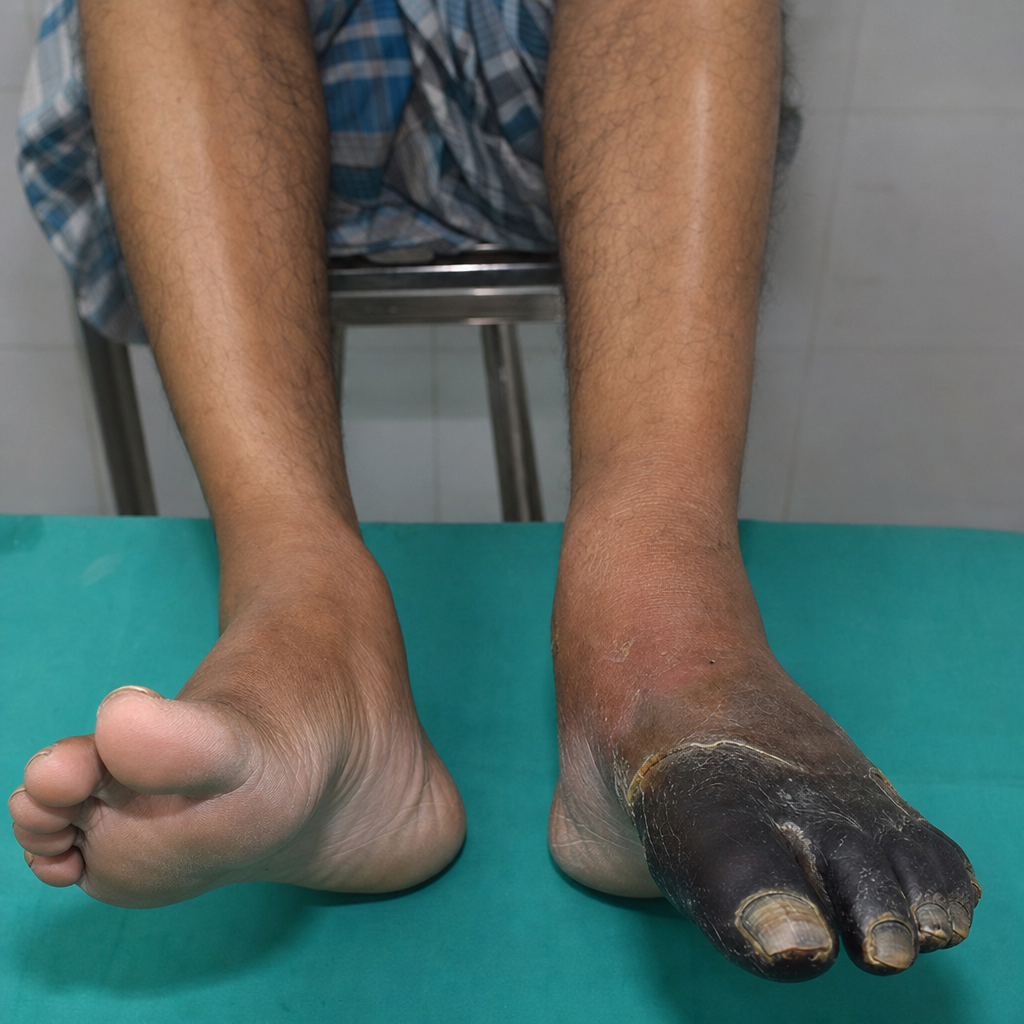
An adult patient presents with leg pain and gangrene of the toe. What would be their Ankle-Brachial Pressure Index (ABPI)?
Fogarty's catheter is used for what purpose?
Which of the following is true about primary lymphedema?
What is the minimum diameter of varicose veins?
Peripheral arterial occlusion (sudden onset) is characterized by all of the following except:
Which of the following is NOT a predisposing factor for chronic limb ischemia?
Which of the following is true about primary lymphedema?
A 56-year-old male with a history of severe coronary artery disease presents with rest leg pain and dyspnea on exertion (unable to walk two flights of steps). Evaluation revealed complete aortoiliac occlusive disease requiring surgical intervention. Which of the following surgical options is acceptable?
Abdominal aortic aneurysm is operated when the size is more than:
Explanation: **Explanation:** Venous ulcers (Gaiter’s ulcers) are the most common type of chronic lower limb ulcers, resulting from chronic venous insufficiency (CVI) and venous hypertension. **1. Why Option B is Correct:** The management of venous ulcers depends entirely on identifying the underlying site of reflux. It is mandatory to examine the **deep venous system** (usually via Duplex Ultrasound) to rule out Deep Vein Thrombosis (DVT) or deep system incompetence. If the deep system is occluded, performing surgery on the superficial system (like stripping) can be catastrophic, as the superficial veins may be the only remaining outflow tract for the limb. **2. Why the other options are incorrect:** * **Option A:** Stripping (of the Great Saphenous Vein) is only indicated if there is superficial venous reflux with a **patent** deep system. It is not "always" performed, especially if the ulcer is due to deep vein pathology or if the patient is unfit for surgery. * **Option C:** While a biopsy is necessary if malignancy (Marjolin’s ulcer) is suspected, it is **not** a routine requirement for every chronic venous ulcer unless it shows atypical features or fails to heal after 3–6 months of standard therapy. * **Option D:** Klippel-Trenaunay Syndrome is a triad of port-wine stains, varicose veins, and bony/soft tissue hypertrophy. While it involves veins, it is a congenital vascular malformation and is not the primary association for standard venous ulcers. **High-Yield Clinical Pearls for NEET-PG:** * **Location:** Typically found in the **"Gaiter Zone"** (medial malleolus). * **Investigation of Choice:** **Duplex Ultrasound** (to assess both superficial and deep systems). * **Gold Standard Treatment:** **Four-layer compression bandaging** (provided the Ankle-Brachial Pressure Index/ABPI is >0.8). * **Pathophysiology:** The "Fibrin Cuff Theory" and "Leukocyte Trapping" are the most accepted mechanisms for ulcer formation.
Explanation: **Explanation:** The **Ankle-Brachial Pressure Index (ABPI)** is a non-invasive tool used to screen for Peripheral Arterial Disease (PAD). It is calculated by dividing the systolic blood pressure at the ankle by the systolic blood pressure in the arm. **Why Option B is Correct:** A normal ABPI ranges from **0.9 to 1.3**. A value **less than 0.9** indicates PAD. The patient presents with **gangrene**, which signifies **Critical Limb Ischemia (CLI)**—the most severe stage of PAD. In CLI (Fontaine Stage IV or Rutherford Category 5/6), the ABPI is typically significantly reduced, often **below 0.5** (and frequently below 0.3 in cases of gangrene). Therefore, "Less than 0.9" is the only option that reflects an arterial deficit. **Analysis of Incorrect Options:** * **Option A & C:** Values between 0.9 and 1.3 are considered **normal**. A patient with gangrene has severe ischemia, which is incompatible with a normal pressure index. * **Option D:** An ABPI **greater than 1.3** suggests **non-compressible, calcified vessels** (Mönckeberg’s arteriosclerosis), commonly seen in long-standing diabetics and patients with end-stage renal disease. In these cases, the ABPI is falsely elevated and unreliable for diagnosis. **High-Yield Clinical Pearls for NEET-PG:** * **Normal ABPI:** 0.9 – 1.3 * **Mild to Moderate Claudication:** 0.5 – 0.9 * **Rest Pain:** < 0.5 * **Gangrene/Tissue Loss:** < 0.3 * **TBI (Toe-Brachial Index):** Used if ABPI is >1.3 (calcified vessels), as digital arteries are rarely calcified. A TBI < 0.7 is diagnostic of PAD. * **Gold Standard Investigation:** Digital Subtraction Angiography (DSA) is the gold standard, but Duplex Ultrasound is the initial investigation of choice.
Explanation: The **Fogarty catheter** is a specialized balloon-tipped catheter designed specifically for **embolectomy or thrombectomy**. ### Why Option B is Correct The catheter is used to remove acute arterial emboli or thrombi. The procedure involves inserting the catheter past the clot, inflating the small balloon at the tip with saline, and gently withdrawing it. As the inflated balloon is pulled back, it drags the obstructing clot out through the arteriotomy, restoring distal blood flow. This is a life-saving procedure in cases of **Acute Limb Ischemia**. ### Why Other Options are Incorrect * **A & C (Urethral catheterization/Bladder drainage):** These functions are performed by **Foley catheters** or **Malecot catheters**. While a Foley also has a balloon, it is designed for retention within the bladder, not for traction or clot removal. * **D (Total Parenteral Nutrition):** TPN requires central venous access via catheters like the **Hickman, Broviac, or PICC lines**, which are designed for long-term infusion into large-bore veins. ### High-Yield Clinical Pearls for NEET-PG * **Inventor:** Thomas J. Fogarty (1963). * **Sizing:** Fogarty catheters are sized using the **French scale** (e.g., 2F to 7F). A common rule of thumb is "3F for the arm, 4F for the leg." * **Balloon Inflation:** The balloon should always be inflated with **saline**, never air (to prevent air embolism if the balloon ruptures). * **Complications:** The most common complications include **intimal injury (dissection)**, arterial perforation, or distal fragmentation of the clot. * **Key Indication:** It is the gold standard for **Acute Arterial Embolism** (often secondary to Atrial Fibrillation).
Explanation: Primary lymphedema is a congenital abnormality of the lymphatic system resulting in hypoplasia, hyperplasia, or aplasia of lymphatic vessels. The classification is primarily based on the age of onset. **Explanation of the Correct Option:** * **Option B (Correct):** Primary lymphedema is classified into three types based on age: 1. **Lymphedema Congenita:** Present at birth or within the first 2 years. 2. **Lymphedema Praecox:** Onset between **2 and 35 years**. This is the most common type (80% of cases) and typically affects females during puberty. 3. **Lymphedema Tarda:** Onset **after 35 years**. *(Note: While the question marks B as correct, please note that standard surgical texts like Bailey & Love define 2–35 years as **Praecox**, and >35 years as **Tarda**. In some exam patterns, these terms may be swapped or tested specifically on the age cut-offs; always prioritize the age ranges 0-2, 2-35, and >35).* **Explanation of Incorrect Options:** * **Option A:** The prevalence of primary lymphedema is much lower than 2%, affecting approximately 1 in 6,000 to 10,000 individuals. * **Option C:** Onset >35 years indicates **Lymphedema Tarda**, not Praecox. * **Option D:** While Milroy’s disease is a form of primary lymphedema, it is specifically the **Congenital** type (autosomal dominant, VEGFR3 mutation). Since the question asks what is "true about primary lymphedema" as a general category, Option B (the classification) is the more definitive clinical definition tested. **High-Yield Clinical Pearls for NEET-PG:** * **Stemmer’s Sign:** Inability to pinch the skin on the dorsal surface of the base of the second toe; a pathognomonic sign of lymphedema. * **Milroy’s Disease:** Congenital lymphedema (onset <2 years). * **Meige’s Disease:** Lymphedema Praecox (onset at puberty/adolescence). * **Investigation of Choice:** Lymphoscintigraphy (Gold Standard). * **Treatment:** Primarily conservative (Complex Decongestive Therapy). Surgery (e.g., Charles procedure) is reserved for refractory cases.
Explanation: **Explanation:** The classification of chronic venous disorders is standardized using the **CEAP classification**. According to the international consensus (reiterated in the American Venous Forum and the Society for Vascular Surgery guidelines), the definition of a varicose vein is based on its diameter when measured in the upright position. * **Correct Answer: D (≥ 3mm):** By definition, **varicose veins** are subcutaneous, dilated, and tortuous veins that measure **3 mm or greater** in diameter. They typically involve the tributaries of the great or small saphenous veins but can also be non-saphenous. **Analysis of Incorrect Options:** * **Option A (≥ 1mm):** This refers to **Telangiectasias** (spider veins), which are confluent venules measuring **less than 1 mm** in diameter. They are located in the intradermal layer (CEAP Class C1). * **Option B (≥ 2mm):** This falls into the range of **Reticular veins**, which are defined as dilated bluish subdermal veins, usually **1 mm to < 3 mm** in size. They are also categorized under CEAP Class C1. * **Option C (≥ 4mm):** While varicose veins can certainly be 4 mm or larger, this is not the *minimum* threshold for the clinical definition. **High-Yield Clinical Pearls for NEET-PG:** * **CEAP Classification (Clinical Section):** * **C0:** No visible/palpable signs. * **C1:** Telangiectasia or reticular veins (< 3mm). * **C2:** Varicose veins (≥ 3mm). * **C3:** Edema. * **C4:** Skin changes (C4a: Pigmentation/Eczema; C4b: Lipodermatosclerosis). * **C5:** Healed venous ulcer. * **C6:** Active venous ulcer. * **Gold Standard Investigation:** Duplex Ultrasound (to assess for reflux at the saphenofemoral or saphenopopliteal junctions). * **Trendelenburg Test:** Used to differentiate between saphenofemoral incompetence and perforator incompetence.
Explanation: **Explanation:** Acute Peripheral Arterial Occlusion is a surgical emergency typically caused by an embolism or thrombosis. It is clinically diagnosed using the classic **"6 Ps"** mnemonic: **P**ain, **P**allor, **P**ulselessness, **P**aresthesia, **P**aralysis, and **P**oikilothermia (coldness). **Why Rubor is the Correct Answer (The "Except"):** **Rubor** (specifically "Dependent Rubor") is a feature of **Chronic Limb-Threatening Ischemia (CLTI)**, not acute occlusion. In chronic disease, arterioles remain chronically dilated to compensate for poor flow; when the limb is dangled, gravity fills these dilated vessels, causing a dusky red appearance. In **acute** occlusion, there is a sudden, total cessation of blood flow, leading to immediate **Pallor** (Option C) because the capillary bed is empty. **Analysis of Other Options:** * **Pain (Option D):** Usually the first symptom. It is sudden, severe, and located distal to the site of occlusion. * **Paresthesia (Option A):** Indicates ischemic injury to sensitive nerve fibers. Along with paralysis, it is a late sign suggesting a threatened limb that requires urgent intervention. * **Pallor (Option C):** The limb appears "waxy white" due to the lack of erythrocyte perfusion. **NEET-PG High-Yield Pearls:** * **Most common source of emboli:** Left Atrium (Atrial Fibrillation). * **Most common site of embolism:** Bifurcation of the Common Femoral Artery. * **Gold Standard Investigation:** Digital Subtraction Angiography (DSA). * **Management:** Immediate anticoagulation with IV Heparin, followed by surgical embolectomy (Fogarty catheter) or catheter-directed thrombolysis.
Explanation: **Explanation:** Chronic limb ischemia (CLI) is primarily caused by **atherosclerosis**, a systemic inflammatory process that leads to the narrowing and occlusion of peripheral arteries. To identify the correct answer, one must distinguish between established cardiovascular risk factors and unrelated metabolic markers. **1. Why Hyperbilirubinemia is the Correct Answer:** Hyperbilirubinemia (elevated bilirubin) is **not** a risk factor for atherosclerosis or chronic limb ischemia. In fact, several clinical studies suggest that mildly elevated serum bilirubin may have a **protective (antioxidant)** effect against oxidative stress and plaque formation. It is typically a marker of hepatobiliary disease or hemolysis, not vascular compromise. **2. Why the other options are incorrect (Predisposing Factors):** * **Diabetes Mellitus:** A major risk factor that accelerates atherosclerosis. It often leads to "distal" involvement (infrapopliteal vessels) and is associated with poor wound healing and neuropathy. * **Hyperlipidemia:** Elevated LDL and low HDL levels promote the formation of fatty streaks and atherosclerotic plaques within the arterial walls. * **Renal Insufficiency:** Chronic Kidney Disease (CKD) is a potent risk factor. It leads to medial arterial calcification (Mönckeberg’s sclerosis), increased systemic inflammation, and altered calcium-phosphate metabolism, all of which worsen limb ischemia. **Clinical Pearls for NEET-PG:** * **Strongest Risk Factor:** Cigarette smoking is the most significant modifiable risk factor for Peripheral Arterial Disease (PAD). * **Fontaine Classification:** Used to stage CLI (Stage I: Asymptomatic; Stage II: Claudication; Stage III: Rest pain; Stage IV: Ulceration/Gangrene). * **Ankle-Brachial Index (ABI):** An ABI < 0.9 is diagnostic of PAD; an ABI < 0.4 indicates critical limb ischemia. * **Other Factors:** Hypertension, hyperhomocysteinemia, and advancing age are also key predisposing factors.
Explanation: **Explanation:** Primary lymphedema results from congenital developmental abnormalities of the lymphatic system (aplasia, hypoplasia, or hyperplasia of lymphatics). It is classified based on the age of onset, and its association with specific genetic syndromes is a high-yield topic for NEET-PG. **Why Option D is Correct:** Primary lymphedema is associated with several hereditary syndromes. **Milroy’s disease** (Lymphedema Congenita) is a familial form of primary lymphedema that is present at birth or within the first year of life. It is typically inherited in an autosomal dominant pattern and is linked to mutations in the **VEGFR-3** gene. **Why Other Options are Incorrect:** * **Option A:** The prevalence of primary lymphedema is much lower than 2%, affecting approximately **1 in 6,000 to 10,000** individuals. Secondary lymphedema (e.g., post-filariasis or post-mastectomy) is far more common globally. * **Option B & C:** These options swap the clinical definitions. * **Lymphedema Praecox:** Onset between **1 and 35 years** (most common type, often occurring at puberty). * **Lymphedema Tarda:** Onset **after 35 years** of age. **High-Yield Clinical Pearls for NEET-PG:** 1. **Kinmonth Classification:** * *Congenital:* Birth to 1 year (e.g., Milroy’s Disease). * *Praecox:* 1 to 35 years (e.g., Meige’s Disease - familial type). * *Tarda:* After 35 years. 2. **Stemmer’s Sign:** Inability to pinch the skin on the dorsal surface of the base of the second toe; it is a pathognomonic physical finding for lymphedema. 3. **Imaging:** **Lymphoscintigraphy** is the gold standard investigation for confirming the diagnosis and assessing lymphatic flow. 4. **Complication:** Long-standing lymphedema can lead to **Stewart-Treves Syndrome** (lymphangiosarcoma).
Explanation: **Explanation:** The patient presents with **Leriche Syndrome** (aortoiliac occlusive disease) and significant comorbidities, specifically severe coronary artery disease (CAD) and poor functional capacity (dyspnea on exertion). The choice of surgical intervention is dictated by the patient's **surgical risk profile**. **1. Why Axillobifemoral Bypass is Correct:** This is an **extra-anatomical bypass**. It involves tunneling a graft subcutaneously from the axillary artery to the femoral arteries, completely avoiding the abdomen. Because it does not require a laparotomy or aortic cross-clamping—both of which cause massive hemodynamic stress and increase cardiac demand—it is the procedure of choice for **high-risk patients** (ASA class III/IV) who cannot tolerate major intra-abdominal surgery. **2. Why the other options are incorrect:** * **Aortobifemoral/Aortobililiac Bypass (Options A & B):** These are the "gold standard" for long-term patency in aortoiliac disease. However, they require a major laparotomy and aortic clamping. This patient’s severe CAD and inability to climb two flights of steps indicate a high risk for perioperative myocardial infarction or heart failure during such invasive procedures. * **Aortoiliac Angioplasty and Stent (Option C):** While endovascular options are preferred for focal lesions (TASC A/B), they are often technically unfeasible or provide poor outcomes for **complete** aortoiliac occlusion (TASC D), especially if the occlusion is extensive. **Clinical Pearls for NEET-PG:** * **Gold Standard for Aortoiliac Disease:** Aortobifemoral bypass (highest 10-year patency). * **Indication for Extra-anatomical Bypass:** High-risk cardiac status, active intra-abdominal infection (hostile abdomen), or previous multiple abdominal surgeries. * **Leriche Syndrome Triad:** Claudication (buttock/thigh), Impotence, and absent/diminished femoral pulses. * **TASC II Classification:** Used to decide between endovascular (TASC A/B) and open surgical (TASC C/D) management.
Explanation: **Explanation:** The management of an Abdominal Aortic Aneurysm (AAA) is based on balancing the risk of spontaneous rupture against the risks associated with surgical intervention (Open or EVAR). **Why 5.5 cm is the correct answer:** The risk of rupture increases exponentially with the diameter of the aneurysm. Clinical trials (such as the UK Small Aneurysm Study) have demonstrated that for asymptomatic patients, the risk of rupture significantly outweighs the surgical risk once the aneurysm reaches **5.5 cm in men**. In women, due to smaller vessel size and higher rupture risk at smaller diameters, intervention is often considered at **5.0 cm**. **Analysis of Incorrect Options:** * **A (3.5 cm) & B (4.5 cm):** These are considered "Small AAAs." The risk of rupture is <1% per year. These are managed conservatively with "Watchful Waiting" (ultrasound surveillance every 6–12 months) and aggressive risk factor modification (smoking cessation and statins). * **D (6.5 cm):** While surgery is definitely indicated at this size, it is considered delayed. At 6.0–6.9 cm, the annual risk of rupture jumps to 10–20%. Waiting until 6.5 cm unnecessarily exposes the patient to a high risk of fatal hemorrhage. **High-Yield Clinical Pearls for NEET-PG:** * **Indications for Surgery regardless of size:** 1. Symptomatic AAA (back/abdominal pain, tenderness). 2. Rapid expansion (>0.5 cm in 6 months or >1 cm in 1 year). * **Most common site:** Infra-renal (between renal arteries and aortic bifurcation). * **Most common cause:** Atherosclerosis (historically), though smoking is the strongest modifiable risk factor. * **Screening:** A one-time USG is recommended for all men aged 65–75 who have ever smoked.
Atherosclerotic Disease
Practice Questions
Aortic Aneurysms
Practice Questions
Peripheral Arterial Disease
Practice Questions
Carotid Artery Disease
Practice Questions
Venous Thromboembolism
Practice Questions
Chronic Venous Insufficiency
Practice Questions
Mesenteric Vascular Disease
Practice Questions
Vascular Trauma
Practice Questions
Vascular Access for Hemodialysis
Practice Questions
Endovascular Techniques
Practice Questions
Diabetic Foot Vascular Disease
Practice Questions
Vasculitis
Practice Questions
Get full access to all questions, explanations, and performance tracking.
Start For Free