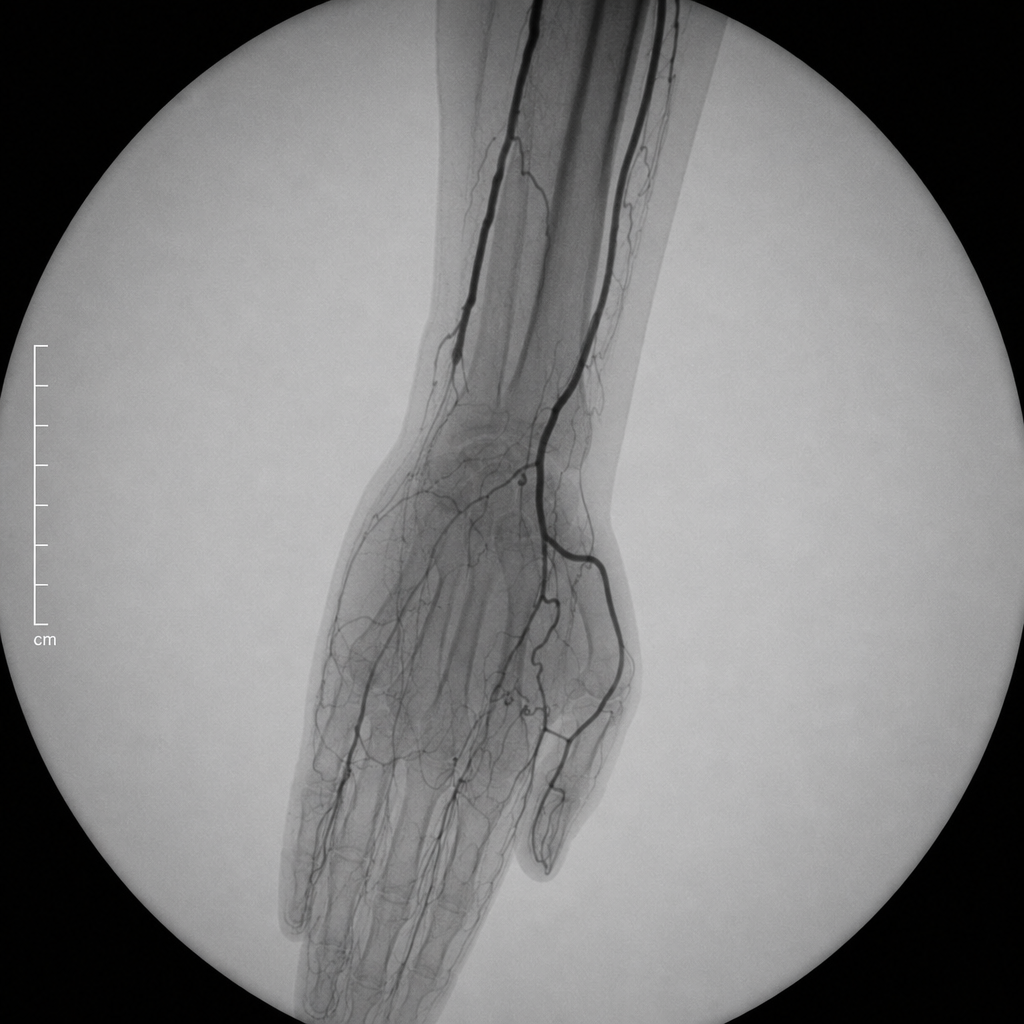
A patient presents with occasional pain over her middle finger. The surgeon identifies a black spot. Pressing around the black spot does not elicit pain, while pain is sensed on pressing the spot itself. What is the most likely diagnosis?
Pseudoaneurysm is most commonly seen in which of the following vessels in a drug abuser?
What is the most common vessel affected in acute limb ischemia?
What is the ideal material used for a femoropopliteal shunt?
Which of the following is a clinical finding in an arteriovenous fistula?
All of the following are true about varicose veins except:
A 36-year-old lady presents with a 20-year duration, fluctuant, and translucent swelling on the right side of her neck. No other history or significant findings on examination are available. What is the most probable diagnosis?
What is the most commonly used graft for the repair of an aortic coarctation?
What is the most common source of pulmonary embolism?
Which of the following is NOT a clinical test used to assess perforator vein incompetence?
Explanation: **Explanation:** The clinical presentation described is classic for a **Glomus Tumour**. These are benign vascular hamartomas arising from the glomus body, a specialized neuromyovascular apparatus involved in thermoregulation. **Why it is the correct answer:** The hallmark of a glomus tumour is the **triad of severe paroxysmal pain, localized tenderness, and cold hypersensitivity**. The description of pain elicited specifically by pressing the "black spot" (the tumour itself) while surrounding areas remain painless is known as **Love’s Test**. The "black spot" or bluish discoloration represents the vascular mass seen through the skin or nail plate. These tumours are most commonly found in the subungual region of the fingers. **Why other options are incorrect:** * **Haemangioma:** While vascular, these are typically painless and present as soft, compressible masses without the exquisite point tenderness seen here. * **Arteriovenous (AV) Fistula:** These usually present with a palpable thrill, an audible bruit, and regional swelling rather than a localized, exquisitely painful spot. * **Melanoma:** Subungual melanoma presents as a dark streak (Hutchinson’s sign) or enlarging pigmented lesion. While it can be serious, it is generally not associated with the intense, localized paroxysmal pain triggered by pressure. **High-Yield Clinical Pearls for NEET-PG:** * **Love’s Test:** Positive when localized pressure with a pinhead or probe elicits excruciating pain. * **Hildreth’s Sign:** Disappearance of pain after inflating a blood pressure cuff (ischaemia) proximal to the lesion. * **Transillumination:** Glomus tumours often transilluminate due to their vascular nature. * **Treatment:** Complete surgical excision is the definitive management.
Explanation: **Explanation:** A **pseudoaneurysm** (false aneurysm) occurs when a breach in the arterial wall leads to a contained hematoma that communicates with the arterial lumen. In intravenous (IV) drug abusers, this is primarily caused by **repeated accidental intra-arterial injections** or local infections (mycotic pseudoaneurysms) resulting from non-sterile techniques. **Why "All of the above" is correct:** Drug abusers frequently use any accessible peripheral artery for injection when venous access becomes difficult due to scarring (thrombophlebitis). * **Femoral Artery:** This is the **most common site overall** for pseudoaneurysms in drug addicts due to its large size and accessibility in the groin ("groin hitting"). * **Brachial and Radial Arteries:** These are also frequently targeted in the upper limbs. While the femoral artery is the single most common site, the radial and brachial arteries are common sites for accidental arterial puncture during attempts to inject into the cephalic or basilic veins. Since the question asks which vessels are involved, and all three are documented sites of frequent involvement in this population, "All of the above" is the most accurate choice. **Clinical Pearls for NEET-PG:** * **Triad of Pseudoaneurysm:** Pulsatile mass, a palpable thrill, and a continuous "to-and-fro" murmur on auscultation. * **Diagnosis:** **Color Doppler Ultrasound** is the initial investigation of choice (shows the "Yin-Yang" sign). * **Management:** Small pseudoaneurysms may be managed with ultrasound-guided compression or thrombin injection. However, in drug abusers, these are often **infected (mycotic)**, requiring surgical debridement, arterial ligation, or revascularization with autologous vein grafts (avoiding synthetic grafts in infected fields). * **Distinction:** A true aneurysm involves all three layers of the vessel wall (intima, media, adventitia), whereas a pseudoaneurysm is contained only by the adventitia or surrounding soft tissue.
Explanation: **Explanation:** Acute limb ischemia (ALI) is a surgical emergency characterized by a sudden decrease in limb perfusion. The most common cause of ALI is **arterial embolism**, followed by **thrombosis in situ**. **1. Why Superficial Femoral Artery (SFA) is correct:** The SFA is the most common site for both atherosclerotic occlusion and embolic lodgment. In the case of emboli (most commonly originating from the heart due to Atrial Fibrillation), the clot tends to lodge where the vessel caliber narrows or at bifurcations. The **SFA at the level of the Adductor (Hunter’s) Canal** is the most frequent site of occlusion because it is a long, relatively narrow segment where the vessel is subjected to mechanical stress. **2. Analysis of Incorrect Options:** * **B. Iliac artery:** While a common site for chronic atherosclerotic disease (Aorto-iliac disease), it is less common than the SFA for acute embolic events because of its larger diameter. * **C. Popliteal artery:** This is the second most common site for embolic lodgment. It is also the most common site for peripheral arterial aneurysms, which can lead to acute thrombosis, but statistically, it occurs less frequently than SFA involvement. * **D. Tibial artery:** These are smaller "run-off" vessels. While they can be affected by "trash foot" (microemboli) or distal propagation of a proximal clot, they are not the primary site of major acute limb-threatening ischemia compared to the SFA. **Clinical Pearls for NEET-PG:** * **The 6 P’s of ALI:** Pain, Pallor, Pulselessness, Paresthesia, Paralysis, and Poikilothermia (coldness). * **Gold Standard Investigation:** Digital Subtraction Angiography (DSA). * **Initial Management:** Immediate anticoagulation with IV Unfractionated Heparin to prevent clot propagation. * **Most common source of emboli:** Left Atrium (secondary to Atrial Fibrillation). * **Fogarty Catheter:** Used for surgical embolectomy.
Explanation: The **Great Saphenous Vein (GSV)** is considered the "gold standard" conduit for infrainguinal arterial bypasses, including femoropopliteal shunts. ### **Why Reverse Saphenous Vein is Correct** The GSV is the ideal material because it is an **autologous** graft, meaning it is harvested from the patient’s own body. * **Endothelial Lining:** Unlike synthetic materials, it has a viable endothelial layer that produces nitric oxide and prostacyclin, providing superior **thromboresistance**. * **Compliance:** Its mechanical properties closely match those of native arteries, reducing intimal hyperplasia at the anastomosis. * **Infection Resistance:** Autologous veins are significantly more resistant to infection compared to prosthetic grafts. * **Patency Rates:** It offers the highest long-term patency rates (approx. 70-80% at 5 years). It is "reversed" during surgery so that the internal valves do not obstruct arterial blood flow. ### **Why Other Options are Incorrect** * **PTFE (Polytetrafluoroethylene) & Dacron:** These are synthetic (prosthetic) materials. While used when the GSV is unavailable or of poor quality, they have higher rates of thrombosis and infection, especially when the bypass extends below the knee. * **Polypropylene:** This is a non-absorbable suture material (e.g., Prolene) used to perform the anastomosis, but it is never used as a conduit material itself. ### **High-Yield Clinical Pearls for NEET-PG** * **In-situ Bypass:** An alternative to the reversed technique where the vein is left in its bed, and a **valvulotome** is used to strip the valves. * **Best Synthetic Choice:** If a vein is unavailable, **PTFE** is generally preferred over Dacron for femoropopliteal bypasses. * **Size Requirement:** For a successful bypass, the GSV should ideally have a diameter of **>3 mm**.
Explanation: ### Explanation In an **Arteriovenous (AV) fistula**, there is a direct communication between a high-pressure artery and a low-pressure vein, bypassing the high-resistance capillary bed. This leads to significant hemodynamic changes: 1. **Why Sinus Tachycardia is Correct:** The shunt causes a decrease in **Total Peripheral Resistance (TPR)**, leading to a drop in mean arterial pressure. To maintain cardiac output and compensate for the decreased afterload, the body activates the sympathetic nervous system, resulting in a compensatory **sinus tachycardia** and increased stroke volume. Over time, this high-output state can lead to high-output cardiac failure. 2. **Analysis of Incorrect Options:** * **Pericarditis:** This is an inflammatory condition of the heart's outer lining, typically caused by infections, uremia, or MI; it is not a direct hemodynamic consequence of an AV fistula. * **Cardiac Arrhythmia:** While chronic heart failure from a large fistula can eventually lead to atrial fibrillation due to chamber enlargement, **sinus tachycardia** is the primary and most characteristic clinical finding. * **Hypothermia:** AV fistulas typically cause **increased local temperature** (hyperthermia) at the site of the shunt due to the rapid flow of warm arterial blood into superficial veins. ### High-Yield Clinical Pearls for NEET-PG: * **Nicoladoni-Branham Sign:** A pathognomonic sign where manual compression of the fistula leads to a sudden **bradycardia** and a rise in blood pressure. * **Machinery Murmur:** A continuous "bruit" or thrill is often palpable/audible over the site of the fistula. * **Proximal vs. Distal:** Proximal to the fistula, the artery dilates; distal to the fistula, there may be signs of chronic venous insufficiency or "steal syndrome" (ischemia). * **Widened Pulse Pressure:** Due to decreased diastolic pressure (rapid runoff into the vein) and increased systolic stroke volume.
Explanation: **Explanation:** The correct answer is **D** because the Trendelenburg operation (Juxtafemoral flush ligation) is no longer considered the gold standard. While historically significant, modern management has shifted toward **Endovenous Thermal Ablation (EVLA or RFA)**, which offers superior recovery profiles, fewer complications, and equivalent long-term efficacy compared to open surgery. **Analysis of Options:** * **Option A (Correct statement):** Dull aching pain is indeed the most common symptom. It typically worsens after prolonged standing due to increased hydrostatic pressure and is relieved by limb elevation or walking (which activates the calf muscle pump). * **Option B (Correct statement):** **Duplex Ultrasound** is the "Gold Standard" investigation. It provides both anatomical (vein diameter) and physiological (direction of flow/reflux) information, essential for mapping before intervention. * **Option C (Correct statement):** **Bisgaard’s Regimen** (also known as the "Reading Technique") is a specific physiotherapy protocol involving massage, exercises, and compression bandaging used to manage chronic venous ulcers and reduce edema. **High-Yield Clinical Pearls for NEET-PG:** * **Trendelenburg Test:** Used to differentiate between Saphenofemoral junction (SFJ) incompetence and perforator incompetence. * **Fegan’s Test:** Used to identify the site of incompetent perforators (palpable gaps in the fascia). * **CEAP Classification:** The international standard for describing Chronic Venous Disorders (C0 to C6; C6 represents an active venous ulcer). * **Cockett’s Perforators:** These connect the posterior arch vein to the deep veins in the lower third of the leg; they are the most common site for primary venous ulcers.
Explanation: ### Explanation The clinical presentation of a long-standing, **fluctuant**, and **translucent** swelling in the neck of a young adult is classic for a **Cystic Hygroma (Cystic Lymphangioma)**, often referred to in exams as a **Lymph cyst**. **Why the correct answer is right:** * **Translucency:** This is the hallmark of a lymph cyst. Because it contains clear, straw-colored lymph and has a thin epithelial lining, it allows light to pass through brilliantly (positive transillumination). * **Fluctuance:** Indicates a fluid-filled cavity. * **Duration:** These are congenital malformations of the lymphatic system (sequestration of jugular lymph sacs). While often detected at birth or by age 2, they can remain asymptomatic and present or enlarge later in life. **Why the incorrect options are wrong:** * **Lymph node:** These are typically solid, firm, and **opaque**. They do not transilluminate. * **Colloid nodule:** These are located within the thyroid gland (anterior neck/midline). While they can undergo cystic degeneration, they are generally not translucent and move with deglutition. * **Cold abscess:** Usually secondary to tuberculosis. While fluctuant, the overlying skin is thickened and the contents (caseous pus) are **opaque**, making them negative for transillumination. **Clinical Pearls for NEET-PG:** 1. **Brilliant Transillumination:** The most important diagnostic sign for Cystic Hygroma. 2. **Anatomical Site:** Most commonly found in the **posterior triangle** of the neck (Left > Right). 3. **Complications:** Sudden increase in size usually suggests hemorrhage into the cyst or secondary infection. 4. **Treatment of Choice:** Surgical excision is preferred. If surgery is risky, sclerotherapy (e.g., OK-432 or Bleomycin) is an alternative.
Explanation: **Explanation:** The surgical management of **Aortic Coarctation** often requires the use of a prosthetic conduit when primary end-to-end anastomosis is not feasible (e.g., long-segment narrowing or adult presentations). **Why Dacron is the Correct Answer:** **Dacron (Polyethylene terephthalate)** is the most commonly used synthetic graft for large-vessel repairs, including the thoracic aorta. It is a **knitted or woven** polyester material that provides excellent tensile strength and durability. In the high-pressure environment of the aorta, Dacron is preferred because it allows for better "tissue ingrowth" (pseudointima formation) compared to other materials, ensuring long-term stability and a lower risk of late aneurysmal dilatation at the graft site. **Analysis of Incorrect Options:** * **Autologous Vein (A):** Great Saphenous Veins are unsuitable for the aorta because they cannot withstand the high arterial pressures of the thoracic segment, leading to inevitable aneurysmal rupture. * **Autologous Artery (B):** While the Subclavian Flap Aortoplasty (Waldhausen procedure) uses an artery, it is a flap technique, not a "graft." Free arterial grafts of sufficient caliber for the aorta are generally unavailable. * **PTFE (D):** Polytetrafluoroethylene (Gore-Tex) is frequently used for peripheral vascular bypasses or smaller shunts (like the Blalock-Taussig shunt). While it can be used for the aorta, Dacron remains the gold standard due to its superior handling characteristics and proven longevity in the thoracic position. **NEET-PG High-Yield Pearls:** * **Gold Standard Treatment:** In infants, **Resection with Primary End-to-End Anastomosis** is preferred. * **Dacron vs. PTFE:** Use Dacron for large vessels (Aorta) and PTFE for smaller vessels or when a "ringed" graft is needed to prevent compression. * **Complication:** A dreaded late complication of synthetic graft repair for coarctation is the formation of a **false aneurysm** at the suture line. * **Rib Notching:** Remember that rib notching (3rd to 8th ribs) occurs due to collateral flow through dilated intercostal arteries.
Explanation: **Explanation:** The correct answer is **Deep leg veins (Option B)**. Pulmonary Embolism (PE) is a life-threatening condition where a blood clot (thrombus) dislodges and travels to the pulmonary arteries. Approximately **90-95% of all pulmonary emboli** originate from Deep Vein Thrombosis (DVT) of the lower extremities. Specifically, thrombi originating from the **proximal deep veins** (popliteal, femoral, and iliac veins) carry the highest risk of embolization compared to distal calf vein thrombi. **Analysis of Incorrect Options:** * **A. Hemorrhoids:** These involve the rectal venous plexus. While they can thrombose locally (causing pain), they rarely lead to PE because the venous drainage often goes into the portal system or involves small-caliber vessels where clots are unlikely to reach the pulmonary circulation in a significant size. * **C. Portal vein:** Thrombi in the portal vein (Portal Vein Thrombosis) lead to portal hypertension and intestinal ischemia. Because the portal system drains into the liver (capillary bed of the sinusoids), these clots are "filtered" by the liver and do not reach the systemic venous circulation or the lungs. **NEET-PG High-Yield Pearls:** * **Most common site for DVT:** The muscular veins of the calf (soleal sinuses), but the **most common source of PE** is the proximal leg veins (Femoral vein). * **Virchow’s Triad:** The three factors contributing to venous thrombosis are Stasis, Endothelial Injury, and Hypercoagulability. * **Gold Standard Investigation:** CT Pulmonary Angiography (CTPA) is the investigation of choice for PE. * **ECG Finding:** The most common finding is sinus tachycardia; the classic but rare sign is the **S1Q3T3 pattern**.
Explanation: **Explanation:** In vascular surgery, clinical tests for varicose veins are categorized based on whether they assess the **Saphenofemoral Junction (SFJ)**, **Saphenopopliteal Junction (SPJ)**, or **Perforator competence**. **Why Morrisey’s Cough Impulse Test is the correct answer:** Morrisey’s test is used to assess **Saphenofemoral Junction (SFJ) incompetence**, not perforator incompetence. When a patient coughs, an expansile impulse is felt over the SFJ (located 2.5 cm below and lateral to the pubic tubercle) due to the retrograde flow of blood through an incompetent valve. **Analysis of Incorrect Options (Tests for Perforator Incompetence):** * **Pratt’s Test:** A three-tourniquet test (or using an elastic bandage) where the patient is asked to walk; the appearance of a "blow-out" or bulge between the bandages indicates a site of incompetent perforators. * **Trendelenburg-II Test:** Also known as the "Double Trendelenburg" test. While Trendelenburg-I assesses the SFJ, Trendelenburg-II involves releasing the pressure while observing for rapid filling of veins *before* the patient stands, indicating incompetent perforators. * **Fegan’s Test:** This is a palpation-based test. With the patient standing, the clinician marks "blow-outs" or bulges. When the patient lies down and elevates the leg, the clinician feels for "circular pits" or defects in the deep fascia, which represent the sites of incompetent perforators. **High-Yield Clinical Pearls for NEET-PG:** * **Gold Standard Investigation:** Duplex Ultrasound is now the investigation of choice for venous insufficiency, replacing most clinical tests in modern practice. * **Schwartz Test:** Also known as the Tap test; it assesses the patency of the valves in the great saphenous vein (SFJ incompetence). * **Perthes’ Test:** Used to assess the **patency of the Deep Venous System**. If a patient develops pain while walking with a superficial tourniquet applied, it suggests Deep Vein Thrombosis (DVT).
Atherosclerotic Disease
Practice Questions
Aortic Aneurysms
Practice Questions
Peripheral Arterial Disease
Practice Questions
Carotid Artery Disease
Practice Questions
Venous Thromboembolism
Practice Questions
Chronic Venous Insufficiency
Practice Questions
Mesenteric Vascular Disease
Practice Questions
Vascular Trauma
Practice Questions
Vascular Access for Hemodialysis
Practice Questions
Endovascular Techniques
Practice Questions
Diabetic Foot Vascular Disease
Practice Questions
Vasculitis
Practice Questions
Get full access to all questions, explanations, and performance tracking.
Start For Free