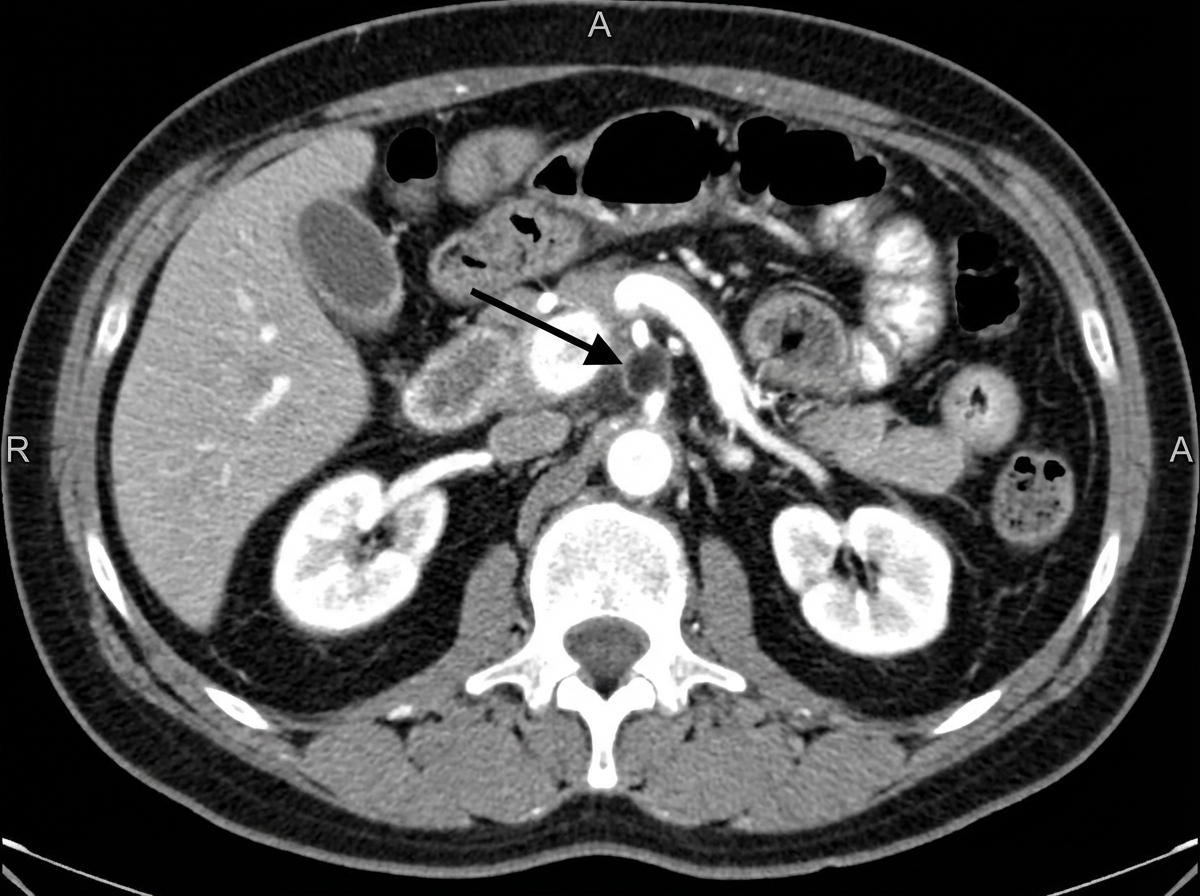
A 67-year-old hypertensive man presents with lower abdominal pain and back pain. An expansive abdominal mass is palpated lateral and superior to the umbilicus. What is the best investigation for this patient?
All are true about Deep Venous Thrombosis (DVT) EXCEPT:
Which of the following tests is used to detect perforator incompetence in varicose veins?
What is the name of the surgical maneuver used to mobilize the right medial visceral rotation to visualize the Inferior Vena Cava (IVC)?
Which of the following is NOT a feature of peripheral arterial occlusion?
Which of the following is true regarding arteriovenous fistula?
Thoracic outlet syndrome is most commonly seen in which age group?
What is the primary pharmacological treatment for Deep Vein Thrombosis (DVT)?
A 67-year-old man presents with sudden left leg pain, absence of pulses, and a cold limb. His past medical history is significant for coronary artery disease and a small aortic aneurysm. Which of the following is most likely responsible for the development of a cold limb in this patient?
Regarding abdominal aortic aneurysm, all are true except?
Explanation: ### Explanation **Diagnosis: Abdominal Aortic Aneurysm (AAA)** The clinical presentation of an elderly hypertensive male with lower abdominal/back pain and a **pulsatile, expansile abdominal mass** is classic for an Abdominal Aortic Aneurysm (AAA). **1. Why Ultrasound Abdomen is the Correct Answer:** * **Screening and Initial Investigation:** Ultrasound (USG) is the **investigation of choice** for screening and the initial diagnosis of AAA. It is non-invasive, cost-effective, and has a sensitivity of nearly 100% for detecting the presence of an aneurysm. * **Utility:** It accurately measures the diameter of the aorta, which is the primary factor in determining the risk of rupture and the need for surgical intervention. **2. Why Other Options are Incorrect:** * **A. X-ray KUB:** While it may show a "curvilinear calcification" (eggshell calcification) in the aortic wall in some patients, it is neither sensitive nor specific enough for diagnosis. * **C. Coronary Angiography:** This is used to visualize coronary arteries. While AAA patients often have co-existing CAD, it plays no role in diagnosing the abdominal mass. * **D. Intravenous Pyelography (IVP):** This is used to visualize the urinary tract. While a large AAA might displace the ureters, it is not a diagnostic tool for vascular pathology. **3. NEET-PG High-Yield Pearls:** * **Gold Standard Investigation:** **CT Angiography (CTA)** is the gold standard for preoperative planning as it provides detailed anatomical mapping. * **Triad of Ruptured AAA:** Hypotension, back/abdominal pain, and a pulsatile mass. * **Surgical Threshold:** Surgery is generally indicated if the aneurysm is **>5.5 cm in men** (>5.0 cm in women) or expanding at a rate of **>0.5 cm in 6 months**. * **Location:** Most AAAs are **infrarenal** (below the origin of renal arteries).
Explanation: **Explanation:** Deep Venous Thrombosis (DVT) is a critical condition characterized by thrombus formation in the deep veins, primarily governed by **Virchow’s Triad** (stasis, endothelial injury, and hypercoagulability). **Why Option C is the correct (False) statement:** While color changes (like *Phlegmasia alba/cerulea dolens*) can occur in severe cases, the **most important and common clinical sign of DVT is calf tenderness and unilateral swelling/edema** (measured 10 cm below the tibial tuberosity). Color change is neither the most common nor the most reliable diagnostic sign; many patients remain asymptomatic or present only with swelling. **Analysis of other options:** * **Option A:** DVT is significantly **more common in the lower limbs** due to gravity-induced stasis and the length of the venous columns, particularly in the calf veins. * **Option B:** **Pulmonary Embolism (PE)** is the most dreaded acute complication of DVT, occurring when a clot dislodges and travels to the pulmonary vasculature. * **Option C:** **Aching pain** in the calf or thigh is the most frequent symptom reported by patients, often exacerbated by walking or dorsiflexion. **High-Yield Clinical Pearls for NEET-PG:** * **Gold Standard Investigation:** Contrast Venography (rarely used now). * **Investigation of Choice:** Duplex Ultrasound (Color Doppler). * **Homan’s Sign:** Pain in the calf on forceful dorsiflexion of the foot (low sensitivity/specificity). * **Moses Sign:** Pain on squeezing the calf muscles transversely. * **Wells Criteria:** Used clinically to predict the pre-test probability of DVT. * **Phlegmasia Cerulea Dolens:** A surgical emergency involving "painful blue edema" indicating near-total venous occlusion.
Explanation: The **Trendelenburg test** is the classic clinical examination used to assess the competence of the valves in the superficial system (Great Saphenous Vein) and the **perforator veins** (which connect the superficial to the deep system). ### Explanation of Options: * **A. Trendelenburg Test (Correct):** This test involves two parts. After emptying the veins by elevating the leg and applying a tourniquet at the saphenofemoral junction (SFJ), the patient stands. If the veins fill rapidly from below despite the tourniquet, it indicates **perforator incompetence**. If they fill rapidly only after the tourniquet is released, it indicates **SFJ incompetence**. * **B. Fegan’s Test:** While this test is used in varicose veins, it is specifically used to **locate** the exact site of incompetent perforators by palpating "blow-outs" or gaps in the deep fascia while the patient stands. * **C. Morrissey’s Test:** Also known as the "Cough Impulse" test. It is used to detect **Saphenofemoral incompetence** (SFJ) by feeling a fluid thrill at the SFJ when the patient coughs. * **D. Homan’s Test:** This is used for the diagnosis of **Deep Vein Thrombosis (DVT)**, not varicose veins. It involves pain in the calf upon forceful dorsiflexion of the foot. ### High-Yield Clinical Pearls for NEET-PG: * **Perthes’ Test:** Used to check the patency of the **Deep Venous System**. If varicosities become more prominent or painful when the patient walks with a tourniquet, the deep veins are likely occluded. * **Schwartz Test:** Used to detect the presence of a continuous column of blood (valvular incompetence) by tapping the lower part of the vein and feeling the impulse proximally. * **Gold Standard Investigation:** For varicose veins, the investigation of choice is **Duplex Ultrasound**.
Explanation: ### Explanation The **Cattell-Braasch maneuver** is the correct answer as it describes the **right-sided medial visceral rotation**. This surgical technique involves mobilizing the right colon, the hepatic flexure, and the root of the small bowel mesentery by incising the white line of Toldt and the retroperitoneal attachments. This allows the surgeon to lift the entire right-sided viscera medially, providing extensive exposure to the **entire infrahepatic Inferior Vena Cava (IVC)**, the right renal vessels, and the superior mesenteric artery. **Analysis of Incorrect Options:** * **A. Kocher maneuver:** This is a limited mobilization of the duodenum and the head of the pancreas. While it exposes the retro-pancreatic IVC and the common bile duct, it does not involve the full medial rotation of the right colon and small bowel. * **B. Mattox maneuver:** This is a **left-sided medial visceral rotation**. It involves mobilizing the left colon, spleen, and tail of the pancreas medially to expose the **entire abdominal aorta** and left renal vessels. * **C. Pringle maneuver:** This is a bedside/intraoperative technique used to control hepatic bleeding by clamping the **hepatoduodenal ligament** (containing the portal vein, hepatic artery, and common bile duct). It does not involve visceral rotation. **High-Yield Clinical Pearls for NEET-PG:** * **Cattell-Braasch:** Right-sided rotation → IVC exposure. * **Mattox:** Left-sided rotation → Aortic exposure. * **Zone I Retroperitoneal Hematoma:** Usually requires exploration via these maneuvers (Cattell-Braasch for right/central, Mattox for left). * **Kocherization:** Essential for pancreaticoduodenectomy (Whipple procedure) to assess tumor resectability.
Explanation: **Explanation:** Peripheral arterial occlusion (acute limb ischemia) is a surgical emergency characterized by the sudden decrease in limb perfusion. The clinical presentation is classically described by the **"6 Ps"**: **P**ain, **P**allor, **P**ulselessness, **P**aresthesia, **P**aralysis, and **P**oikilothermia (perishing cold). **Why "Shock" is the correct answer:** Shock is a state of systemic circulatory failure leading to inadequate tissue perfusion at the multiorgan level. Peripheral arterial occlusion is a **localized vascular event** affecting a specific limb. While it causes severe local ischemia, it does not typically cause systemic hypotension or hemodynamic instability (shock) unless complicated by massive reperfusion injury, systemic sepsis, or if the occlusion is a result of a catastrophic event like a ruptured aortic aneurysm. **Analysis of incorrect options:** * **Pain:** Usually the earliest and most common symptom. It is sudden, severe, and often involves the distal part of the limb. * **Pallor:** Occurs due to the lack of arterial blood flow to the dermal capillary beds, giving the limb a "waxy white" appearance. * **Pulselessness:** A hallmark sign. The absence of pulses distal to the site of occlusion is diagnostic. **Clinical Pearls for NEET-PG:** * **The Golden Period:** Revascularization should ideally occur within **6 hours** to prevent irreversible muscle necrosis. * **Most common cause:** Embolism (often originating from the heart due to Atrial Fibrillation). * **Most common site of embolization:** The bifurcation of the **Common Femoral Artery**. * **Investigation of Choice:** Digital Subtraction Angiography (DSA) is the gold standard, but CT Angiography is more commonly used in acute settings.
Explanation: An **Arteriovenous (AV) Fistula** is an abnormal communication between an artery and a vein, bypassing the capillary bed. This leads to significant hemodynamic and structural changes. **Explanation of Options:** * **A. Cardiac Failure:** AV fistulas decrease total peripheral resistance (TPR), leading to a compensatory increase in stroke volume and heart rate. This results in **high-output cardiac failure**. A classic sign is **Nicoladoni-Branham’s sign**, where manual compression of the fistula causes bradycardia and a rise in blood pressure. * **B. Local Gigantism:** If a congenital AV fistula occurs before the closure of the epiphyseal plates, the increased blood flow and venous congestion stimulate bone overgrowth, leading to limb lengthening or local gigantism (e.g., **Klippel-Trenaunay Syndrome**). * **C. Ulcers:** While it seems counterintuitive, AV fistulas cause **venous hypertension** and "steal" oxygenated blood away from the distal capillary beds. This leads to chronic venous insufficiency and distal ischemia, both of which manifest as skin pigmentation and non-healing ulcers. **High-Yield Clinical Pearls for NEET-PG:** * **Machinery Murmur:** A continuous thrill and bruit are heard over the site of the fistula. * **Proximal vs. Distal:** The artery proximal to the fistula becomes dilated and tortuous, while the distal part may show signs of ischemia. * **Diagnostic Gold Standard:** Digital Subtraction Angiography (DSA). * **Management:** Small asymptomatic fistulas are observed; symptomatic ones require surgical excision or endovascular embolization.
Explanation: **Explanation:** Thoracic Outlet Syndrome (TOS) refers to the compression of the neurovascular bundle (brachial plexus, subclavian artery, or subclavian vein) as it passes through the superior thoracic aperture. **Why Middle-aged Women?** TOS is most commonly seen in **women (F:M ratio of approximately 3:1)**, typically between the ages of **20 and 50 years**. The higher prevalence in women is attributed to several factors: * **Anatomical Factors:** Women generally have narrower thoracic outlets and lower-set shoulders (drooping shoulders), which increases the likelihood of nerve or vessel entrapment. * **Muscular Development:** Less developed neck and shoulder girdle musculature compared to men can lead to poor posture, further narrowing the costoclavicular space. * **Hormonal/Structural:** The presence of a cervical rib (a common predisposing factor) is more frequently symptomatic in females. **Analysis of Incorrect Options:** * **Children:** TOS is extremely rare in children as the musculoskeletal structures are still developing and the thoracic outlet is relatively spacious. * **Elderly:** While degenerative changes can occur, the peak incidence is in the productive middle years. In the elderly, symptoms are more likely due to cervical spondylosis. * **Athletes:** While "Paget-Schroetter Syndrome" (effort thrombosis) is a form of venous TOS seen in young athletes, it represents a specific subset and is not the most common demographic for TOS overall. **Clinical Pearls for NEET-PG:** * **Most common type:** Neurogenic TOS (95%), involving the brachial plexus (usually lower trunk, C8-T1). * **Most common cause:** Presence of a **Cervical Rib** (though most cervical ribs are asymptomatic). * **Clinical Tests:** Adson’s test, Roos test (Elevated Arm Stress Test), and Wright’s test. * **First-line Treatment:** Physical therapy and postural correction (except for acute vascular TOS, which may require surgery).
Explanation: **Explanation:** The primary goal in the management of Deep Vein Thrombosis (DVT) is to prevent thrombus extension and the life-threatening complication of Pulmonary Embolism (PE). **1. Why Unfractionated Heparin (UFH) is correct:** Anticoagulation is the cornerstone of DVT treatment. **Unfractionated Heparin** (or Low Molecular Weight Heparin) acts by activating Antithrombin III, which inactivates Thrombin (Factor IIa) and Factor Xa. This prevents further clot propagation while the body’s endogenous fibrinolytic system works to dissolve the existing clot. In clinical practice, UFH is often preferred in patients with renal failure or those who may require surgical intervention due to its short half-life and easy reversibility with Protamine Sulfate. **2. Why the other options are incorrect:** * **Limb elevation (B):** This is a supportive measure to reduce edema and venous pressure; it does not treat the underlying thrombus. * **Surgery (C):** Venous thrombectomy is reserved for limb-threatening emergencies like *Phlegmasia Cerulea Dolens* where medical therapy fails. It is not the "primary" or first-line treatment. * **Duplex ultrasound (D):** This is the **gold standard investigation** for diagnosing DVT, but it is a diagnostic tool, not a pharmacological treatment. **High-Yield Clinical Pearls for NEET-PG:** * **Investigation of Choice:** Color Duplex Ultrasound (Non-invasive). * **Gold Standard Investigation:** Contrast Venography (Rarely used now). * **Virchow’s Triad:** Stasis, Endothelial injury, and Hypercoagulability. * **Warfarin Bridge:** Heparin must be continued for at least 5 days and until the INR is therapeutic (2.0–3.0) for 24 hours to avoid "Warfarin-induced skin necrosis." * **Phlegmasia Alba Dolens:** "Milk leg" (total occlusion of deep venous system). * **Phlegmasia Cerulea Dolens:** "Blue leg" (occlusion of deep and collateral veins; precursor to gangrene).
Explanation: ### Explanation **Correct Answer: B. Arterial thromboembolism** The patient presents with the classic **"6 Ps" of Acute Limb Ischemia (ALI)**: Pain, Pallor, Pulselessness, Paresthesia, Paralysis, and Perishingly cold (Poikilothermia). In a patient with a history of coronary artery disease and an aortic aneurysm, the most likely cause is an **arterial thromboembolism**. Emboli typically originate from the heart (often due to atrial fibrillation or post-MI mural thrombi) or from proximal aneurysms (where stagnant flow leads to thrombus formation). These emboli lodge at arterial bifurcations (most commonly the femoral artery bifurcation), leading to sudden vascular occlusion and a cold, pulseless limb. **Why incorrect options are wrong:** * **A. Acute myocardial infarction:** While an MI can lead to a mural thrombus that eventually embolizes, the MI itself causes chest pain and hemodynamic instability, not isolated limb ischemia. * **C. Cardiogenic shock:** This would present with systemic hypotension, global hypoperfusion, and bilateral cool extremities, rather than an isolated, pulseless single limb. * **D. Deep venous thrombosis (DVT):** DVT typically presents with a **warm**, swollen, and tender limb (e.g., Phlegmasia cerulea dolens in extreme cases). It does not cause an immediate loss of arterial pulses or a cold limb unless secondary arterial compromise occurs. **High-Yield Clinical Pearls for NEET-PG:** * **Most common site of arterial embolism:** Femoral artery bifurcation (followed by the iliacs and popliteal artery). * **Gold Standard Investigation:** Digital Subtraction Angiography (DSA). * **Immediate Management:** IV Unfractionated Heparin to prevent clot propagation. * **Surgical Management:** Emergency embolectomy using a **Fogarty catheter**. * **Time Window:** Irreversible tissue damage (muscle necrosis) typically begins after **6 hours** of complete ischemia.
Explanation: **Explanation:** The question asks for the "except" statement regarding Abdominal Aortic Aneurysms (AAA). While Option C is a true medical fact, it is the **correct answer** because it does not pertain to the pathology of an *Abdominal Aortic Aneurysm*; it describes a *Visceral Artery Aneurysm*. In the context of a question specifically about AAA characteristics, this statement is the outlier. **Analysis of Options:** * **Option A & D (True):** AAA is significantly more common in **males** (M:F ratio approx. 4:1) and **smokers**. Smoking is the strongest modifiable risk factor, increasing the risk of formation, growth, and rupture. * **Option B (True):** By definition, an abdominal aorta is considered aneurysmal when its diameter is **≥ 3.0 cm**. A diameter > 5.5 cm in men (or > 5.0 cm in women) is generally the threshold for elective surgical intervention. * **Option C (The "Except" Statement):** While it is true that the **Splenic artery** is the most common site for visceral artery aneurysms (followed by the Hepatic artery), this is a separate clinical entity from an Abdominal Aortic Aneurysm. **High-Yield Clinical Pearls for NEET-PG:** * **Location:** Most AAAs are **infrarenal** (90%). * **Screening:** USG is the investigation of choice for screening; CT Angiography is the gold standard for surgical planning. * **Triad of Rupture:** Hypotension, pulsatile abdominal mass, and back/abdominal pain. * **Indications for Surgery:** Diameter > 5.5 cm, rapid expansion (> 0.5 cm in 6 months), or any symptomatic aneurysm regardless of size. * **Protective Factor:** Interestingly, **Diabetes Mellitus** is associated with a *lower* risk of developing AAA.
Atherosclerotic Disease
Practice Questions
Aortic Aneurysms
Practice Questions
Peripheral Arterial Disease
Practice Questions
Carotid Artery Disease
Practice Questions
Venous Thromboembolism
Practice Questions
Chronic Venous Insufficiency
Practice Questions
Mesenteric Vascular Disease
Practice Questions
Vascular Trauma
Practice Questions
Vascular Access for Hemodialysis
Practice Questions
Endovascular Techniques
Practice Questions
Diabetic Foot Vascular Disease
Practice Questions
Vasculitis
Practice Questions
Get full access to all questions, explanations, and performance tracking.
Start For Free