Investigation of choice for screening of proximal internal carotid artery stenosis is :
All of the following come under priority of Stroke control programme EXCEPT:
Following are the risk factors of atherosclerosis, except?
Anterior choroidal artery is a branch of which of the following arteries?
A woman presenting with abrupt onset of "the worst headache of her life" Which is the best investigation?
Which of the following is NOT a risk factor for atherosclerosis?
Which of the following is the best management for radiation induced occlusive disease of carotid artery?
Which of these is a palliative shunt procedure created between the left subclavian artery and pulmonary artery to treat cyanotic congenital heart disease?
Following endarterectomy on the right common carotid, a patient is found to be blind in the right eye. It appears that a small thrombus embolized during surgery and lodged in the artery supplying the retina. Which artery would be blocked?
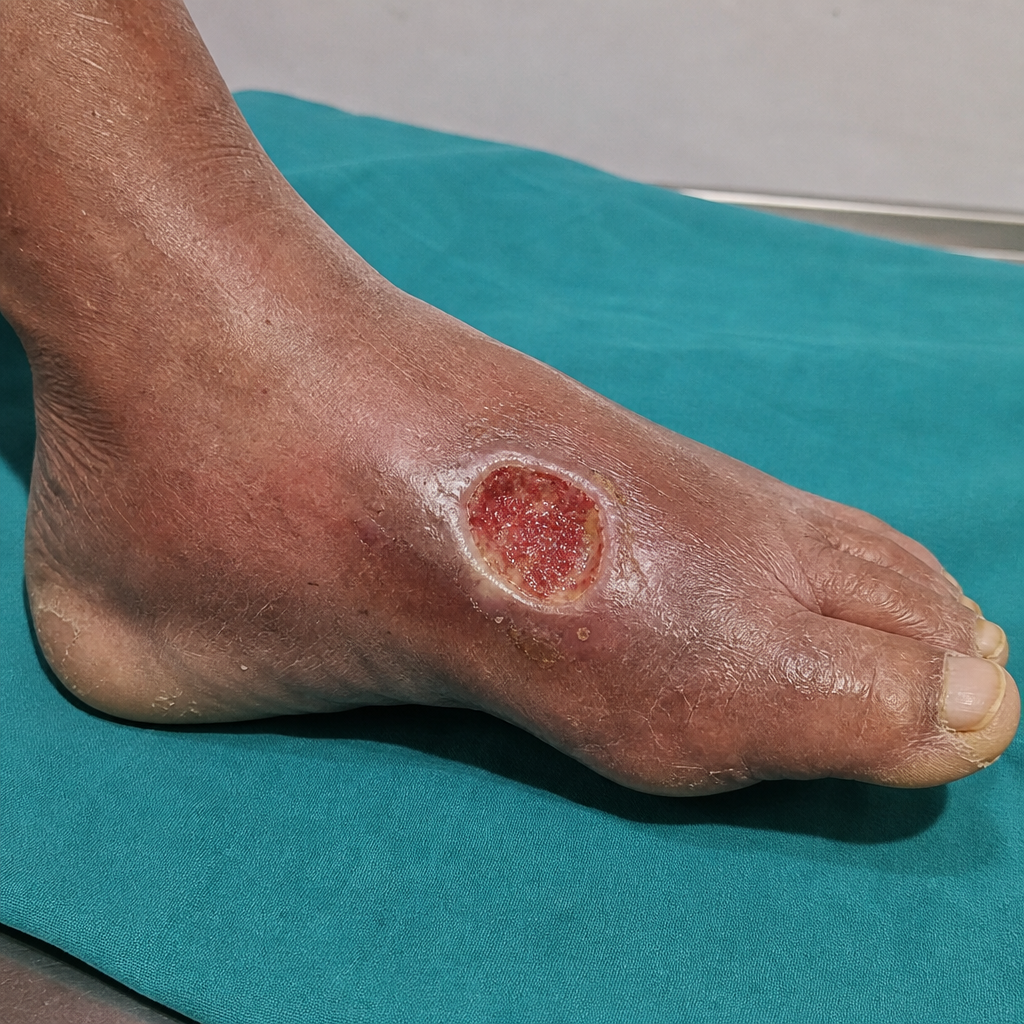
What type of ulcer is shown below?
Explanation: ***Doppler ultrasound (USG)*** - **Doppler ultrasound** is the investigation of choice for screening carotid artery stenosis due to its **non-invasive nature**, widespread availability, and cost-effectiveness. It provides excellent anatomical information and hemodynamics, including **blood flow velocity** and presence of **plaque**. - It can effectively estimate the degree of **stenosis** based on flow characteristics and is safe for serial monitoring. *CT angiography* - **CT angiography** provides detailed anatomical imaging of the carotid arteries but involves **ionizing radiation** and **iodinated contrast agents**, making it less suitable for routine screening, especially in patients with renal impairment or contrast allergies. - While it offers higher resolution for certain plaque characteristics, it’s typically reserved for cases where ultrasound findings are inconclusive or for surgical planning. *Magnetic resonance imaging (MRI)* - **MRI** and **MR angiography (MRA)** can visualize carotid stenosis without ionizing radiation but are more expensive and time-consuming than ultrasound, and can be limited by artifacts from patient movement. - Patients with **claustrophobia** or **metallic implants** may not be suitable for MRI, making it less ideal for general screening. *Digital subtraction angiography (DSA)* - **Digital subtraction angiography (DSA)** is the **gold standard** for diagnosing carotid stenosis as it provides the most detailed and accurate images of the arterial lumen. However, it is an **invasive procedure** associated with risks such as stroke, arterial dissection, contrast nephropathy, and radiation exposure. - Due to its invasiveness and potential complications, DSA is typically reserved for cases with **discordant non-invasive findings** or prior to intervention rather than as a primary screening tool.
Explanation: ***Control of alcoholism*** - While **alcoholism** is a health concern, its direct and immediate impact as a primary modifiable risk factor for stroke in large-scale stroke control programs is generally less emphasized compared to other factors. - Stroke control programs typically prioritize risk factors with a more direct and significant impact on stroke incidence and severity, such as hypertension, diabetes, and dyslipidemia. *Control of smoking* - **Smoking** is a major modifiable risk factor for stroke, significantly increasing the risk of both ischemic and hemorrhagic stroke due to its effects on atherosclerosis and clotting. - Quitting smoking is a cornerstone of any stroke prevention strategy, and thus its control is a high priority. *Control of diabetes* - **Diabetes** significantly increases the risk of stroke by promoting atherosclerosis and affecting blood vessel health. - Strict glycemic control is essential in preventing stroke and is a priority in stroke control programs. *Control of hypertension* - **Hypertension** is the most important modifiable risk factor for stroke, contributing to both ischemic and hemorrhagic strokes. - Effective blood pressure management is critical for primary and secondary stroke prevention and is a top priority in stroke control programs.
Explanation: ***Obesity*** - Obesity is considered a **modifiable risk factor** for atherosclerosis as it can be addressed through lifestyle changes like diet and exercise. [2] - It is associated with increased levels of **LDL cholesterol** and other metabolic disturbances that contribute to vascular disease. [5] *Hypertension* - Hypertension is also a **modifiable risk factor** and can be managed through medication and lifestyle changes. [4] - Elevated blood pressure contributes to **endothelial damage** and atherosclerosis progression. [1] *Diabetes* - Diabetes is a significant **modifiable risk factor** as it can worsen atherosclerosis through high blood sugar levels damaging blood vessels. [4] - Management of diabetes through diet, exercise, and medication can significantly reduce cardiovascular risk. [3] *Physical inactivity* - Physical inactivity is a **modifiable risk factor** as regular exercise can improve cardiovascular health and lower atherosclerosis risk. - Increased physical activity helps maintain a healthy weight and reduces **blood pressure** and blood sugar levels.
Explanation: ***Correct: Internal carotid artery*** - The **anterior choroidal artery** is a direct branch of the **internal carotid artery**, specifically originating from its **supraclinoid segment**. - It supplies crucial structures such as the **choroid plexus of the lateral ventricle**, parts of the **hippocampus**, **amygdala**, and the **posterior limb of the internal capsule**. - This is a clinically important vessel, as occlusion can lead to significant neurological deficits. *Incorrect: Basilar artery* - The basilar artery is part of the **posterior circulation**, formed by the union of the vertebral arteries. - It gives rise to branches like the **pontine arteries**, **superior cerebellar arteries**, and **posterior cerebral arteries**, but not the anterior choroidal artery. *Incorrect: Anterior cerebral artery* - The anterior cerebral artery is a terminal branch of the **internal carotid artery**, but it primarily supplies the **medial surface of the frontal and parietal lobes**. - It does not give rise to the anterior choroidal artery; instead, the anterior choroidal artery branches off the internal carotid artery more **proximally**, before the terminal bifurcation. *Incorrect: Posterior cerebral artery* - The posterior cerebral artery is a terminal branch of the **basilar artery** and is part of the posterior circulation. - It supplies the **occipital lobe** and parts of the **temporal lobe**. - Its branches include **posterior choroidal arteries** (not anterior choroidal artery), which supply the choroid plexus of the third ventricle and lateral ventricles.
Explanation: ***NCCT of the head*** - A **non-contrast CT scan of the head** is the immediate and most appropriate first imaging study for a suspected **subarachnoid hemorrhage (SAH)**, often presenting as the "worst headache of her life" [1]. - It can rapidly detect blood in the **subarachnoid space** with high sensitivity, particularly within the first 6-12 hours of symptom onset [1], [2]. *Vessel carotid Doppler* - **Carotid Doppler ultrasound** is primarily used to assess **carotid artery stenosis** or dissection, which would not be the initial investigation for a sudden severe headache [2]. - It does not visualize intracranial blood or vascular abnormalities within the brain parenchyma or subarachnspace. *No imaging* - Given the severe, abrupt onset "worst headache of her life," **subarachnoid hemorrhage (SAH)** is a critical differential, making no imaging an inappropriate and potentially dangerous choice. - Delaying imaging could lead to severe neurological consequences if SAH is missed. *MRI* - While **MRI** can detect SAH, it is generally less accessible, takes more time to perform, and is less suitable for the initial rapid assessment of **acute SAH** compared to NCCT [3]. - **MRI** is often used for follow-up evaluation or when CT findings are equivocal, but not as the first-line emergency investigation.
Explanation: ***Normal LDL cholesterol*** - Maintaining **normal LDL cholesterol levels** indicates a healthy lipid profile and does not promote the accumulation of plaque in arteries, thus it is not a risk factor for atherosclerosis. - In fact, keeping LDL cholesterol within the normal range is a **protective factor** against the development and progression of atherosclerosis. *Smoking* - **Smoking** is a significant risk factor for atherosclerosis as it damages the **endothelium** (the inner lining of blood vessels), making it more susceptible to plaque formation. - It also reduces **HDL cholesterol** (good cholesterol) and increases **blood viscosity**, further contributing to arterial damage and clot formation. *High blood pressure* - **High blood pressure (hypertension)** is a major risk factor because it creates increased force against the artery walls, leading to **endothelial injury** and promoting the infiltration of lipids [1], [2]. - This chronic stress on the arterial walls accelerates the development of **atherosclerotic plaques** and stiffening of arteries [1]. *High cholesterol* - Specifically, **high levels of LDL cholesterol** (low-density lipoprotein, often referred to as "bad" cholesterol) directly contribute to atherosclerosis by depositing cholesterol within the arterial walls [3], [4]. - These deposits form **fatty streaks** that can progress into mature atherosclerotic plaques, narrowing arteries and impeding blood flow [3].
Explanation: ***Carotid angioplasty and stenting*** - **Radiation-induced carotid artery disease** often involves the distal part of the carotid artery, making it less amenable to surgical endarterectomy. - **Angioplasty and stenting** offer a less invasive approach with good technical success in these challenging cases, especially given the increased fragility and fibrosis of radiated tissues. *Carotid endarterectomy* - **Carotid endarterectomy** in previously radiated fields is associated with a significantly higher risk of complications, including **cranial nerve injury**, **wound infection**, and **carotid artery rupture**, due to tissue fibrosis and scarring. - The disease often extends beyond the easily accessible segment for endarterectomy in radiation-induced cases. *Low dose aspirin* - **Low-dose aspirin** is an important component of medical therapy for **atherosclerotic disease** and **stroke prevention**, but it is insufficient as a sole treatment for symptomatic or high-grade occlusive disease of the carotid artery. - It helps manage the underlying **atherosclerotic process** but does not directly address the severe stenosis or occlusion. *Carotid bypass procedure* - **Carotid bypass procedures** are complex surgical interventions usually reserved for cases of **carotid artery occlusion** or **recurrent stenosis** after previous interventions where endarterectomy or stenting is not feasible. - While an option, it is more invasive and technically demanding than angioplasty and stenting, particularly in already radiated tissues with compromised vascular integrity.
Explanation: **Blalock-Taussig shunt** - This procedure creates a **systemic-to-pulmonary artery shunt** by anastomosing a systemic artery (often the **subclavian artery**) to the pulmonary artery, increasing **pulmonary blood flow**. - It is a palliative measure for **cyanotic congenital heart diseases** where there is reduced pulmonary blood flow, such as **Tetralogy of Fallot**. *Waterston's shunt* - This is an older, no longer commonly used palliative shunt connecting the **ascending aorta to the right pulmonary artery**. - It was associated with a high incidence of complications, including **pulmonary overcirculation** and **pulmonary vascular disease**. *Lieno renal shunt* - This refers to a shunt created between the **splenic vein (lienal vein)** and the **left renal vein**. - It is primarily used to treat **portal hypertension** by decompressing the portal venous system, not congenital heart disease. *Gott's shunt* - This involves a **temporary bypass shunt** often used during **thoracic aortic surgery** to protect the spinal cord from ischemia. - It maintains blood flow to the distal aorta during aortic clamping and is not related to congenital heart disease palliation.
Explanation: ***Central artery of the retina*** - The **central artery of the retina** is a branch of the **ophthalmic artery** that supplies blood to the inner two-thirds of the retina, including the **photoreceptors** and **ganglion cells**. - Its occlusion, often due to an **embolus** like in this scenario, leads to sudden, **painless monocular vision loss**, often described as a "curtain" coming down, which aligns with **blindness in the right eye**. *Nasociliary artery* - The **nasociliary artery** supplies structures like the **ethmoid sinuses**, **dura mater**, and part of the **nasal cavity**. - It does not directly supply the **optic nerve** or the **retina** and its occlusion would not cause blindness. *Infraorbital artery* - The **infraorbital artery** supplies structures in the **maxilla**, **lower eyelid**, and part of the **cheek**. - Its occlusion would primarily affect these areas and would not result in **blindness**. *Lacrimal artery* - The **lacrimal artery** primarily supplies the **lacrimal gland**, which produces tears, as well as parts of the **eyelids** and **conjunctiva**. - While it's a branch of the ophthalmic artery, its occlusion would not directly cause **blindness** by affecting the retina or optic nerve.
Explanation: ***Arterial ulcer*** - The image depicts an ulcer with a **punched-out appearance**, often found on the toes, heels, or shin, indicative of **arterial insufficiency**. - The surrounding skin appears **pale** and might show signs of **trophic changes** (e.g., hair loss, shiny skin), consistent with poor arterial blood supply. *Venous ulcer* - Venous ulcers typically occur around the **medial malleolus**, are superficial, and have irregular borders with a **"gaiter" appearance** (brawny edema and hyperpigmentation). - The ulcer bed is usually ruddy red with **exudate** and the surrounding skin often shows signs of **venous stasis changes**. *Trophic ulcer* - "Trophic ulcer" is a broad term for an ulcer caused by **poor nutrition** or nerve supply, and can encompass arterial or neuropathic ulcers. - This term is less specific than identifying the underlying vascular etiology shown in the image. *Diabetic foot* - Diabetic foot ulcers often occur on **pressure points** of the foot, such as the plantar surface or the heel, and can be neuropathic or neuro-ischemic. - While this image could potentially be associated with diabetes due to microvascular complications, the **punched-out, ischemic appearance** more strongly points to an arterial origin which can occur independently of diabetes.
Get full access to all questions, explanations, and performance tracking.
Start For Free