Intraoperative recognition of ureter is by which of the following features? 1. Transparent tubular appearance 2. Pale glistening appearance 3. Longitudinal vessels on surface 4. Circumferential vessels on surface Select the correct answer using the code given below:
A 22-year-old male rugby player presents with acute scrotal pain that began 2 hours ago. Physical examination shows a high-riding, tender left testis with an absent cremasteric reflex. Doppler ultrasound shows decreased blood flow to the left testis. What is the time-sensitive factor most critical to testicular salvage?
Which of the following statements is incorrect regarding vasectomy?
Tubectomy is typically performed on which part of the fallopian tube and why?
A patient presents with a penile lesion staged as T3, with clinically palpable lymph nodes. What is the most appropriate management?
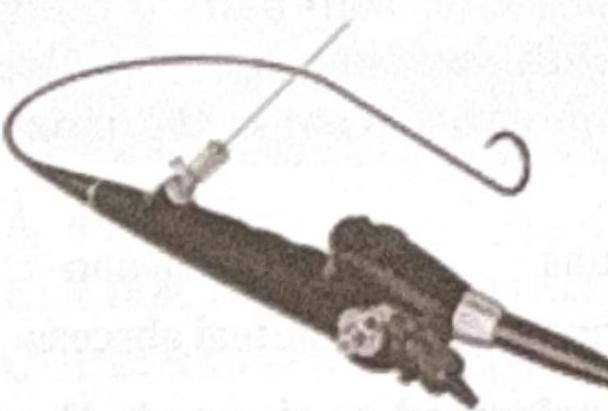
Identify the instrument shown in the image.
A 30-year-old male undergoes varicocele surgery to correct his left-sided varicocele. Following the procedure, the surgeon explains the postoperative changes to the patient. The patient asks, "Through which route does the venous drainage primarily occur after the surgery?" Which of the following is the correct response by the surgeon?
A 50 year old male patient came to the outpatient department with complaints of hematuria. A 2 x 2 cm bladder mass is seen which is low grade transitional cell carcinoma. Which among the following is the ideal management?
A 13-year-old boy is brought to the emergency department by his parents for evaluation of severe groin pain for the past 4 hours. His symptoms began while he was participating in a basketball game. On arrival to the ED, the resident on call notes a swollen, tender, and elevated left testicle with absence of the cremasteric reflex. A urology consult is requested and the patient is scheduled for surgery. An abnormality in which of the following anatomical structures is most likely responsible for this patient’s condition?
The complication which will not occur after PCNL surgery:
Explanation: ***2 and 3*** - The ureter has a characteristic **pale, glistening appearance** (often described as "pearly white"), which helps distinguish it from surrounding tissues during surgery. - The presence of **longitudinal vessels** running along its surface is a key anatomical feature for intraoperative identification. - Additional identification feature: The ureter shows **peristaltic waves** when gently stimulated or pinched with forceps. *2 and 4* - While the ureter is indeed **pale and glistening**, the vessels on its surface are **longitudinal**, not circumferential. - **Circumferential vessels** would encircle the structure, which is not characteristic of ureteric vascular anatomy. *1 and 3* - The ureter is a tubular structure, but it is **not transparent**; it has a distinct **opaque, pale coloration**. - Although **longitudinal vessels** are correctly present, the transparency descriptor is inaccurate and not a reliable identification feature. *1 and 4* - The ureter is **not transparent** (it's opaque), and its vessels are **longitudinal**, not circumferential. - Neither of these features accurately describes the intraoperative appearance of the ureter.
Explanation: ***Duration of symptoms*** - **Testicular torsion** is a medical emergency requiring rapid intervention; the viability of the testicle significantly decreases with prolonged ischemia. - Surgical detorsion within **6 hours** of symptom onset offers the highest chance of testicular salvage. Salvage rates drop drastically after this timeframe. *Age of the patient* - While testicular torsion is more common in adolescents and neonates, the patient's age (22) is not the critical factor determining testicular salvage. - The patient's youth helps with recovery but doesn't change the time-sensitive nature of the condition. *Presence of nausea and vomiting* - Nausea and vomiting are common **sympathetic responses** to severe pain, which often accompanies acute testicular torsion. - These symptoms indicate pain severity but do not directly influence the window for testicular salvage. *Results of Doppler ultrasound* - Doppler ultrasound helps **confirm the diagnosis** of decreased blood flow, but the delay in obtaining and interpreting the results can waste precious time. - Clinical diagnosis is often sufficient to proceed with surgical exploration given the time-sensitive nature of the condition.
Explanation: ***Sterility is achieved 3 weeks after the procedure*** - Full sterility after vasectomy is not achieved instantly; it typically takes **at least 8-16 weeks** or approximately **20 ejaculations** to clear residual sperm. - Patients are advised to use other birth control methods until a **sperm count of zero** is confirmed by a semen analysis. *The procedure is done under local anesthesia* - Vasectomy is commonly performed using **local anesthesia**, often alongside mild sedation, making it an outpatient procedure. - This approach minimizes patient discomfort and avoids the risks associated with general anesthesia. *The vas deferens is the structure that is divided in the procedure* - The **vas deferens** is indeed the specific anatomical structure that is cut, tied, or sealed during a vasectomy. - This interruption prevents sperm from traveling from the epididymis to the urethra, thus preventing fertilization. *A no-scalpel technique is being widely used now* - The **no-scalpel vasectomy (NSV)** technique is a modern, less invasive approach that uses a puncturing instrument instead of a scalpel incision. - This method typically results in less pain, bleeding, and a quicker recovery compared to traditional incisional techniques.
Explanation: ***Isthmus - narrowest*** - The **isthmus** is preferred for tubectomy because its **narrowest diameter** and thick muscular wall make it easier to ligate and minimize recanalization. - Its narrow lumen also reduces the chances of spontaneous rejoining and pregnancy, ensuring a more effective and permanent sterilization. *Ampulla - uniform thickness of muscle* - The **ampulla** is a wider, more distensible part of the fallopian tube, making it **less suitable for ligation** due to a higher risk of recanalization. - While tubular muscle thickness is a factor, the **ampulla's larger lumen** makes it less ideal for effective and permanent occlusion compared to the isthmus. *Ampulla - widest* - The **ampulla's wider diameter** increases the technical difficulty of creating a secure and permanent occlusion, as ligating a broad segment is less effective. - A wider lumen makes **spontaneous recanalization** more likely, compromising the contraceptive efficacy of the procedure. *Isthmus - uniform thickness of muscle* - While the isthmus does have a relatively **uniform and thick muscular wall**, it is the **narrowness of the lumen** that is the primary reason for its selection in tubectomy. - The consistency of its muscle is a contributing factor to its robustness, but the **small caliber** is key to preventing recanalization.
Explanation: ***Penectomy with deep ilioinguinal node dissection*** - A **T3 penile lesion** indicates invasion of the corpus cavernosum or corpus spongiosum, which is an aggressive stage requiring **radical local excision (penectomy)**. - **Clinically palpable lymph nodes** alongside a T3 tumor suggest nodal involvement (N1-N3), necessitating a **deep ilioinguinal lymph node dissection** to remove affected deeper lymph nodes that are not readily accessible by superficial dissection. *Penectomy* - While penectomy addresses the primary tumor, it does not manage the **clinically palpable lymph nodes**, which are crucial for staging and prognosis in advanced penile cancer. - This option would be insufficient given the documented **nodal involvement**, leading to likely recurrence and progression of the disease. *Penectomy with superficial node dissection* - This approach is inadequate for **palpable lymph nodes**, especially with a T3 lesion, because such nodes often indicate involvement of **deeper lymphatics (deep ilioinguinal)**. - Superficial dissection alone would likely leave residual disease, failing to properly stage and treat the extent of the cancer. *Chemoradiotherapy* - **Chemoradiotherapy** is typically reserved for patients who are not surgical candidates, or as a neoadjuvant/adjuvant therapy, not as primary treatment for a **T3 lesion with palpable nodes** where surgical intervention is the standard of care for optimal local and regional control. - While it may be used in certain settings, surgery (penectomy with lymph node dissection) offers the best chance for cure in this scenario.
Explanation: ***Ureteroscope*** - The image distinctly shows a long, thin, flexible scope with a working channel, consistent with a **flexible ureteroscope**. - The presence of a **guidewire** alongside the scope further indicates its use for navigating the narrow and tortuous ureter. *Nephroscope* - A nephroscope is typically a more rigid and wider instrument used for percutaneous access to the **kidney's collecting system**. - Its design is optimized for procedures within the kidney, not for navigating the ureter. *Cystoscope* - A cystoscope is used to visualize the **bladder** and urethra and is generally shorter and thicker than a ureteroscope. - While it can be flexible or rigid, the instrument shown is too long and thin to be a standard cystoscope. *Laparoscope* - A laparoscope is a rigid instrument used for **abdominal surgery**, inserted through the abdominal wall. - Its design and application are entirely different from the instrument shown, which is designed for internal urinary tract procedures.
Explanation: ***Cremasteric and deferential veins*** - After varicocele surgery, the **internal spermatic veins** (pampiniform plexus) are ligated or embolized, eliminating the primary drainage route. - Venous drainage then shifts to **collateral pathways**: the **cremasteric veins** (which drain to the inferior epigastric vein) and the **deferential/vasal veins** (which drain to the vesical venous plexus). - These provide adequate alternative venous outflow from the testis, preventing venous congestion post-operatively. - This is a well-established anatomical principle in varicocele surgery. *Penile veins* - Penile veins primarily drain the **penis** itself (corpus cavernosum and spongiosum), not the testis. - They are anatomically distinct from the testicular venous drainage system and do not serve as a collateral route after varicocele repair. *Ectopic drainage in the iliac fossa* - This is not a recognized anatomical pathway for testicular venous drainage. - While cremasteric veins eventually drain to the external iliac system via inferior epigastric veins, referring to this as "ectopic drainage in the iliac fossa" is anatomically imprecise and not standard terminology. *At the usual location* - The usual pre-operative drainage is through the **pampiniform plexus → internal spermatic vein** (left side drains to left renal vein, right side to IVC). - This is the pathway that is **surgically interrupted** during varicocele repair (ligation or embolization). - Post-operatively, drainage cannot occur at this location as these vessels are deliberately occluded.
Explanation: ***Transurethral resection of the tumour*** - For a **low-grade transitional cell carcinoma** that is 2x2 cm and thus considered small and localized, **transurethral resection of the tumor (TURBT)** is the initial and often definitive treatment. - This procedure allows for both **diagnosis** by obtaining tissue samples and **complete removal** of the visible tumor. *Resection with ileal conduit* - This option, involving a **radical cystectomy** and urinary diversion, is a more aggressive treatment reserved for **invasive, high-grade, or recurrent bladder cancers** that cannot be managed by less invasive means. - It would be **overtreatment** for a low-grade, relatively small bladder mass. *Partial cystectomy with bladder reconstruction* - **Partial cystectomy** is considered for solitary, muscle-invasive tumors located away from critical areas (like the trigone) when bladder preservation is desirable. - It is generally not the first-line treatment for **non-muscle-invasive, low-grade tumors** due to the potential for recurrence in the remaining bladder and the morbidity of open surgery compared to TURBT. *Neoadjuvant chemotherapy* - **Neoadjuvant chemotherapy** is typically administered before radical cystectomy for **muscle-invasive bladder cancer** to improve oncologic outcomes. - It is not indicated for **low-grade, non-muscle-invasive bladder cancer** which is usually managed surgically first, without systemic chemotherapy.
Explanation: ***Tunica vaginalis*** - This patient presents with symptoms highly suggestive of **testicular torsion**, characterized by acute scrotal pain, testicular elevation, and absence of the cremasteric reflex. - In most cases of testicular torsion, the *tunica vaginalis* has an abnormally high attachment, which allows the testis to rotate freely within the scrotum (bell-clapper deformity). *Cremasteric muscle* - The cremasteric muscle is responsible for elevating the testis; its absence of reflex is a *symptom* of torsion, not the underlying cause of the anatomical predisposition. - While its function is important for testicular positioning, an abnormality in the muscle itself is not the primary anatomical defect leading to torsion. *Tunica dartos* - The tunica dartos is a layer of smooth muscle beneath the scrotal skin that helps regulate testicular temperature by contracting and relaxing the scrotal skin. - Abnormalities in the tunica dartos do not predispose to testicular torsion. *Tunica albuginea* - The tunica albuginea is a dense, fibrous capsule directly surrounding the testis, providing its structural integrity. - While it encases the testis, its abnormal attachment is not the main reason for the increased mobility that leads to torsion; rather, it is the relationship of the *tunica vaginalis* to the testis.
Explanation: ***Urethral stricture*** - **Urethral stricture** is a complication typically associated with transurethral procedures involving instrumentation through the urethra, such as a **Transurethral Resection of the Prostate (TURP)** or repeated urethral catheterisation. - **PCNL (Percutaneous Nephrolithotomy)** involves direct access to the kidney through the skin in the flank, bypassing the urethra entirely, therefore, making urethral stricture not a direct complication of this procedure. *Organ injury* - **Organ injury**, particularly to adjacent organs like the **colon**, **pleura**, or **spleen/liver**, can occur during PCNL if the access tract is misdirected or during instrumentation. - This is a well-recognised but infrequent complication requiring careful pre-operative planning and imaging guidance. *Bleeding* - **Bleeding** is a common complication of PCNL due to the invasive nature of the procedure, involving puncture of the kidney and fragmentation of stones. - It can range from minor self-limiting bleeding to significant haemorrhage requiring transfusion or further intervention such as **angiography** and **embolization**. *Sepsis* - **Sepsis** is a serious potential complication, particularly if the patient has pre-existing urinary tract infection or if bacteria are dislodged during stone fragmentation. - **Infection** can disseminate into the bloodstream, leading to severe systemic inflammatory response syndrome and septic shock.
Urological Anatomy
Practice Questions
Hematuria Evaluation
Practice Questions
Urinary Calculi
Practice Questions
Benign Prostatic Hyperplasia
Practice Questions
Prostate Cancer
Practice Questions
Bladder Cancer
Practice Questions
Renal Cell Carcinoma
Practice Questions
Testicular Tumors
Practice Questions
Urinary Tract Infections
Practice Questions
Urinary Incontinence
Practice Questions
Genitourinary Trauma
Practice Questions
Pediatric Urology Basics
Practice Questions
Get full access to all questions, explanations, and performance tracking.
Start For Free