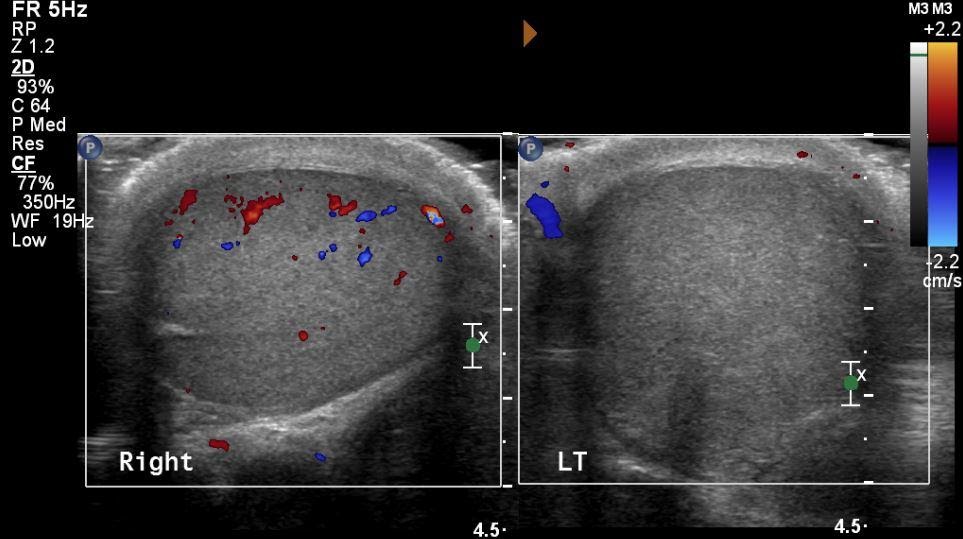
Alveolitis sicca dolorosa is otherwise known as?
A 55-year-old male with a history of repeated attacks of Urinary Tract Infection presents with a radio-opaque shadow on X-ray KUB. What is the most likely underlying pathology?
Which statement is false regarding hydrocele?
Regarding testicular torsion, all are true EXCEPT?
Which of the following substances is NOT used as an irrigant during transurethral resection of the prostate?
A 70-year-old male chronic smoker is diagnosed with carcinoma in situ of the urinary bladder and undergoes transurethral resection (TUR). There is now a recurrence with the tumor extending into the muscle. What is the recommended treatment?
During the surgical extraction of a lower impacted right molar, to what extent is bone removal typically performed?
A 70-year-old man presents with urinary retention and back pain. Which investigation should be performed?
Defective migration of neural crest cells results in which of the following conditions?
Which of the following is NOT true about urethral injuries?
Explanation: **Explanation:** **Alveolitis sicca dolorosa** is the formal medical term for **Dry Socket**, a common post-extraction complication in dentistry and oral surgery. 1. **Why "Dry Socket" is correct:** The term literally translates to "painful dry inflammation of the alveolus." It occurs when the blood clot at the site of a tooth extraction fails to form, dislodges, or dissolves prematurely (fibrinolysis). This exposes the underlying alveolar bone and nerve endings to the oral environment, leading to intense pain, a foul odor (halitosis), and an empty-looking "dry" socket. It typically manifests 3–5 days post-extraction. 2. **Analysis of Incorrect Options:** * **Trigeminal neuralgia (A):** A chronic pain condition affecting the 5th cranial nerve, characterized by sudden, severe, electric shock-like facial pain. While it involves facial pain, it is neurological, not inflammatory or post-surgical. * **Sicca Syndrome (B):** Also known as Sjögren’s syndrome, this is an autoimmune condition characterized by dry eyes (xerophthalmia) and dry mouth (xerostomia) due to lymphocytic infiltration of exocrine glands. * **Myospherulosis (D):** A rare iatrogenic swelling caused by the interaction of extravasated blood with petroleum-based antibiotic dressings (like tetracycline ointment) used in surgical cavities. **High-Yield Clinical Pearls for NEET-PG:** * **Risk Factors:** Smoking (most significant), oral contraceptives (estrogen increases fibrinolysis), and mandibular third molar extractions. * **Management:** Treatment is symptomatic. It involves gentle irrigation with saline and placement of a medicated dressing (e.g., **Zinc Oxide Eugenol** or Alveogyl) to provide immediate pain relief. Antibiotics are generally not required unless systemic infection is present.
Explanation: **Explanation:** The presence of a **radio-opaque shadow** on an X-ray KUB (Kidney, Ureter, Bladder) in a patient with recurrent Urinary Tract Infections (UTIs) most likely indicates a **urinary calculus**. Among the given options, **Ureteric pathology** (specifically a ureteric stone) is the most plausible cause for such a radiological finding. Recurrent UTIs often lead to stasis or are caused by urea-splitting organisms (like *Proteus*), which promote the formation of stones. Conversely, an existing stone can act as a nidus for infection, creating a vicious cycle of "infection-stone-infection." **Analysis of Options:** * **B. Prostate pathology:** While Benign Prostatic Hyperplasia (BPH) can cause urinary stasis and subsequent bladder stones, the prostate itself is located in the pelvis. Prostatic calculi are usually small, multiple, and rarely present as a significant "radio-opaque shadow" on KUB unless associated with chronic prostatitis. * **C. Testicular pathology:** Testicular issues (like tumors or torsion) do not typically present with radio-opaque shadows on a KUB film, nor are they a primary cause of recurrent UTIs. * **D. Stricture of the urethra:** A stricture is a soft tissue narrowing. While it causes UTIs due to poor emptying, the stricture itself is radiolucent and cannot be seen on a plain X-ray; it requires a Retrograde Urethrogram (RGU) for visualization. **High-Yield Clinical Pearls for NEET-PG:** * **90% of urinary stones** are radio-opaque (Calcium oxalate is the most common). * **Pure Uric Acid, Xanthine, and Indinavir stones** are radiolucent (Mnemonic: **U**nseen **X**-rays). * **Struvite stones** (Triple phosphate) are associated with recurrent UTIs and often form "Staghorn" calculi. * The three most common sites for ureteric stone impaction are the **Pelviureteric Junction (PUJ)**, the **crossing of iliac vessels**, and the **Vesicoureteric Junction (VUJ)**.
Explanation: **Explanation:** In a vaginal hydrocele, the fluid accumulates within the **tunica vaginalis**, which is a serous sac that almost entirely surrounds the testis (except for the posterior border). Because the testis is enveloped by this fluid-filled sac, it is **not separate** from the swelling; rather, the testis lies within it and is typically non-palpable unless the fluid is drained or the hydrocele is very lax. **Analysis of Options:** * **Option C (Correct):** This is the false statement. In a hydrocele, the testis is "invaginated" into the sac and cannot be felt as a distinct entity. In contrast, in a **spermatocele** or **epididymal cyst**, the testis can be felt separately from the swelling. * **Option A:** True. Hydrocele fluid is typically a clear, straw-colored **transudate** containing albumin and fibrinogen. If it becomes an exudate, it usually indicates secondary infection or underlying malignancy. * **Option B:** True. This is a key clinical feature used to differentiate a hydrocele from an inguinal hernia. In a hydrocele, you can **"get above the swelling"** because the pathology is confined to the scrotum, allowing palpation of the spermatic cord at the neck of the scrotum. * **Option D:** True. A large or tense hydrocele can extend upwards toward the external inguinal ring, making it difficult to clinically identify a concomitant inguinal hernia. **NEET-PG High-Yield Pearls:** * **Transillumination Test:** The classic diagnostic sign for hydrocele (positive due to clear serous fluid). * **Lord’s Plication:** Surgical technique used for thin-walled hydroceles. * **Jaboulay’s Procedure:** Eversion of the sac, used for large, thick-walled hydroceles. * **Primary vs. Secondary:** Always perform an ultrasound in young men with a sudden hydrocele to rule out **testicular tumors**, which can cause a secondary hydrocele.
Explanation: **Explanation:** Testicular torsion is a **surgical emergency** caused by the twisting of the spermatic cord, leading to venous occlusion followed by arterial compromise and testicular infarction. **Why Option B is the Correct Answer (The False Statement):** The management of testicular torsion is **primarily surgical**, not medical. The "Golden Period" for salvage is within **6 hours** of symptom onset. Immediate surgical exploration and detorsion are mandatory. If the testis is viable, orchidopexy (fixation) is performed; if gangrenous, orchidectomy is required. Medical management (like antibiotics or observation) is contraindicated as it delays definitive treatment, leading to organ loss. **Analysis of Other Options:** * **Option A:** Acute epididymitis is the most common differential diagnosis. Clinical features like Prehn’s sign (relief of pain on elevation of the testis) and the presence of a Cremasteric reflex help differentiate them (both are typically negative/absent in torsion). * **Option C:** The anatomical predisposition, known as the **"Bell-clapper deformity"** (high attachment of tunica vaginalis), is often bilateral. Therefore, prophylactic fixation of the contralateral testis is always performed during surgery. * **Option D:** Unlike epididymo-orchitis, which is often associated with urinary tract infections, testicular torsion is a mechanical event and typically **does not present with dysuria** or pyuria. **High-Yield Clinical Pearls for NEET-PG:** * **Most common age:** 12–18 years (Pubertal peak). * **Cremasteric Reflex:** The most sensitive physical exam finding (it is **absent** in torsion). * **Investigation of Choice:** Color Doppler Ultrasound (shows decreased or absent blood flow). However, surgery should not be delayed for imaging if clinical suspicion is high. * **Manual Detorsion:** Performed using the "Open Book" maneuver (rotating the testis outwards).
Explanation: In **Transurethral Resection of the Prostate (TURP)**, the choice of irrigating fluid is critical because the procedure involves opening venous sinuses, which can lead to the systemic absorption of the fluid. ### Why Normal Saline is NOT Used The primary reason **Normal Saline (0.9% NaCl)** is avoided during traditional monopolar TURP is that it is an **isotonic, ionized (conducting) solution**. * **The Mechanism:** Monopolar electrocautery requires a **non-conducting (non-electrolytic)** medium to allow the electrical current to flow from the loop to the tissue. If saline is used, the current disperses through the fluid, causing "short-circuiting" and potential thermal injury to surrounding tissues. * *Note:* Saline **can** be used in **Bipolar TURP**, which is a newer technique where the current stays within the loop. ### Analysis of Other Options * **1.5% Glycine (Option B):** The most commonly used irrigant. It is non-conducting and near-iso-osmolar. However, excessive absorption can lead to **TURP Syndrome** (hyponatremia and ammonia toxicity). * **5% Dextrose (Option C):** A non-conducting, iso-osmolar solution. It is rarely used because it can cause hyperglycemia and makes the surgical field "sticky." * **Distilled Water (Option D):** Non-conducting and provides excellent visibility. However, it is **hypotonic**, leading to hemolysis and acute renal failure if absorbed in large quantities. ### High-Yield Clinical Pearls for NEET-PG * **TURP Syndrome:** Characterized by **dilutional hyponatremia**, fluid overload, and CNS symptoms (confusion, seizures). * **Glycine Metabolism:** Glycine is metabolized into **ammonia**, which can cause transient blindness or visual disturbances post-surgery. * **Ideal Irrigant:** Should be non-toxic, non-conducting, transparent, and isotonic (though most used are slightly hypotonic). * **Bipolar TURP:** The "Gold Standard" for large glands because it allows the use of **Normal Saline**, virtually eliminating the risk of TURP syndrome.
Explanation: ### Explanation The management of bladder cancer is primarily determined by the **depth of invasion**. This patient has progressed from Carcinoma in situ (CIS) to **Muscle-Invasive Bladder Cancer (MIBC)**, defined as stage T2 or higher. **Why Radical Cystectomy is the Correct Choice:** The standard of care for any patient with muscle-invasive bladder cancer (T2-T4a) who is fit for surgery is **Radical Cystectomy** with urinary diversion. Once the tumor involves the detrusor muscle, the risk of lymphatic and systemic metastasis increases significantly. Intravesical therapies are no longer sufficient because they cannot penetrate deep enough into the bladder wall to eradicate the invasive component. **Analysis of Incorrect Options:** * **A & B (Intravesical BCG/Chemotherapy):** These are the treatments of choice for **Non-Muscle Invasive Bladder Cancer (NMIBC)**, such as Ta, T1, or CIS. Since the tumor has now extended into the muscle, these local therapies are considered inadequate and would result in disease progression. * **C (Palliative Radiotherapy):** Radiotherapy is generally reserved for patients who are unfit for major surgery or as part of a "Bladder Preserving Protocol" (Tri-modality therapy) in highly selected cases. It is not the primary "recommended treatment" for a standard surgical candidate. **Clinical Pearls for NEET-PG:** * **Gold Standard:** Radical cystectomy includes removal of the bladder, prostate, and seminal vesicles in men, and the bladder, uterus, ovaries, and anterior vaginal wall in women (**Anterior Pelvic Exenteration**). * **Staging:** The detrusor muscle invasion marks the transition from T1 to **T2**. * **BCG Failure:** If CIS or T1 tumors recur or persist despite intravesical BCG, radical cystectomy is the next step (BCG-refractory disease). * **Smoking:** The most significant risk factor for bladder cancer; it increases the risk of recurrence and progression.
Explanation: **Explanation:** The surgical extraction of an impacted mandibular third molar (lower right molar) requires a systematic approach to bone removal to facilitate a path of exit for the tooth while minimizing trauma to surrounding structures. **Why Option B is Correct:** The standard surgical principle for bone guttering is to remove bone **up to the cementoenamel junction (CEJ)**. Removing bone to this level exposes the greatest horizontal circumference of the crown and provides a clear point of application for elevators. This "guttering" technique (usually performed on the buccal and distal aspects) creates a space that allows the tooth to be luxated or sectioned without excessive force, thereby preventing jaw fractures or damage to the adjacent second molar. **Analysis of Incorrect Options:** * **Option A:** Exposing the "maximum dimension" is vague. While the crown must be cleared, the CEJ is the specific anatomical landmark that defines the boundary between the crown and root, serving as the clinical endpoint for bone removal. * **Option C & D:** Removing bone to the **furcation** or **half the root length** is excessive and contraindicated. Deep bone removal increases the risk of injuring the **Inferior Alveolar Nerve (IAN)**, weakening the mandible, and causing significant post-operative edema and pain. **Clinical Pearls for NEET-PG:** * **Winter’s Classification:** Used to describe the angulation of the impacted tooth (Mesioangular is the most common; Vertical is the easiest; Distoangular is the most difficult to remove). * **Pell and Gregory Classification:** Based on the relationship to the ramus and the occlusal plane. * **Safety Zone:** Bone removal should be restricted to the buccal and distal sides; **lingual bone** is never removed to avoid damaging the **Lingual Nerve**.
Explanation: **Explanation:** The clinical presentation of an elderly male (70 years) with urinary retention and back pain is highly suggestive of **Carcinoma Prostate** with bone metastasis. **1. Why Serum Acid Phosphatase (SAP) is the correct answer:** Historically, Serum Acid Phosphatase (specifically the prostatic fraction) was the first biochemical marker used for prostate cancer. Its levels rise significantly when the tumor breaches the prostatic capsule and spreads to the bones (osteoblastic metastasis). While Serum PSA (Prostate-Specific Antigen) is now the gold standard for screening and diagnosis, SAP remains a classic textbook answer for identifying metastatic spread in the context of prostatic malignancy in older exams. **2. Analysis of Incorrect Options:** * **Serum Calcium:** While bone metastasis can alter calcium levels, it is non-specific. In prostate cancer, metastases are typically **osteoblastic** (bone-forming), which often results in normal or even low serum calcium, unlike the hypercalcemia seen in osteolytic lesions (e.g., Multiple Myeloma or Breast Cancer). * **Serum Alkaline Phosphatase (ALP):** ALP levels increase during active bone formation (osteoblastic activity). While elevated in metastatic prostate cancer, it is also elevated in liver diseases and other bone pathologies, making it less specific than SAP for the prostate. * **Serum Electrophoresis:** This is the investigation of choice for **Multiple Myeloma**. While Multiple Myeloma also presents with back pain in the elderly, it typically causes "punched-out" lytic lesions and is not associated with urinary retention (prostatism). **Clinical Pearls for NEET-PG:** * **Prostate Cancer Metastasis:** Characteristically **Osteoblastic** (appears dense/white on X-ray). * **PSA vs. SAP:** PSA is more sensitive for early detection; SAP is a marker of **extra-capsular extension** and metastatic disease. * **Most common site of metastasis:** Lumbar spine (via Batson’s venous plexus). * **Prostatic Acid Phosphatase (PAP):** Specifically used to monitor response to treatment in advanced stages.
Explanation: **Explanation:** **1. Why Congenital Megacolon is correct:** Congenital megacolon, also known as **Hirschsprung disease**, is caused by the failure of **neural crest cells** to migrate cranio-caudally into the distal colon during the 5th to 12th weeks of gestation. This results in an **aganglionic segment** (lacking Meissner’s and Auerbach’s plexuses) starting from the internal anal sphincter and extending proximally. The affected segment remains in a state of tonic contraction, leading to functional obstruction and massive dilation of the proximal normal colon. **2. Why other options are incorrect:** * **Albinism:** This is a genetic disorder of melanin synthesis (typically a defect in the enzyme **tyrosinase**). While melanocytes are derived from neural crest cells, albinism is a defect in *function/production*, not migration. * **Adrenogenital hypoplasia:** This refers to underdevelopment of the adrenal glands or disorders of steroidogenesis (like CAH). While the adrenal medulla is neural crest-derived, this specific condition is usually linked to genetic mutations (e.g., DAX1) rather than migratory failure. * **Dentinogenesis imperfecta:** This is a genetic defect in **dentin formation** (Type I collagen or DSPP gene). While odontoblasts (which form dentin) are neural crest-derived, the pathology lies in the mineralization and structure of the matrix. **High-Yield Clinical Pearls for NEET-PG:** * **Gold Standard Diagnosis:** Full-thickness rectal biopsy showing absence of ganglion cells and presence of hypertrophied nerve bundles. * **Associated Conditions:** Down Syndrome (10% of cases) and RET proto-oncogene mutations. * **Clinical Presentation:** Delayed passage of meconium (>48 hours), neonatal intestinal obstruction, and "blast sign" (explosive release of stool) on digital rectal exam. * **Other Neural Crest Migration Defects:** Waardenburg syndrome and Piebaldism.
Explanation: **Explanation:** In the management of suspected urethral injury, **immediate catheterization is strictly contraindicated.** Attempting to pass a catheter in a patient with a urethral tear can convert a partial tear into a complete transection and introduce infection into a pelvic hematoma. The gold standard initial investigation to assess urethral integrity is a **Retrograde Urethrogram (RUG)**. Only after a RUG has ruled out injury should catheterization be attempted. **Analysis of Options:** * **Option A (Correct):** As stated, blind catheterization is dangerous. If the patient cannot void, a suprapubic cystostomy (SPC) is the preferred method of bladder drainage. * **Option B:** Posterior urethral injuries (specifically at the membranous urethra) are highly associated with **pelvic fractures** (up to 10% of cases), often due to the shearing forces at the puboprostatic ligaments. * **Option C:** High-energy trauma causing pelvic fractures often results in concomitant injuries to the bladder (extraperitoneal or intraperitoneal) along with the posterior urethra. * **Option D:** **Blood at the external urethral meatus** is the most reliable clinical sign of urethral injury. Other signs include a "high-riding prostate" on digital rectal exam and a perineal "butterfly" hematoma (in anterior injuries). **Clinical Pearls for NEET-PG:** * **Anterior Urethra Injury:** Most common site is the **bulbar urethra**, usually due to a "straddle injury" (falling astride). * **Posterior Urethra Injury:** Most common site is the **membranous urethra**, usually due to pelvic fractures. * **Triad of Urethral Injury:** Blood at meatus, inability to void, and a palpable distended bladder. * **Management:** If RUG shows a tear, the initial management is typically a **Suprapubic Catheter (SPC)** followed by delayed repair (Urethroplasty).
Urological Anatomy
Practice Questions
Hematuria Evaluation
Practice Questions
Urinary Calculi
Practice Questions
Benign Prostatic Hyperplasia
Practice Questions
Prostate Cancer
Practice Questions
Bladder Cancer
Practice Questions
Renal Cell Carcinoma
Practice Questions
Testicular Tumors
Practice Questions
Urinary Tract Infections
Practice Questions
Urinary Incontinence
Practice Questions
Genitourinary Trauma
Practice Questions
Pediatric Urology Basics
Practice Questions
Get full access to all questions, explanations, and performance tracking.
Start For Free