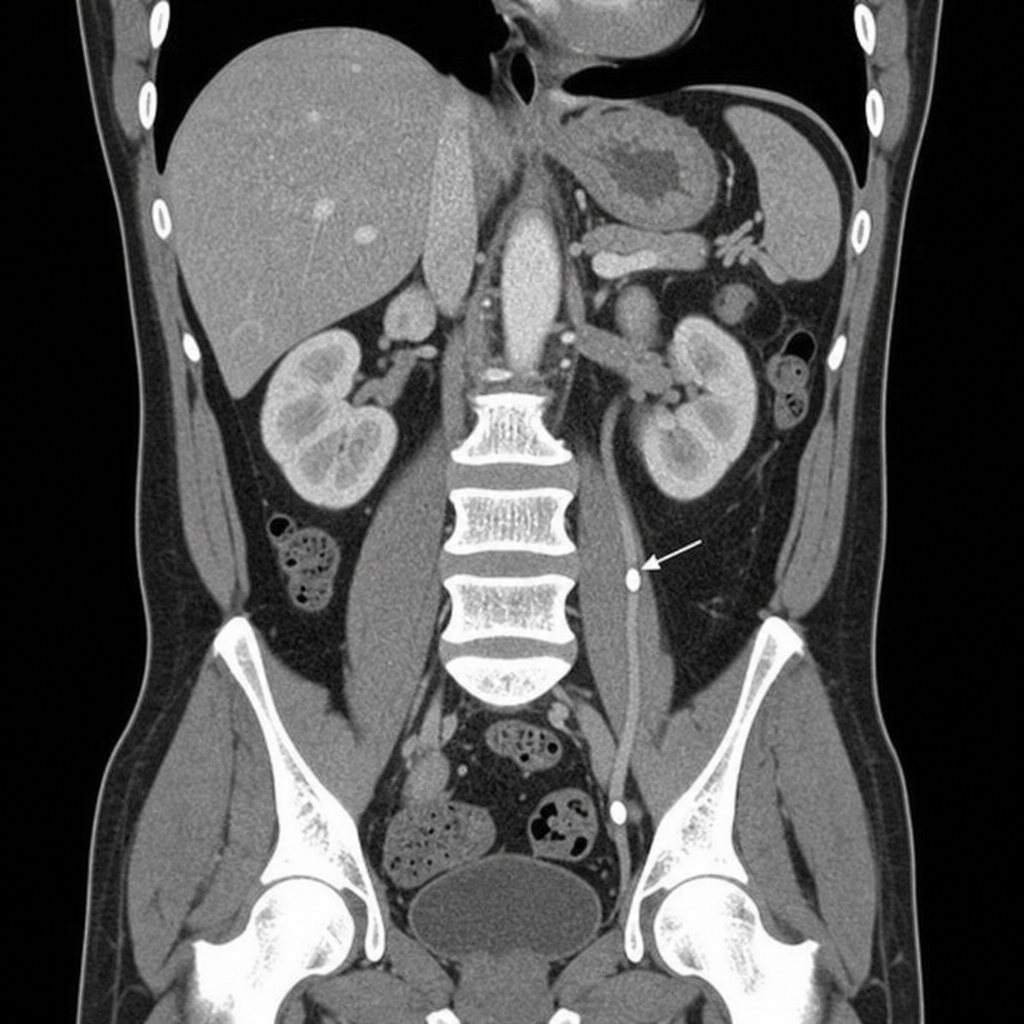
What is the TNM staging for penile carcinoma extending up to the urethra?
Which of the following should contraindicate the performance of the Fontan procedure?
What is the most important use of transrectal ultrasonography (TRUS)?
Which of the following is NOT an indication for surgery in BPH?
Which of the following is most commonly involved in retroperitoneal fibrosis?
What is the most important investigation for posterior urethral valve?
Which of the following is NOT an indication for surgery in benign prostatic hypertrophy?
Which of the following is the most appropriate cause of urinary stone formation?
Undescended testis increases the risk of which cancer?
90% of bladder cancers arise from which cell type?
Explanation: The TNM staging of penile carcinoma is a high-yield topic for NEET-PG, specifically focusing on the depth of anatomical invasion. ### **Explanation of the Correct Answer** According to the **AJCC 8th Edition** for Penile Cancer, the staging is determined by the specific structures the tumor invades: * **T3** is defined as a tumor that invades the **urethra**. * The anatomical progression moves from the glans/prepuce (T1) to the corpus spongiosum/cavernosum (T2), and finally to the **urethra (T3)**. Since the question specifies extension up to the urethra, **T3** is the correct stage. ### **Analysis of Incorrect Options** * **A. T1:** The tumor invades the subepithelial connective tissue (lamina propria) without lymphovascular invasion or perineural invasion and is not high-grade. * **D. T2:** The tumor invades the **corpus spongiosum** (with or without urethral invasion) or **corpus cavernosum**. *Note: In the 8th edition, invasion of the corpus spongiosum alone is T2, but invasion of the urethra specifically elevates it to T3.* * **C. T4:** The tumor invades other adjacent structures such as the **scrotum, prostate, or pubic bone**. ### **High-Yield Clinical Pearls for NEET-PG** 1. **N-Staging Nuance:** N1 is a single mobile inguinal lymph node; N2 is multiple or bilateral mobile inguinal nodes; **N3** is a fixed nodal mass or pelvic lymphadenopathy. 2. **Most Common Histology:** Squamous Cell Carcinoma (SCC) is the most common type. 3. **Risk Factors:** Phimosis (most significant), HPV (types 16, 18), and smoking. Circumcision in infancy is protective. 4. **Erythroplasia of Queyrat:** This is CIS (Carcinoma in situ) of the glans or prepuce, which corresponds to **Tis**.
Explanation: The **Fontan procedure** is the final stage of palliative surgery for single-ventricle physiology (e.g., tricuspid atresia). It involves diverting systemic venous blood directly to the pulmonary arteries, bypassing the heart. Because there is no sub-pulmonary pump, the flow depends entirely on a pressure gradient between the systemic veins and the pulmonary atrium. ### **Why Option C is Correct** The success of a Fontan circulation depends on low pulmonary vascular resistance and **low ventricular end-diastolic pressure (LVEDP)**. An LVEDP of **18 mm Hg** is significantly elevated (normal is <12 mm Hg). High diastolic pressure indicates ventricular dysfunction or poor compliance, which increases resistance to passive pulmonary flow. This leads to Fontan failure, characterized by low cardiac output and massive systemic venous congestion. ### **Why Other Options are Incorrect** * **A. Patient age of 25 years:** While the ideal age for Fontan is 2–4 years, adult age is a relative risk factor but not an absolute contraindication if hemodynamics are favorable. * **B. Severe mitral insufficiency:** While it increases LVEDP, it can often be surgically repaired or managed concurrently with the Fontan procedure. * **C. Right pulmonary artery stenosis:** This is a technical hurdle rather than a contraindication. Stenosis can be treated via patch angioplasty or stenting during the procedure to ensure low-resistance flow. ### **NEET-PG High-Yield Pearls: "Choussat’s Criteria"** To ensure a successful Fontan, the following "Ten Commandments" (Choussat’s Criteria) should ideally be met: 1. **Mean Pulmonary Artery Pressure (mPAP):** Should be <15 mm Hg. 2. **Pulmonary Vascular Resistance (PVR):** Should be <4 units/m². 3. **LVEDP:** Should be <12 mm Hg. 4. **PA-Somatic Index:** McGoon ratio >1.8. 5. **Ejection Fraction:** >60% (preserved ventricular function). 6. **Sinus Rhythm:** Essential for optimal filling.
Explanation: **Explanation:** The primary and most important clinical utility of **Transrectal Ultrasonography (TRUS)** in modern urology is to provide real-time image guidance for performing **systematic prostate biopsies**. While TRUS can visualize the zonal anatomy of the prostate, its sensitivity and specificity for identifying malignant lesions are relatively low. Therefore, its role is not to diagnose cancer based on imaging alone, but to ensure that biopsy needles are accurately and systematically distributed throughout the gland (typically a 12-core biopsy) to obtain tissue for histopathological diagnosis. **Analysis of Options:** * **Option A:** TRUS is **not** a screening tool. Screening for prostate cancer is primarily done using Digital Rectal Examination (DRE) and Serum PSA levels. * **Option B:** TRUS cannot reliably distinguish between BPH and cancer. Many prostate cancers are isoechoic (invisible on USG), and many hypoechoic lesions turn out to be prostatitis or infarcts rather than malignancy. * **Option D:** Transurethral Resection of the Prostate (TURP) is an endoscopic procedure guided by direct vision through a cystoscope, not by ultrasound. **Clinical Pearls for NEET-PG:** * **Classic Appearance:** On TRUS, prostate cancer typically appears as a **hypoechoic lesion** in the **peripheral zone**, though this is not pathognomonic. * **Gold Standard for Diagnosis:** Systematic TRUS-guided biopsy remains the standard for diagnosing prostate cancer when PSA is elevated or DRE is abnormal. * **Emerging Trend:** Multiparametric MRI (mpMRI) followed by **MRI-TRUS Fusion Biopsy** is now preferred for better localization of suspicious lesions compared to TRUS alone.
Explanation: In Benign Prostatic Hyperplasia (BPH), the decision to proceed with surgery (typically TURP) is based on the presence of **absolute indications** or the failure of medical management. ### **Why Option D is the Correct Answer** The **International Prostate Symptom Score (IPSS)** is used to categorize the severity of lower urinary tract symptoms (LUTS). * **0–7:** Mild symptoms * **8–19:** Moderate symptoms * **20–35:** Severe symptoms An IPSS of 8 falls into the **moderate** category. For patients with moderate symptoms, the first line of management is typically **medical therapy** (e.g., Alpha-blockers or 5-Alpha-reductase inhibitors) or watchful waiting, rather than immediate surgery. ### **Analysis of Incorrect Options (Absolute Indications for Surgery)** * **A. Chronic Urine Retention:** Persistent or recurrent retention despite catheterization indicates bladder outlet obstruction that requires surgical relief. * **B. Multiple UTIs:** Recurrent infections suggest significant post-void residual urine acting as a nidus for bacteria, necessitating surgery. * **C. Bilateral Hydronephrosis:** This indicates high-pressure chronic retention leading to obstructive uropathy and potential renal failure. It is a critical indication for surgery to preserve kidney function. ### **NEET-PG High-Yield Clinical Pearls** * **Absolute Indications for Surgery (Mnemonic: "H-R-R-B-S"):** 1. **H**ydronephrosis (Obstructive uropathy/Renal failure) 2. **R**etention (Refractory/Recurrent) 3. **R**ecurrent UTIs 4. **B**ladder Stones (Vesical calculi) 5. **S**evere Hematuria (Recurrent/Gross) * **Gold Standard Surgery:** Transurethral Resection of the Prostate (TURP). * **Size Consideration:** For glands >80–100g, Open Prostatectomy or HoLEP (Holmium Laser Enucleation) is preferred over TURP.
Explanation: **Explanation:** **Retroperitoneal Fibrosis (Ormond’s Disease)** is characterized by the proliferation of aberrant fibro-inflammatory tissue in the retroperitoneum, which eventually encases and compresses local structures. **Why Ureter is the correct answer:** The **ureter** is the most clinically significant and commonly involved structure. The fibrotic process typically begins at the level of the aortic bifurcation and spreads laterally. As the plaque contracts, it pulls the ureters medially (**medial deviation of ureters**) and compresses them. This leads to obstructive uropathy, hydronephrosis, and eventually renal failure, which is the most common presentation and cause of morbidity in these patients. **Analysis of Incorrect Options:** * **A. Aorta:** While the fibrotic mass often surrounds the infrarenal aorta (it is frequently associated with periaortitis), the aorta is thick-walled and high-pressure; therefore, it is rarely functionally compromised or compressed compared to the thin-walled ureters. * **C. Inferior Vena Cava (IVC):** The IVC can be involved and compressed, leading to lower limb edema or DVT, but this occurs less frequently than ureteral involvement. * **D. Sympathetic nerve plexus:** These nerves may be encased, potentially causing vague back pain, but they are not the primary structure used to define the clinical progression or complications of the disease. **High-Yield Clinical Pearls for NEET-PG:** * **Etiology:** 70% are idiopathic; 30% are secondary to drugs (Methysergide, Ergotamine, Beta-blockers), malignancy, or infections. * **Association:** Strongly linked with **IgG4-related disease**. * **Classic Triad on IVP:** Medial deviation of the middle third of the ureters, hydronephrosis, and extrinsic ureteral compression. * **Management:** Medical (Corticosteroids - first line; Tamoxifen) and Surgical (Ureterolysis with intraperitoneal transposition).
Explanation: ### Explanation **Posterior Urethral Valve (PUV)** is the most common cause of bladder outlet obstruction in male infants. It involves obstructing membranes in the prostatic urethra. **Why Micturating Cystourethrogram (MCU) is the Correct Answer:** MCU is the **gold standard** and the most important investigation for PUV. The diagnosis is confirmed during the voiding phase, which reveals a **dilated and elongated prostatic urethra** with a "filling defect" at the site of the valve, often accompanied by a narrow bulbar urethra (the "spinning top" appearance). Additionally, MCU is essential to detect associated **Vesicoureteral Reflux (VUR)**, which occurs in approximately 50% of these patients. **Why Other Options are Incorrect:** * **Urethroscopy:** While it can visualize the valves directly and is used during surgical ablation, it is invasive and not the primary diagnostic investigation of choice. * **Intravenous Pyelogram (IVP):** IVP provides poor visualization of the urethra and is generally avoided in infants due to the immaturity of the kidneys and the risk of contrast load. * **Retrograde Cystogram:** This involves injecting contrast against the flow. Since PUV acts as a one-way valve, a retrograde study may not demonstrate the obstructive pathology as effectively as a voiding study. **High-Yield Clinical Pearls for NEET-PG:** * **Initial Investigation:** Antenatal Ultrasound (shows "Keyhole sign" due to dilated bladder and prostatic urethra). * **Best Initial Postnatal Test:** Ultrasound of the KUB region. * **Gold Standard/Definitive Diagnosis:** MCU. * **Immediate Management:** Catheterization (using a small feeding tube) to decompress the bladder. * **Definitive Management:** Endoscopic Primary Valve Ablation (Fulguration).
Explanation: In Benign Prostatic Hyperplasia (BPH), the decision to operate is based on **symptoms and complications**, not the physical size of the gland. ### Why "A large prostate gland alone" is the correct answer: The size of the prostate does not correlate directly with the severity of bladder outlet obstruction (BOO). A patient may have a massively enlarged prostate (e.g., 100g) but remain asymptomatic if the growth is peripheral. Conversely, a small median lobe can cause significant obstruction. Surgery is indicated only when the enlargement causes physiological distress or end-organ damage. ### Explanation of Incorrect Options (Indications for Surgery): * **Prostatism (Option A):** This refers to bothersome Lower Urinary Tract Symptoms (LUTS) that fail medical management (Alpha-blockers/5-ARIs). If symptoms significantly impair the patient's quality of life, surgery (like TURP) is indicated. * **Chronic Urinary Retention (Option B):** Persistent retention leads to increased intravesical pressure, which can cause hydroureteronephrosis and renal failure (post-renal azotemia). This is an absolute indication for surgery. * **Recurrent Gross Hematuria (Option C):** BPH causes friable neovascularization on the prostatic surface. If bleeding is recurrent or severe enough to cause clot retention, surgical intervention is required. ### High-Yield Clinical Pearls for NEET-PG: * **Absolute Indications for Surgery (Mnemonic: "H-R-R-S-B"):** 1. **H**ematuria (Recurrent/Severe) 2. **R**enal insufficiency (due to BPH) 3. **R**etention (Refractory to catheterization) 4. **S**tones (Bladder calculi) 5. **B**ladder Diverticula or recurrent UTIs. * **Gold Standard Treatment:** Transurethral Resection of the Prostate (TURP). * **Size Threshold:** For glands >80-100g, Open Prostatectomy or HoLEP (Holmium Laser Enucleation) is often preferred over TURP.
Explanation: ### Explanation Urinary stone formation (urolithiasis) is a complex process involving the supersaturation of urine with stone-forming salts and a deficiency of crystallization inhibitors. **Why "High Urinary Oxalate" is Correct:** Hyperoxaluria is a potent risk factor for the formation of **Calcium Oxalate** stones, the most common type of renal calculi (approx. 80%). Oxalate is a stronger promoter of crystallization than calcium; even a small increase in urinary oxalate levels significantly increases the ion activity product of calcium oxalate, leading to crystal nucleation and growth. Common causes include dietary intake (spinach, nuts), enteric hyperoxaluria (malabsorption syndromes like Crohn’s disease), or primary genetic defects. **Analysis of Incorrect Options:** * **Low urinary Mg:** While Magnesium is a known **inhibitor** of stone formation (it binds to oxalate to form soluble magnesium oxalate), "High urinary oxalate" is a more direct and potent "cause" or promoter of the most common stone type compared to isolated low magnesium. * **Low urinary sodium:** This is actually **protective**. High urinary sodium (Hypernatriuria) promotes stone formation by increasing urinary calcium excretion (hypercalciuria) and decreasing urinary citrate (an inhibitor). * **High urinary chloride:** Urinary chloride levels do not have a direct, significant role in the pathophysiology of stone nucleation compared to oxalate or calcium. **Clinical Pearls for NEET-PG:** * **Most common stone:** Calcium Oxalate (specifically Calcium Oxalate Monohydrate/Whewellite). * **Most common metabolic abnormality:** Idiopathic Hypercalciuria. * **Most potent inhibitor:** Urinary **Citrate** (hypocitraturia is a major risk factor). * **Dietary Advice:** Patients with calcium stones should **not** restrict calcium; instead, they should restrict sodium and oxalate, as low calcium intake paradoxically increases oxalate absorption.
Explanation: **Explanation:** **Undescended Testis (Cryptorchidism)** is a significant risk factor for the development of testicular germ cell tumors (GCTs). The risk is approximately 4 to 10 times higher than in the general population. **Why Seminoma is the Correct Answer:** Among patients with a history of cryptorchidism, **Seminoma** is the most common histological subtype encountered. The underlying pathophysiology involves the failure of gonocytes to differentiate into spermatogonia due to the higher core body temperature in the inguinal canal or abdomen, leading to malignant transformation. Even after surgical correction (orchiopexy), the risk of malignancy remains higher than in the general population, though orchiopexy performed before puberty significantly reduces this risk and allows for easier clinical screening. **Why Other Options are Incorrect:** * **Teratoma:** While a type of non-seminomatous germ cell tumor (NSGCT), it is not the most common association with undescended testis. * **Yolk Sac Tumor:** This is the most common testicular tumor in infants and young children (pre-pubertal), but it is not specifically linked as the primary malignancy arising from cryptorchidism. * **Lymphoma:** This is the most common testicular tumor in men over the age of 60. It is a systemic malignancy rather than a primary germ cell tumor related to developmental descent. **Clinical Pearls for NEET-PG:** * **Location Risk:** The higher the position of the undescended testis (e.g., abdominal vs. inguinal), the higher the risk of malignancy. * **Contralateral Risk:** There is a small but significant risk (approx. 10%) of developing a tumor in the contralateral, normally descended testis. * **Best Time for Surgery:** Current guidelines recommend orchiopexy between **6 to 12 months** of age to preserve fertility and reduce the risk of malignancy. * **Most Common Site:** The most common site for an undescended testis is the **inguinal canal**.
Explanation: **Explanation:** Bladder cancer is the most common malignancy of the urinary tract, and its classification is based on the histological origin of the cells lining the bladder. **1. Why Transitional Cells are correct:** The entire urinary tract (from the renal pelvis to the proximal urethra) is lined by a specialized epithelium known as **urothelium** or **transitional epithelium**. Because this cell type is the predominant lining of the bladder, approximately **90-95%** of all bladder cancers in developed countries are **Transitional Cell Carcinomas (TCC)**, now more commonly referred to as **Urothelial Carcinomas**. **2. Why the other options are incorrect:** * **Squamous cells (Option A):** These account for about 3-7% of bladder cancers. They are usually associated with chronic irritation, such as long-term catheterization or chronic infection with *Schistosoma haematobium* (endemic in Egypt). * **Glandular cells (Option B):** Adenocarcinomas are rare (approx. 1-2%). They typically arise from the **urachus** (at the bladder dome) or in the setting of cystitis glandularis or bladder exstrophy. * **Smooth muscle cells (Option D):** These would represent mesenchymal tumors like leiomyosarcomas, which are extremely rare in the bladder. **Clinical Pearls for NEET-PG:** * **Risk Factors:** Smoking (most common), exposure to aromatic amines (aniline dyes), and Cyclophosphamide. * **Presentation:** The classic presentation is **painless gross hematuria**. * **Gold Standard Investigation:** Cystoscopy with biopsy. * **Schistosomiasis Link:** While TCC is most common globally, in areas endemic for *Schistosoma haematobium*, **Squamous Cell Carcinoma** is the most frequent type.
Urological Anatomy
Practice Questions
Hematuria Evaluation
Practice Questions
Urinary Calculi
Practice Questions
Benign Prostatic Hyperplasia
Practice Questions
Prostate Cancer
Practice Questions
Bladder Cancer
Practice Questions
Renal Cell Carcinoma
Practice Questions
Testicular Tumors
Practice Questions
Urinary Tract Infections
Practice Questions
Urinary Incontinence
Practice Questions
Genitourinary Trauma
Practice Questions
Pediatric Urology Basics
Practice Questions
Get full access to all questions, explanations, and performance tracking.
Start For Free