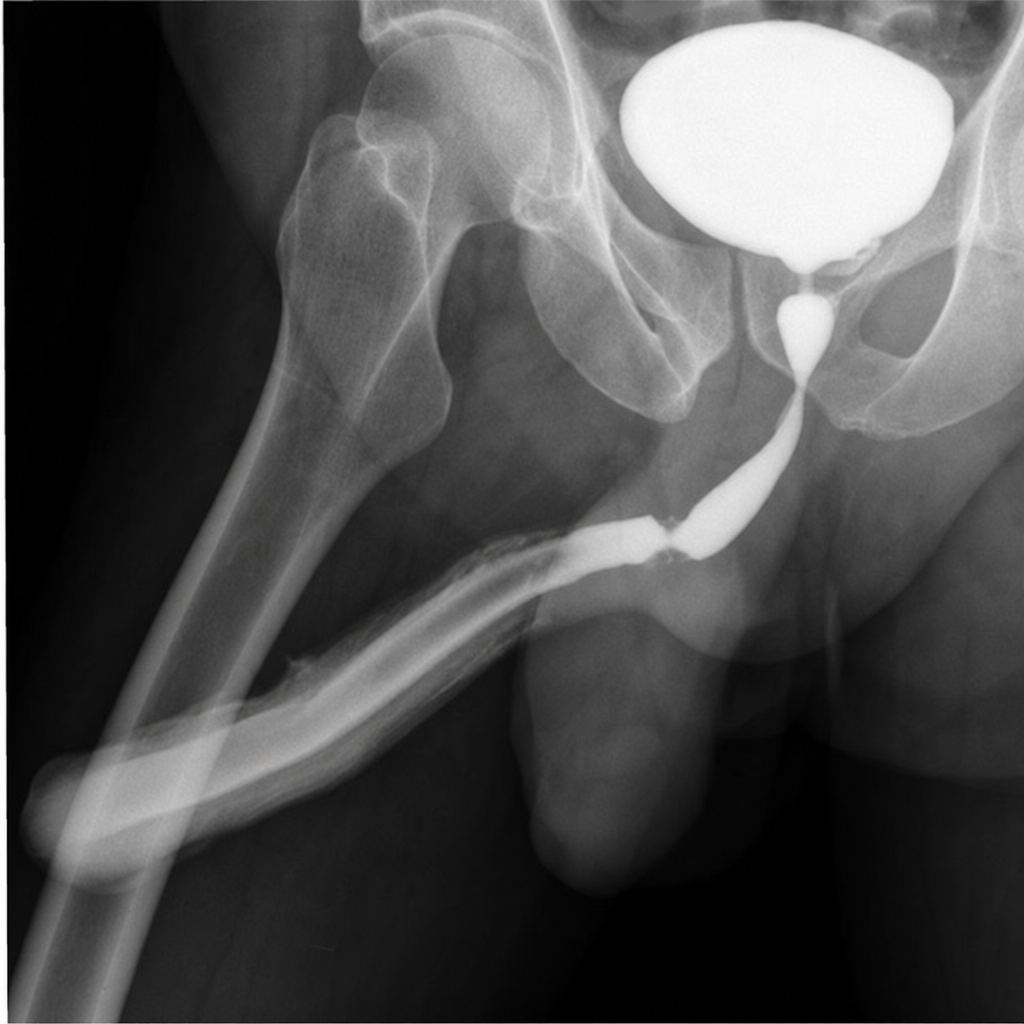
All of the following statements regarding hypospadias are true, EXCEPT?
Whitaker test is done for diagnosing which of the following conditions?
A patient presents with acute severe lower abdominal pain radiating towards the inguinal region, and ultrasonography shows renal stones. Conservative management is indicated when:
Hutch diverticulum is seen in which structure?
What is the most commonly encountered complication during the extraction of a maxillary third molar?
Prostate cancer most commonly occurs in which zone of the gland?
What is the recommended treatment for a superficial bladder carcinoma presenting as a single papillary lesion?
Which of the following is NOT a feature of posterior urethral valve?
Which of the following statements regarding bladder cancer is true?
What is the most common route of infection in renal tuberculosis?
Explanation: **Explanation** Hypospadias is a congenital anomaly characterized by the abnormal ventral opening of the urethral meatus, often associated with chordee (ventral curvature) and a hooded prepuce. **1. Why Option B is the Correct Answer (The False Statement):** Contrary to the option, **surgery is often indicated even in the glandular variety.** While glandular hypospadias is the mildest form, surgical correction is recommended if the meatus is stenotic (causing obstructive voiding), if there is significant cosmetic deformity, or if the urinary stream is deflected in a way that prevents the child from voiding while standing. **2. Analysis of Other Options:** * **Option A (True):** Circumcision is strictly **contraindicated** in infancy. The prepuce (foreskin) is essential for surgical repair, as it provides the vascularized skin flaps or grafts needed for urethroplasty. * **Option C (True/Standard Practice):** While the option mentions puberty, the standard of care is to perform surgery early (usually between **6–18 months** of age) to minimize psychological trauma and ensure healing before school age. However, in the context of this specific MCQ, the statement regarding the necessity of surgery in the glandular variety is the most definitive "false" statement. **Clinical Pearls for NEET-PG:** * **Triad of Hypospadias:** Ectopic urethral meatus (ventral), Chordee (ventral curvature), and Hooded prepuce (deficient ventral skin). * **Most Common Site:** Glandular/Distal (approx. 70%). * **Associated Anomalies:** Cryptorchidism (undescended testis) and Inguinal hernia are the most common. * **Surgical Techniques:** * *MAGPI* (Meatal Advancement and Glanuloplasty) for distal cases. * *Snodgrass Procedure* (TIP - Tubularized Incised Plate) is currently the most popular technique. * **Goal of Surgery:** To create a straight penis (orthoplasty) and a functional neo-urethra (urethroplasty) with a terminal meatus.
Explanation: **Explanation:** The **Whitaker test** is a percutaneous pressure-flow study used to differentiate between **obstructive hydronephrosis** and **non-obstructive dilation** (such as a prominent extrarenal pelvis or residual dilation after surgery). **Why Hydronephrosis is Correct:** In cases where imaging (like IVU or Ultrasound) shows a dilated collecting system but cannot definitively confirm a functional obstruction, the Whitaker test provides a definitive diagnosis. It involves placing a needle into the renal pelvis and a catheter into the bladder. Saline is infused into the renal pelvis at a constant rate (10 ml/min). The pressure difference between the renal pelvis and the bladder is measured. A pressure gradient **>22 cm H₂O** confirms a significant mechanical obstruction requiring intervention. **Why Other Options are Incorrect:** * **Renal Carcinoma & Wilms Tumor:** These are solid malignancies. Diagnosis is primarily based on imaging (CT/MRI) and histopathology, not urodynamic pressure studies. * **Renal Tuberculosis:** This is a chronic granulomatous infection. Diagnosis relies on urine microscopy (AFB), culture (Lowenstein-Jensen medium), and imaging showing "putty kidney" or "moth-eaten" calyces. **High-Yield Clinical Pearls for NEET-PG:** * **Gold Standard:** While the Whitaker test is the "gold standard" for confirming the *presence* of obstruction, it is invasive. * **Non-invasive Alternative:** The **DTPA or MAG3 Diuretic Renogram** (Nuclear scan) is the preferred first-line non-invasive investigation to differentiate obstructive from non-obstructive hydronephrosis. * **Indications:** It is most commonly used today when nuclear scans are equivocal or in patients with significantly impaired renal function where scans are unreliable.
Explanation: **Explanation:** The management of urolithiasis depends primarily on the size of the stone, its location, and the presence of complications. **1. Why Option A is Correct:** The likelihood of spontaneous passage of a ureteric stone is inversely proportional to its size. Stones **< 5-6 mm** in diameter have a high probability (approximately 60-80%) of passing spontaneously with conservative management (Medical Expulsive Therapy using Alpha-blockers like Tamsulosin, hydration, and analgesics). Therefore, conservative management is the initial treatment of choice for small, uncomplicated stones. **2. Why the Other Options are Incorrect:** * **Option B (Hydronephrosis and Infection):** This represents "Obstructed Infected Kidney," which is a urological emergency. It requires immediate surgical intervention (stenting or nephrostomy) to prevent pyonephrosis and urosepsis. * **Option C (Congenital Anomalies):** Stones in anomalous kidneys (e.g., Horseshoe kidney, ectopic kidney) often have poor drainage and are less likely to pass spontaneously, usually requiring active intervention. * **Option D (Failure to descend):** If a stone remains impacted in the same location for **4-6 weeks**, the risk of permanent renal damage and stricture formation increases. Conservative management should be abandoned in favor of intervention (URS or ESWL). **Clinical Pearls for NEET-PG:** * **Size Thresholds:** Stones **< 5 mm** (High chance of passage), **5-10 mm** (Variable; trial of MET), **> 10 mm** (Low chance; usually requires intervention). * **Narrowest point of the ureter:** The **Vesicoureteric Junction (VUJ)** is the most common site for stone impaction. * **Absolute Indications for Surgery:** Intractable pain, persistent obstruction, deteriorating renal function, and infection.
Explanation: **Explanation:** **Hutch diverticulum** is a congenital para-ureteral diverticulum of the **urinary bladder**. It occurs due to a structural weakness in the muscular wall of the bladder (detrusor muscle) at the point where the ureter penetrates the bladder wall (the ureterovesical junction). Because the muscle layer is deficient in this area, the bladder mucosa herniates outward, forming a diverticulum. * **Why Option A is correct:** The diverticulum is specifically located at the hiatus where the ureter enters the bladder. It is clinically significant because it can distort the intramural course of the ureter, leading to the loss of the "anti-reflux" mechanism, which frequently results in **Vesicoureteral Reflux (VUR)** and recurrent urinary tract infections. * **Why Options B, C, and D are incorrect:** While the ureter (B) is anatomically adjacent, the diverticulum is a herniation of the bladder wall itself. Duodenal diverticula (C) are common but are usually acquired and related to mesenteric borders. Caecal diverticula (D) are rare and unrelated to the embryological defects seen in the urinary tract. **High-Yield Clinical Pearls for NEET-PG:** * **Association:** Hutch diverticulum is strongly associated with **Vesicoureteral Reflux (VUR)**. * **Diagnosis:** It is best visualized during the filling phase of a **Voiding Cystourethrogram (VCUG)**. * **Acquired vs. Congenital:** Unlike acquired bladder diverticula (which are usually multiple and caused by bladder outlet obstruction like BPH), a Hutch diverticulum is typically **congenital and solitary**. * **Surgical Management:** If symptomatic or causing high-grade reflux, it is treated via diverticulectomy and ureteral reimplantation.
Explanation: **Explanation:** The **fracture of the maxillary tuberosity** is considered the most common complication specifically associated with the extraction of the maxillary third molar. This occurs primarily due to the anatomical proximity of the third molar to the thin posterior wall of the maxilla and the tuberosity. **Why it is the correct answer:** The maxillary tuberosity is often weakened by a large maxillary sinus (pneumatization) or can be fused to the roots of the third molar (synostosis). During extraction, especially if the tooth is impacted or if excessive distal force is applied with elevators, the bone of the tuberosity is prone to fracturing away with the tooth. **Analysis of Incorrect Options:** * **A. Oro-antral communication:** While common in maxillary molar extractions, it is statistically less frequent than tuberosity fractures for the *third* molar specifically. It occurs more often when roots are widely divergent or deeply embedded in the sinus floor. * **B. Root displacement into the sinus:** This is a known complication but usually results from improper apical pressure during use of elevators. It is less common than a bony fracture of the alveolar housing. * **C. Excessive hemorrhage:** While bleeding occurs in all extractions, "excessive" hemorrhage is rare in routine third molar extractions unless there is an underlying coagulopathy or injury to the greater palatine artery. **Clinical Pearls for NEET-PG:** * **Management:** If a tuberosity fracture occurs and the fragment is small, it is removed with the tooth. If the fragment is large and attached to the periosteum, the extraction is aborted, and the tooth is splinted for 4–6 weeks to allow bony healing. * **Risk Factors:** Lone-standing maxillary molars, divergent roots, and hypercementosis. * **High-Yield Fact:** The **maxillary third molar** is the most common tooth to be displaced into the **infratemporal fossa**.
Explanation: **Explanation:** The prostate gland is divided into distinct anatomical zones according to **McNeal’s classification**. Understanding these zones is crucial for differentiating between common prostatic pathologies. **1. Why Peripheral Zone (PZ) is correct:** Approximately **70–80% of prostatic adenocarcinomas** originate in the peripheral zone. This zone constitutes the bulk of the glandular tissue and is located posteriorly, surrounding the distal urethra. Because of its posterior location, tumors in this zone are easily palpable during a **Digital Rectal Examination (DRE)**. Furthermore, cancers here often remain asymptomatic until advanced stages because they are distant from the urethra. **2. Why other options are incorrect:** * **Transitional Zone (TZ):** This zone surrounds the proximal urethra. It is the primary site for **Benign Prostatic Hyperplasia (BPH)**. Only about 10–20% of prostate cancers arise here. * **Central Zone (CZ):** This zone surrounds the ejaculatory ducts. It is the least common site for malignancy (approx. 5–10%) but tends to host more aggressive tumors. * **Anterior Portion (Anterior Fibromuscular Stroma):** This area is non-glandular, consisting primarily of muscle and fibrous tissue; therefore, it rarely gives rise to adenocarcinomas. **Clinical Pearls for NEET-PG:** * **Most common site for BPH:** Transitional Zone. * **Most common site for Prostate Cancer:** Peripheral Zone. * **Best Screening Tool:** Combination of DRE and Serum PSA. * **Gold Standard Diagnosis:** TRUS-guided (Transrectal Ultrasound) biopsy. * **Metastasis:** Prostate cancer characteristically spreads to the bone (lumbar spine) via the **Batson venous plexus**, typically presenting as **osteoblastic (sclerotic) lesions**.
Explanation: ### Explanation **Correct Answer: A. Transurethral resection** **Underlying Medical Concept:** Superficial bladder cancer (Non-Muscle Invasive Bladder Cancer - NMIBC) refers to tumors confined to the mucosa (Ta, CIS) or submucosa (T1). The gold standard for both the **initial diagnosis and the primary treatment** of a single papillary lesion is **Transurethral Resection of Bladder Tumor (TURBT)**. The goal is to completely remove all visible lesions and obtain deep tissue (including the detrusor muscle) to accurately stage the disease. **Analysis of Incorrect Options:** * **B & D (Intravesical Therapy):** While intravesical immunotherapy (BCG) or chemotherapy (Mitomycin C) are crucial components of management, they are **adjuvant** treatments. They are used *after* TURBT to reduce recurrence and progression in intermediate or high-risk cases, but they cannot replace surgical resection of a visible tumor. * **C (Radical Cystectomy):** This is the treatment of choice for **muscle-invasive bladder cancer (T2 or higher)** or refractory high-risk NMIBC. It is too aggressive for a single superficial papillary lesion. **High-Yield Clinical Pearls for NEET-PG:** * **Most common histological type:** Transitional Cell Carcinoma (Urothelial Carcinoma). * **Single most important risk factor:** Smoking (followed by occupational exposure to arylamines/aniline dyes). * **The "Post-Op" Rule:** A single immediate postoperative dose of intravesical chemotherapy (e.g., Mitomycin C) within 6–24 hours of TURBT is recommended to reduce the "seeding" of tumor cells. * **Staging:** TURBT must include the **Muscularis Propria** to differentiate between T1 (superficial) and T2 (muscle-invasive) disease.
Explanation: **Explanation:** **Posterior Urethral Valve (PUV)** is the most common cause of bladder outlet obstruction in male infants. It results from abnormal mucosal folds in the prostatic urethra, leading to high-pressure urinary retention. **Why "Painful Stress Incontinence" is the correct answer:** Stress incontinence refers to the involuntary leakage of urine during activities that increase intra-abdominal pressure (e.g., coughing, sneezing). In PUV, the primary mechanism of leakage is **Overflow Incontinence** (dribbling due to a chronically overdistended bladder) or **Urge Incontinence** (due to detrusor instability). Stress incontinence is typically seen in females or post-prostatectomy patients, not as a feature of PUV. **Analysis of Incorrect Options:** * **Palpable Bladder:** The obstruction causes chronic urinary retention, leading to a thick-walled, distended bladder that is often palpable on physical examination. * **Recurrent UTI:** Urinary stasis in the bladder and upper tracts provides a nidus for bacterial growth, making recurrent infections a common presentation. * **Hydronephrosis:** High intravesical pressures lead to vesicoureteral reflux (VUR) and obstructive uropathy, resulting in bilateral hydroureteronephrosis and potential renal dysplasia. **NEET-PG High-Yield Pearls:** * **Classic Presentation:** Poor urinary stream (dribbling) and a palpable midline mass in a male neonate. * **Gold Standard Investigation:** **MCUG (Micturating Cystourethrogram)** – shows a dilated posterior urethra and a "narrowing" at the level of the valves (Shield sign). * **Initial Management:** Bladder drainage via a small feeding tube (avoid Foley's if possible). * **Definitive Treatment:** Endoscopic primary valve ablation (fulguration). * **Antenatal USG Sign:** "Keyhole sign" (dilated bladder and proximal urethra).
Explanation: ### Explanation **Correct Option: B** In Muscle-Invasive Bladder Cancer (MIBC), the standard of care is radical cystectomy with bilateral pelvic lymphadenectomy. While lymph node involvement generally indicates a poorer prognosis, patients with **limited nodal disease** (e.g., N1 or low-volume N2) can achieve long-term survival and potential cure through meticulous surgical clearance (extended lymphadenectomy) alone, or in combination with adjuvant therapy. **Analysis of Incorrect Options:** * **Option A:** For T2 lesions, the gold standard is **Neoadjuvant Chemotherapy (NAC)** followed by radical surgery. Immediate radiotherapy followed by surgery is not the standard protocol; radiotherapy is typically reserved for bladder-preserving protocols (Tri-modality therapy) or palliative cases. * **Option C:** Continent urinary diversions (e.g., **Orthotopic Neobladder** or Indiana Pouch) are well-established and routinely used. They allow patients to void via the urethra or a continent stoma, significantly improving quality of life compared to ileal conduits. * **Option D:** Intravesical chemotherapy (e.g., BCG, Mitomycin C) is used for **Non-Muscle Invasive Bladder Cancer (NMIBC)** (Ta, T1, CIS). For muscle-invasive disease (T2+), **systemic** chemotherapy (cisplatin-based) is required, as intravesical agents do not penetrate the muscularis propria. **Clinical Pearls for NEET-PG:** * **Most common type:** Transitional Cell Carcinoma (Urothelial CA). * **Staging:** T2 indicates invasion into the muscularis propria (detrusor muscle). * **Gold Standard Treatment for MIBC:** Radical Cystectomy + Pelvic Lymphadenectomy + Neoadjuvant Chemotherapy. * **Schistosomiasis:** Associated specifically with **Squamous Cell Carcinoma** of the bladder. * **Investigation of Choice:** Contrast-Enhanced CT (CECT) for staging; Cystoscopy with TURBT for diagnosis and initial T-staging.
Explanation: **Explanation:** **1. Why Hematogenous Spread is Correct:** Renal tuberculosis (GU-TB) is almost always a secondary infection. The primary site is typically the lungs (or occasionally the gut). During the initial primary pulmonary infection, a subclinical bacillemia occurs, allowing *Mycobacterium tuberculosis* to seed the glomerular and peritubular capillaries of both kidneys. These bacilli form microscopic granulomas (cortical follicles) in the renal cortex. While many of these remain dormant for years, they can reactivate later, leading to clinical renal TB. Therefore, **hematogenous spread** is the definitive route of infection. **2. Why Other Options are Incorrect:** * **Ascending infection:** Unlike common bacterial UTIs (e.g., *E. coli*), TB does not travel from the urethra/bladder up to the kidneys. In GU-TB, the infection actually "descends" from the kidney to the ureter and bladder. * **Lymphatic spread:** While TB can spread via lymphatics within the lung or to regional nodes, it is not the primary mechanism for seeding the kidneys. * **Direct invasion:** This would imply spread from adjacent infected organs (like the psoas muscle or spine), which is extremely rare for renal involvement. **3. Clinical Pearls for NEET-PG:** * **"Sterile Pyuria":** The classic presentation of GU-TB is the presence of pus cells in urine with no growth on routine culture media. * **Putty Kidney:** A late-stage radiological finding (autonephrectomy) where the kidney is non-functional and filled with caseous calcification. * **Thimble Bladder:** A small-capacity, fibrotic bladder resulting from chronic TB cystitis. * **Investigation of Choice:** The gold standard for diagnosis is a **Urine Culture (Lowenstein-Jensen medium)**, typically requiring three to five early morning midstream urine samples.
Urological Anatomy
Practice Questions
Hematuria Evaluation
Practice Questions
Urinary Calculi
Practice Questions
Benign Prostatic Hyperplasia
Practice Questions
Prostate Cancer
Practice Questions
Bladder Cancer
Practice Questions
Renal Cell Carcinoma
Practice Questions
Testicular Tumors
Practice Questions
Urinary Tract Infections
Practice Questions
Urinary Incontinence
Practice Questions
Genitourinary Trauma
Practice Questions
Pediatric Urology Basics
Practice Questions
Get full access to all questions, explanations, and performance tracking.
Start For Free