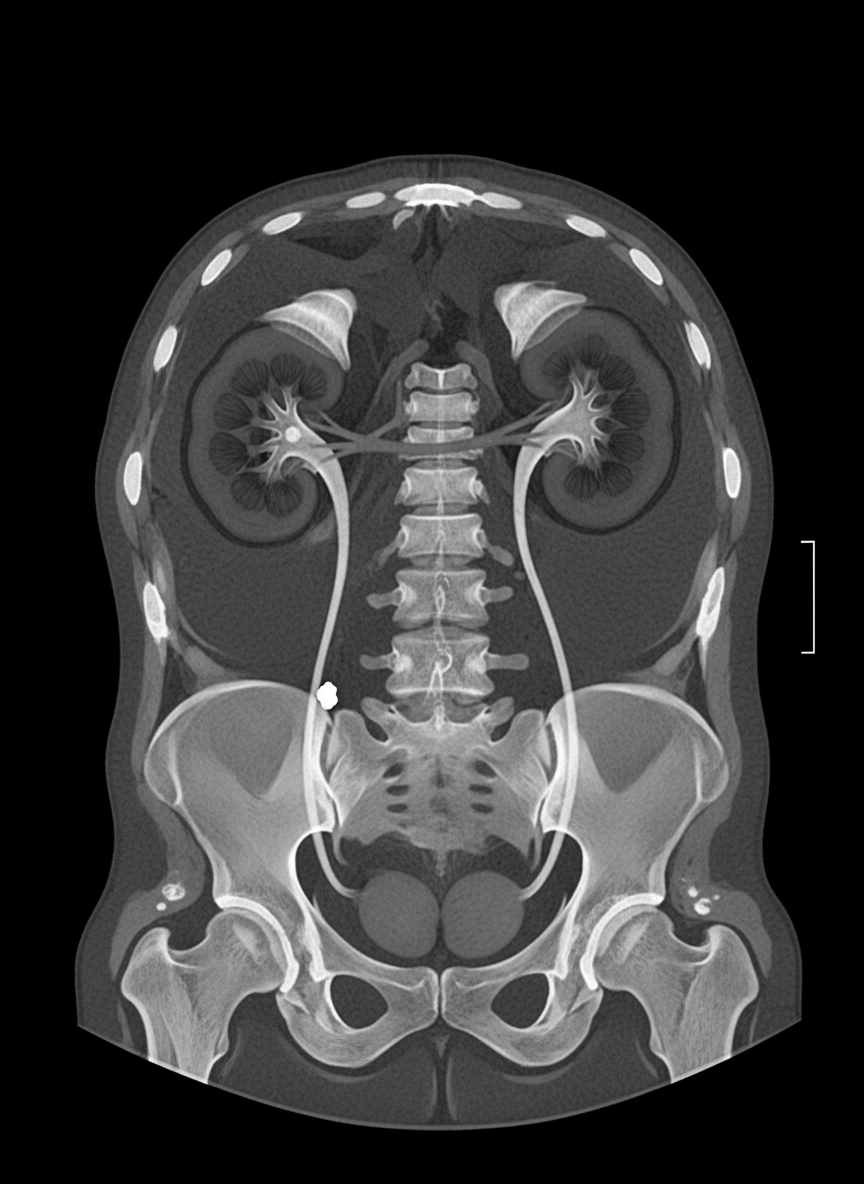
In a 3-glass urine test, thread is observed in the first glass. What is the probable diagnosis?
What is the most common site of metastasis for prostate cancer?
What is the investigation of choice for testicular swelling?
In the treatment of varicocele, testicular vein ligation is performed at which level?
To maximize fertility potential, orchidopexy for cryptorchidism should be done before which age?
A patient who has undergone pancreaticoduodenectomy for ampullary carcinoma presents on the 3rd postoperative day with a Foley's catheter that cannot be deflated and removed. What is the next step to remove the catheter?
What is the difficulty score for a mesioangular impacted mandibular 3rd molar, Class II and Level II?
What is the most common site of ureter injury during a hysterectomy?
Orchidopexy for cryptorchidism is typically performed at what age?
A 72-year-old male presents for a routine medical examination. Digital rectal examination reveals a nodule on the prostate. Serum examination shows elevated PSA levels. What is the next step in the investigation?
Explanation: **Explanation:** The **3-glass urine test** (Stamey-Meares test) is a traditional diagnostic tool used to localize the site of infection or inflammation in the lower urinary tract. **Why Prostatitis is correct:** In this test, the patient voids into three separate containers. The presence of **"threads"** (mucopurulent strands or debris) specifically in the **first glass** (initial 10-15 ml of urine) is a classic clinical sign of **chronic prostatitis**. These threads represent inflammatory exudate and prostatic secretions that have accumulated in the prostatic urethra and are washed out by the initial stream of urine. While the 4-glass test (including prostatic massage) is the gold standard, the appearance of threads in the first glass remains a high-yield association for prostatitis in surgical exams. **Analysis of Incorrect Options:** * **Cystitis:** Inflammation of the bladder typically results in pyuria (cloudy urine) or hematuria that is uniform across all three glasses (total pyuria). * **Urethritis:** While urethritis also affects the first glass, it usually presents with frank pus or discharge rather than the distinct "threads" characteristic of prostatic involvement. * **Pyelonephritis:** This is an upper urinary tract infection. The urine would show uniform cloudiness and systemic symptoms (fever, flank pain), not localized threads in the initial stream. **Clinical Pearls for NEET-PG:** * **1st Glass (Initial):** Represents the Urethra/Prostate. * **2nd Glass (Midstream):** Represents the Bladder/Upper Tract. * **3rd Glass (Terminal):** Represents the Prostate/Bladder neck (as the prostate contracts at the end of micturition). * **High-Yield Fact:** If the question mentions "threads in the *last* glass," it even more strongly points toward a prostatic origin due to terminal contraction.
Explanation: **Explanation:** Prostate cancer has a strong predilection for hematogenous spread to the axial skeleton, specifically causing **osteoblastic (sclerotic) metastases**. **Why the Lumbar Spine is Correct:** The most common site of metastasis for prostate cancer is the **lumbar spine**. This occurs primarily due to the **Batson venous plexus**, a valveless system of veins that connects the deep pelvic veins (prostatic venous plexus) directly to the internal vertebral venous plexus. Because these veins are valveless, changes in intra-abdominal pressure allow cancer cells to bypass the systemic circulation (and the lungs) to seed directly into the vertebrae. The spread typically follows an ascending pattern: Pelvis → Lumbar Spine → Thoracic Spine → Skull. **Analysis of Incorrect Options:** * **A. Skull:** While prostate cancer can spread to the skull, it is a late-stage manifestation and significantly less common than spinal involvement. * **B. Femur:** The proximal femur is a common site for many bony metastases, but in prostate cancer, the axial skeleton (spine and pelvis) is involved much earlier and more frequently than the appendicular skeleton. * **D. Sacrum:** The sacrum and pelvis are often the *first* bones involved due to proximity, but statistically, the **lumbar spine** remains the most frequently documented site of involvement in clinical practice and imaging. **NEET-PG High-Yield Pearls:** * **Osteoblastic Lesions:** Prostate cancer is the classic cause of sclerotic/radio-opaque bone lesions (unlike Multiple Myeloma or RCC, which are lytic). * **Batson’s Plexus:** Key anatomical route for retrograde spread. * **Investigation of Choice:** **Radionuclide Bone Scan (Technetium-99m)** is the most sensitive screening tool for detecting bony metastases. * **Tumor Marker:** PSA >20 ng/mL significantly increases the probability of bone metastasis.
Explanation: **Explanation:** The investigation of choice for any testicular swelling is **Ultrasonography (USG) of the scrotum**, preferably with High-Frequency (7.5–10 MHz) probes and Color Doppler. **Why USG is the Correct Answer:** USG is highly sensitive (nearly 100%) in distinguishing between **intra-testicular** and **extra-testicular** lesions. This is the most critical clinical distinction: intra-testicular masses are highly likely to be malignant, whereas extra-testicular masses (like hydroceles or spermatoceles) are usually benign. It is non-invasive, cost-effective, and lacks ionizing radiation, making it ideal for the sensitive scrotal tissue. **Why Other Options are Incorrect:** * **Fine Needle Aspiration Cytology (FNAC):** This is **strictly contraindicated** in suspected testicular tumors. Piercing the tunica albuginea can lead to "scrotal seeding," altering the lymphatic drainage and causing the tumor to spread to inguinal lymph nodes rather than the standard para-aortic nodes. * **Computed Tomography (CT):** While CT of the Abdomen and Pelvis is the investigation of choice for **staging** (detecting retroperitoneal lymphadenopathy), it is not the primary tool for evaluating the local testicular mass itself. * **Magnetic Resonance Imaging (MRI):** MRI provides excellent soft tissue detail but is expensive and not readily available. It is reserved for complex cases where USG results are equivocal. **High-Yield Clinical Pearls for NEET-PG:** * **Gold Standard for Diagnosis:** Histopathology via **Radical Inguinal Orchidectomy** (never trans-scrotal). * **Tumor Markers:** Always check AFP, LDH, and beta-hCG before surgery. * **Lymphatic Drainage:** Testis drains to **Para-aortic nodes**; Scrotal skin drains to **Superficial Inguinal nodes**.
Explanation: **Explanation:** The primary objective of varicocele surgery (Varicocelectomy) is to ligate the dilated pampiniform plexus of veins while preserving the testicular artery and lymphatics. **Why Option A is Correct:** The most common surgical approach is the **Palomo procedure (High Ligation)**. In this technique, the testicular vein is ligated **above the inguinal ligament** (retroperitoneal level) near the internal inguinal ring. At this level, the testicular vein has usually coalesced into one or two large trunks, making ligation technically simpler and reducing the risk of recurrence compared to distal sites where the venous plexus is more complex. **Why the Other Options are Incorrect:** * **Option B (Below the inguinal ligament):** This refers to the **Sub-inguinal approach (Marmor technique)**. While common in microsurgery, the standard teaching for "testicular vein ligation" traditionally refers to the high ligation (Palomo) or inguinal (Ivanissevich) levels. Sub-inguinal ligation involves many more small venous branches, increasing the risk of missing collateral veins. * **Option C (Neck of the sac):** This is a landmark used in **hernia repair** (indirect inguinal hernia), not varicocele surgery. * **Option D (Scrotum):** Scrotal approaches are avoided because they carry a high risk of damaging the testicular artery and causing scrotal edema or hematoma due to the extensive network of veins in the scrotum. **NEET-PG High-Yield Pearls:** * **Most common side:** Left side (due to the left testicular vein entering the left renal vein at a right angle). * **Sudden right-sided varicocele:** Always rule out a retroperitoneal tumor (e.g., Renal Cell Carcinoma). * **Gold Standard Treatment:** Microsurgical sub-inguinal varicocelectomy (lowest recurrence rate and lowest complication rate, specifically hydrocele). * **Indication for surgery:** Infertility (abnormal semen analysis), testicular atrophy, or severe pain.
Explanation: **Explanation:** **Cryptorchidism (Undescended Testis)** is the most common congenital anomaly of the male genitalia. The core physiological concern is that the higher core body temperature of the abdomen/inguinal canal (compared to the scrotum) leads to progressive germ cell degradation and peritubular fibrosis. **Why 2 years is the correct answer:** Histological studies show that irreversible changes to the germinal epithelium begin as early as **6 to 12 months** of age. To maximize fertility potential and reduce the risk of future malignancy, current guidelines (AUA/EAU) recommend that orchidopexy be performed between **6 and 18 months** of age. In the context of standard NEET-PG options, **2 years** serves as the critical upper limit; performing the surgery after this age significantly increases the risk of infertility and subfertility. **Why other options are incorrect:** * **Options A, B, and C (12, 15, and 18 years):** These ages are well beyond the window of germ cell preservation. While orchidopexy is still performed in older children/adolescents to facilitate testicular self-examination (for cancer screening) and for cosmetic/psychological reasons, the **fertility potential** is already severely compromised by this stage. **Clinical Pearls for NEET-PG:** * **Spontaneous Descent:** Most testes that are undescended at birth will descend by **3–4 months** of age. Descent is rare after 6 months. * **Malignancy Risk:** Orchidopexy does *not* eliminate the risk of testicular cancer (Seminoma is most common), but it makes the testis accessible for screening. * **Most Common Site:** The **inguinal canal** is the most common location for an undescended testis. * **Investigation of Choice:** Clinical examination is gold standard; **Diagnostic Laparoscopy** is the investigation of choice for impalpable testes.
Explanation: ### Explanation A non-deflating Foley’s catheter is a common urological emergency, usually caused by a faulty valve or a blocked inflation channel (often due to crystallization of the fluid). **Why Option A is Correct:** When conservative methods (like cutting the valve or using a fine guide wire) fail, **ultrasound-guided percutaneous puncture** of the balloon is the preferred next step. It is safe, precise, and can be performed transabdominally, transrectally, or transvaginally. Ultrasound guidance ensures that the needle accurately targets the balloon while avoiding injury to the bladder wall or surrounding structures. **Why Other Options are Incorrect:** * **Option B:** CT guidance is unnecessary, expensive, and involves radiation. Ultrasound is faster and more accessible at the bedside. * **Option C:** Advancing the catheter does not solve the deflation issue and provides no mechanism for rupture. * **Option D:** Injecting water or air until the balloon bursts (over-inflation) is **contraindicated**. This can cause the balloon to fragment into multiple pieces, which may act as a nidus for future stone formation or cause severe bladder spasms and mucosal trauma. **High-Yield Clinical Pearls for NEET-PG:** * **First-line management:** Lubricate the valve and attempt to bypass the blockage with a fine wire. * **Chemical methods:** Instilling ether or mineral oil to dissolve the balloon is now **obsolete** because it causes severe chemical cystitis. * **Post-removal care:** Always inspect the removed balloon to ensure it is intact. If fragments are suspected to be left behind, a cystoscopy is mandatory. * **Prevention:** Use only sterile water to inflate the balloon; saline should be avoided as it can crystallize and block the channel.
Explanation: The difficulty of extracting an impacted mandibular third molar is most commonly assessed using the **Pell and Gregory Classification** combined with **Winter’s Classification**. To determine the total difficulty score, we use the **Modified Parant Scale (Santhosh Kumar’s modification)**. ### **Explanation of the Correct Answer (A)** The total score is the sum of three parameters: 1. **Winter’s Classification (Angulation):** * **Mesioangular:** 1 point (Easiest) * Horizontal/Distoangular: 2 points * Vertical: 3 points 2. **Pell & Gregory (Relationship to Ramus - Class):** * Class I: 1 point * **Class II:** 2 points (Space between distal of 2nd molar and ramus is less than the MD width of the 3rd molar) * Class III: 3 points 3. **Pell & Gregory (Depth - Level):** * Level A: 1 point * **Level B (II):** 2 points (Occlusal plane of 3rd molar is between the occlusal plane and cervical line of 2nd molar) * Level C: 3 points **Calculation:** 1 (Mesioangular) + 2 (Class II) + 2 (Level II) = **5**. A score of 5-7 indicates **moderate difficulty**. ### **Explanation of Incorrect Options** * **B (7):** This would be the score if the tooth were Distoangular or Vertical with the same Class/Level. * **C (10):** This represents a very high difficulty score, usually seen in deep Level C, Class III distoangular impactions. * **D (6):** This would occur if one of the parameters (like angulation) was one point higher (e.g., Horizontal). ### **High-Yield Clinical Pearls for NEET-PG** * **Easiest Angulation:** Mesioangular (Winter’s). * **Most Difficult Angulation:** Distoangular (contrary to intuition, it has the most difficult path of delivery). * **Pell & Gregory Class:** Based on available space distal to the second molar. * **Pell & Gregory Level:** Based on the depth of the impacted tooth relative to the occlusal plane of the second molar.
Explanation: The ureter is highly vulnerable during gynecological surgeries due to its close proximity to the pelvic vasculature and the uterus. **Explanation of the Correct Answer:** The **most common site** of ureteric injury during a hysterectomy is at the **level of the pelvic brim (as it enters the pelvis)**. This occurs during the ligation of the **infundibulopelvic (IP) ligament** (which contains the ovarian vessels). At this point, the ureter lies immediately medial and deep to the vessels. In cases of pelvic adhesions, endometriosis, or large ovarian masses, the anatomy is often distorted, making the ureter highly susceptible to accidental clamping or transection. **Analysis of Incorrect Options:** * **Option A (Entry into the bladder):** While the ureter is at risk here during the dissection of the bladder flap or vaginal vault closure (the "water under the bridge" concept), it is statistically less frequent than injuries at the pelvic brim in general hysterectomy data. * **Option B (Crossing by the uterine artery):** This is the **second most common site** of injury. The ureter passes approximately 1–2 cm lateral to the cervix, directly underneath the uterine artery. It is often injured here during the ligation of the uterine vessels. **High-Yield Clinical Pearls for NEET-PG:** * **Most common cause of ureteric injury:** Gynecological surgery (Hysterectomy is the #1 procedure). * **Most common site overall:** Pelvic brim (Infundibulopelvic ligament ligation). * **Most common site in Radical Hysterectomy:** The ureteric tunnel (as it enters the bladder). * **Gold standard for diagnosis:** IVP (Intravenous Pyelogram) or CT Urogram. * **Prevention:** Intraoperative identification of the ureter and "medialization" of the ureter before clamping vessels.
Explanation: **Explanation:** **Correct Answer: C. Puberty** In the context of traditional surgical teaching and specific historical NEET-PG patterns, **Puberty** is often cited as the answer when considering the prevention of testicular torsion or when addressing late-presenting cases. However, it is crucial to note that modern surgical guidelines have shifted significantly. In clinical practice, the primary goal of orchidopexy is to preserve fertility and allow for early screening of testicular cancer. **Analysis of Options:** * **A. 1 to 2 years:** This is the **modern clinical standard**. Current guidelines (AUA/EAU) recommend performing orchidopexy between **6 to 12 months** of age, and certainly before 18 months, to prevent the loss of germ cells and Leydig cells. * **B. 5 to 6 years:** This was an older recommendation based on the belief that spontaneous descent could occur later in childhood. It is now considered too late, as irreversible histological changes occur by age 2. * **D. Neonatal period:** Surgery is never performed in neonates because many undescended testes will descend spontaneously during the first 3 to 6 months of life due to the postnatal "mini-puberty" (testosterone surge). **NEET-PG High-Yield Pearls:** 1. **Spontaneous Descent:** Most testes descend by **3 months** of age. If it hasn't descended by 6 months, spontaneous descent is unlikely. 2. **Complications of Cryptorchidism:** The most common complication is **Inguinal Hernia** (due to patent processus vaginalis). The most serious long-term risk is **Testicular Malignancy** (Seminoma is most common; orchidopexy does not eliminate the risk but makes the testis palpable for screening). 3. **Infertility:** Bilateral cryptorchidism carries a near 100% risk of infertility if left untreated. 4. **Investigation of Choice:** **USG** is usually the first line, but **Diagnostic Laparoscopy** is the gold standard for locating a non-palpable intra-abdominal testis.
Explanation: **Explanation:** The clinical presentation of a **palpable nodule** on Digital Rectal Examination (DRE) and **elevated Prostate-Specific Antigen (PSA)** levels is highly suspicious for Prostate Cancer. In such cases, the definitive next step is a tissue diagnosis to confirm malignancy and determine the Gleason score. **Why Option D is Correct:** **Transrectal Ultrasound (TRUS)-guided biopsy** is the standard procedure for obtaining prostatic tissue. It typically involves a systematic 12-core biopsy (sampling the apex, mid-section, and base of both lobes). While multiparametric MRI (mpMRI) is increasingly used to target suspicious areas, TRUS-guided biopsy remains the definitive diagnostic step following abnormal screening tests (DRE/PSA). **Why Other Options are Incorrect:** * **A. CT Scan:** CT is poor at visualizing intra-prostatic architecture. It is used for staging (detecting lymphadenopathy) after a diagnosis is confirmed, not for initial diagnosis. * **B. IVP:** This is used to visualize the collecting system of the kidneys and ureters. It has no role in the diagnosis of prostate cancer. * **C. Prostatic Massage:** This is indicated for diagnosing chronic prostatitis. In suspected malignancy, massage is contraindicated as it can transiently spike PSA levels and provides no histological data. **High-Yield Clinical Pearls for NEET-PG:** * **PSA Cut-off:** Generally, >4 ng/mL is considered the threshold for further evaluation, though age-specific ranges apply. * **Most Common Site:** 70% of prostate cancers arise in the **Peripheral Zone** (hence palpable on DRE). * **Metastasis:** The most common site of distant spread is the bone (specifically **osteoblastic lesions**). The Batson venous plexus explains the spread to the lumbar spine. * **Gleason Scoring:** Based on glandular architecture, not nuclear atypia. It is the most important prognostic factor.
Urological Anatomy
Practice Questions
Hematuria Evaluation
Practice Questions
Urinary Calculi
Practice Questions
Benign Prostatic Hyperplasia
Practice Questions
Prostate Cancer
Practice Questions
Bladder Cancer
Practice Questions
Renal Cell Carcinoma
Practice Questions
Testicular Tumors
Practice Questions
Urinary Tract Infections
Practice Questions
Urinary Incontinence
Practice Questions
Genitourinary Trauma
Practice Questions
Pediatric Urology Basics
Practice Questions
Get full access to all questions, explanations, and performance tracking.
Start For Free