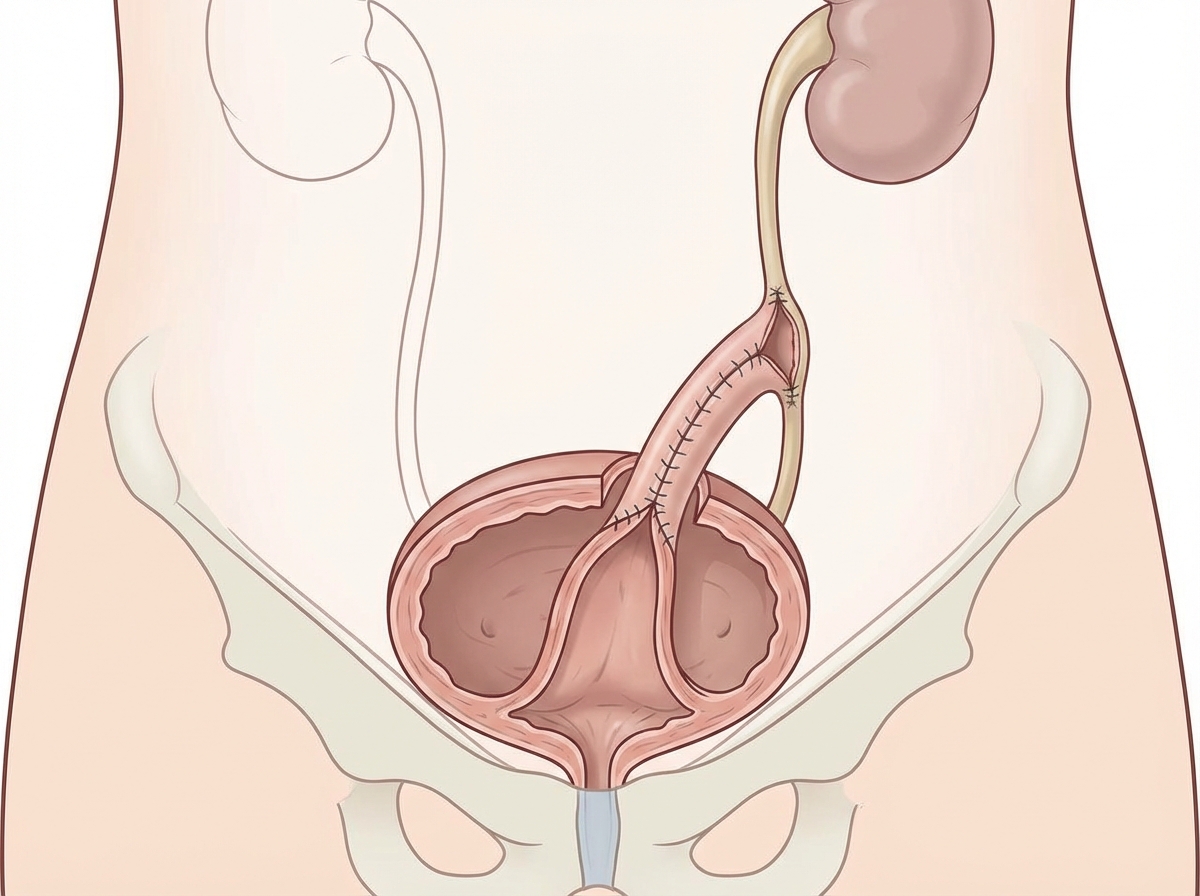
What is the commonest cause of ureteric injury during surgical operation?
According to the classification of renal injuries, which grade is assigned to a laceration more than 1 cm deep without extension into the renal pelvis or collecting system?
A 23-year-old male presented with fever, chills, and back pain. He also complained of increased frequency of voiding. Ultrasonography revealed bladder stones. All of the following are true about bladder stones, EXCEPT:
A male has a history of bilateral undescended testes. What is the most likely consequence?
Which of the following statements about hypospadias is/are true?
What is the recommended method for collecting samples for the diagnosis of renal tuberculosis?
The Hunt-Hess scale is used for the grading of which condition?
The graph shown in the illustration is known as:

What is the best treatment for Grade I benign prostate with outflow obstruction?
Scrambled egg appearance is seen in which of the following conditions?
Explanation: **Explanation:** Ureteric injury is a significant complication of pelvic and abdominal surgeries. **Hysterectomy** (Option B) is the most common cause, accounting for over 50% of all iatrogenic ureteric injuries. This is primarily due to the close anatomical proximity of the ureter to the female reproductive organs. The most vulnerable site is where the ureter passes **under the uterine artery** ("water under the bridge") near the level of the internal os of the cervix. Injuries typically occur during clamping of the uterine vessels or during the closure of the vaginal vault. **Analysis of Incorrect Options:** * **Abdomino-perineal resection (Option A) & Colectomy (Option D):** While colorectal surgeries are the second most common cause of ureteric injury, they occur less frequently than gynecological procedures. In these cases, the ureter is usually injured during the mobilization of the colon or ligation of the inferior mesenteric artery. * **Prostatectomy (Option C):** Ureteric injury is rare during prostatectomy because the ureters enter the bladder trigone superior to the surgical field of the prostate. **High-Yield Clinical Pearls for NEET-PG:** * **Most common site of injury:** Lower third of the ureter (pelvic segment). * **Most common mechanism:** Ligation (crushing) or transection. * **Gold standard for diagnosis:** Intravenous Urogram (IVU) or CT Urography. * **Intraoperative detection:** If suspected, intravenous indigo carmine or methylene blue can be administered to check for extravasation. * **Management:** If detected intraoperatively, primary uretero-ureterostomy (over a double J stent) or uretero-neocystostomy (re-implantation into the bladder) is performed depending on the level of injury.
Explanation: The classification of renal trauma is based on the **AAST (American Association for the Surgery of Trauma) Renal Injury Scale**, which is a high-yield topic for NEET-PG. ### **Explanation of the Correct Answer** **Grade III** injuries are defined by a renal cortex laceration that is **greater than 1 cm in depth** but **does not involve the collecting system** (no urinary extravasation). There is also no evidence of a perirenal hematoma expanding into the renal pelvis. Since the question specifies a laceration >1 cm without collecting system involvement, Grade III is the correct classification. ### **Why Other Options are Incorrect** * **Grade I (Option A):** Involves only a **contusion** (microscopic or macroscopic hematuria with normal imaging) or a **non-expanding subcapsular hematoma** without a parenchymal laceration. * **Grade IV (Option C):** This grade involves a laceration extending into the **renal collecting system** (demonstrated by urinary extravasation on CT) OR injury to the main renal artery or vein with contained hemorrhage. * **Grade V (Option D):** This is the most severe stage, involving a **completely shattered kidney** or **avulsion of the renal hilum** (devascularization of the kidney). ### **High-Yield Clinical Pearls for NEET-PG** * **Grade II:** Laceration **<1 cm** in depth confined to the cortex (no collecting system involvement). * **Imaging Gold Standard:** Contrast-enhanced CT (CECT) is the investigation of choice for stable patients with suspected renal trauma. * **Management:** Most Grade I-III injuries (and even many Grade IV) are managed **conservatively** in hemodynamically stable patients. * **Key Distinction:** The presence of **urinary extravasation** is the primary differentiator between Grade III and Grade IV.
Explanation: **Explanation:** The correct answer is **A (Rare in Indian children)** because this statement is false. In developing countries like India, endemic bladder stones are historically common among children, particularly boys. These are often associated with a diet high in cereal and low in animal protein, leading to hyperoxaluria. **Analysis of Options:** * **Option A (False/Correct Answer):** Bladder stones are **not rare** in Indian children; they are a classic presentation in pediatric urology in the Indian subcontinent, often linked to nutritional factors. * **Option B (True):** Bladder calculi are significantly more common in men. This is primarily due to **Bladder Outlet Obstruction (BOO)** caused by conditions like Benign Prostatic Hyperplasia (BPH) or urethral strictures, which lead to urinary stasis. * **Option C (True):** Small stones can be managed via **Cystolitholapaxy**, where stones are fragmented and removed through the urethra using a cystoscope. * **Option D (True):** In the majority of cases, a **solitary** bladder stone is the rule, although multiple stones can occur in cases of severe stasis or diverticula. **Clinical Pearls for NEET-PG:** * **Composition:** Most bladder stones are composed of **Ammonium Acid Urate**, Calcium Oxalate, or Uric Acid. * **The "Jackstone" Calculus:** A specific type of calcium oxalate dihydrate stone with a spiked appearance, typically found in the bladder. * **Clinical Presentation:** Characterized by "interruption of urinary stream" and pain referred to the tip of the penis (mediated by the S2-S3 nerve roots). * **Gold Standard Investigation:** Non-contrast CT (NCCT) is the most sensitive, though Ultrasound is often the initial screening tool.
Explanation: ### Explanation **1. Why Option A is Correct:** The primary consequence of bilateral undescended testes (cryptorchidism) is **infertility/sterility**. Normal spermatogenesis requires a temperature approximately 2–3°C lower than the core body temperature. When testes remain in the inguinal canal or abdomen, they are exposed to higher temperatures, leading to progressive degeneration of germ cells and tubular atrophy. While unilateral cryptorchidism carries a lower risk of infertility (~10%), **bilateral** involvement results in a significantly higher risk, with nearly 75–100% of untreated patients becoming sterile. **2. Why the Other Options are Incorrect:** * **Option B:** This is incorrect. Cryptorchidism is the most significant risk factor for **testicular germ cell tumors** (most commonly Seminoma). The risk is 5 to 10 times higher than in the general population. * **Option C:** This is incorrect. While mechanical factors (e.g., short spermatic vessels or narrow inguinal canal) play a role, the pathophysiology is often **multifactorial**, involving hormonal deficiencies (H-P-G axis) and genetic predispositions. * **Option D:** This is incorrect. Psychological well-being is a valid indication for intervention. An empty scrotum can lead to body image issues and anxiety during adolescence, making orchidopexy or prosthetic insertion necessary. **3. NEET-PG High-Yield Pearls:** * **Most common site:** Inguinal canal (specifically just outside the external ring). * **Most common tumor:** Seminoma (overall); however, if the testis is intra-abdominal, the risk of malignancy is higher. * **Ideal age for surgery:** Orchidopexy should ideally be performed between **6 to 12 months** of age to preserve fertility and allow for easier screening of malignancy. * **Orchidopexy** does not eliminate the risk of cancer, but it makes the testis palpable for early detection.
Explanation: Hypospadias is a common congenital anomaly characterized by the failure of the urethral folds to fuse, resulting in the external urethral meatus opening on the **ventral aspect** of the penis. ### **Why Option C is Correct** 1. **Ventral Defect:** The hallmark of hypospadias is an ectopic urethral opening anywhere from the glans to the perineum on the ventral side. 2. **Hooded Prepuce:** Due to the failure of the foreskin to fuse ventrally, there is an excess of dorsal skin, creating a characteristic "hooded" appearance. 3. **Avoid Circumcision:** This is a critical clinical rule. The prepuce is essential for surgical reconstruction (urethroplasty), as it provides the vascularized graft or flap material needed to create the new urethra. ### **Why Other Options are Incorrect** * **The "Always" Chordee Fallacy (Options A, B, and D):** While chordee (ventral curvature of the penis) is a frequent association, it is **not always present**, especially in distal or glanular types of hypospadias. Including the word "always" makes these options technically incorrect. * **Option A & B:** These options also fail to include all three primary clinical features or the crucial contraindication of circumcision. ### **High-Yield Clinical Pearls for NEET-PG** * **Triad of Hypospadias:** Ectopic urethral meatus (ventral), Hooded prepuce, and Chordee (usually present). * **Most Common Site:** Glanular/Distal (Sub-coronal). * **Associated Anomalies:** Cryptorchidism (undescended testis) and Inguinal hernia are the most common. If hypospadias is associated with undescended testes, consider **Disorders of Sex Development (DSD)**. * **Ideal Age for Surgery:** Usually between **6 to 12 months** of age. * **Common Procedures:** Snodgrass (TIP) repair, MAGPI (for distal), and Mathieu’s flap.
Explanation: **Explanation:** The diagnosis of **Renal Tuberculosis (Genitourinary TB)** relies on the demonstration of *Mycobacterium tuberculosis* in the urine. Because the shedding of the bacilli is **intermittent** and the concentration is often low, a specific sampling technique is required to maximize the diagnostic yield. **Why "Three morning urine samples" is correct:** The **first-voided early morning urine** is the most concentrated sample of the day. Collecting it over **three consecutive days** increases the cumulative sensitivity for detecting acid-fast bacilli (AFB) via smear or culture (Gold Standard). This method balances high diagnostic yield with a lower risk of specimen contamination compared to pooled samples. **Analysis of Incorrect Options:** * **A. Single early morning urine sample:** While the morning sample is ideal, a single specimen has low sensitivity due to the intermittent shedding of the bacteria. * **B. 24-hour urine collection:** This was historically practiced but is now **strongly discouraged**. 24-hour samples are often contaminated with commensal organisms, and the acidity of the urine over a long period can lead to the death of the tubercle bacilli, making culture difficult. * **C. Three random urine samples:** Random samples are more dilute, significantly reducing the probability of detecting the organism compared to concentrated morning voids. **High-Yield Clinical Pearls for NEET-PG:** * **Sterile Pyuria:** The classic presentation of Renal TB is the presence of WBCs in urine with a negative routine bacterial culture. * **Gold Standard:** Culture on **Lowenstein-Jensen (LJ) medium** (takes 6–8 weeks) or liquid media like BACTEC. * **Radiology:** Look for the **"Putty Kidney"** (autonephrectomy due to caseous calcification) or **"Thimble Bladder"** (small capacity, fibrotic bladder). * **Earliest Sign:** The earliest radiological sign of renal TB is **"moth-eaten" calyces** (erosion of the papilla).
Explanation: **Explanation:** The **Hunt-Hess scale** is a clinical grading system used to assess the severity of a **Subarachnoid Hemorrhage (SAH)** based on the patient’s clinical presentation. It is a critical tool for predicting perioperative mortality and determining the timing of surgical intervention (clipping or coiling). * **Grade I:** Asymptomatic or mild headache. * **Grade II:** Moderate to severe headache, nuchal rigidity, no neurological deficit (except cranial nerve palsy). * **Grade III:** Drowsiness, confusion, or mild focal deficit. * **Grade IV:** Stupor, moderate to severe hemiparesis. * **Grade V:** Deep coma, decerebrate rigidity, moribund appearance. **Analysis of Incorrect Options:** * **Subdural Hematoma (SDH):** Typically assessed using the Glasgow Coma Scale (GCS) and CT imaging (crescent-shaped hematoma) rather than a specific clinical grading scale like Hunt-Hess. * **Meningiomas:** These are graded using the **WHO Classification** (Grade I-III) based on histopathology, not clinical presentation. * **Tuberculosis:** CNS tuberculosis is often graded using the **British Medical Research Council (BMRC)** staging for tuberculous meningitis. **NEET-PG High-Yield Pearls:** 1. **Fisher Scale:** Used alongside Hunt-Hess for SAH, but it is based on **CT findings** to predict the risk of cerebral vasospasm. 2. **Most common cause of SAH:** Trauma (Overall); Rupture of Saccular (Berry) aneurysm (Spontaneous). 3. **Gold Standard Investigation:** Digital Subtraction Angiography (DSA). 4. **Management:** Nimodipine is administered to prevent vasospasm-induced delayed ischemic neurological deficits.
Explanation: ***Cystometrogram*** - A **cystometrogram** is a urodynamic graph that plots **bladder pressure** against **bladder volume** during bladder filling. - Used to assess **bladder compliance** and **detrusor muscle activity** in patients with voiding dysfunction or neurogenic bladder. *Nephrogram* - A **nephrogram** is a radiological imaging study showing the **kidney parenchyma** after contrast administration. - It represents the **nephron phase** of contrast excretion, not a pressure-volume graph. *Pyelograph* - A **pyelograph** (or pyelogram) is an imaging study visualizing the **renal pelvis** and **ureter** using contrast. - It's a **radiological procedure**, not a graphical representation of bladder dynamics. *None of the above* - This option is incorrect as **cystometrogram** accurately describes the urodynamic graph shown. - The graph specifically measures **bladder pressure-volume relationships**, which is the definition of cystometrography.
Explanation: **Explanation:** The management of Benign Prostatic Hyperplasia (BPH) with outflow obstruction depends on the size of the gland and the severity of symptoms. **Transurethral Resection of the Prostate (TURP)** is considered the "Gold Standard" surgical treatment for small to moderate-sized glands (typically <60–80 grams). **Grade I BPH** refers to a small enlargement (usually <25 grams). In cases where medical management fails or outflow obstruction is significant, TURP is the preferred modality because it is minimally invasive, offers excellent functional outcomes, and has a lower morbidity rate compared to open surgeries. **Analysis of Incorrect Options:** * **Retropubic (Millin’s) & Transvesical (Freyer’s) Prostatectomy:** These are open surgical procedures reserved for **large prostates** (typically >80–100 grams) or when there are associated bladder stones/diverticula that cannot be managed endoscopically. * **Androgen Therapy:** This is incorrect. While 5-alpha reductase inhibitors (like Finasteride) reduce DHT levels, "Androgen therapy" (testosterone) would actually worsen BPH symptoms. Medical management usually involves Alpha-blockers or 5-ARIs, but once "outflow obstruction" requires definitive intervention, surgery is indicated. **High-Yield Clinical Pearls for NEET-PG:** * **Gold Standard for BPH:** TURP. * **TURP Syndrome:** Caused by the absorption of glycine (irrigating fluid), leading to dilutional hyponatremia and CNS symptoms. * **Most common complication of TURP:** Retrograde ejaculation (up to 75%). * **Most common late complication:** Urethral stricture or bladder neck contracture. * **Laser of choice:** Holmium Laser Enucleation of the Prostate (HoLEP) is now preferred for very large glands as an alternative to open surgery.
Explanation: **Explanation:** The "Scrambled Egg Appearance" is a classic radiological sign associated with **Pancreatic Carcinoma**, specifically when it involves the head of the pancreas and invades the duodenum. **1. Why Pancreatic Carcinoma is correct:** When a tumor in the head of the pancreas infiltrates the second part of the duodenum, it causes mucosal destruction, irregular filling defects, and ulceration. On a **Barium Meal** study, this creates a disorganized, mottled, and fragmented appearance of the contrast within the duodenal lumen, resembling "scrambled eggs." This sign indicates advanced local invasion of the pancreatic malignancy into the adjacent bowel. **2. Analysis of Incorrect Options:** * **Carcinoma of the Stomach:** Typically presents with a "Leather bottle" appearance (Linitis Plastica) or a "Carman’s Meniscus sign" for malignant ulcers. * **Carcinoma of the Gallbladder:** Often shows a "Porcelain gallbladder" (pre-malignant) or a fixed filling defect on cholecystography, but not the scrambled egg sign. * **Renal Carcinoma (RCC):** Characterized by the "Stretching of calyces" (Spider leg appearance) on Intravenous Urogram (IVU) due to the mass effect. **3. High-Yield Clinical Pearls for NEET-PG:** * **Frostberg’s Inverted ‘3’ Sign:** Another classic barium sign for Pancreatic Head Carcinoma, caused by the tumor fixing the duodenal mucosa at the Ampulla of Vater. * **Courvoisier’s Law:** In a patient with painless obstructive jaundice, if the gallbladder is palpable, the cause is unlikely to be gallstones (usually pancreatic or periampullary malignancy). * **Double Duct Sign:** Seen on ERCP/MRCP, representing simultaneous dilatation of the Common Bile Duct and Pancreatic Duct.
Urological Anatomy
Practice Questions
Hematuria Evaluation
Practice Questions
Urinary Calculi
Practice Questions
Benign Prostatic Hyperplasia
Practice Questions
Prostate Cancer
Practice Questions
Bladder Cancer
Practice Questions
Renal Cell Carcinoma
Practice Questions
Testicular Tumors
Practice Questions
Urinary Tract Infections
Practice Questions
Urinary Incontinence
Practice Questions
Genitourinary Trauma
Practice Questions
Pediatric Urology Basics
Practice Questions
Get full access to all questions, explanations, and performance tracking.
Start For Free