What is the most common organic cause of erectile dysfunction?
All of the following are true about gonococcal epididymitis, EXCEPT?
Which of the following is NOT a typical cystoscopic finding in TB bladder?
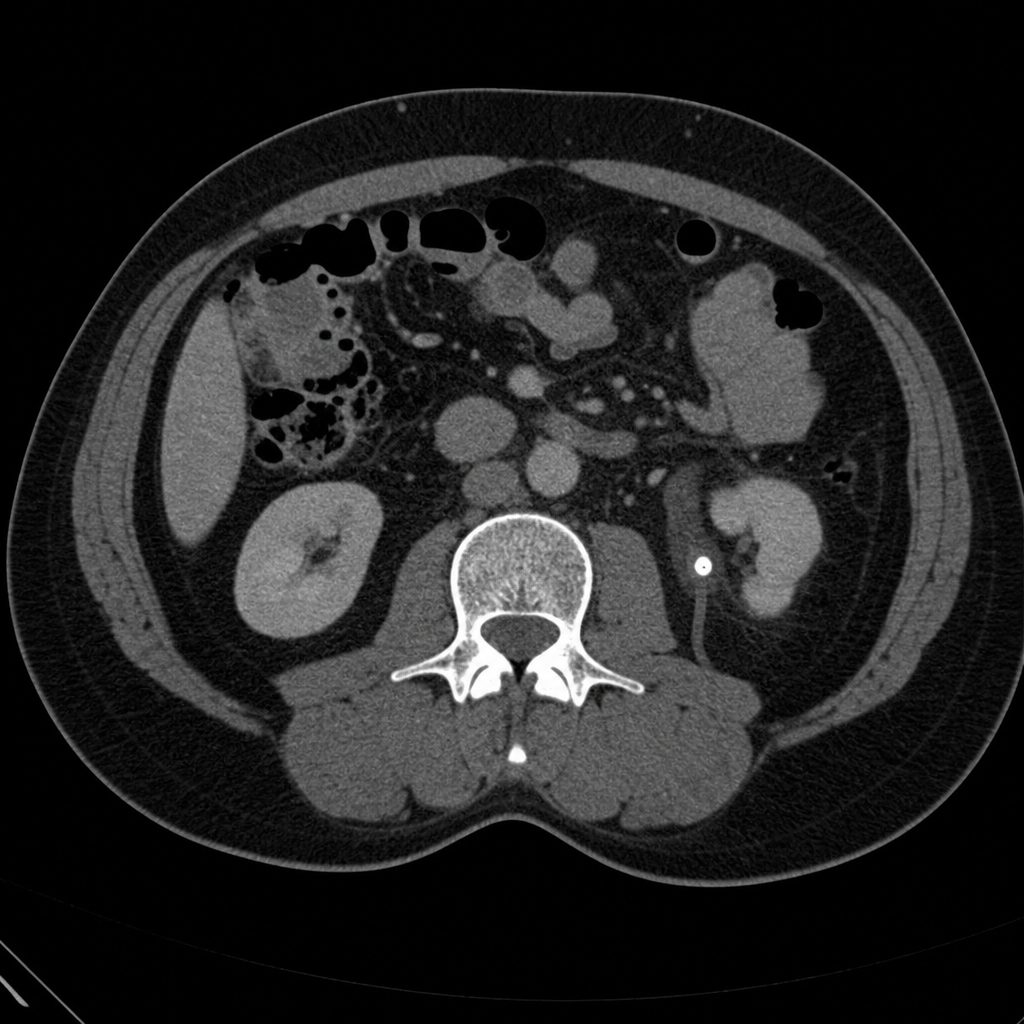
A 50-year-old woman presents with acute right flank pain of 72 hours in duration. Her temperature is 37°C, BP 140/85 mm Hg, and pulse 85/minute. A CBC is normal. Urinalysis reveals hematuria and urine cultures are negative. Imaging studies show stones in the right renal pelvis and ureter. This patient's condition may be associated with which of the following endocrine disorders?
Regarding testicular torsion, which of the following statements is FALSE?
Which of the following conditions is associated with asymptomatic bacteriuria?
Distention of the abdomen with the passage of a large amount of urine is known as?
A 70-year-old gentleman underwent TURP. Prostate specimen showed malignant histology. What is the next step?
What is the treatment of choice for a stone in the submandibular duct located distal to the lingual nerve?
A 3-year-old male patient presents with only one testis in the scrotum. On examination, the right testis is palpable in the inguinal canal. What is the preferred treatment?
Explanation: **Explanation:** **Atherosclerosis** is the most common organic cause of erectile dysfunction (ED). The underlying mechanism is **vasculogenic**; since the penile arteries are small in diameter (1–2 mm), they are often the first to be affected by atherosclerotic plaque formation. This leads to impaired blood flow to the corpora cavernosa, preventing the pressure required for a rigid erection. It is frequently considered a "sentinel symptom" for systemic cardiovascular disease. **Analysis of Incorrect Options:** * **Multiple Sclerosis (B):** This is a neurogenic cause of ED. While common in MS patients, neurogenic causes are statistically less frequent than vasculogenic causes in the general population. * **Penile Fibrosis (C):** This refers to the replacement of smooth muscle with collagen, often due to chronic ischemia or post-priapism. It is a structural cause but not the primary epidemiological driver of ED. * **Peyronie’s Disease (D):** This involves the formation of a fibrous plaque in the tunica albuginea, leading to penile curvature and painful erections. While it causes ED, its prevalence is much lower than systemic atherosclerosis. **Clinical Pearls for NEET-PG:** * **Most common cause of ED overall:** Psychogenic (especially in younger men). * **Most common organic cause:** Vasculogenic (Atherosclerosis/Diabetes Mellitus). * **The "Artery Size Hypothesis":** ED often precedes Coronary Artery Disease (CAD) by 3–5 years because penile arteries are smaller than coronary arteries. * **First-line Investigation:** Detailed history and IIEF-5 (International Index of Erectile Function) questionnaire. * **Gold Standard for Vasculogenic ED:** Duplex Doppler Ultrasound of penile arteries.
Explanation: **Explanation:** The core management of **acute epididymitis**, whether caused by *Neisseria gonorrhoeae* (common in men <35 years) or enteric organisms, is **medical, not surgical**. **Why Option D is the Correct Answer (The "Except"):** Immediate surgical intervention is **not indicated** for epididymitis. Surgery is reserved for complications like abscess formation or when **testicular torsion** cannot be ruled out. In torsion, "time is muscle," and immediate surgery is mandatory; however, in epididymitis, the inflammation is managed conservatively. **Analysis of Other Options:** * **Option A (Antibiotics):** Since the etiology is bacterial (*N. gonorrhoeae*), targeted antibiotic therapy (e.g., Ceftriaxone plus Doxycycline/Azithromycin) is the cornerstone of treatment to eradicate the pathogen. * **Option B (Anti-inflammatories):** NSAIDs are standard supportive care to reduce pain, scrotal edema, and inflammatory markers. * **Option C (Surgery after infection subsides):** While rare, chronic complications like epididymal obstruction or persistent pain may necessitate surgical intervention (e.g., epididymectomy or vasoepididymostomy) *after* the acute infection has been fully resolved. **NEET-PG High-Yield Pearls:** * **Prehn’s Sign:** Elevation of the scrotum relieves pain in epididymitis (Positive Prehn’s) but worsens or has no effect on pain in testicular torsion (Negative Prehn’s). * **Cremasteric Reflex:** Usually **present** in epididymitis but **absent** in testicular torsion. * **Age Factor:** In patients <35 years, the most common causes are *C. trachomatis* and *N. gonorrhoeae*. In patients >35 years, *E. coli* is the most common cause. * **Investigation of Choice:** Color Doppler Ultrasound (shows increased blood flow/hyperemia in epididymitis).
Explanation: **Explanation:** In Genitourinary Tuberculosis (GUTB), the bladder is typically affected secondary to renal tuberculosis. The cystoscopic findings are a result of chronic inflammation, ulceration, and subsequent fibrosis. **Why Option D is the correct answer:** **Whitish efflux from the ureteric openings** is not a feature of TB bladder. In active renal TB, the urine is typically clear but contains microscopic pus cells (**Sterile Pyuria**). Thick, whitish, or "milky" efflux is characteristic of **Chyluria** (seen in Filariasis) or severe pyogenic infections (pyonephrosis), but not typically TB. **Analysis of Incorrect Options:** * **Cobblestone mucosa:** Early TB cystitis presents with tubercles (yellowish-white nodules) surrounded by a zone of hyperemia. When these coalesce and the mucosa becomes edematous and inflamed, it gives a "cobblestone" appearance. * **Thimble bladder:** Chronic TB leads to extensive fibrosis and cicatrization of the bladder wall. This results in a severely reduced bladder capacity (often <50ml), known as a "Thimble bladder" or "Systolic bladder." * **Golf hole ureter:** Fibrosis and shortening of the ureter (due to ureteritis) lead to the retraction of the ureteric orifice. This causes the orifice to remain permanently patent and gaping, resembling a "golf hole." **Clinical Pearls for NEET-PG:** * **Sterile Pyuria:** Presence of pus cells in acidic urine with no growth on routine culture media is the hallmark of GUTB. * **Gold Standard Diagnosis:** Culture on **Lowenstein-Jensen (LJ) medium** (takes 6–8 weeks) or rapid BACTEC. * **Imaging:** The earliest radiological sign of GUTB is "moth-eaten" appearance of the calyces on IVU. * **Putty Kidney:** Refers to autonephrectomy where the kidney is replaced by a bag of caseous material.
Explanation: ### Explanation **Correct Answer: C. Hyperparathyroidism** The clinical presentation of acute flank pain, hematuria, and imaging evidence of renal and ureteral stones (nephrolithiasis) is a classic manifestation of **Primary Hyperparathyroidism (PHPT)**. **Pathophysiology:** PHPT is characterized by the autonomous overproduction of Parathyroid Hormone (PTH), usually due to a parathyroid adenoma. PTH increases bone resorption and distal tubular calcium reabsorption while stimulating the synthesis of 1,25-dihydroxyvitamin D. This leads to **hypercalcemia** and **hypercalciuria** (as the filtered load of calcium exceeds reabsorptive capacity). The excess urinary calcium precipitates with oxalate or phosphate, forming stones. PHPT is a leading cause of recurrent or bilateral renal calculi in middle-aged women. **Why Incorrect Options are Wrong:** * **A & B (Conn and Cushing Syndromes):** These adrenal disorders primarily involve mineralocorticoid or glucocorticoid excess. While they cause hypertension and metabolic derangements, they are not classically associated with calcium-based nephrolithiasis. * **D (Hyperthyroidism):** While severe hyperthyroidism can cause increased bone turnover and mild hypercalcemia, it is a rare cause of clinical nephrolithiasis compared to PHPT. **NEET-PG High-Yield Pearls:** * **Classic Triad of PHPT:** "Stones (Renal), Bones (Osteitis fibrosa cystica), Groans (Abdominal pain/Constipation), and Psychic Moans (Depression/Confusion)." * **Most Common Stone:** Calcium oxalate is the most common type of stone in PHPT. * **Screening:** In any patient with recurrent or bilateral renal stones, always check **Serum Calcium** and **Serum PTH** levels. * **Imaging:** Sestamibi scan is the investigation of choice to localize a parathyroid adenoma.
Explanation: **Explanation:** Testicular torsion is a surgical emergency caused by the twisting of the spermatic cord, leading to venous occlusion and subsequent arterial ischemia. **Why Option C is False (The Correct Answer):** The statement regarding the 6-hour window is inaccurate. In testicular torsion, the salvage rate is approximately **90–100% if detorsion occurs within 6 hours** of symptom onset. The salvage rate drops to about 50% at 12 hours and becomes **less than 10% (virtually zero) only after 24 hours**. Therefore, the "6-hour window" is the "golden period" for high success, not the threshold for failure. **Analysis of Other Options:** * **Option A:** Undescended testes have a higher risk of torsion, often associated with the development of testicular tumors or abnormal mesenteric attachments. * **Option B:** Color Doppler Ultrasound is the imaging modality of choice. It characteristically shows absent or decreased blood flow in the affected testis compared to the normal contralateral side. * **Option D:** The anatomical defect (e.g., "Bell-clapper deformity") is usually bilateral. Therefore, **bilateral orchidopexy** (fixation) is mandatory to prevent future torsion on the unaffected side. **NEET-PG High-Yield Pearls:** * **Most common age:** Bimodal distribution (neonatal period and puberty). * **Clinical Sign:** Negative Prehn’s sign (pain is not relieved by lifting the testis) and absent cremasteric reflex. * **Deformity:** "Bell-clapper deformity" (high tunica vaginalis attachment) is the most common predisposing factor. * **Management:** Immediate surgical exploration. If the testis is viable, perform orchidopexy; if gangrenous, perform orchidectomy. Always fix the contralateral side.
Explanation: **Explanation:** **Asymptomatic Bacteriuria (ASB)** is defined as the presence of a significant quantity of bacteria in the urine (typically >10⁵ CFU/mL) in a patient without clinical symptoms of a urinary tract infection (UTI). **Why Pelvic Inflammatory Disease (PID) is the correct answer:** In clinical practice and urological studies, there is a recognized association between ASB and **Pelvic Inflammatory Disease**. The proximity of the female reproductive tract to the urinary system allows for the potential migration of pathogens. Chronic inflammation or subclinical infections in the pelvic region can lead to persistent colonization of the urinary tract. Furthermore, both conditions share common risk factors, such as sexual activity and certain anatomical predispositions, making ASB a frequent finding in patients with a history of or active PID. **Analysis of Incorrect Options:** * **Anemia:** While chronic infections can lead to "anemia of chronic disease," there is no direct pathophysiological link establishing anemia as a condition associated with the presence of asymptomatic bacteria in the urine. * **Hypertension:** Although chronic pyelonephritis (which can result from untreated symptomatic UTIs) can lead to renal scarring and hypertension, ASB itself is not typically associated with the development of high blood pressure. * **Gestational Diabetes:** While pregnancy is a major indication to *screen* for ASB, and diabetic patients have a higher prevalence of ASB, **Gestational Diabetes** specifically is not the primary associated condition in this context compared to the inflammatory link with PID. **High-Yield NEET-PG Pearls:** 1. **Who to treat:** ASB is generally not treated except in two specific scenarios: **Pregnancy** (to prevent pyelonephritis and preterm labor) and **prior to urological procedures** where mucosal bleeding is expected. 2. **Pregnancy:** 2–10% of pregnant women have ASB; if untreated, up to 30% develop acute pyelonephritis. 3. **Diabetes:** Diabetic women have a higher prevalence of ASB, but treatment does not reduce the risk of symptomatic UTIs or complications.
Explanation: **Explanation:** The correct answer is **Dietl’s crisis**. This clinical phenomenon is classically associated with **Pelviureteric Junction (PUJ) obstruction**, often caused by an aberrant renal artery or nephroptosis (wandering kidney). 1. **Why Dietl’s Crisis is correct:** When the kidney is obstructed, it becomes acutely distended with urine (hydronephrosis), leading to severe episodic loin pain and a palpable abdominal mass (distention). As the obstruction spontaneously relieves—often due to a change in posture—the accumulated urine drains rapidly into the bladder. This results in the sudden disappearance of the mass/pain followed by the **passage of a large volume of urine (polyuria)**. 2. **Why other options are incorrect:** * **Anderson-Hynes crisis:** This is a distractor. Anderson-Hynes is actually the name of the **dismembered pyeloplasty** surgical procedure used to treat PUJ obstruction, not the name of the clinical crisis itself. * **Meteorism:** This refers to abdominal distention caused by excessive gas in the gastrointestinal tract (tympanites), unrelated to urinary output or renal pathology. **Clinical Pearls for NEET-PG:** * **Triad of Dietl’s Crisis:** Episodic renal colic, abdominal swelling (hydronephrosis), and relief of pain followed by polyuria. * **Gold Standard Investigation:** For PUJ obstruction, the investigation of choice is **DTPA scan (Renogram)** with Lasix to assess the degree of obstruction. * **Surgical Management:** The gold standard treatment is **Anderson-Hynes Dismembered Pyeloplasty** (can be open, laparoscopic, or robotic).
Explanation: **Explanation:** This scenario describes an **incidental finding of prostate cancer** following a Transurethral Resection of the Prostate (TURP) performed for presumed benign prostatic hyperplasia (BPH). In the TNM staging system, this is classified as **Stage T1a or T1b**. **Why Active Surveillance is the correct answer:** For a 70-year-old patient with incidentally discovered prostate cancer (especially if it is low-grade, low-volume, and has a low PSA level), **Active Surveillance** is the preferred management. At this age, the natural progression of low-risk prostate cancer is often slower than the patient's life expectancy. Active surveillance avoids the significant morbidity associated with surgery or radiation (incontinence, impotence) while monitoring the disease closely via serial PSA levels and repeat biopsies. **Analysis of Incorrect Options:** * **A. Radical Prostatectomy:** This is typically reserved for younger patients (<65-70 years) with a life expectancy >10-15 years and higher-stage localized disease (T2). In a 70-year-old with incidental T1 disease, the risks of surgery often outweigh the benefits. * **C. External Beam Radiotherapy (EBRT):** While an option for localized cancer, it is generally deferred in low-risk incidental cases in favor of surveillance to avoid radiation-induced proctitis or cystitis. * **D. Bilateral Orchiectomy:** This is a form of Androgen Deprivation Therapy (ADT) used for **metastatic (Stage D/M1)** prostate cancer. It is not indicated for localized, incidental findings. **Clinical Pearls for NEET-PG:** * **T1a:** Tumor involves ≤5% of resected tissue. * **T1b:** Tumor involves >5% of resected tissue. * **Most common site for Prostate Cancer:** Peripheral Zone (detected by DRE). * **Most common site for BPH:** Transition Zone (reason why TURP specimens occasionally show incidental cancer). * **Gleason Scoring:** The most important prognostic factor for prostate cancer.
Explanation: **Explanation:** The treatment of choice for a submandibular duct stone (sialolithiasis) depends primarily on its location. The submandibular duct (Wharton’s duct) runs along the floor of the mouth, crossing the lingual nerve. 1. **Why Intraoral Removal is Correct:** When a stone is located **distal to the lingual nerve** (closer to the duct orifice/anteriorly), it is easily accessible through the oral cavity. An **intraoral sialolithotomy** is performed by making a small incision directly over the stone in the floor of the mouth. This approach is minimally invasive, preserves the gland, and avoids the risks associated with major surgery. 2. **Why Other Options are Incorrect:** * **Submandibular Excision:** This is reserved for stones located within the gland parenchyma or proximal to the lingual nerve (posteriorly) that cannot be reached intraorally, or in cases of chronic permanent gland damage. * **Antibiotics:** These are used to treat secondary infection (sialadenitis) but do not remove the mechanical obstruction (the stone). * **Observation:** Sialolithiasis rarely resolves spontaneously and typically leads to recurrent pain and swelling (mealtime syndrome) or infection if left untreated. **High-Yield Clinical Pearls for NEET-PG:** * **80% Rule:** 80% of all salivary stones occur in the submandibular gland (due to alkaline pH, high calcium/mucin content, and antigravity flow). * **Radiopacity:** 80% of submandibular stones are radiopaque (visible on X-ray), whereas 80% of parotid stones are radiolucent. * **Imaging:** The best initial imaging for a suspected ductal stone is an **intraoral occlusal radiograph**. * **Anatomy:** The lingual nerve "loops" under Wharton’s duct from lateral to medial. Stones distal to this loop are palpable and surgically accessible intraorally.
Explanation: ### Explanation **Correct Answer: D. Orchidopexy** The clinical presentation describes **Cryptorchidism** (undescended testis). In this case, the testis is palpable in the inguinal canal, which is the most common location for an undescended testis. **Why Orchidopexy is the Correct Choice:** Spontaneous descent of the testis is rare after the age of **6 months**. Current guidelines recommend surgical intervention (**Orchidopexy**) between **6 to 12 months** of age, and certainly before 18 months. The goals of early surgery are to preserve fertility (by preventing germ cell loss), reduce the risk of testicular malignancy, and allow for easier clinical monitoring (screening for seminomas). **Why Other Options are Incorrect:** * **A. Observation until puberty:** This is contraindicated. Delaying surgery beyond infancy leads to irreversible damage to the seminiferous tubules and significantly increases the risk of infertility and cancer. * **B. Androgen therapy:** Hormonal therapy (hCG or GnRH) has a very low success rate and is generally not recommended as a primary treatment, especially when the testis is mechanically obstructed or located in the inguinal canal. * **C. Orchiectomy:** This is reserved for post-pubertal patients with a unilateral undescended testis or cases where the testis is found to be completely atrophic/non-viable during surgery. In a 3-year-old, preservation is the priority. **High-Yield Clinical Pearls for NEET-PG:** * **Most common site:** Inguinal canal (specifically just outside the external ring). * **Most common complication:** Infertility (even with repair, paternity rates are lower than the general population). * **Malignancy risk:** Cryptorchidism increases the risk of testicular cancer (most commonly **Seminoma**). Orchidopexy does *not* eliminate the risk but makes the testis accessible for examination. * **Associated condition:** Often associated with a **patent processus vaginalis** (congenital inguinal hernia). * **Investigation of choice:** Clinical examination is paramount. If the testis is non-palpable bilaterally, evaluate for Disorders of Sex Development (DSD). Diagnostic laparoscopy is the gold standard for locating an intra-abdominal testis.
Urological Anatomy
Practice Questions
Hematuria Evaluation
Practice Questions
Urinary Calculi
Practice Questions
Benign Prostatic Hyperplasia
Practice Questions
Prostate Cancer
Practice Questions
Bladder Cancer
Practice Questions
Renal Cell Carcinoma
Practice Questions
Testicular Tumors
Practice Questions
Urinary Tract Infections
Practice Questions
Urinary Incontinence
Practice Questions
Genitourinary Trauma
Practice Questions
Pediatric Urology Basics
Practice Questions
Get full access to all questions, explanations, and performance tracking.
Start For Free