Which of the following conditions is characterized by a fluid-filled cyst that transilluminates and contains sperm-rich fluid?
Q1062
A patient presents with persistent and severe pain in the lateral thigh and pubic regions, requiring hospital admission for observation and potential surgical intervention. Where is the ureteral stone most likely lodged?
Q1063
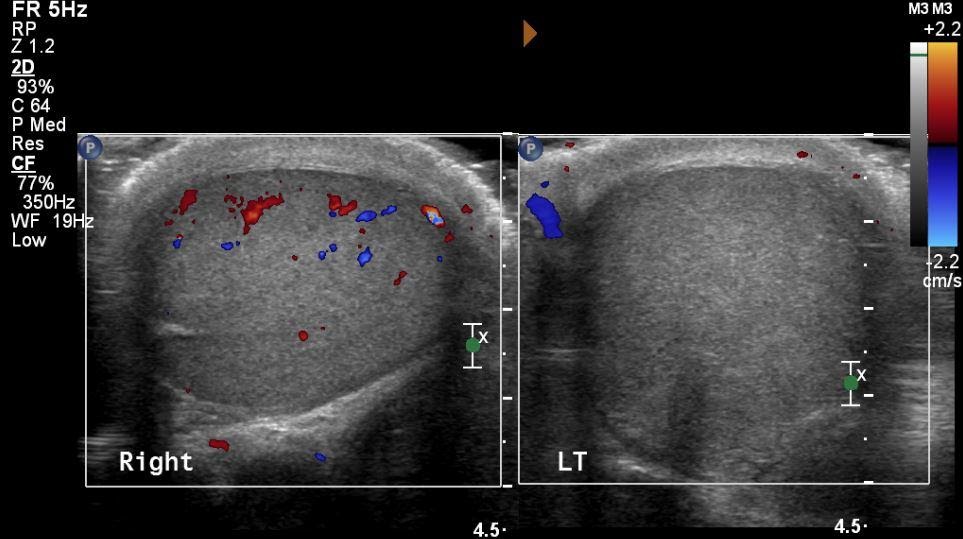
A 20-year-old male presented to the emergency department with acute onset of pain in the right scrotum. On examination, the testes were swollen, and the transillumination test was negative. What could be the probable diagnosis based on the ultrasound of the scrotum?
Q1064
Which of the following structures in the spermatic cord is typically preserved (not divided) during vasectomy surgery?
Urology Indian Medical PG Practice Questions and MCQs
Question 1061: Which of the following conditions is characterized by a fluid-filled cyst that transilluminates and contains sperm-rich fluid?
A. Lymphatic cyst
B. Parasitic cyst
C. Hydrocele
D. Spermatocele (Correct Answer)
Explanation: ***Spermatocele***
- A spermatocele is a **benign, fluid-filled cyst** that usually arises from the head of the epididymis.
- It classically **transilluminates** on examination and contains **sperm-rich fluid**, which distinguishes it from other scrotal masses.
*Hydrocele*
- A hydrocele is a collection of **serous fluid** within the tunica vaginalis surrounding the testis.
- While it also **transilluminates**, its contents are typically clear or straw-colored serous fluid, not sperm-rich.
*Lymphatic cyst*
- A lymphatic cyst is a rare lesion resulting from abnormal development of the **lymphatic system**.
- It typically contains **lymphatic fluid**, which is clear to milky, and would not contain sperm.
*Parasitic cyst*
- Parasitic cysts in the scrotal region are uncommon and are caused by infections such as **filariasis**.
- These cysts do not typically transilluminate and would contain inflammatory or parasitic material, not sperm-rich fluid.
Question 1062: A patient presents with persistent and severe pain in the lateral thigh and pubic regions, requiring hospital admission for observation and potential surgical intervention. Where is the ureteral stone most likely lodged?
A. At the junction of the renal pelvis and ureter
B. Midureter as it passes beneath the gonadal vessels
C. At the pelvic brim (Correct Answer)
D. In the intramural portion of the ureter where it penetrates the bladder
Explanation: ***At the pelvic brim***
- Stones lodged at the **pelvic brim**, particularly at the crossing of the **iliac vessels**, often cause severe, radiating pain to the **lateral thigh** and **groin/pubic** regions due to irritation of adjacent somatic nerves.
- This location is a common site of impaction and can lead to significant obstruction and pain severe enough to warrant hospital admission.
*At the junction of the renal pelvis and ureter*
- Obstruction at the **ureteropelvic junction (UPJ)** typically causes **flank pain** radiating towards the abdomen, but not usually to the lateral thigh or pubic region.
- While it can be severe, the pain distribution is characteristic of upper urinary tract distension.
*Midureter as it passes beneath the gonadal vessels*
- Stones in the **midureter** might cause pain that refers to the **anterior abdominal wall**, but it is less likely to specifically target the lateral thigh or pubic areas as intensely as stones at the pelvic brim.
- Obstruction here can lead to hydronephrosis and colic, but the pain pattern is distinct.
*In the intramural portion of the ureter where it penetrates the bladder*
- Stones in the **intramural ureter** are associated with symptoms of **bladder irritation**, such as urinary frequency, urgency, and dysuria, along with referred pain to the **tip of the penis** or **labia**.
- While painful, this location typically does not cause severe pain radiating to the lateral thigh or pubic region.
Question 1063: A 20-year-old male presented to the emergency department with acute onset of pain in the right scrotum. On examination, the testes were swollen, and the transillumination test was negative. What could be the probable diagnosis based on the ultrasound of the scrotum?
A. Acute epididymitis
B. Testicular torsion (Correct Answer)
C. Fournier's syndrome
D. Hydrocele
Explanation: ***Testicular torsion***
- The ultrasound image shows a significant **lack of blood flow** (absent or markedly decreased color flow signals) in the right testis compared to the left, which is characteristic of **testicular torsion**.
- **Acute onset of pain**, swollen testis, and a **negative transillumination test** in a young male are clinical signs highly suggestive of testicular torsion, requiring urgent intervention.
*Fournier's syndrome*
- This is a severe form of **necrotizing fasciitis** of the perineum and genitals, typically presenting with crepitus, gangrene, and systemic symptoms, which are not described.
- Ultrasound would show gas in the soft tissues and possibly fluid collections, not primarily compromised testicular blood flow within the testis itself.
*Acute epididymitis*
- Acute epididymitis would typically show **increased blood flow** (hyperemia) in the affected epididymis and potentially the testis on Doppler ultrasound.
- While it causes acute scrotal pain and swelling, the key differentiator here is the **absent/decreased blood flow** on the ultrasound, which rules out epididymitis.
*Hydrocele*
- A hydrocele is a collection of **fluid around the testis**, which would appear as an anechoic (black) fluid collection on ultrasound.
- A hydrocele typically would yield a **positive transillumination test** and does not usually cause acute, severe pain or lead to a significant change in testicular blood flow on Doppler like torsion does.
Question 1064: Which of the following structures in the spermatic cord is typically preserved (not divided) during vasectomy surgery?
A. Autonomic nerves
B. Testicular vein
C. Vas deferens
D. Testicular artery (Correct Answer)
Explanation: ***Testicular artery***
- The goal of a vasectomy is to interrupt sperm transport, not the blood supply to the testis. The **testicular artery** is the most critical structure to preserve as it provides the primary blood supply to the testis.
- Preserving the **testicular artery** ensures continued blood flow to the testis, preventing ischemia and maintaining both spermatogenesis (though sperm won't exit) and endocrine function (testosterone production).
- Surgeons carefully isolate and preserve the testicular artery while dividing only the vas deferens.
*Vas deferens*
- The **vas deferens** is the target structure that is deliberately divided and ligated during vasectomy.
- Cutting the **vas deferens** interrupts the pathway for sperm transport from the epididymis to the ejaculatory duct, achieving permanent contraception.
- This is the only structure within the spermatic cord that is intentionally divided during the procedure.
*Autonomic nerves*
- While **autonomic nerves** (sympathetic postganglionic fibers) are present in the spermatic cord and innervate the vas deferens, they may be inadvertently damaged during the vasectomy procedure.
- The primary function of these **autonomic nerves** related to the vas deferens is smooth muscle contraction for sperm transport, which becomes irrelevant once the vas deferens is divided.
- These nerves are not actively preserved as their division doesn't significantly impact testicular function.
*Testicular vein*
- The **testicular vein** (pampiniform plexus) drains blood from the testis and is also typically preserved during vasectomy, along with the testicular artery.
- However, the **testicular artery** is considered more critical as arterial blood supply is essential for tissue viability, whereas venous drainage has collateral pathways through cremasteric and deferential veins.
- Both vessels are preserved, but the arterial supply takes priority in surgical technique.