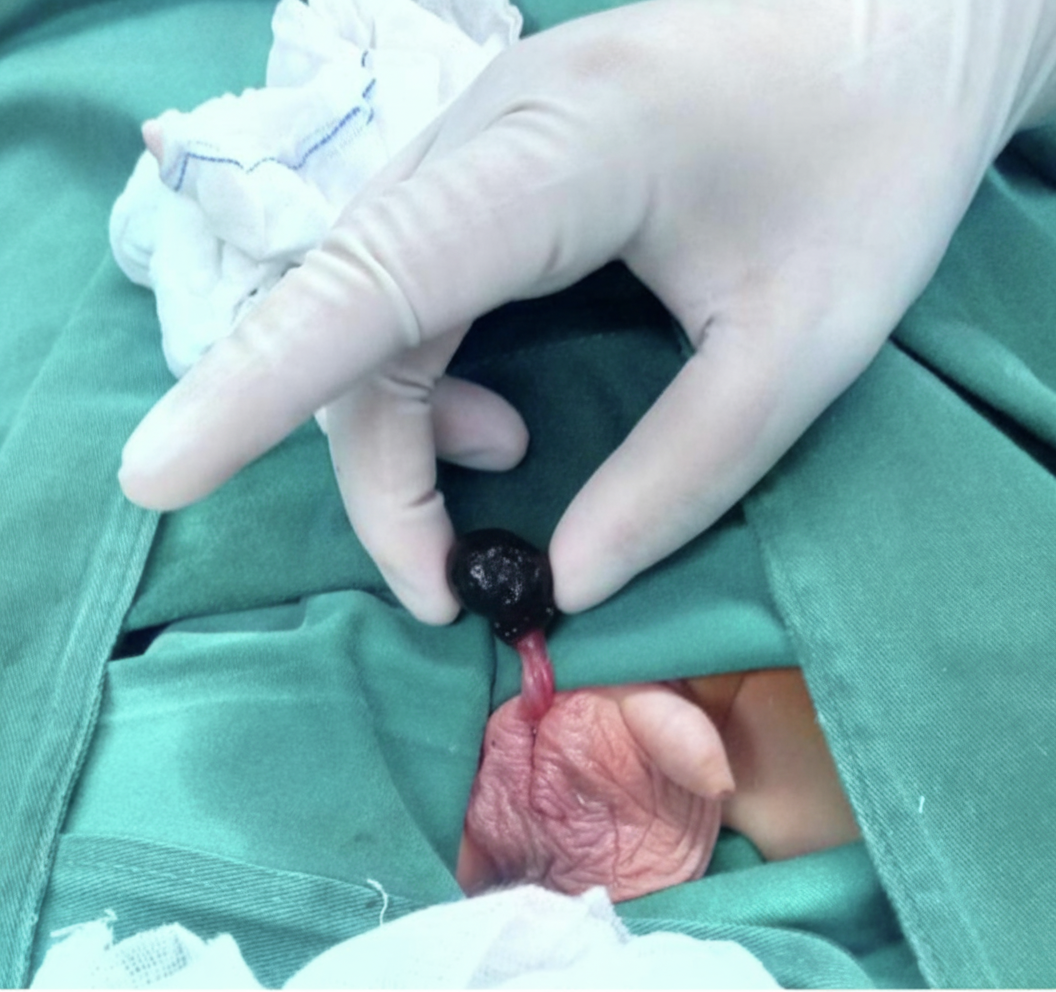
What is the most common cause of severe obstructive uropathy in children?
What is the reason for the following set of symptoms after prostatic surgery - restlessness, vomiting, and altered sensorium?
Renal calculi are often associated with which type of stone in the presence of Proteus infection?
What is the most common cause of upper gastrointestinal bleeding?
What should be offered to a 55-year-old sexually active male with stage T1b prostate cancer?
What is not the management of a 1.6 cm bulbar urethral stricture in a patient with a history of pelvic fracture?
Which one of the following is not performed in Lichtenstein tension-free hernioplasty?
A 16-year-old boy presents with acute onset pain in the left testis. Which of the following statements about his management is FALSE?
What is the differential diagnosis of acute funiculitis with a small inguinal swelling?
What does 'French' refer to in the context of a Foley's catheter measurement?
Explanation: **Explanation:** **Posterior Urethral Valves (PUV)** are the most common cause of severe obstructive uropathy and bladder outlet obstruction in male children. This congenital condition involves the presence of abnormal mucosal folds (Type I being most common) in the prostatic urethra, which act as a one-way valve, severely impeding urine flow. This leads to high intravesical pressures, causing secondary changes like bladder wall hypertrophy, vesicoureteral reflux (VUR), hydroureteronephrosis, and potentially irreversible renal dysplasia or failure. **Analysis of Incorrect Options:** * **Phimosis:** While common, it is a narrowing of the preputial opening. It rarely causes "severe" obstructive uropathy or upper tract damage unless it is extreme and associated with secondary infections. * **Urethral Atresia:** This is a rare and often fatal condition unless associated with a patent urachus or rectourethral fistula. It is not the "most common" cause. * **Bladder Neck Obstruction:** This is more frequently seen in adults (e.g., Marion’s disease) or as a functional issue; it is significantly less common than PUV in the pediatric population. **High-Yield Clinical Pearls for NEET-PG:** * **Antenatal Diagnosis:** Often suspected on ultrasound by the **"Keyhole Sign"** (dilated posterior urethra and thick-walled bladder). * **Clinical Presentation:** Poor urinary stream, palpable bladder, and failure to thrive. * **Gold Standard Investigation:** **Voiding Cystourethrogram (VCUG)** is the definitive diagnostic test. * **Initial Management:** Immediate bladder decompression via a small feeding tube (catheterization). * **Definitive Treatment:** Endoscopic primary valve ablation (fulguration).
Explanation: ### Explanation The symptoms described—restlessness, vomiting, and altered sensorium—following prostatic surgery (specifically TURP) are classic indicators of **TURP Syndrome**, which is primarily caused by **Electrolyte Imbalance**. **1. Why Electrolyte Imbalance is Correct:** During Transurethral Resection of the Prostate (TURP), large volumes of non-conductive irrigation fluids (like Glycine 1.5% or Sorbitol) are used. If these fluids are absorbed into the systemic circulation through opened prostatic venous sinuses, it leads to **dilutional hyponatremia** and hypervolemia. * **Neurological symptoms** (restlessness, confusion, seizures, coma) occur due to cerebral edema caused by low serum sodium. * **Gastrointestinal symptoms** (nausea, vomiting) are early signs of this metabolic disturbance. **2. Why Other Options are Incorrect:** * **Bladder neck obstruction:** This would present with localized symptoms like suprapubic pain, inability to void, or a palpable bladder, rather than systemic neurological changes. * **Acute pyelonephritis:** While it can cause vomiting and malaise, it typically presents with high-grade fever, chills, and flank pain. It rarely causes acute altered sensorium immediately post-op unless it progresses to urosepsis. * **Ureter stenosis:** This is a late complication of urological procedures and would present with hydronephrosis or chronic renal pain, not acute postoperative restlessness. **Clinical Pearls for NEET-PG:** * **Triad of TURP Syndrome:** Hypertension (early), Bradycardia, and Altered Mental Status. * **Prevention:** Limit resection time to <60 minutes, keep irrigation bag height <60 cm, and use Bipolar TURP (which allows the use of Normal Saline, eliminating the risk of hyponatremia). * **Treatment:** Fluid restriction and loop diuretics for mild cases; **3% Hypertonic Saline** for severe symptomatic hyponatremia.
Explanation: **Explanation:** The correct answer is **Triple phosphate** (also known as Struvite or Magnesium Ammonium Phosphate stones). **Why Triple Phosphate is correct:** Proteus species (and other organisms like Klebsiella and Pseudomonas) are **urease-producing bacteria**. Urease splits urea into ammonia and carbon dioxide. The resulting ammonia increases the urine pH, making it **alkaline** (pH > 7.2). In this alkaline environment, the solubility of phosphate decreases, leading to the precipitation of magnesium, ammonium, and phosphate. These stones often grow rapidly and take the shape of the renal pelvis and calyces, forming **Staghorn calculi**. **Why the other options are incorrect:** * **Uric acid:** These stones form in **persistently acidic urine** (low pH). They are radiolucent on X-ray and are associated with conditions like gout or high cell turnover. * **Calcium oxalate:** This is the **most common** type of renal stone overall. Their formation is generally independent of infection and is often linked to hypercalciuria or hyperoxaluria. * **Xanthine:** These are rare stones caused by a genetic deficiency of the enzyme xanthine oxidase. They are not associated with urinary tract infections. **High-Yield Clinical Pearls for NEET-PG:** * **Microscopy:** Triple phosphate crystals have a characteristic **"Coffin-lid"** appearance. * **Radiology:** Struvite stones are **radio-opaque** (though less dense than calcium oxalate). * **Composition:** Triple phosphate = Magnesium + Ammonium + Calcium Phosphate. * **Management:** Complete surgical removal of the stone is necessary because the stone itself acts as a reservoir for bacteria, leading to recurrent infections.
Explanation: **Explanation:** Upper Gastrointestinal Bleeding (UGIB) is a common surgical emergency defined as bleeding proximal to the **Ligament of Treitz**. **1. Why Duodenal Ulcer is Correct:** Peptic Ulcer Disease (PUD) is the most common cause of UGIB worldwide, accounting for approximately 50% of cases. Among peptic ulcers, **Duodenal Ulcers (DU)** are more frequent than gastric ulcers. Specifically, bleeding from a DU often occurs when an ulcer on the **posterior wall** of the first part of the duodenum erodes into the **Gastroduodenal Artery**. **2. Why the Other Options are Incorrect:** * **Gastric Cancer:** While a significant cause of chronic occult blood loss and anemia, it is a relatively uncommon cause of acute, massive UGIB compared to PUD. * **Esophageal Varices:** These are a major cause of life-threatening UGIB, especially in patients with portal hypertension/cirrhosis. However, statistically, they account for only 10–15% of cases. * **Erosive Gastritis:** Often associated with NSAID use, alcohol, or stress (Curling’s or Cushing’s ulcers), it is a frequent cause but ranks behind PUD in overall prevalence. **3. NEET-PG High-Yield Pearls:** * **Most common cause of UGIB:** Peptic Ulcer Disease (specifically Duodenal Ulcer). * **Most common cause of massive/lower GI bleeding:** Diverticulosis. * **Dieulafoy’s Lesion:** A rare but high-yield cause of UGIB involving a large tortuous submucosal artery that erodes the overlying epithelium. * **Rockall Score & Blatchford Score:** Used to predict mortality and the need for intervention in UGIB. * **Management:** Early endoscopy (within 24 hours) is both diagnostic and therapeutic (e.g., clipping, thermal coagulation, or adrenaline injection).
Explanation: ### Explanation **Correct Option: A. Radical Prostatectomy** The management of prostate cancer is primarily determined by the clinical stage, Gleason score, PSA levels, and the patient’s life expectancy. * **Stage T1b** refers to a tumor incidentally found during a TURP (for presumed BPH) involving **more than 5%** of the resected tissue. * In a **55-year-old male**, the life expectancy is typically >10–15 years. For localized prostate cancer (T1 or T2) in a young, fit patient, **Radical Prostatectomy (RP)** is the gold standard treatment. It offers the best chance for long-term cure by removing the entire prostate, seminal vesicles, and regional lymph nodes. * Being **sexually active** is also a consideration; nerve-sparing radical prostatectomy can be attempted to preserve erectile function. **Why Incorrect Options are Wrong:** * **B. Orchidectomy:** This is a form of surgical androgen deprivation therapy (ADT). It is indicated for **metastatic (Stage D/M1)** disease or palliative care, not for localized T1b cancer. * **C. Hormone Ablation:** Medical or surgical hormonal therapy is reserved for advanced/metastatic disease or as neoadjuvant/adjuvant therapy with radiation. It is not curative for localized disease. * **D. TURP:** This is a procedure for symptomatic relief of bladder outlet obstruction (BPH). While T1b cancer is often *discovered* via TURP, the procedure itself is not a definitive treatment for the malignancy. **High-Yield Clinical Pearls for NEET-PG:** * **T1a:** Tumor involves ≤5% of resected tissue (usually managed by active surveillance). * **T1b:** Tumor involves >5% of resected tissue (requires definitive treatment like RP or Radiotherapy). * **Most common site of Prostate Cancer:** Peripheral Zone (70%). * **Most common site of BPH:** Transition Zone. * **Gleason Scoring:** Based on glandular differentiation; it is the most important prognostic factor. * **Osteoblastic Metastasis:** Prostate cancer characteristically spreads to the bone (lumbar spine) via **Batson’s plexus**, causing osteoblastic (sclerotic) lesions.
Explanation: ### Explanation The management of urethral strictures depends on the **length, location, and etiology** of the stricture. **1. Why Option D is the Correct Answer (The "Not" Management):** For a short bulbar urethral stricture (**<2 cm**) resulting from trauma (like a pelvic fracture), the gold standard surgical treatment is **Excision and Primary Anastomosis (EPA)**. Reconstruction using a **Buccal Mucosa Graft (BMG)** is typically reserved for longer strictures (**>2 cm**) or complex cases where the ends cannot be mobilized for a tension-free primary anastomosis. Therefore, using a graft for a simple 1.6 cm bulbar stricture is unnecessary and not the standard primary approach. **2. Analysis of Other Options:** * **Options A & B (Dilatation/Internal Urethrotomy):** These are considered first-line "minimally invasive" options for short (<1.5–2 cm) primary bulbar strictures. While they have a high recurrence rate, they are technically part of the management algorithm. * **Option C (Excision and End-to-End Urethroplasty):** This is the **treatment of choice** for bulbar strictures <2 cm. It has a success rate of >90% because the bulbar urethra is mobile enough to allow for a tension-free anastomosis after excision of the fibrotic segment. **Clinical Pearls for NEET-PG:** * **Gold Standard for <2 cm Bulbar Stricture:** Excision and Primary Anastomosis (EPA). * **Gold Standard for >2 cm Bulbar Stricture:** Substitution Urethroplasty (Buccal Mucosa Graft is the preferred material). * **Most common site of post-traumatic stricture:** Bulbar urethra (due to straddle injury) or Membranous urethra (due to pelvic fracture). * **Investigation of Choice:** Retrograde Urethrogram (RUG) to define the site and length; Voiding Cystourethrogram (VCUG) to see the proximal extent.
Explanation: **Explanation:** The **Lichtenstein repair** is the gold standard "tension-free" hernioplasty for inguinal hernias. The fundamental principle of this procedure is to reinforce the posterior wall of the inguinal canal using a synthetic mesh (usually polypropylene) without pulling tissues together under tension. * **Why Option C is the correct answer:** Suturing the conjoint tendon to the inguinal ligament is the hallmark of the **Bassini repair** (a "tissue-to-tissue" tension repair). In a Lichtenstein repair, the mesh is sutured to these structures, but the structures themselves are never apposed. Bringing them together creates tension, which increases postoperative pain and the risk of recurrence—the very issues the Lichtenstein technique was designed to avoid. * **Why other options are incorrect:** * **Option A:** High ligation of the indirect sac (at the level of the internal ring) remains a standard step in managing indirect hernias to prevent a persistent patent processus vaginalis. * **Option B:** The mesh is secured inferiorly to the inguinal ligament and superiorly to the conjoint tendon (or rectus sheath) to provide a sturdy reinforcement of the floor. * **Option C:** The mesh is slit to create two "tails" that are positioned around the spermatic cord at the internal ring, recreating the valve mechanism. **High-Yield Clinical Pearls for NEET-PG:** * **Gold Standard:** Lichtenstein repair is the most common open repair due to its low recurrence rate (<1%). * **Nerve Injury:** The **ilioinguinal nerve** is the most commonly injured nerve during open inguinal hernia surgery, leading to numbness over the scrotum/labia and medial thigh. * **Mesh Placement:** The mesh is placed between the external oblique aponeurosis and the transversalis fascia. * **Contraindication:** Mesh should generally be avoided in "strangulated" hernias with contamination (infected fields) to prevent mesh infection.
Explanation: **Explanation:** The clinical presentation of acute scrotal pain in a 16-year-old boy must be treated as **Testicular Torsion** until proven otherwise. This is a surgical emergency where the spermatic cord twists, leading to ischemia and potential necrosis of the testis. **1. Why Option A is the Correct Answer (The False Statement):** Prescribing antibiotics and delaying management is dangerous and incorrect. Testicular torsion has a "golden period" of **6 hours**; if detorsion occurs within this window, the salvage rate is >90%. Waiting a week would inevitably lead to testicular infarction and loss of the organ. Antibiotics are only indicated if Epididymo-orchitis is definitively diagnosed, but in this age group, torsion must be ruled out first. **2. Analysis of Other Options:** * **Option B:** **Color Doppler Ultrasound** is the investigation of choice. It shows decreased or absent blood flow to the affected testis, helping differentiate torsion from inflammatory conditions. * **Option C:** If imaging is unavailable or the diagnosis is clinically certain, **immediate surgical exploration** is mandatory. "Time is testis," and one should not delay surgery for imaging if it delays definitive care. * **Option D:** If the testis is gangrenous (non-viable), an **orchidectomy** is performed. Crucially, the contralateral (right) testis must undergo **orchidopexy** (fixation) because the anatomical defect (like "Bell-clapper deformity") is often bilateral, putting the other side at risk. **High-Yield Clinical Pearls for NEET-PG:** * **Peak Incidence:** Puberty (12–18 years). * **Prehn’s Sign:** Negative in torsion (pain is not relieved by lifting the scrotum). * **Cremasteric Reflex:** Usually absent in torsion (highly sensitive). * **Golden Period:** Best prognosis if operated within 6 hours. * **Manual Detorsion:** Performed in an "open book" fashion (medial to lateral).
Explanation: **Explanation:** The clinical presentation of **acute funiculitis** (inflammation of the spermatic cord) involves a painful, tender, and often swollen spermatic cord within the inguinal canal. A **small strangulated indirect inguinal hernia** is the most critical differential diagnosis because it mimics these features. When a small knuckle of bowel or omentum becomes trapped (strangulated) at the internal ring, it presents as a tense, tender, irreducible swelling in the inguinal region with an absent cough impulse, closely resembling the inflammatory mass of funiculitis. **Why the other options are incorrect:** * **Undescended testes:** While an undescended testis can undergo torsion (causing acute pain), the scrotum would be empty on palpation. In funiculitis, the testis is usually present in the scrotum. * **Acute orchitis:** This primarily involves inflammation of the body of the testis. While the cord may be secondary congested, the maximal tenderness and swelling are located in the scrotum, not as an isolated inguinal swelling. * **Lymphadenitis:** Inguinal lymphadenitis typically presents as multiple, firm, mobile, or matted nodes. While tender, they are usually more superficial and lateral/inferior to the pubic tubercle, unlike the cord structures. **NEET-PG High-Yield Pearls:** * **Prehn’s Sign:** Used to differentiate epididymitis from torsion; elevation of the scrotum relieves pain in epididymitis/funiculitis but worsens it in torsion. * **Clinical Rule:** Any painful, irreducible swelling in the inguinal region must be considered a **strangulated hernia** until proven otherwise, as it is a surgical emergency. * **Funiculitis Etiology:** Most commonly secondary to retrograde spread of infection from the urinary tract (e.g., *Chlamydia* or *E. coli*).
Explanation: The **French scale** (also known as the Charrière scale, denoted as Fr, F, or Ch) is the standard unit used to measure the size of catheters and other medical tubing. ### Why "Diameter of the catheter" is correct: The French size specifically represents the **outer diameter** of the catheter in millimeters multiplied by 3. * **Formula:** $1 \text{ French (Fr)} = 0.33 \text{ mm}$ or $3 \text{ Fr} = 1 \text{ mm}$ of outer diameter. * Therefore, a 18 Fr Foley catheter has an outer diameter of 6 mm ($18/3 = 6$). This measurement is crucial for clinicians to ensure the instrument fits through the urethral meatus without causing trauma. ### Why the other options are incorrect: * **Outer circumference:** While the French size is numerically equal to the circumference in millimeters (since $C = \pi \times d$, and $\pi \approx 3$), the formal definition of the French unit is based on the **diameter**. * **Inner circumference / Lumen size:** These refer to the internal space of the catheter. The lumen size varies depending on the material (e.g., latex vs. silicone) and the number of channels (two-way vs. three-way), even if the outer French size remains the same. ### High-Yield Clinical Pearls for NEET-PG: 1. **Standard Sizes:** Adult males typically require 16–18 Fr, while females require 14–16 Fr. 2. **Color Coding:** Catheters are color-coded for easy identification (e.g., **14 Fr is Green**, **16 Fr is Orange**, **18 Fr is Red**). 3. **Material:** Silicone catheters have a larger internal lumen compared to latex catheters of the same French size, making them better for long-term drainage. 4. **Coude Tip:** A catheter with a curved tip used specifically for patients with an enlarged prostate (BPH).
Urological Anatomy
Practice Questions
Hematuria Evaluation
Practice Questions
Urinary Calculi
Practice Questions
Benign Prostatic Hyperplasia
Practice Questions
Prostate Cancer
Practice Questions
Bladder Cancer
Practice Questions
Renal Cell Carcinoma
Practice Questions
Testicular Tumors
Practice Questions
Urinary Tract Infections
Practice Questions
Urinary Incontinence
Practice Questions
Genitourinary Trauma
Practice Questions
Pediatric Urology Basics
Practice Questions
Get full access to all questions, explanations, and performance tracking.
Start For Free