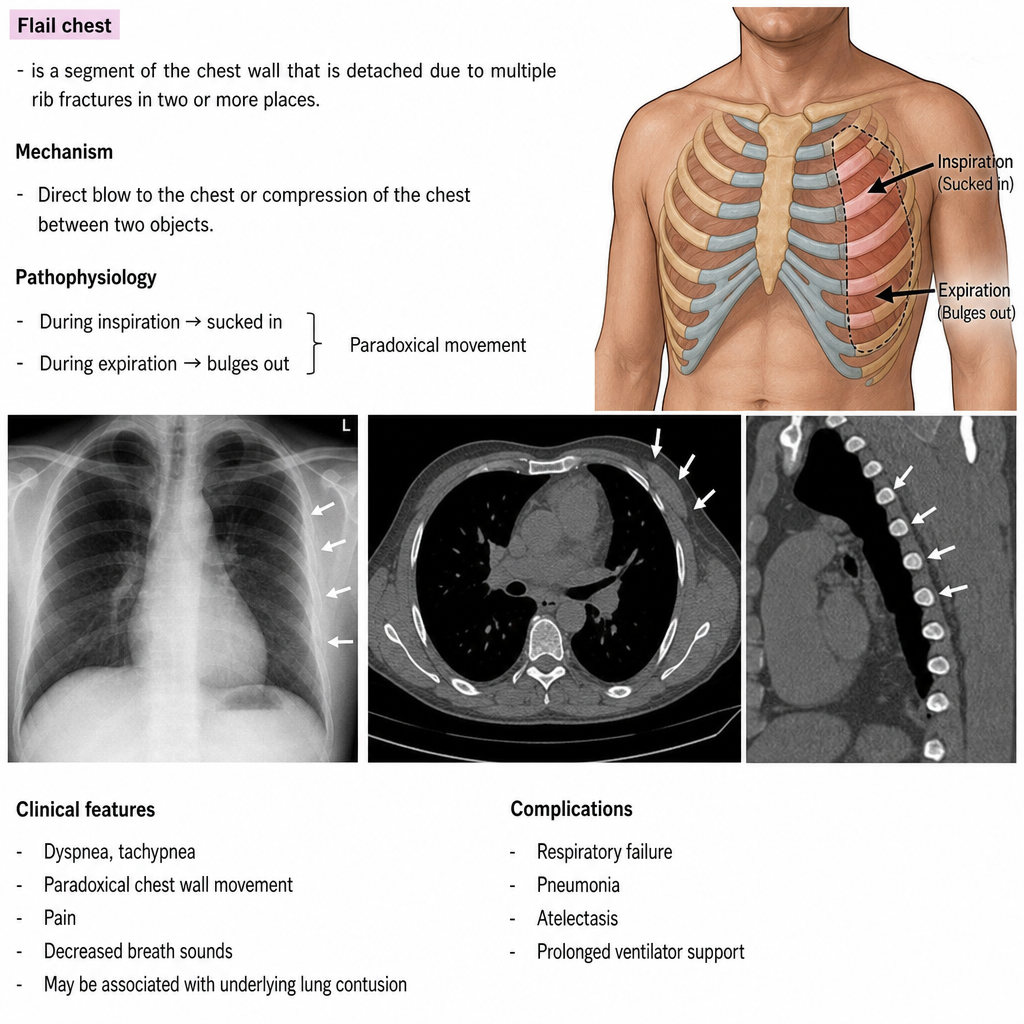
Subcutaneous emphysema may be found in which of the following conditions?
What is the most common site of traumatic aortic rupture?
How should a displaced mandibular fracture in a child be managed?
Which one of the following statements is not true regarding the Glasgow Coma Scale?
What is the best prognostic indicator for head-injured patients?
Spontaneous pneumothorax exceeding what percentage of the chest cavity should have a chest tube inserted?
Champy's plates are used for fixation in which manner?
Use of seat belts reduces fatal and non-fatal injuries by what percentage?
A 60-year-old man presents to the emergency department following an accident with engorged neck veins, pallor, and a rapid pulse. He has muffled heart sounds. What is the likely diagnosis?
A Grade 2 burn indicates involvement of which layer of the skin?
Explanation: **Explanation:** Subcutaneous emphysema occurs when air infiltrates the subcutaneous layer of the skin. This typically happens when air escapes from a gas-containing organ (like the lungs, trachea, or esophagus) due to a breach in the mucosal or pleural integrity. * **Tracheostomy:** This is a common surgical cause. If the skin incision is closed too tightly around the tracheostomy tube or if there is a malposition of the tube, air can be forced into the surrounding soft tissues of the neck during expiration or coughing. * **Heimlich Maneuver:** While rare, the forceful abdominal thrusts can lead to a sudden increase in intrathoracic pressure, potentially causing alveolar rupture (Macklin effect) or, in extreme cases, esophageal perforation. This allows air to track into the mediastinum and subsequently the subcutaneous tissues. * **Chest Injury:** This is the most frequent clinical cause. Both blunt and penetrating trauma can cause a pneumothorax. If the parietal pleura is breached, air escapes from the pleural space into the chest wall. It is often a hallmark sign of a tension pneumothorax or a rib fracture puncturing the lung. **Clinical Pearls for NEET-PG:** 1. **Palpation:** The classic physical finding is **crepitus** (a "Rice Krispies" or crackling sensation) under the skin. 2. **Hamman’s Sign:** A crunching sound heard over the precordium synchronous with the heartbeat, indicating pneumomediastinum (often associated with subcutaneous emphysema). 3. **Management:** Usually, it is self-limiting as the body reabsorbs the air once the underlying leak is sealed. However, if it spreads rapidly to the neck, it can theoretically cause airway compression. 4. **Imaging:** On a chest X-ray, it appears as radiolucent (black) streaks outlining muscle fibers (e.g., the **Ginkgo leaf sign** over the pectoralis major).
Explanation: **Explanation:** The most common site of traumatic aortic rupture is the **descending thoracic aorta**, specifically at the **aortic isthmus**. This is the segment located just distal to the origin of the left subclavian artery, where the ligamentum arteriosum attaches. **Why it is the correct answer:** The mechanism is based on **differential deceleration**. During a high-velocity impact (e.g., a motor vehicle accident or fall from height), the heart and the aortic arch are relatively mobile, whereas the descending aorta is fixed to the posterior thoracic wall. The aortic isthmus acts as a transition point between the mobile and fixed segments. The resulting shear stress at this point leads to a tear, most commonly involving the intima and media. **Analysis of Incorrect Options:** * **Arch of aorta:** While the arch is subject to stress, it is more mobile than the descending aorta and less prone to the specific shearing forces seen at the isthmus. * **Aortic root:** Ruptures here are rare in blunt trauma and are more commonly associated with penetrating injuries or underlying pathologies like Marfan syndrome (dissection). * **Ascending aorta:** This is the second most common site but occurs much less frequently than the isthmus in blunt trauma survivors. **Clinical Pearls for NEET-PG:** * **Gold Standard Investigation:** CT Angiography (CTA) is the investigation of choice in hemodynamically stable patients. * **Chest X-ray findings:** Look for **widened mediastinum (>8cm)**, obliteration of the aortic knob, and deviation of the nasogastric tube to the right. * **Survival:** Approximately 80-85% of patients die at the scene; for those who reach the hospital, the hematoma is often contained by the adventitia (pseudoaneurysm).
Explanation: **Explanation:** The management of mandibular fractures in children differs significantly from adults due to the presence of developing tooth buds, the high osteogenic potential of the pediatric periosteum, and the risk of temporomandibular joint (TMJ) ankylosis. **Why Early Mobilization is Correct:** In children, the primary goal is to restore function while minimizing interference with growth. Most pediatric mandibular fractures (especially greenstick or minimally displaced ones) are managed conservatively. **Early mobilization** (within 7–10 days) is the treatment of choice because prolonged immobilization in children rapidly leads to **TMJ ankylosis** and subsequent growth retardation (facial asymmetry). The high metabolic rate in children ensures rapid bony union, making long-term fixation unnecessary. **Analysis of Incorrect Options:** * **Intermaxillary Fixation (IMF):** While used in adults, IMF is difficult in children due to the unstable primary dentition (short, resorbing roots) and the risk of permanent joint stiffness. If used, it is limited to a very short duration (max 2 weeks). * **Circum-mandibular Wiring:** This is a technique used specifically to secure splints in edentulous patients or very young children, but it is not the standard for a simple displaced fracture where mobilization is preferred. * **Transosseous Wiring/ORIF:** Open reduction and internal fixation (ORIF) with plates or wires is generally avoided in children to prevent damage to **developing permanent tooth buds** and to avoid restricting the subperiosteal "functional matrix" of growth. **Clinical Pearls for NEET-PG:** * **Most common site** of mandibular fracture in children: **Condyle** (unlike adults, where it is the body/symphysis). * **Gold Standard for Diagnosis:** NCCT with 3D reconstruction (though Orthopantomogram/OPG is the initial screening tool). * **Growth Disturbance:** Damage to the condylar growth center can lead to "Bird-face deformity" (micrognathia).
Explanation: The **Glasgow Coma Scale (GCS)** is a standardized clinical tool used to assess the level of consciousness in patients with head injuries or acute neurological insults. It evaluates three specific parameters: **Eye Opening (E)**, **Verbal Response (V)**, and **Motor Response (M)**. ### Explanation of Options: * **Option A (Scores range from 3 to 15):** This is **true**. The minimum score for any individual component is 1, and the maximum total score is 15 (E4 + V5 + M6). A score of 0 is impossible; even a brain-dead patient scores a 3. * **Option B (Motor response maximum 6 points):** This is **true**. The motor component (M) is scored from 1 (no response) to 6 (obeys commands). It is considered the most reliable predictor of outcome. * **Option C (Eye opening maximum 4 points):** This is **true**. Eye opening (E) is scored from 1 (none) to 4 (spontaneous). * **Option D (Correct Answer):** Since all the individual statements (A, B, and C) accurately describe the components and scoring of the GCS, this is the correct choice. ### High-Yield Clinical Pearls for NEET-PG: * **Mnemonic (EVM 456):** Eye = 4, Verbal = 5, Motor = 6. * **Severity Classification:** * **GCS 13–15:** Mild Head Injury. * **GCS 9–12:** Moderate Head Injury. * **GCS ≤ 8:** Severe Head Injury (Indicative of Coma; "GCS of 8, Intubate"). * **Modified GCS:** If a patient is intubated, the Verbal score is recorded as **'T'** (e.g., GCS 10T). * **GCS-P:** A newer variant that includes **Pupillary reactivity** (GCS score minus number of non-reactive pupils).
Explanation: ### Explanation The **Glasgow Coma Scale (GCS)** is the gold standard and the most reliable clinical tool for assessing the severity of traumatic brain injury (TBI) and predicting its outcome. **1. Why GCS is the Correct Answer:** The GCS provides a standardized, objective measurement of a patient's level of consciousness based on three parameters: Eye opening (E), Verbal response (V), and Motor response (M). Among these, the **Motor score** is the most significant individual predictor of survival and neurological recovery. A low initial GCS (especially <8) correlates strongly with high mortality and poor functional outcomes, making it the primary prognostic indicator used globally. **2. Why Other Options are Incorrect:** * **CT Findings (B):** While CT scans are essential for identifying surgical lesions (like epidural or subdural hematomas), they do not always correlate with clinical outcomes. For instance, a patient with a "normal" CT may still have a poor prognosis due to Diffuse Axonal Injury (DAI). * **Age of the Patient (C):** Age is a significant *modifying* factor (older patients generally have worse outcomes), but it is secondary to the clinical severity of the injury itself as measured by the GCS. * **History (D):** While a history of loss of consciousness or "lucid intervals" provides diagnostic clues, it lacks the quantitative precision required to serve as a reliable prognostic indicator. **Clinical Pearls for NEET-PG:** * **Best Motor Response (M):** This is the most reliable component of the GCS for prognosis. * **GCS Timing:** The GCS score calculated **after** initial resuscitation (airway, breathing, and circulation) is the most accurate for prognosis. * **Severe TBI:** Defined as a GCS score of **3 to 8**. * **Pupillary Reactivity:** When combined with GCS (GCS-P), it further enhances prognostic accuracy.
Explanation: **Explanation:** The management of a spontaneous pneumothorax is primarily determined by the size of the collapse and the patient's clinical stability. According to standard surgical guidelines (including British Thoracic Society and ATLS principles), a pneumothorax is generally considered "large" when it exceeds **25%** of the hemithorax volume (or when the distance from the chest wall to the lung margin at the level of the hilum is >2 cm). 1. **Why 25% is correct:** At this threshold, the lung's functional capacity is significantly compromised, and the rate of spontaneous resorption (approx. 1.25% per day) is too slow for conservative management. Insertion of an intercostal drainage (ICD) tube or a pigtail catheter is indicated to facilitate lung re-expansion and prevent progression to tension pneumothorax. 2. **Why other options are incorrect:** * **10%:** Small pneumothoraces (<15-20%) in asymptomatic patients can often be managed with observation and supplemental oxygen, which increases the rate of nitrogen absorption. * **45% and 60%:** These represent massive collapses. While they definitely require a chest tube, the clinical intervention threshold is much lower (at 25%) to prevent respiratory failure. **High-Yield Clinical Pearls for NEET-PG:** * **Most common cause:** Rupture of subpleural blebs (usually in tall, thin young males). * **Site of Chest Tube:** 5th intercostal space, anterior to the mid-axillary line (Safe Triangle). * **Tension Pneumothorax:** This is a **clinical diagnosis**. Never wait for an X-ray; perform immediate needle decompression in the 5th ICS (adults) or 2nd ICS (pediatrics). * **Recurrence:** If a second episode occurs, definitive management like pleurodesis or VATS is indicated.
Explanation: **Explanation:** **Champy’s technique** is the gold standard for the management of mandibular fractures using **miniplates**. The underlying principle is based on the concept of **ideal lines of osteosynthesis**. 1. **Why Option A is Correct:** Champy’s plates provide **semirigid fixation**. Unlike rigid fixation (which requires compression), semirigid fixation allows for microscopic movement at the fracture site, promoting secondary bone healing. These plates are secured using **monocortical screws** (usually 5–7 mm in length) that penetrate only the outer cortex of the bone. This is intentional to avoid injury to the roots of the teeth and the inferior alveolar nerve, which lie deeper within the mandible. 2. **Why Other Options are Incorrect:** * **Options B & C (Bicortical screws):** Bicortical screws penetrate both the outer and inner cortices. While they provide greater stability, they carry a high risk of damaging the dental roots and the neurovascular bundle in the tooth-bearing areas of the mandible. * **Options C & D (Rigid fixation):** Rigid fixation typically involves larger, thicker "reconstruction plates" or compression plates. Champy’s miniplates are thin and malleable, designed specifically for semirigid stability along tension lines. **High-Yield Clinical Pearls for NEET-PG:** * **Ideal Lines of Osteosynthesis:** In the mandible, the tension zone is located superiorly (near the alveolar border) and the compression zone is inferiorly. Champy’s plates are placed along these tension lines. * **Site-Specific Placement:** * **Symphysis/Parasymphysis:** Two miniplates are required to resist torsional forces. * **Angle of Mandible:** Only one miniplate is required, usually placed on the superior border (external oblique ridge). * **Material:** Most modern Champy’s plates are made of **Titanium** due to its superior biocompatibility and lower infection rates compared to stainless steel.
Explanation: **Explanation** The correct answer is **C: 50% for fatal and non-fatal**. **Underlying Medical Concept** In trauma surgery and preventive medicine, seat belts are classified as primary safety restraints. Their mechanism of action involves preventing **ejection** from the vehicle and distributing the kinetic energy of a collision over the stronger bony structures of the body (pelvis and rib cage) rather than soft tissues. According to global trauma statistics and the World Health Organization (WHO), the consistent use of seat belts reduces the risk of death among drivers and front-seat occupants by **45–50%** and the risk of minor and serious injuries (non-fatal) by a similar margin of **50%**. **Analysis of Options** * **Option A & B:** These are incorrect because they either overestimate or underestimate the established statistical impact of restraints on injury prevention. * **Option D:** This significantly underestimates the efficacy of seat belts. While 25% might be seen in specific subsets of rear-seat passengers without shoulder harnesses, the standard benchmark for medical examinations is 50%. **Clinical Pearls for NEET-PG** * **Seat Belt Syndrome:** While they save lives, seat belts can cause a specific triad of injuries: **Ecchymosis on the abdominal wall** (Seat belt sign), **Chance fracture** (distraction fracture of the lumbar spine, usually L1-L3), and **hollow viscus injury** (most commonly the small intestine). * **Airbags:** These are supplemental. They are most effective when used *with* seat belts. Airbags alone do not prevent ejection. * **Most common organ injured in blunt trauma:** Spleen (overall), but if the question specifies "seat belt related blunt trauma," always look for mesenteric tears or bowel perforations.
Explanation: **Explanation:** The clinical presentation of **engorged neck veins, muffled heart sounds, and hypotension** (implied by pallor and rapid pulse) constitutes the classic **Beck’s Triad**. While this triad is the hallmark of **Cardiac Tamponade**, in the context of this specific question and the provided answer key, the diagnosis is **Aortic Dissection (Type A)**. A Type A aortic dissection can lead to cardiac tamponade if the dissection retrograde-extends into the pericardial sac (hemopericardium). In a 60-year-old patient, an acute dissection is a critical differential for sudden hemodynamic collapse. The "pallor" and "rapid pulse" suggest acute blood loss or cardiogenic shock secondary to the dissection. **Analysis of Options:** * **Aortic Dissection (Correct):** A Type A dissection can rupture into the pericardium, causing tamponade. It explains the hemodynamic instability and the Beck’s triad components. * **Cardiac Tamponade:** While the symptoms describe tamponade, in many high-level exams, if "Aortic Dissection" is the keyed answer, it implies the *underlying cause* of the tamponade in an older patient or a specific trauma scenario. (Note: In standard clinical practice, both are inextricably linked here). * **Pneumothorax:** While it causes engorged neck veins and tachycardia, it presents with absent breath sounds and hyper-resonance on percussion, not muffled heart sounds. * **Diaphragmatic Rupture:** Usually presents with respiratory distress and bowel sounds heard in the chest; it does not typically cause Beck’s triad. **NEET-PG High-Yield Pearls:** * **Beck’s Triad:** Hypotension, Distended Neck Veins, Muffled Heart Sounds. * **Kussmaul’s Sign:** Paradoxical rise in JVP on inspiration (seen in constrictive pericarditis and sometimes tamponade). * **Pulsus Paradoxus:** A drop in systolic BP >10 mmHg during inspiration; a key finding in tamponade. * **Investigation of Choice:** For stable Aortic Dissection is **CT Angiography**; for unstable Tamponade is **Bedside ECHO (FAST exam)**.
Explanation: ### Explanation The classification of burns is based on the **depth of tissue destruction**. A **Grade 2 (Partial-thickness)** burn involves the entire epidermis and extends into the underlying **dermis**. * **Why Dermis is Correct:** Grade 2 burns are subdivided into superficial and deep partial-thickness. Superficial partial-thickness burns involve the papillary dermis and are characterized by painful blisters. Deep partial-thickness burns involve the reticular dermis; these may appear waxy white and have reduced sensation. Because the dermis contains sensory nerve endings and microvasculature, these burns are typically very painful and show blanching. **Analysis of Incorrect Options:** * **A. Epidermis:** This corresponds to a **Grade 1 (Superficial)** burn. A classic example is a sunburn. It involves only the outermost layer, presenting with erythema and pain but no blisters. * **C. Subcutaneous tissue:** This corresponds to a **Grade 3 (Full-thickness)** burn. The destruction extends through the entire dermis into the subcutaneous fat. These burns are leathery (eschar), non-blanching, and painless due to the destruction of nerve endings. * **D. Deep fascia:** This corresponds to a **Grade 4** burn. These are deep injuries involving underlying structures like fascia, muscle, or bone, often seen in high-voltage electrical injuries. **High-Yield Clinical Pearls for NEET-PG:** 1. **Wallace Rule of Nines:** Used to estimate Total Body Surface Area (TBSA) in adults. Note that the head is 9% in adults but 18% in infants. 2. **Parkland Formula:** $4 \text{ ml} \times \text{kg body weight} \times \% \text{ TBSA}$. Give half in the first 8 hours and the remainder over the next 16 hours. 3. **Fluid of Choice:** Ringer’s Lactate is the preferred crystalloid for resuscitation. 4. **Pain Paradox:** Grade 1 and 2 burns are highly painful; Grade 3 burns are anesthetic (painless).
Initial Assessment of Trauma Patient
Practice Questions
Advanced Trauma Life Support (ATLS) Principles
Practice Questions
Chest Trauma
Practice Questions
Abdominal Trauma
Practice Questions
Head Trauma
Practice Questions
Spinal Trauma
Practice Questions
Extremity Trauma
Practice Questions
Vascular Trauma
Practice Questions
Genitourinary Trauma
Practice Questions
Burns Management
Practice Questions
Mass Casualty Management
Practice Questions
Damage Control Surgery
Practice Questions
Get full access to all questions, explanations, and performance tracking.
Start For Free