A 26 year old female was brought to ER post fire incidence. Her face and lower limbs were spared. Based on the burn distribution shown, calculate the percentage of body surface area affected.
A fracture caused by falls landing on feet/buttocks (force transmitted through the spine), heavy blows to the top of the skull/vertex, twisting of the head on the spine, or blows to the occiput or chin. Which type of fracture is this?
A patient presents with a transverse fracture at the skull base, described as splitting it and creating a 'hinge' with a 'nodding face sign.' This fracture extends from one petrous ridge across the sella turcica to the other petrous ridge. Which type of fracture is this?
Four patients were brought to the casualty after sustaining trauma. Which of the following is the correct match among the following?
Which of the following is associated with CSF otorrhea?
A 32-year-old male presents to the emergency department 6 hours after a motor vehicle accident with hypotension (BP 80/50 mmHg), tachycardia (HR 130/min), and abdominal distension. FAST (Focused Assessment with Sonography for Trauma) shows free fluid in Morrison's pouch. What is the most appropriate immediate management?
A patient has burns involving the face, both upper limbs and front of the chest. What is the percentage of burns involved?
A 40-year-old male with head injury presents with respiratory distress and absent breath sounds on the right. GCS is 8/15. What is the most immediate next step in management?
After a building collapse, a patient presents with airway obstruction and mouth filled with concrete debris. BP is 90/60 mmHg, HR 105/min. A cricothyrotomy is performed. Which of the following statements regarding this procedure is true?
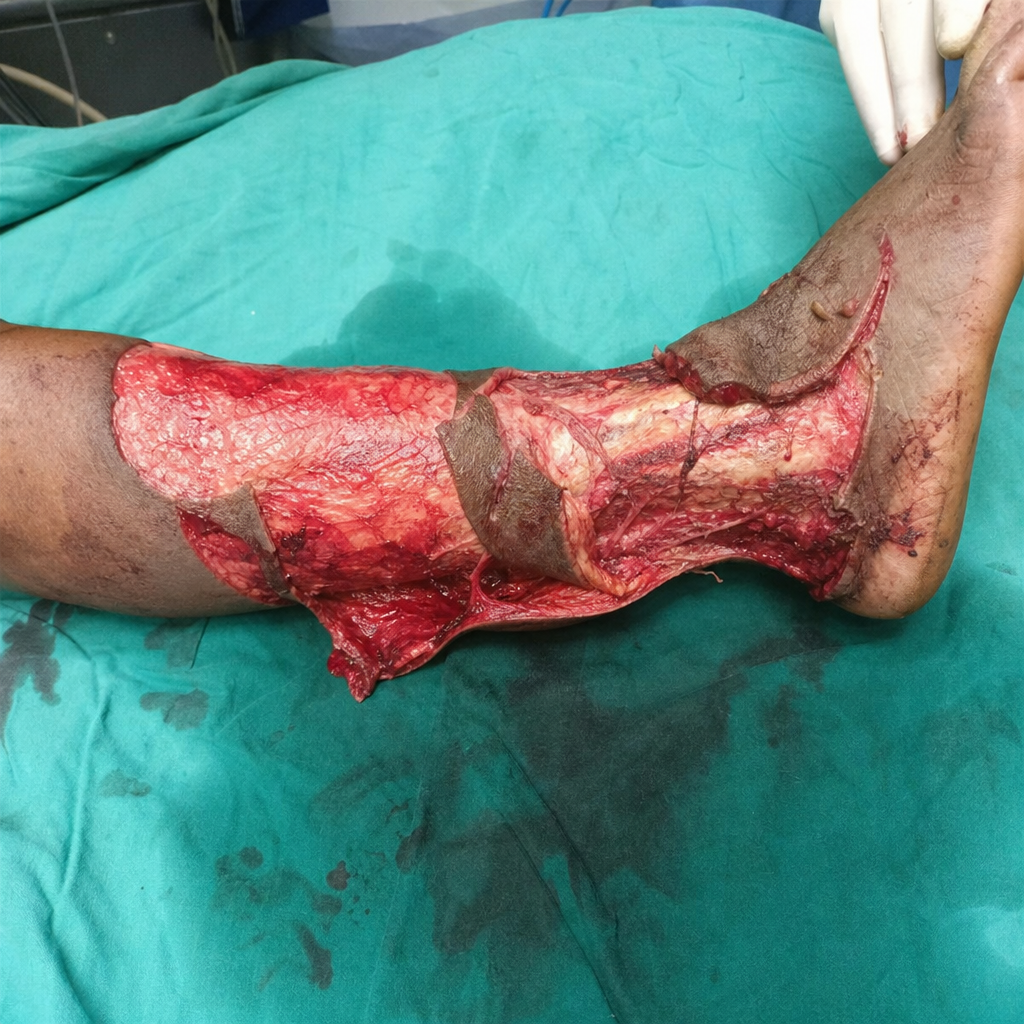
A 30-year-old female was brought to the emergency room after a fire. On examination, full-thickness burns and deep partial-thickness burns were present involving the lower limb circumferentially. A procedure was performed to relieve vascular compromise. Identify the procedure?
Explanation: ***40-50%*** - The **Rule of Nines** is used to estimate the Total Body Surface Area (TBSA) of burns in adults. According to this rule, the anterior trunk is 18%, each upper limb is 9%, and the posterior trunk is 18%. - In this patient, burns cover the entire anterior trunk (18%), both upper limbs (9% + 9% = 18%), and likely the upper posterior trunk (approx. 9%), totaling around **45%**, which falls in this range. This calculation is critical for fluid resuscitation. *5-10%* - This percentage represents a much smaller burn area, equivalent to approximately one full arm (9%) or the head (9%). - The visual evidence clearly shows extensive burns involving the entire torso and both arms, far exceeding this estimation. *20-30%* - This TBSA would typically represent burns covering the entire anterior trunk (18%) plus one arm (9%), totaling 27%. - This estimate is incorrect as it fails to account for the burns on the second upper limb and the likely involvement of the back. *10-15%* - A burn of this size would involve an area such as the anterior chest (9%) or one leg from the knee down. - This option significantly underestimates the burn severity, as the anterior trunk alone accounts for 18% of the TBSA.
Explanation: ***Fissured Fracture (Linear Fracture)*** - This type of fracture, also known as a **linear fracture**, results from forces that cause a simple, nondisplaced crack in the skull vault. - The mechanisms described—such as forces transmitted through the spine (falls on feet/buttocks) or blows to the vertex, chin, or occiput—are classic causes of **linear skull fractures** because the force is typically dispersed over a wide area, rather than focused enough to cause depression. *Depressed Fracture* - These fractures occur due to high-velocity **localized impact**, where the outer table of the skull is driven inward below the level of the inner table, posing a high risk of **dural tear** and underlying brain injury. - The mechanisms listed in the question involve generalized force transmission or twisting, which are inconsistent with the **inward comminution** required for a depressed fracture. *Gutter Fracture* - This term is specifically associated with **penetrating missile injuries**, like low-velocity bullet wounds, where bone fragments are typically driven inward, creating a characteristic groove or channel. - The mechanisms listed in the prompt are **blunt force** injuries or transmission of force, not penetrating trauma that creates a 'gutter.' *Diastatic Fracture (Sutural Fracture)* - This fracture involves the **separation of cranial sutures** due to a fracture line extending into them, primarily observed in infants and young children before the sutures are fully fused. - The forces described result in a break *through* the bone of the vault (a fissure) rather than primarily causing the **separation of existing, fused sutures** in an adult skull.
Explanation: ***Motorcyclist Fracture (Hinge Fracture)*** - This is a descriptive term for a high-energy **transverse skull base fracture** that typically runs through the middle cranial fossa, traversing the skull base from one **petrous ridge** across the **sella turcica** to the opposite petrous ridge. - The fracture creates a 'hinge' mechanism that physically separates the facial skeleton from the calvarium, resulting in instability often described clinically as the **'nodding face sign'**. *Depressed Fracture* - A depressed fracture is characterized by bone fragments driven inwards, below the level of the surrounding skull, often leading to potential injury to the underlying **dura mater** and brain parenchyma. - These fractures result from blunt force trauma focused on a small area, and their primary feature is **inward displacement**, not the transverse splitting and hinge mechanism described. *Comminuted Fracture* - A comminuted fracture involves the bone being broken into **multiple pieces** (three or more separate fragments) at the fracture site. - While hinge fractures are often complex, the defining feature of this clinical presentation is the **transverse path** across the sella and the resulting hinge-like instability, which is a structural description differentiating it from a general comminution. *Ring Fracture* - A ring fracture occurs around the **foramen magnum** and is caused by significant axial loading (e.g., severe fall onto the feet or buttocks). - This fracture causes instability at the **craniocervical junction** and is localized to the posterior cranial fossa, not the extensive transverse fracture across the middle cranial fossa described.
Explanation: ***Gaze palseis-Mid brain lesion***- **Vertical gaze palsies** are commonly associated with lesions affecting the **midbrain**, particularly the **pretectal area** and the rostral interstitial nucleus of the **medial longitudinal fasciculus (riMLF)**.- Trauma or increased intracranial pressure leading to compression in this region, such as in **Parinaud syndrome**, can result in impaired upward or downward gaze.*Extradural hemorrhage (EDH)- Pin point pupil*- An **EDH** typically causes rapid mass effect and subsequent **uncal herniation**, leading to compression of the **oculomotor nerve (CN III)** and resulting in a fixed, **dilated pupil** (mydriasis) ipsilateral to the lesion.- **Pinpoint pupils** are classically associated with damage to the descending sympathetic pathways in the **pons** (pontine hemorrhage) or opioid overdose.*Penetrating injury to eustachian tube- CSF otorrhea*- **CSF otorrhea** (leakage of CSF from the ear) occurs due to a tear in the dura mater and the **temporal bone**, specifically involving the **petrous segment** and tympanic membrane rupture.- Injury to the **Eustachian tube** primarily connects the middle ear to the nasopharynx; damage here would typically cause air leak or middle ear bleeding, not primary CSF leakage through the external auditory canal.*Penetrating injury to eye- Battle sign*- **Battle sign** is ecchymosis (bruising) over the **mastoid process** and is a hallmark clinical indicator of a **basilar skull fracture**, usually involving the middle cranial fossa (temporal bone).- Penetrating injuries to the eye are associated with localized ocular trauma (e.g., globe rupture, hyphema) but are not typically linked to this specific sign of underlying skull base injury.
Explanation: ***Battle sign***- **Battle sign** (ecchymosis over the mastoid process) is highly indicative of a **basilar skull fracture**, specifically involving the **temporal bone**.- Fractures of the petrous portion of the temporal bone often breach the **dura mater** and middle ear cavity, leading directly to leakage of cerebrospinal fluid (**CSF otorrhea**).*Traumatic rupture of the tympanic membrane*- While rupture of the **tympanic membrane (TM)** is often present, it is usually a consequence of the underlying **temporal bone fracture**, not the primary source of the CSF leak.- CSF otorrhea fundamentally requires a fracture allowing communication between the **subarachnoid space** and the middle ear; TM rupture solely allows fluid egress.*Penetrating injury to the eye*- These injuries involve the orbit and structures of the eye, typically causing orbital trauma, globe rupture, or associated **facial fractures**.- They are not the usual mechanism for basilar skull fractures involving the **middle cranial fossa** or temporal bone, which are necessary for CSF otorrhea.*Fracture of the roof of the nose*- Fractures of the skull base involving the anterior cranial fossa, such as the **cribriform plate** (roof of the nose), classically cause **CSF rhinorrhea** (CSF leakage through the nose).- This anatomical location is functionally separate from the temporal bone pathology required to produce **CSF otorrhea**.
Explanation: ***Immediate exploratory laparotomy*** - The patient has evidence of **hemorrhagic shock** (hypotension BP 80/50 mmHg and tachycardia HR 130/min) combined with a positive FAST exam showing free fluid in Morrison's pouch, indicating **hemoperitoneum** following blunt abdominal trauma. - According to **ATLS (Advanced Trauma Life Support) guidelines**, hemodynamically unstable patients with positive FAST findings require immediate transfer to the operating room for **exploratory laparotomy** to identify and control the source of hemorrhage. - This represents a life-threatening injury requiring definitive surgical intervention without delay. *CT abdomen with intravenous contrast* - CT scan is the **gold standard** for evaluating hemodynamically **stable** patients with blunt abdominal trauma. - This patient is **hemodynamically unstable** (BP 80/50 mmHg), making transport to the CT scanner dangerous and potentially fatal. - Delaying definitive surgical treatment to obtain imaging in an unstable patient significantly increases mortality risk. *Observation with serial abdominal examinations* - Observation is appropriate only for **stable patients** with equivocal findings or minor trauma. - This patient has clear evidence of **ongoing hemorrhage** (shock + positive FAST) requiring immediate intervention. - Serial examinations would dangerously delay life-saving surgery and lead to preventable death from exsanguination. *Diagnostic peritoneal lavage* - DPL is an older invasive diagnostic test that has been largely replaced by **FAST** in modern trauma management. - When FAST has already confirmed hemoperitoneum in an unstable patient, performing DPL adds no diagnostic value and only delays definitive treatment. - The diagnosis is already made - the patient needs surgery, not further diagnostic procedures.
Explanation: ***Correct: 30 to 37*** - This percentage is derived using the **Rule of Nines** for adults: Face (part of Head) = 4.5%, Both Upper Limbs (9% each) = 18%, and Front of Chest (part of Anterior Trunk) = 9%. Total = 4.5 + 18 + 9 = **31.5%**. - The Rule of Nines is a quick method for estimating the total body surface area burned (TBSA) in adults, assigning 9% to major body sections (or multiples thereof). *Incorrect: 27 to 30* - This range is too low; the precise calculation according to the Rule of Nines is **31.5%**, which falls outside and above this range. - This would underestimate the burn area and potentially lead to inadequate fluid resuscitation. *Incorrect: 38 to 42* - This range is too high; it would imply involvement of additional surface area beyond what is described. - 36% would cover the entire head (9%), both upper limbs (18%), and the entire anterior trunk (18%), which is more than just the front of the chest. *Incorrect: 25 to 48* - While the calculated value (31.5%) falls within this excessively wide range, it is an unnecessarily broad estimation and not clinically useful. - The most precise option provided is **30 to 37**, which appropriately contains the calculated value of 31.5%.
Explanation: ***Secure airway*** - In a patient with **head injury** (GCS 8/15) and **respiratory distress**, establishing a definitive, protected airway is the **absolute priority** following **ABC** principles of trauma management. - A GCS of **≤8** is a clear indication for **endotracheal intubation** to prevent aspiration, ensure adequate ventilation, and protect the airway. - While absent breath sounds suggest **pneumothorax**, the absence of hemodynamic instability (hypotension, tachycardia) or other signs of **tension pneumothorax** (JVD, tracheal deviation) suggests this is likely a **simple pneumothorax** rather than tension. - In simple pneumothorax with severe head injury, **airway securement takes precedence** per ATLS guidelines, followed immediately by chest decompression. - **Note:** If clinical signs of **tension pneumothorax** were present (cardiovascular collapse, severe hypotension), immediate needle decompression would take priority even before intubation, as positive pressure ventilation in untreated tension pneumothorax can be fatal. *Incorrect: Intercostal chest drain (ICD)* - While the patient shows signs of **pneumothorax** or **hemothorax** (absent breath sounds on right), and ICD placement is definitely required, it comes *after* securing the airway in this scenario. - The **critical GCS of 8** makes airway protection the immediate priority to prevent aspiration and respiratory arrest. - ICD placement should follow immediately after intubation, as the patient needs both interventions urgently. *Incorrect: Contrast-enhanced CT (CECT)* - Imaging studies are necessary for definitive diagnosis but are **secondary to resuscitation** and addressing immediate life threats. - Transporting an unstable patient with GCS 8 and an unprotected airway to CT scanner is dangerous and violates **ATLS principles**. - **"Treat first, scan later"** is the rule in unstable trauma patients. - CT is performed after airway is secured, breathing is stabilized, and patient is hemodynamically stable. *Incorrect: Oxygen by nasal prongs* - While oxygen supplementation is important, **nasal prongs** provide inadequate oxygenation for a patient in severe respiratory distress with GCS 8. - This passive method does not address the **unprotected airway** or provide adequate ventilation support. - With GCS 8, the patient cannot protect their airway and requires **definitive airway management** (endotracheal intubation), not just supplemental oxygen.
Explanation: ***It must be followed by a formal tracheostomy*** - The procedure performed is an emergency surgical airway, likely a **cricothyrotomy**, which is a life-saving but temporary measure used when **endotracheal intubation** is impossible. - Due to the high risk of long-term complications, especially **subglottic stenosis** and cricoid cartilage damage, it requires prompt conversion (typically within 48-72 hours) to a more permanent airway using a **formal tracheostomy**. *It provides adequate ventilation for up to 6 hours* - While it provides adequate immediate ventilation, 6 hours is not a safety cut-off; the decision to convert is driven by the risk of **laryngeal damage** and scarring with delayed action. - The primary goal of cricothyrotomy is **immediate stability**, not providing a specific period of ventilation. *It allows for removal of large foreign bodies from the airway* - The procedure bypasses the upper airway obstruction by inserting a tube through the **cricothyroid membrane** (below the vocal cords). - It does **not** facilitate the removal of large foreign bodies or concrete debris, which would require specialized tools like **bronchoscopy** or direct laryngoscopy. *It can be safely used for prolonged airway management without further intervention* - This statement is false, as prolonged use (>72 hours) of a cricothyrotomy is highly associated with localized complications, including vocal cord dysfunction and life-threatening **subglottic stenosis**. - A cricothyrotomy is only intended as a **bridge** until a definitive airway (tracheostomy) can be established in a controlled environment.
Explanation: ***Escharotomy*** - Performed for **full-thickness (circumferential)** burns to relieve pressure caused by the rigid, constricting **eschar** (necrotic tissue). - Indicated when there are signs of **compartment syndrome** or impaired distal circulation (e.g., absent pulses, cyanosis) in the affected limb. *Debridement* - Involves removing dead, contaminated, or foreign material from a wound to promote healing. - While necessary for complex burns, simply debridement does not address the acute vascular compromise caused by circumferential full-thickness burns. *Excised to healthy tissue* - Refers to **tangential** or **fascial excision** of the burn wound, an operative procedure typically done under general anesthesia for definitive wound management. - This is performed later for wound bed preparation, not an immediate, bedside procedure to restore circulation and prevent limb loss like **escharotomy**. *Early skin grafting* - The definitive procedure used to close the wound after it is excised and prepared. - Cannot be performed until severe vascular constriction is relieved and the wound bed is adequately prepared, making it a later step in management.
Initial Assessment of Trauma Patient
Practice Questions
Advanced Trauma Life Support (ATLS) Principles
Practice Questions
Chest Trauma
Practice Questions
Abdominal Trauma
Practice Questions
Head Trauma
Practice Questions
Spinal Trauma
Practice Questions
Extremity Trauma
Practice Questions
Vascular Trauma
Practice Questions
Genitourinary Trauma
Practice Questions
Burns Management
Practice Questions
Mass Casualty Management
Practice Questions
Damage Control Surgery
Practice Questions
Get full access to all questions, explanations, and performance tracking.
Start For Free