Which of the following is true for superficial burns?
All of the following are true about the CRASH-2 trial except:
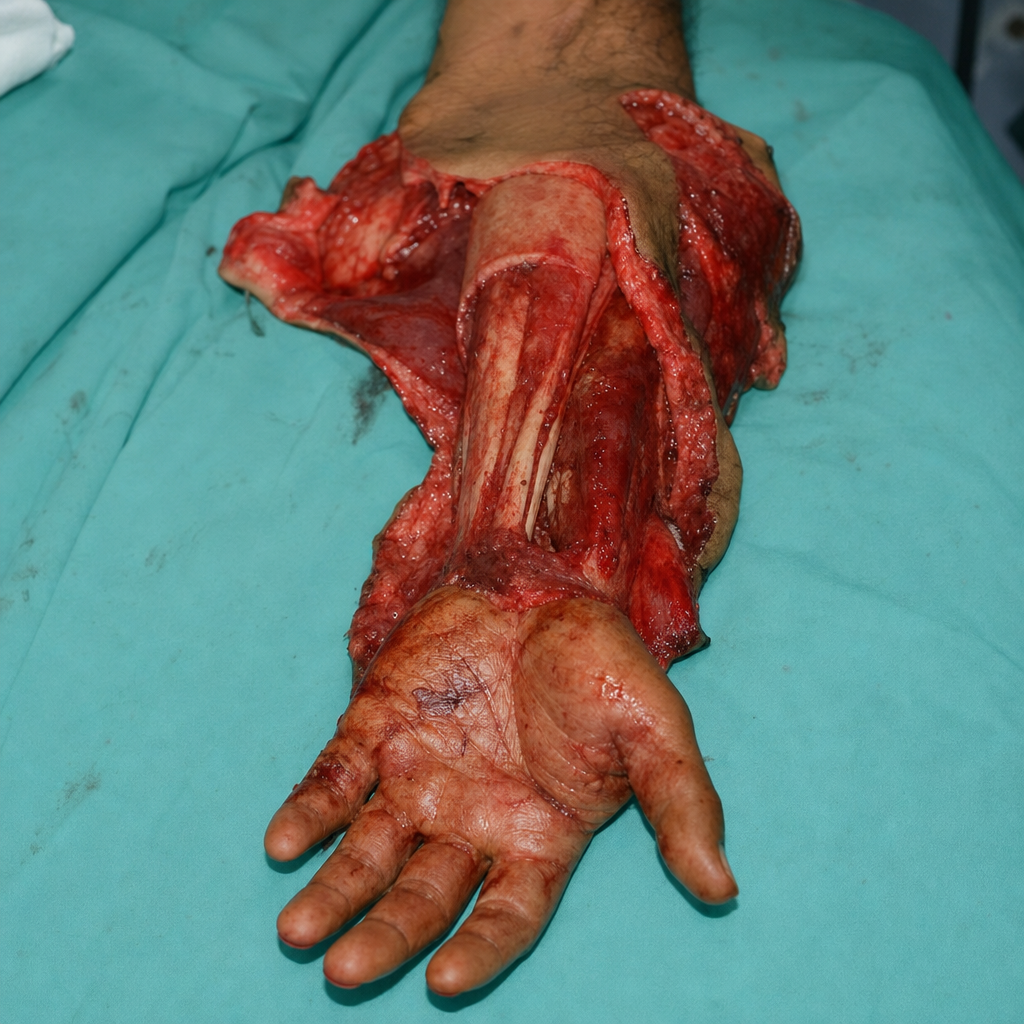
What is the best initial treatment for a contaminated wound of the leg?
A 3-year-old child suffers from a burn injury involving the face, including the scalp, both buttocks, and circumferentially around both thighs. What is the Total Body Surface Area (TBSA) involved?
Which of the following laboratory values should NOT be monitored in refeeding syndrome?
In a condylar fracture with greater than 5 mm of overlapping and greater than 37 degrees of angulation of the fracture segment, what is the line of treatment?
Which of the following is NOT true regarding burn patients?
Which among the following topical agents used in burns can cause acidosis?
A burn patient should be referred to a burn unit when which of the following criteria are met?
What is the Glasgow Coma Scale score in a fully conscious person?
Explanation: ### Explanation **Superficial Partial-Thickness Burns (Second-Degree)** involve the epidermis and the superficial (papillary) dermis. **Why Option C is Correct:** The hallmark of superficial partial-thickness burns is **blister formation**. This occurs because the damage to the basal layer of the epidermis leads to inflammatory exudate accumulating between the epidermis and the dermis. These burns are typically **erythematous (pink), blanch with pressure, and are moist/weeping** due to the exposure of the dermis. **Why Other Options are Incorrect:** * **Option A:** Superficial burns usually heal spontaneously within 7–21 days through epithelialization from the skin appendages (hair follicles, sweat glands). They **do not require skin grafting** unless they are deep or involve extensive surface areas with complications. * **Option B:** Superficial burns are **moist** due to serum leakage. "Dry and inelastic" (leathery) describes **Full-thickness (Third-degree) burns**, where the entire dermis and its vasculature are destroyed. * **Option D:** Superficial burns are **exceedingly painful** because the sensory nerve endings in the dermis remain intact but are exposed. **Painless** burns are characteristic of full-thickness burns where the nerve endings are completely destroyed (anesthesia). ### NEET-PG High-Yield Pearls: * **First-degree burns:** Only epidermis involved (e.g., sunburn); painful, red, no blisters. * **Deep Partial-Thickness:** Waxy white, does not blanch, reduced sensation. * **Rule of Nines:** Used for initial assessment of Total Body Surface Area (TBSA). * **Parkland Formula:** $4 \text{ ml} \times \text{kg} \times \% \text{TBSA}$ (using Ringer’s Lactate) is the gold standard for fluid resuscitation in the first 24 hours.
Explanation: The **CRASH-2 trial** (Clinical Randomisation of an Antifibrinolytic in Significant Haemorrhage 2) is a landmark study that established the role of Tranexamic Acid (TXA) in trauma management. ### **Explanation of Options** * **Option D (The Correct Answer/False Statement):** The CRASH-2 trial demonstrated that TXA significantly reduces all-cause mortality and death due to bleeding in **both blunt and penetrating trauma**. There was no evidence that the effect differed by the type of injury. * **Option A:** The standardized protocol used in the trial (and now in clinical practice) is a **loading dose of 1 gm IV over 10 minutes**, followed by a **maintenance infusion of 1 gm over 8 hours**. * **Option B:** The trial included adult trauma patients with significant hemorrhage (SBP <90 mmHg or heart rate >110 bpm) or those **judged to be at risk** of significant hemorrhage. * **Option C:** Time is critical. The trial showed that TXA is most effective when given early. Administration **after 3 hours** was actually associated with an **increased risk of death** due to bleeding; hence, it must be given within the 3-hour window. ### **High-Yield Clinical Pearls for NEET-PG** * **Mechanism of Action:** TXA is a synthetic analogue of lysine that inhibits fibrinolysis by blocking the lysine-binding sites on **plasminogen**, preventing its conversion to plasmin. * **The "Golden 3 Hours":** TXA should be administered as soon as possible. Benefit decreases by 10% for every 15-minute delay. * **CRASH-3 Trial:** Extended these findings to **Traumatic Brain Injury (TBI)**, showing that TXA reduces head-injury-related death in patients with mild-to-moderate TBI (GCS 9–15) if treated within 3 hours. * **Side Effects:** Rapid IV injection can cause **hypotension**. High doses are associated with **seizures**.
Explanation: ### Explanation The management of a contaminated wound follows the fundamental surgical principle: **"The solution to pollution is dilution and debridement."** **Why Debridement and Antibiotics is Correct:** A contaminated wound contains foreign bodies, devitalized tissue, and bacteria. 1. **Debridement:** This is the most critical step. It involves the removal of dead (necrotic) tissue and foreign debris, which otherwise act as a nidus for infection and prevent healing. It converts a contaminated wound into a clean, vascularized wound. 2. **Antibiotics:** These are administered to prevent the progression of contamination into a systemic or localized clinical infection (prophylaxis or early treatment). **Why Other Options are Incorrect:** * **Hyperbaric Oxygen (HBO):** While HBO can be used as an adjunct for specific conditions like gas gangrene or chronic non-healing diabetic ulcers, it is never the *initial* treatment for an acute contaminated wound. * **Amputation:** This is a radical measure reserved for non-viable limbs (Mangled Extremity Severity Score ≥ 7) or life-threatening sepsis where debridement is insufficient. It is not the first-line approach for a standard contaminated wound. **High-Yield Clinical Pearls for NEET-PG:** * **Golden Period:** Ideally, debridement should be performed within **6–8 hours** of injury to prevent the transition from contamination to established infection. * **Wound Closure:** Contaminated wounds are often managed by **Delayed Primary Closure (DPC)**—the wound is left open after debridement and closed 3–5 days later once healthy granulation tissue appears. * **Tetanus Prophylaxis:** Always check the immunization status in any traumatic wound management. * **Irrigation:** Copious irrigation with normal saline is as important as surgical debridement. Adding povidone-iodine to the irrigation fluid is generally avoided as it can be cytotoxic to healthy cells.
Explanation: To calculate the Total Body Surface Area (TBSA) in pediatric burns, we must use the **Lund and Browder chart** or the **Modified Rule of Nines**, as children have a larger head-to-body ratio compared to adults. ### **Calculation Breakdown:** * **Face and Scalp (Entire Head):** In a 3-year-old, the head accounts for approximately **15%** (Formula: $19 - \text{age in years}$). Since the question specifies the face *including* the scalp, we calculate the full head surface area. * **Both Buttocks:** Each buttock is **2.5%**, totaling **5%**. * **Both Thighs (Circumferential):** In a 3-year-old, each thigh is approximately **7.5%**. For both thighs, this equals **15%**. * **Total:** $15\% (\text{Head}) + 5\% (\text{Buttocks}) + 15\% (\text{Thighs}) = \mathbf{35\%}$ (or **0.35**). ### **Analysis of Incorrect Options:** * **A (0.25) & B (0.26):** These values underestimate the TBSA by failing to account for the larger surface area of the pediatric head or the circumferential nature of the thigh burns. * **D (0.45):** This overestimates the area, likely by using adult proportions or incorrectly adding the entire lower limb instead of just the thighs. ### **NEET-PG High-Yield Pearls:** 1. **The "Rule of Nines" is inaccurate for children.** Use the Lund-Browder chart for the most accurate assessment. 2. **Pediatric Head Proportions:** At birth, the head is 19%. For every year of age up to 10, subtract 1% from the head and add 0.5% to each leg. 3. **Palmar Method:** The patient’s palm (including fingers) represents roughly **1% TBSA**; this is useful for small or patchy burns. 4. **Fluid Resuscitation:** In pediatrics, the **Parkland Formula** ($4\text{ ml} \times \text{kg} \times \% \text{TBSA}$) is used, but **maintenance fluids** (using the 4-2-1 rule) must be added separately because children have lower glycogen stores.
Explanation: ### Explanation **Refeeding Syndrome** is a potentially fatal metabolic complication that occurs when nutritional support (enteral or parenteral) is reintroduced to severely malnourished patients. The shift from a catabolic to an anabolic state triggers a massive insulin surge, leading to the intracellular shift of electrolytes. **Why Ammonia is the Correct Answer:** Ammonia levels are not typically monitored in refeeding syndrome because hyperammonemia is not a characteristic feature of this metabolic shift. While protein metabolism involves ammonia, the acute life-threatening complications of refeeding syndrome are driven by **electrolyte shifts** and **thiamine deficiency**, not by urea cycle dysfunction or ammonia toxicity. **Why the Other Options are Incorrect:** * **Phosphate (C):** This is the **most important** value to monitor. Hypophosphatemia is the hallmark of refeeding syndrome. Insulin causes cells to take up glucose and phosphate for ATP production, leading to severe depletion in the blood, which can cause respiratory failure and cardiac arrest. * **Magnesium (B) and Calcium (A):** Both are critical cations that shift intracellularly alongside phosphate. Hypomagnesemia can lead to arrhythmias and neuromuscular irritability, while hypocalcemia often occurs secondary to the rapid metabolic changes and magnesium depletion. **High-Yield Clinical Pearls for NEET-PG:** * **Hallmark:** Hypophosphatemia. * **Key Hormone:** Insulin (the primary driver of the electrolyte shift). * **Vitamin Deficiency:** **Thiamine (B1)** deficiency is common and can lead to Wernicke’s encephalopathy; it should be supplemented *before* starting feeds. * **Prevention:** "Start low and go slow" (begin at 25–50% of estimated caloric requirements). * **High-risk patients:** Chronic alcoholics, patients with anorexia nervosa, and those with prolonged starvation (e.g., post-major GI surgery).
Explanation: **Explanation:** The management of mandibular condylar fractures is categorized into absolute and relative indications for surgery. The correct answer is **ORIF (Open Reduction and Internal Fixation)** based on the established **Zide and Yale criteria**. **Why ORIF is correct:** According to the Zide and Yale criteria, specific degrees of displacement necessitate surgical intervention to restore functional occlusion and prevent long-term complications like ankylosis or facial asymmetry. The relative indications for ORIF include: * **Displacement:** Greater than 5 mm. * **Angulation:** Greater than 37 degrees between the condylar fragment and the ramus. * **Loss of vertical height** of the ramus. In this case, the patient meets both the displacement and angulation thresholds, making ORIF the treatment of choice to ensure anatomical reduction. **Why other options are incorrect:** * **A. Closed reduction and IMF:** While common for non-displaced fractures, it is insufficient here. Excessive angulation (>37°) often leads to malocclusion and chronic pain if not surgically corrected. * **C & D. Soft diet / No treatment:** These are reserved for very minimally displaced fractures or intracapsular fractures in children. In a displaced condylar fracture, "no treatment" would result in permanent functional impairment and possible pseudoarthrosis. **High-Yield Clinical Pearls for NEET-PG:** * **Absolute Indications for ORIF (Zide & Yale):** Displacement into the middle cranial fossa, inability to obtain occlusion by closed reduction, and presence of a foreign body. * **Most common site of Mandible Fracture:** Condyle (followed by Body and Angle). * **Nerve at risk during ORIF:** Facial Nerve (specifically the marginal mandibular or temporal branches depending on the approach). * **Guardians of the Condyle:** The lateral pterygoid muscle typically pulls the fractured condylar segment **anteromedially**.
Explanation: In burn management, understanding the physiological complications and standard protocols is vital for NEET-PG. **Explanation of the Correct Answer:** **Option A (Hematemesis)** is the correct choice because it is **not** a typical or immediate feature of burn patients. While burn patients are at risk for **Curling’s Ulcer** (acute stress ulcers in the gastric or duodenal mucosa due to reduced mucosal blood flow), these usually manifest as occult bleeding or melena later in the clinical course. Massive hematemesis is rare in the modern era due to the routine use of Proton Pump Inhibitors (PPIs) and early enteral feeding in burn units. **Analysis of Other Options:** * **Option B:** For head and neck burns, **exposure (open) treatment** is preferred. Dressings are difficult to apply and maintain in these areas, and the rich vascularity of the face promotes healing without the need for occlusive dressings. * **Option C:** **Stridor** is a critical sign of **inhalation injury** and impending airway obstruction due to laryngeal edema. It is a classic "red flag" indicating the need for immediate endotracheal intubation. * **Option D:** **Pseudomonas aeruginosa** remains the most common opportunistic pathogen causing burn wound sepsis, characterized by a greenish discoloration and a fruity odor. **High-Yield Clinical Pearls for NEET-PG:** 1. **Curling’s Ulcer:** Associated with Burns; **Cushing’s Ulcer:** Associated with Head Trauma (increased ICP). 2. **Fluid Resuscitation:** Parkland Formula ($4ml \times \text{kg} \times \text{TBSA\%}$) is the gold standard; Ringer’s Lactate is the fluid of choice. 3. **Inhalation Injury:** Suspect if there are singed nasal hairs, carbonaceous sputum, or burns in a closed space. 4. **Silver Sulfadiazine:** The most common topical antibiotic, but contraindicated in patients with sulfa allergies or on the face (causes staining).
Explanation: **Mafenide acetate (Sulfamylon)** is a highly effective topical antimicrobial agent, particularly useful in burns due to its excellent penetration through thick eschar and its activity against *Pseudomonas*. ### Why Mafenide Acetate causes Acidosis? The underlying mechanism is the inhibition of the enzyme **Carbonic Anhydrase**. By inhibiting this enzyme in the renal tubules, it prevents the reabsorption of bicarbonate and decreases the excretion of hydrogen ions. This leads to **Hyperchloremic Metabolic Acidosis**. Additionally, to compensate for this metabolic acidosis, patients often develop **hyperventilation** (respiratory compensation), which can lead to respiratory failure in patients with underlying pulmonary injuries. ### Explanation of Incorrect Options: * **Silver sulfadiazine (A):** The most commonly used topical agent. Its primary side effect is **transient leukopenia** (neutropenia), not acidosis. It has poor eschar penetration. * **Silver Nitrate (C):** This agent is associated with electrolyte imbalances, specifically **hyponatremia and hypochloremia**, because it leaches chloride and sodium from the wound. It also causes black staining of the skin/dressings. * **Povidone Iodine (D):** While it can cause iodine toxicity or transient hypothyroidism if used over very large areas, it is not a classic cause of metabolic acidosis in standard burn care. ### NEET-PG High-Yield Pearls: * **Best eschar penetration:** Mafenide acetate (Drug of choice for ear burns to prevent suppurative chondritis). * **Painful application:** Mafenide acetate causes a severe stinging sensation upon application. * **Silver Sulfadiazine contraindication:** Do not use in neonates (risk of kernicterus), pregnancy at term, or patients with sulfa allergies. * **Silver Nitrate precaution:** It must be used in 0.5% concentration; higher concentrations are caustic to tissues.
Explanation: The American Burn Association (ABA) has established specific referral criteria to specialized burn units because certain injuries carry a higher risk of functional impairment, cosmetic disfigurement, or systemic complications. **Explanation of the Correct Answer:** The correct answer is **D (All of the above)** because each option represents a critical category requiring specialized care: * **Burns involving palms (Option A):** Burns to "special areas" such as the hands, feet, face, genitalia, perineum, or major joints are automatic indications for referral. These areas are functionally vital; improper healing can lead to contractures and permanent disability. * **Scald in face (Option B):** Facial burns are high-risk due to potential airway involvement (inhalation injury) and the need for specialized cosmetic management to prevent severe scarring and psychological morbidity. * **Chemical burns (Option C):** These injuries are often progressive and require specific neutralization protocols and intensive monitoring that general surgical wards may not be equipped to provide. **High-Yield Clinical Pearls for NEET-PG:** * **Partial-thickness (2nd degree) burns >10% TBSA** (Total Body Surface Area) require referral. * **Full-thickness (3rd degree) burns** in any age group require referral. * **Electrical burns** (including lightning) are high-yield; they often have "iceberg" deep tissue damage and require cardiac monitoring. * **Comorbidities:** Patients with pre-existing medical conditions (e.g., Diabetes, Renal failure) that could complicate management should be referred. * **Trauma + Burn:** If the burn is the major threat, refer to the burn unit. If the trauma is life-threatening, stabilize in a trauma center first. **Summary:** Any burn involving specialized anatomy, complex mechanisms (chemical/electrical), or significant extent (>10% TBSA) necessitates a burn unit transfer.
Explanation: The **Glasgow Coma Scale (GCS)** is a clinical tool used to assess a patient's level of consciousness based on three parameters: **Eye opening (E), Verbal response (V), and Motor response (M).** ### Why Option D is Correct: In a fully conscious, healthy individual, the maximum score for each component is achieved: * **Eye Opening (E):** 4 (Spontaneous) * **Verbal Response (V):** 5 (Oriented) * **Motor Response (M):** 6 (Obeys commands) * **Total Score:** E4 + V5 + M6 = **15**. ### Why Other Options are Incorrect: * **Option B (3):** This is the **minimum possible score** on the GCS. It represents a patient in a deep coma or brain death (E1, V1, M1). A score of 0 is impossible. * **Option A (8) & C (10):** These scores indicate varying degrees of impaired consciousness. Specifically, a GCS score of **≤ 8** is the clinical definition of a **coma** and is a standard indication for endotracheal intubation ("GCS of 8, intubate"). ### High-Yield Clinical Pearls for NEET-PG: 1. **Classification of Head Injury:** * **Mild:** GCS 13–15 * **Moderate:** GCS 9–12 * **Severe:** GCS 3–8 2. **Modified GCS:** For intubated patients, the verbal score is replaced with 'T' (e.g., GCS 10T). 3. **Motor Response:** This is the most reliable prognostic indicator among the three components. 4. **Decorticate vs. Decerebrate:** Abnormal flexion (Decorticate) scores **M3**, while abnormal extension (Decerebrate) scores **M2**. Extension indicates a more severe brainstem injury.
Initial Assessment of Trauma Patient
Practice Questions
Advanced Trauma Life Support (ATLS) Principles
Practice Questions
Chest Trauma
Practice Questions
Abdominal Trauma
Practice Questions
Head Trauma
Practice Questions
Spinal Trauma
Practice Questions
Extremity Trauma
Practice Questions
Vascular Trauma
Practice Questions
Genitourinary Trauma
Practice Questions
Burns Management
Practice Questions
Mass Casualty Management
Practice Questions
Damage Control Surgery
Practice Questions
Get full access to all questions, explanations, and performance tracking.
Start For Free