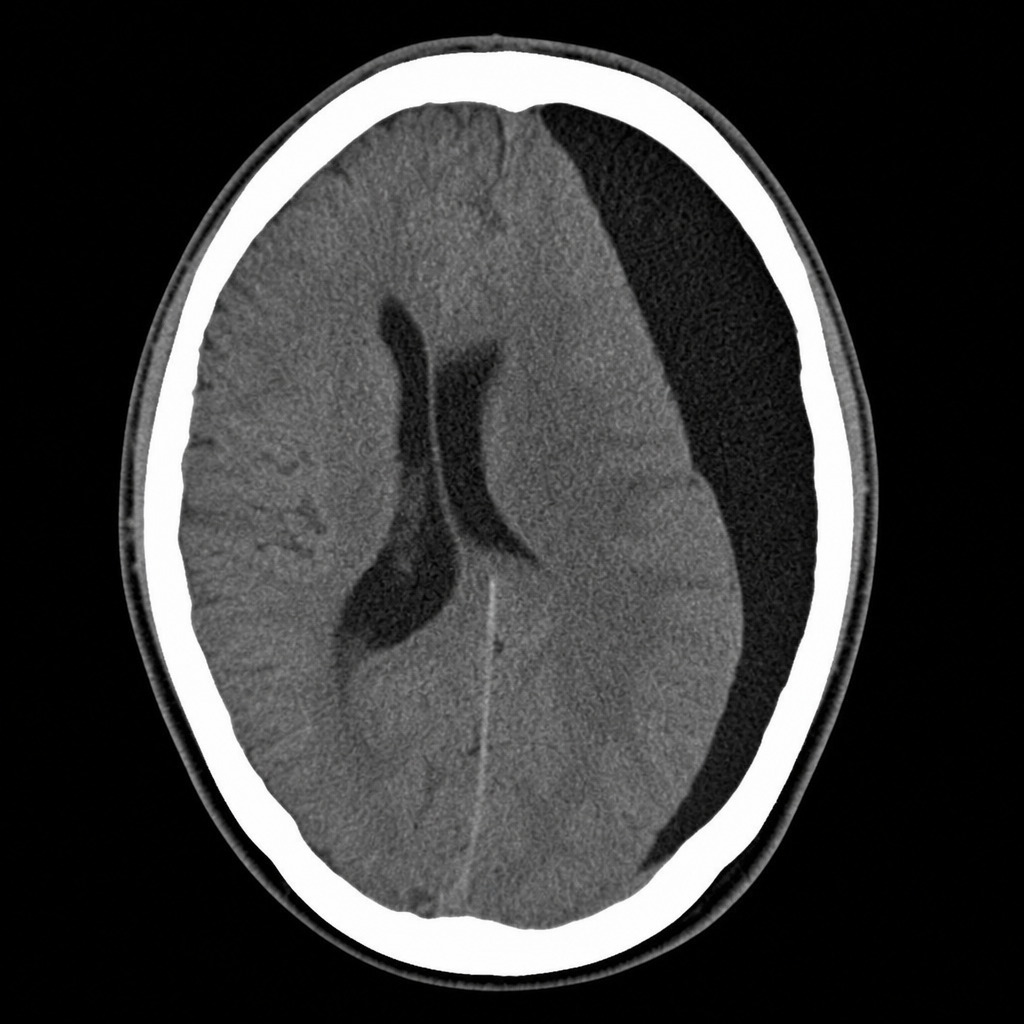
Battle's sign is presented in which type of cranial fossa fracture?
What is defined as the 'golden hour' in trauma care?
Which of the following is NOT a common cause of death in a patient with burns?
What is the recommended treatment for a mandibular fracture located between the incisors?
A patient sustained a head injury in a road traffic accident and lost consciousness instantaneously. After a few minutes, he regained consciousness, exhibited spontaneous eye opening without muscular weakness, and was fully aware of his surroundings. The GCS score is E4V5M6. However, the patient continues to complain of headache, dizziness, nausea, faintness, and an episode of emesis. What is the severity of his head injury?
A 38-year-old male patient presents after a road traffic accident with multiple rib fractures, tenderness in the left chest wall and left hypochondrium, guarding, and rigidity. X-ray shows free fluid in the abdomen. What is the most likely diagnosis?
The Parkland formula for burns is primarily used to calculate the fluid resuscitation needs, typically with which type of intravenous fluid?
Hypovolemic shock develops after what percentage of blood loss?
Which of the following is NOT typically seen in a midface fracture?
In a case of acute trauma, what is the best guideline for quick replacement of fluids?
Explanation: **Explanation:** **Battle’s sign** (postauricular ecchymosis) is a clinical sign characterized by bruising over the mastoid process. It is a pathognomonic indicator of a **Middle Cranial Fossa fracture**. 1. **Why Middle Cranial Fossa is Correct:** The sign occurs when a fracture involves the petrous portion of the temporal bone. Blood tracks along the path of the posterior auricular artery and accumulates in the subcutaneous tissue over the mastoid area. It typically takes 1–3 days to appear after the initial trauma. 2. **Analysis of Incorrect Options:** * **Anterior Cranial Fossa Fracture:** This typically presents with **"Raccoon Eyes"** (periorbital ecchymosis) due to blood tracking from the orbital roof, and **CSF Rhinorrhea** (leakage through the cribriform plate). * **Posterior Cranial Fossa Fracture:** While rare, these fractures are more likely to involve the occipital bone and may present with lower cranial nerve palsies rather than mastoid ecchymosis. * **Lesser Wing of Sphenoid:** Fractures here are associated with Superior Orbital Fissure Syndrome or injury to the optic nerve, rather than external bruising over the mastoid. **Clinical Pearls for NEET-PG:** * **CSF Leak:** Middle fossa fractures often present with **CSF Otorrhea** (leakage from the ear) or hemotympanum. * **Nerve Injury:** The most common cranial nerve injured in middle fossa/temporal bone fractures is the **Facial Nerve (CN VII)**, followed by the Vestibulocochlear Nerve (CN VIII). * **Halo Sign:** If blood is mixed with CSF, dropping the fluid on gauze produces a central red spot with a clear outer ring (Halo/Ring sign). * **Target Sign:** Beta-2 transferrin is the most specific biochemical marker for confirming CSF leakage.
Explanation: The concept of the **'Golden Hour'** is a fundamental principle in trauma surgery and emergency medicine. It refers to the **first 60 minutes (one hour)** following a traumatic injury. ### Why Option B is Correct The underlying medical concept is that the body’s compensatory mechanisms are most effective immediately after injury. If definitive surgical intervention or resuscitation occurs within this first hour, the chances of preventing irreversible shock and multi-organ failure are significantly higher. This period is critical for managing life-threatening conditions like tension pneumothorax, massive hemorrhage, and airway obstruction. ### Why Other Options are Incorrect * **Option A (30 mins):** While "the sooner, the better" applies, 30 minutes is often logistically impossible for transport and initial assessment. * **Options C & D (1.5–2 hours):** By this time, the "lethal triad" (acidosis, coagulopathy, and hypothermia) often sets in, making the trauma irreversible and significantly increasing mortality rates. ### NEET-PG High-Yield Pearls * **Origin:** The term was popularized by **R. Adams Cowley**, the founder of the Shock Trauma Center in Baltimore. * **Trimodal Distribution of Death:** 1. **Immediate (Seconds to minutes):** Due to brain/spinal cord injury or great vessel rupture. 2. **Early (Minutes to hours):** This is the **Golden Hour** where medical intervention (ATLS protocols) saves lives. 3. **Late (Days to weeks):** Due to sepsis or Multi-Organ Dysfunction Syndrome (MODS). * **Platinum 10 Minutes:** A subset of the golden hour referring to the maximum time emergency medical services should spend on-site before transporting a critical patient.
Explanation: In burn management, understanding the timeline of mortality is crucial for NEET-PG. **Explanation of the Correct Answer:** **D. Air embolism** is not a characteristic complication of burn injuries. Air embolism typically occurs due to iatrogenic causes (e.g., improper central line insertion/removal), trauma to large veins, or barotrauma during mechanical ventilation. While burn patients may require central venous access, air embolism is not a direct pathological consequence of the burn injury itself. **Analysis of Incorrect Options:** * **A. Shock:** This is the leading cause of death in the **early/resuscitative phase (first 24–48 hours)**. Hypovolemic (burn) shock occurs due to massive fluid shifts from the intravascular to the interstitial space (capillary leak syndrome). * **B. Suffocation (Inhalation Injury):** This is the most common cause of **immediate death** at the scene. It results from carbon monoxide poisoning, smoke inhalation, or upper airway edema leading to asphyxia. * **C. Sepsis:** This is the most common cause of **late mortality (>48–72 hours)**. The loss of the skin barrier, combined with immunosuppression and necrotic tissue (eschar), provides an ideal medium for bacterial and fungal proliferation. **High-Yield Clinical Pearls for NEET-PG:** * **Most common cause of death overall:** Sepsis (specifically Multi-Organ Dysfunction Syndrome). * **Most common organism in burn sepsis:** *Pseudomonas aeruginosa* (early) and *Staphylococcus aureus*. * **Curling’s Ulcer:** Acute gastric erosion occurring in burn patients due to reduced mucosal blood flow. * **Parkland Formula:** $4 \text{ ml} \times \text{TBSA\%} \times \text{Weight (kg)}$; used to calculate fluid resuscitation in the first 24 hours.
Explanation: **Explanation:** The management of mandibular fractures depends on the location and the stability of the fracture. For fractures located in the **midline (symphysis or parasymphysis)**, such as those between the incisors, the primary goal is to prevent the fragments from splaying due to the pull of the mylohyoid and digastric muscles. **Why Risdon Wiring is Correct:** **Risdon wiring** is a specific technique used for midline mandibular fractures. It involves placing a heavy-gauge wire around the most posterior teeth (usually molars) on both sides. The ends of these wires are then twisted and brought forward to the midline, where they are twisted together. This creates a stable horizontal "tension band" that pulls the fragments together, providing excellent stabilization for fractures between the incisors. **Analysis of Incorrect Options:** * **Essig wiring:** This is a stabilization technique used primarily for **dentoalveolar fractures** or to stabilize loose teeth within a segment. It is not robust enough to provide primary fixation for a complete mandibular body or symphysis fracture. * **Cap splint with circum-mandibular wiring:** This technique is typically reserved for **pediatric mandibular fractures** (where developing tooth buds contraindicate internal fixation) or edentulous patients. It is not the standard first-line choice for a simple midline fracture in an adult. * **Transosseous wiring:** While historically used, this involves drilling holes directly into the bone. It has largely been replaced by **Open Reduction and Internal Fixation (ORIF)** with miniplates, as wiring provides less rigid stability and often requires prolonged intermaxillary fixation (IMF). **High-Yield Clinical Pearls for NEET-PG:** * **Most common site of Mandibular Fracture:** Condyle (followed by Angle and Symphysis). * **Guardsman Fracture:** A midline symphysis fracture combined with bilateral condylar fractures (usually from a fall on the chin). * **First line for most displaced fractures today:** ORIF with miniplates (Champy’s technique). * **Risdon Wiring** is the classic "textbook" answer for stabilizing midline/parasymphysis fractures using a tension band principle.
Explanation: ### Explanation The patient is presenting with a classic case of **Minor Head Injury (Concussion)**. **1. Why "Minor Head Injury" is correct:** The severity of a traumatic brain injury (TBI) is primarily classified using the **Glasgow Coma Scale (GCS)** score assessed after initial resuscitation: * **Minor (Mild) TBI:** GCS 13–15 * **Moderate TBI:** GCS 9–12 * **Severe TBI:** GCS 3–8 In this scenario, the patient has a **GCS of 15 (E4V5M6)**, which falls squarely into the "Minor" category. The brief loss of consciousness (LOC) followed by a "lucid" recovery with symptoms like headache, nausea, and dizziness are hallmark features of a concussion. Despite the symptoms, the neurological status remains intact. **2. Why the other options are incorrect:** * **Severe head injury:** This is defined by a GCS of 8 or less. These patients are typically comatose, unable to follow commands, and often require intubation for airway protection. * **Intermediate (Moderate) severity:** This corresponds to a GCS of 9–12. These patients usually exhibit significant lethargy or focal neurological deficits, which are absent in this patient. **3. Clinical Pearls for NEET-PG:** * **Concussion definition:** A transient, trauma-induced alteration in mental status (e.g., LOC, amnesia) with or without loss of consciousness, where imaging (CT/MRI) is typically normal. * **The "Lucid Interval":** While this patient regained consciousness, do not confuse a simple concussion with an **Epidural Hematoma (EDH)**. In EDH, the "lucid interval" is followed by rapid deterioration. * **Indications for CT in Minor Head Injury (Canadian CT Head Rule):** GCS <15 two hours post-injury, suspected skull fracture, >2 episodes of vomiting, or age >65. * **Post-concussion syndrome:** Persistent symptoms like headache and dizziness (as seen here) can last for weeks but do not change the initial injury classification.
Explanation: **Explanation:** The clinical presentation of left-sided rib fractures, left hypochondriac tenderness, and signs of peritoneal irritation (guarding and rigidity) in the setting of blunt trauma strongly points toward a **Splenic injury**. **1. Why Splenic Injury is Correct:** The spleen is the most commonly injured organ in blunt abdominal trauma. Its anatomical location in the left upper quadrant makes it highly susceptible to injury from fractures of the lower left ribs (9th, 10th, and 11th). The presence of free fluid (hemoperitoneum) on X-ray/USG combined with signs of peritonitis (rigidity) suggests significant intra-abdominal bleeding or associated visceral injury. **2. Why Other Options are Incorrect:** * **Liver injury:** While also common in blunt trauma, liver injuries typically present with right-sided rib fractures and right hypochondriac pain. * **Lung injury:** While rib fractures can cause pneumothorax or hemothorax, these would present with respiratory distress and decreased breath sounds rather than abdominal guarding and rigidity. * **Diaphragmatic injury:** This often presents with bowel sounds heard in the chest or a "nasogastric tube in the thorax" on X-ray. While it can occur with left-sided trauma, it does not typically cause generalized abdominal rigidity unless associated with other visceral ruptures. **Clinical Pearls for NEET-PG:** * **Kehr’s Sign:** Referred pain to the left shoulder due to diaphragmatic irritation by splenic blood (classic for splenic rupture). * **Ballance’s Sign:** Fixed dullness to percussion in the left flank and shifting dullness in the right flank. * **Investigation of Choice:** CECT (Contrast-Enhanced Computed Tomography) is the gold standard for stable patients; FAST (Focused Assessment with Sonography for Trauma) is used for unstable patients. * **Management:** Grade I-III are often managed conservatively; Grade IV-V or hemodynamic instability requires Splenectomy or Splenorrhaphy.
Explanation: The **Parkland formula** is the most widely used guideline for initial fluid resuscitation in burn patients. The correct answer is **Ringer’s Lactate (RL)** because it is a balanced crystalloid that closely mimics the electrolyte composition of human plasma. ### Why Ringer’s Lactate is the Gold Standard: In major burns, there is a massive systemic inflammatory response leading to "capillary leak," resulting in the loss of water and electrolytes into the interstitial space. RL is preferred because: 1. **Prevents Hyperchloremic Acidosis:** Unlike Normal Saline, RL has a lower chloride concentration, reducing the risk of metabolic acidosis. 2. **Buffering Capacity:** The lactate in RL is metabolized by the liver into bicarbonate, which helps counteract the metabolic acidosis often seen in burn shock. ### Why Other Options are Incorrect: * **Normal Saline (0.9% NaCl):** Contains high levels of chloride (154 mEq/L). Large volumes can lead to hyperchloremic metabolic acidosis and may worsen renal perfusion. * **Glucose Saline / 25% Dextrose:** Glucose-containing fluids are avoided in the first 24 hours of adult burn resuscitation because the stress response causes endogenous hyperglycemia. Dextrose can cause osmotic diuresis, which makes "urine output" an unreliable indicator of fluid resuscitation. ### High-Yield Clinical Pearls for NEET-PG: * **The Formula:** Total fluid in 24 hours = **4 mL × Body Weight (kg) × % Total Body Surface Area (TBSA) burned.** * **Administration:** Give **half** of the calculated volume in the first **8 hours** (from the time of injury, not arrival) and the remaining half over the next 16 hours. * **Monitoring:** The best indicator of adequate fluid resuscitation is **Urine Output** (Target: 0.5 mL/kg/hr in adults; 1 mL/kg/hr in children). * **Modified Brooke Formula:** Uses 2 mL/kg/% TBSA instead of 4 mL.
Explanation: The classification of hemorrhagic shock is a high-yield topic for NEET-PG, primarily based on the **ATLS (Advanced Trauma Life Support) guidelines**. ### **Why 40% is the Correct Answer** According to the ATLS classification, **Class IV Hemorrhage** is defined as a blood loss of **>40%** of the total blood volume. This stage represents severe, life-threatening hypovolemic shock. At this point, compensatory mechanisms (like tachycardia and vasoconstriction) fail to maintain perfusion, leading to marked hypotension, narrow pulse pressure, negligible urine output, and a depressed mental status (lethargy/coma). ### **Analysis of Incorrect Options** * **10% (Class I):** Blood loss up to 15% is usually well-tolerated. Vital signs remain stable due to compensatory mechanisms. * **20% (Class II):** Defined as 15–30% loss. While tachycardia and increased respiratory rate occur, the **systolic blood pressure is typically maintained**. * **30% (Class III):** Defined as 30–40% loss. This is the stage where **systolic blood pressure begins to fall** (decompensated shock), but the classic definition of profound, end-stage hypovolemic shock is reserved for Class IV (>40%). ### **NEET-PG High-Yield Pearls** * **Earliest Sign of Shock:** Tachycardia (except in Class I). * **Earliest Change in Vital Signs:** Increase in Heart Rate and Respiratory Rate. * **Blood Pressure:** Remains normal in Class I and II; it only drops in **Class III and IV**. * **Management:** Class I & II are managed with crystalloids; Class III & IV require **crystalloids plus blood products**. * **Urine Output:** Drops significantly (<15 ml/hr) in Class III and is negligible in Class IV.
Explanation: In midface fractures, particularly **Le Fort II and III** types, the anatomical hallmark is **facial lengthening**, not shortening. This occurs because the midface complex is separated from the cranial base and displaced **downward and backward** due to the pull of the pterygoid muscles and the force of gravity. This displacement creates a characteristic "donkey face" or "dish-face" appearance. **Explanation of Options:** * **Facial Shortening (Correct Answer):** This is incorrect because the midface drops inferiorly. Facial shortening is more characteristic of mandibular fractures with significant vertical displacement or specific types of impacted zygomatic fractures, but not classic Le Fort midface injuries. * **Facial Lengthening:** As the fractured segment separates from the skull base and slides down the inclined plane of the sphenoid bone, the vertical height of the face increases. * **Dental Malocclusion:** This is a cardinal sign of midface fractures. The posterior displacement of the maxilla leads to an **"anterior open bite,"** where the posterior teeth meet prematurely, preventing the front teeth from closing. * **CSF Rhinorrhea:** Because Le Fort II and III fractures involve the ethmoid bone and the cribriform plate, dural tears are common, leading to the leakage of cerebrospinal fluid through the nose. **High-Yield Clinical Pearls for NEET-PG:** * **Guerin’s Sign:** Ecchymosis in the region of the greater palatine vessels (seen in Le Fort I). * **Panda Sign/Raccoon Eyes:** Periorbital ecchymosis associated with Le Fort II/III or basilar skull fractures. * **Battle’s Sign:** Post-auricular ecchymosis indicating a fracture of the posterior cranial fossa/petrous temporal bone. * **Dish-face Deformity:** Specifically refers to the concave facial profile seen in Le Fort III fractures due to the recession of the midface.
Explanation: **Explanation:** In the management of acute trauma and hemorrhagic shock, **Urine Output (UOP)** is considered the most reliable and practical bedside indicator for the adequacy of fluid resuscitation. **Why Urine Output is the Correct Answer:** Urine output serves as a direct surrogate for **renal perfusion** and, by extension, global tissue perfusion and cardiac output. In trauma, the body compensates for volume loss by diverting blood away from non-essential organs (like the kidneys) to the heart and brain. A steady urine output of **0.5 ml/kg/hr in adults** (or 1 ml/kg/hr in children) indicates that the kidneys are being adequately perfused, signifying that the circulating volume has been sufficiently restored. **Why Other Options are Incorrect:** * **Pulse (A):** While tachycardia is an early sign of shock, it is non-specific. It can be influenced by pain, anxiety, or medications (e.g., beta-blockers), making it an unreliable guide for the *titration* of fluid replacement. * **Hemoglobin (B):** In acute trauma, hemoglobin levels do not drop immediately because the patient loses whole blood (both cells and plasma). It takes hours for compensatory fluid shifts or resuscitation fluids to dilute the blood and reflect a drop in Hb. * **Central Venous Pressure (D):** CVP measures right atrial pressure. While it can help assess fluid status, it is an invasive procedure and can be misleading in cases of obstructive shock (e.g., tension pneumothorax or cardiac tamponade), which are common in trauma. **Clinical Pearls for NEET-PG:** * **Target UOP:** Adults: 0.5 ml/kg/hr; Children: 1 ml/kg/hr; Infants (<1 year): 2 ml/kg/hr. * **Class of Shock:** Significant drop in UOP is typically seen in **Class III Hemorrhage** (30-40% blood loss). * **Golden Rule:** If a trauma patient is not producing urine despite fluid boluses, the first step is to rule out urethral injury or a blocked catheter before assuming persistent shock.
Initial Assessment of Trauma Patient
Practice Questions
Advanced Trauma Life Support (ATLS) Principles
Practice Questions
Chest Trauma
Practice Questions
Abdominal Trauma
Practice Questions
Head Trauma
Practice Questions
Spinal Trauma
Practice Questions
Extremity Trauma
Practice Questions
Vascular Trauma
Practice Questions
Genitourinary Trauma
Practice Questions
Burns Management
Practice Questions
Mass Casualty Management
Practice Questions
Damage Control Surgery
Practice Questions
Get full access to all questions, explanations, and performance tracking.
Start For Free