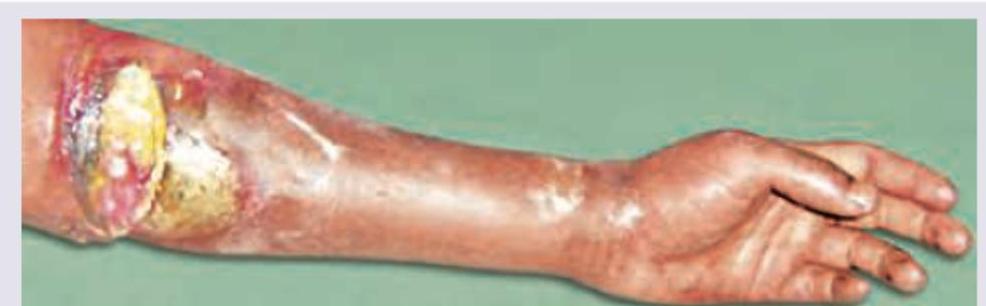
A Sepsis Wound score includes all of the following except:
What is the most common organism implicated in the causation of necrotizing fasciitis?
All of the following are true about pulp space infection EXCEPT?
Which of the following is the organism causing chronic burrowing ulcer?
What is the primary treatment for clostridial myonecrosis?
With regard to surgical site infection, what is it called if bacteria are dividing and have invaded the wound surface?
What is the required treatment for acute lymphangitis?
A 63-year-old man with insulin-dependent diabetes develops a black, crusting lesion in the nose and left maxillary sinus. Biopsy reveals nonseptate hyphae. What is the diagnosis?
Which one of the following surgical procedures is considered to have a clean-contaminated wound?
Tetanus is usually noticed in which type of cases?
Explanation: The **ASEPSIS Wound Score** is a standardized quantitative scoring system used to assess surgical site infections (SSIs) based on clinical observations during the first week after surgery. ### **Explanation of the Correct Answer** **D. Induration** is the correct answer because it is **not** a component of the ASEPSIS scoring system. While induration is a classic sign of inflammation, the ASEPSIS score focuses on objective, visible parameters of wound healing and systemic response. ### **Components of the ASEPSIS Score** The acronym **ASEPSIS** stands for: * **A** – **Additional treatment** (Antibiotics, drainage of pus, or debridement under GA). * **S** – **Serous discharge** (Option A - "Scours" is a common typographical error in Indian medical exams for "Serous"). * **E** – **Erythema** (Option C - Redness). * **P** – **Purulent discharge** (Option B - Pus). * **S** – **Separation of deep tissues** (Dehiscence). * **I** – **Isolation of bacteria** (Wound swab culture). * **S** – **Stay** in hospital (Prolonged stay >14 days). ### **Analysis of Options** * **Serous discharge (Scours), Purulent discharge, and Erythema** are all primary clinical criteria evaluated daily for the first 5–7 days post-operatively to calculate the score. * **Induration** is excluded to maintain the objectivity of the score, as it is harder to quantify than discharge or redness. ### **High-Yield Clinical Pearls for NEET-PG** * **Scoring Interpretation:** A score of **0–10** is considered normal healing; **>20** indicates a minor infection, and **>30** indicates a major surgical site infection. * **Gold Standard:** ASEPSIS is often considered more objective than the Southampton Wound Grading System for research purposes. * **Timing:** The clinical signs (Erythema, Serous/Purulent discharge, and Separation) are recorded daily for the first week.
Explanation: **Explanation:** **Necrotizing Fasciitis (NF)** is a life-threatening, rapidly progressive infection of the deep fascia and subcutaneous tissues. **Why Option B is Correct:** While necrotizing fasciitis is often polymicrobial (Type I), **Group A Streptococcus (Streptococcus pyogenes)** is the most common **monomicrobial** cause (Type II). It is frequently referred to as the "flesh-eating bacteria." Its virulence is attributed to the production of exotoxins (like Pyrogenic Exotoxin A) and M-proteins, which trigger an overwhelming inflammatory response and tissue necrosis. **Why Other Options are Incorrect:** * **A. Staphylococcus aureus:** While often found in polymicrobial infections (Type I) or as a co-pathogen (especially MRSA), it is less frequently the primary causative agent compared to Streptococcus. * **C. Clostridium perfringens:** This is the primary agent for **Gas Gangrene** (Clostridial Myonecrosis). While it can cause necrotizing infections, it involves the muscle layer, whereas NF primarily affects the fascia. * **D. Pneumococcus:** This is a rare cause of soft tissue infections and is typically associated with respiratory or meningeal pathologies. **NEET-PG High-Yield Pearls:** * **Classification:** * **Type I:** Polymicrobial (Aerobes + Anaerobes); most common in diabetics and post-surgery. * **Type II:** Monomicrobial (Group A Strep); occurs in otherwise healthy individuals. * **Type III:** *Vibrio vulnificus* (associated with seawater/marine injuries). * **Clinical Hallmark:** "Pain out of proportion" to clinical findings and "Dishwater pus" (thin, foul-smelling discharge). * **Fournier’s Gangrene:** A specific type of necrotizing fasciitis involving the perineum and scrotum. * **Treatment:** Immediate surgical debridement is the definitive management; antibiotics are adjunctive.
Explanation: **Explanation:** **Pulp space infection**, commonly known as a **Felon**, is an acute infection of the terminal fatty compartment of the finger. **Why Option B is the correct answer (The Exception):** Pulp space infection is **exceedingly painful**, not painless. The pulp of the finger is divided into numerous small, non-compliant compartments by tough fibrous vertical septa that extend from the periosteum of the distal phalanx to the skin. When infection occurs, inflammatory edema causes a rapid rise in pressure within these closed compartments. This high tension compresses the local nerve endings, resulting in **severe, throbbing pain** and exquisite tenderness. **Analysis of other options:** * **Option A:** "Felon" is the standard clinical synonym for a pulp space infection. * **Option D:** The anatomy of the pulp consists of **vertical fibrous septa** that create multiple small "honeycombed" compartments. This anatomical arrangement is responsible for localizing the infection and increasing pressure. * **Option C:** If left untreated, the high pressure can occlude the small vessels (digital artery branches) supplying the distal phalanx. This leads to **ischemic necrosis** of the pulp and can progress to **osteomyelitis** of the terminal phalanx. **Clinical Pearls for NEET-PG:** * **Management:** The primary treatment is **Incision and Drainage (I&D)**. The incision should be made where the tension is maximal (usually lateral) to avoid scarring on the tactile surface. * **Complication:** The most common bony complication is **sequestration of the distal phalanx** (the epiphysis is usually spared in children because the blood supply to the base of the phalanx arises proximal to the pulp space). * **Key Sign:** The patient often holds the finger in a dependent position to relieve the throbbing sensation.
Explanation: **Explanation:** **Meleney’s Gangrene**, also known as a **chronic burrowing ulcer**, is a progressive, synergistic infection of the skin and subcutaneous tissues. The primary causative organism is **Microaerophilic streptococci** (Option D). ### Why Microaerophilic Streptococci is Correct: The pathogenesis of a chronic burrowing ulcer involves a synergistic relationship between microaerophilic non-hemolytic streptococci and other organisms (typically *Staphylococcus aureus* or Proteus). The microaerophilic streptococci thrive in the low-oxygen environment of the subcutaneous tissues, leading to slow, relentless destruction. Clinically, this presents as an ulcer with a characteristic **"burrowing"** nature, where the infection tracks under the skin edges, creating multiple sinuses and extensive undermining. ### Why Other Options are Incorrect: * **A. Peptostreptococcus:** While these are anaerobic cocci often found in polymicrobial abscesses, they are not the specific hallmark organism described for Meleney’s chronic burrowing ulcer. * **B. Streptococcus viridans:** These are alpha-hemolytic commensals of the oral cavity, primarily associated with dental caries and subacute bacterial endocarditis, not burrowing skin ulcers. * **C. Streptococcus pyogenes:** This is the classic cause of acute, rapidly spreading infections like **Erysipelas** or **Necrotizing Fasciitis** (Type II). It causes acute destruction rather than the chronic, slow-progressing burrowing seen in Meleney’s gangrene. ### High-Yield Pearls for NEET-PG: * **Meleney’s Gangrene vs. Fournier’s Gangrene:** Meleney’s is a chronic, synergistic skin gangrene (post-operative/abdominal), whereas Fournier’s is an acute, fulminant necrotizing fasciitis of the perineum/scrotum. * **Clinical Feature:** Look for the triad of a central necrotic area, a middle purplish zone, and an outer erythematous zone. * **Treatment:** Requires aggressive surgical debridement of the undermined edges and prolonged antibiotic therapy.
Explanation: **Explanation:** **Clostridial myonecrosis**, commonly known as **Gas Gangrene**, is a life-threatening muscle infection primarily caused by *Clostridium perfringens*. This gram-positive, anaerobic, spore-forming bacillus produces potent exotoxins (specifically Alpha-toxin) that cause rapid tissue necrosis and systemic toxicity. **Why Penicillin is Correct:** High-dose **Penicillin G** remains the drug of choice for *Clostridium* species. It effectively inhibits cell wall synthesis in these anaerobic organisms. In modern clinical practice, it is often combined with **Clindamycin**, which is added for its ability to inhibit bacterial protein synthesis and suppress the production of the lethal alpha-toxins. **Why Other Options are Incorrect:** * **Amikacin and Gentamicin (Options A & D):** These are Aminoglycosides. Aminoglycosides are ineffective against anaerobes because their uptake into the bacterial cell is an oxygen-dependent process. They are primarily used for Gram-negative aerobic infections. * **Ampicillin (Option C):** While Ampicillin is a broad-spectrum penicillin, Penicillin G is more potent against *Clostridium* and remains the gold standard for targeted therapy in gas gangrene. **High-Yield Clinical Pearls for NEET-PG:** 1. **Gold Standard Treatment:** The most critical step is **emergency surgical debridement** (radical excision of dead tissue). Antibiotics are adjunctive. 2. **Clinical Sign:** Presence of **crepitus** on palpation and "dishwater" discharge with a sweet, mousy odor. 3. **X-ray Finding:** Characteristic "feathering" pattern of gas in muscle planes. 4. **Hyperbaric Oxygen (HBO):** Often used as an adjunct to increase tissue oxygen tension, which is lethal to the anaerobic *Clostridia*.
Explanation: ### Explanation The progression of microorganisms in a wound follows a specific continuum based on bacterial load and host response. The correct answer is **Tropical infection** (also referred to in some surgical texts as **Critical Colonization** or **Local Infection** depending on the classification system used; however, in the context of this specific question, "Tropical infection" refers to the stage where bacteria are actively multiplying and invading the tissue). #### 1. Why "Tropical infection" is correct: In the spectrum of wound microbiology, when bacteria are not just present but are **actively dividing** and have **invaded the wound surface**, it is termed a local or tropical infection. At this stage, the bacteria begin to interfere with wound healing, often presenting with "delayed healing" or "unhealthy granulation tissue" even before systemic signs (fever, leucocytosis) appear. #### 2. Why other options are incorrect: * **Contamination:** This is the simple presence of non-replicating bacteria in the wound. It does not impede healing and is common in all open wounds. * **Colonization:** Here, bacteria are **multiplying** (replicating), but they have **not yet invaded** the tissue or caused a host response. * **Local infection:** While similar, in specific surgical nomenclature used in certain standardized exams, "Tropical infection" is the specific term used to denote the transition from colonization to invasive disease at the wound surface. #### 3. NEET-PG Clinical Pearls: * **SSI Definition:** Infection occurring within **30 days** of surgery (or **1 year** if a prosthetic implant is used). * **Bacterial Load:** A wound is generally considered "infected" when the bacterial count exceeds **$10^5$ organisms per gram** of tissue. * **Most Common Organism:** *Staphylococcus aureus* remains the most common cause of SSI globally. * **Classification:** SSIs are classified into **Superficial Incisional** (skin/subcutaneous), **Deep Incisional** (fascia/muscle), and **Organ/Space**.
Explanation: **Explanation:** **Acute Lymphangitis** is a non-suppurative inflammation of the lymphatic channels, most commonly caused by **Streptococcus pyogenes** (Group A Strep) or occasionally *Staphylococcus aureus*. It typically presents as painful, red, linear streaks extending from a site of infection toward regional lymph nodes. **Why Option A is correct:** The mainstay of treatment is **conservative medical management**. Because the underlying cause is bacterial, systemic **antibiotics** (usually penicillin-based or cephalosporins) are mandatory to prevent progression to bacteremia or sepsis. **Rest** and elevation of the affected limb help reduce edema and facilitate lymphatic drainage, while warm compresses aid in local circulation and pain relief. **Why the other options are wrong:** * **Option B (Lymphangiography):** This is a diagnostic imaging modality used to visualize lymph vessels. It is contraindicated in acute infection as it is invasive and provides no therapeutic benefit. * **Option C (Multiple Incisions):** This is a historical error. Acute lymphangitis is a non-suppurative spreading infection; making incisions is unnecessary and harmful unless a localized abscess has formed. It can lead to further spread of the pathogen. * **Option D (No treatment):** Untreated lymphangitis can rapidly progress to cellulitis, abscess formation, or life-threatening systemic sepsis. **NEET-PG High-Yield Pearls:** * **Clinical Sign:** Look for the "red streak" extending proximally. * **Commonest Organism:** *Streptococcus pyogenes*. * **Differential:** Do not confuse with **Thrombophlebitis**, where the "cord" is palpable and streaks are absent. * **Complication:** If untreated, it leads to **lymphadenitis** (inflammation of the regional nodes).
Explanation: **Explanation:** The clinical presentation of a **black, crusting lesion** (eschar) in the nasal cavity and maxillary sinus of an **uncontrolled diabetic patient** is a classic hallmark of **Rhinocerebral Mucormycosis**. **Why Mucormycosis is correct:** Mucormycosis is an opportunistic fungal infection caused by fungi of the order Mucorales. It predominantly affects immunocompromised individuals, especially those with **Diabetic Ketoacidosis (DKA)** or poorly controlled diabetes. The fungus thrives in acidic, glucose-rich environments. The definitive histopathological finding is the presence of **broad, non-septate hyphae** that branch at **right angles (90°)**. These fungi are angioinvasive, leading to tissue infarction and the characteristic black necrotic eschar. **Why other options are incorrect:** * **Erysipelas:** A superficial bacterial skin infection (usually *S. pyogenes*) characterized by a well-demarcated, raised, erythematous rash. It does not present with non-septate hyphae or deep sinus involvement. * **Eczema:** An inflammatory skin condition (atopic dermatitis) presenting with pruritus and vesicles; it is not an invasive fungal infection. * **Scarlet fever:** A systemic bacterial infection caused by Group A Streptococcus, characterized by a "sandpaper" rash and "strawberry tongue," not necrotic sinus lesions. **High-Yield Clinical Pearls for NEET-PG:** * **Risk Factor:** Uncontrolled Diabetes (DKA) is the most common association. * **Microscopy:** Broad, ribbon-like, **non-septate** hyphae with **90-degree (right-angle)** branching. (Contrast with *Aspergillus*: Septate hyphae with 45-degree branching). * **Treatment:** Immediate surgical debridement + Intravenous **Liposomal Amphotericin B**. * **Complication:** Can spread rapidly to the orbit (proptosis) and brain (cavernous sinus thrombosis).
Explanation: ### Explanation The classification of surgical wounds is based on the degree of microbial contamination at the time of surgery, which predicts the risk of postoperative surgical site infection (SSI). **1. Why Option A is Correct:** **Elective open cholecystectomy** is classified as **Clean-Contaminated (Class II)**. This category includes procedures where a hollow viscus (respiratory, alimentary, genital, or urinary tract) is entered under controlled conditions without unusual contamination. In an elective cholecystectomy for cholelithiasis, the biliary tract is entered, but there is no active infection or major break in sterile technique. **2. Analysis of Incorrect Options:** * **B. Herniorrhaphy with mesh repair:** This is a **Clean (Class I)** wound. These are uninfected operative wounds in which no inflammation is encountered and the respiratory, alimentary, genital, or urinary tracts are not entered. * **C. Appendectomy without inflammation:** While the appendix is part of the alimentary tract, an appendectomy is generally classified as **Contaminated (Class III)** if there is any spillage, or **Clean-Contaminated** only if it is an incidental procedure. However, in the context of standard surgical exams, a "normal" appendectomy is often grouped with Class II, but Option A is the more classic, definitive textbook example of Class II. * **D. Appendectomy with walled-off abscess:** This is a **Dirty/Infected (Class IV)** wound. This class involves old traumatic wounds with retained devitalized tissue or existing clinical infection/perforation. **3. Clinical Pearls for NEET-PG:** * **Class I (Clean):** SSI risk <2%. No hollow viscus entered. Example: Thyroidectomy, Mastectomy. * **Class II (Clean-Contaminated):** SSI risk <10%. Controlled entry into a hollow viscus. Example: Gastrectomy, TURP, Hysterectomy. * **Class III (Contaminated):** SSI risk 15–20%. Gross spillage from GI tract or acute non-purulent inflammation. Example: Cholecystitis with bile spill. * **Class IV (Dirty):** SSI risk ~40%. Established infection or perforated viscera. Example: Peritonitis, Faecal fistula.
Explanation: **Explanation:** The correct answer is **B. Wounds contaminated with faecal matter.** **Why it is correct:** Tetanus is caused by *Clostridium tetani*, an obligate anaerobic, Gram-positive, spore-forming bacillus. The natural habitat of these spores is soil and the **intestinal tracts of animals and humans**. Therefore, faeces are a primary reservoir for the organism. Wounds contaminated with faecal matter provide both the inoculum and the necessary anaerobic environment (due to tissue necrosis or co-infection with aerobic bacteria) for the spores to germinate and release **tetanospasmin**, the potent neurotoxin responsible for the clinical manifestations of tetanus. **Analysis of Incorrect Options:** * **A. Burn cases:** While tetanus can occur in burns (especially deep, neglected ones), it is less common than in contaminated traumatic wounds. * **C. Open fractures:** These are "tetanus-prone" wounds due to soil contamination and tissue devitalization, but they are statistically less likely to harbor the high concentration of spores found in faecal matter. * **D. Gunshot wounds:** These create anaerobic tracts and contain foreign bodies (wadding/clothing), making them high-risk, but they are not the primary source of the pathogen itself compared to faecal contamination. **Clinical Pearls for NEET-PG:** * **Tetanospasmin:** Acts by blocking the release of inhibitory neurotransmitters (**GABA and Glycine**) from Renshaw cells in the spinal cord, leading to spastic paralysis. * **Incubation Period:** Typically 3–21 days; a shorter incubation period usually correlates with a poorer prognosis. * **First Sign:** Trismus (lockjaw) due to masseter spasm is the most common presenting symptom. * **Management:** Wound debridement is crucial to remove the anaerobic niche. Metronidazole is the preferred antibiotic (over Penicillin G) as Penicillin is a GABA antagonist and may potentiate spasms.
Surgical Site Infections
Practice Questions
Intra-abdominal Infections
Practice Questions
Soft Tissue Infections
Practice Questions
Necrotizing Soft Tissue Infections
Practice Questions
Surgical Sepsis
Practice Questions
Tetanus Prophylaxis
Practice Questions
Antimicrobial Prophylaxis
Practice Questions
Antimicrobial Therapy in Surgical Infections
Practice Questions
Surgical Drainage Procedures
Practice Questions
Infection Control in Operating Room
Practice Questions
Biofilms and Implant-Related Infections
Practice Questions
Prevention Strategies
Practice Questions
Get full access to all questions, explanations, and performance tracking.
Start For Free