A patient with a long-standing thyroid nodule is scheduled for subtotal thyroidectomy. Which investigation must be performed preoperatively?
A patient underwent complicated surgery for chronic pancreatitis. What is the most preferred route for supplementary nutrition in this patient?
Which of the following is not an immediate postoperative complication of thyroidectomy?
All of the following are indications for total parenteral nutrition except?
Thyroid storm after operation is typically due to which of the following factors?
A 35-year-old CEO underwent an antrectomy and vagotomy for a bleeding ulcer. Although usually careful with his diet, he ate a large meal during a business lunch. Within 1 hour, he felt lightheaded and developed abdominal cramping and diarrhea. His symptoms may be attributed to:
On postoperative day 5, an otherwise healthy 55-year-old man recovering from a partial hepatectomy is noted to have a fever of 38.6°C (101.5°F). Which of the following is the most common nosocomial infection postoperatively?
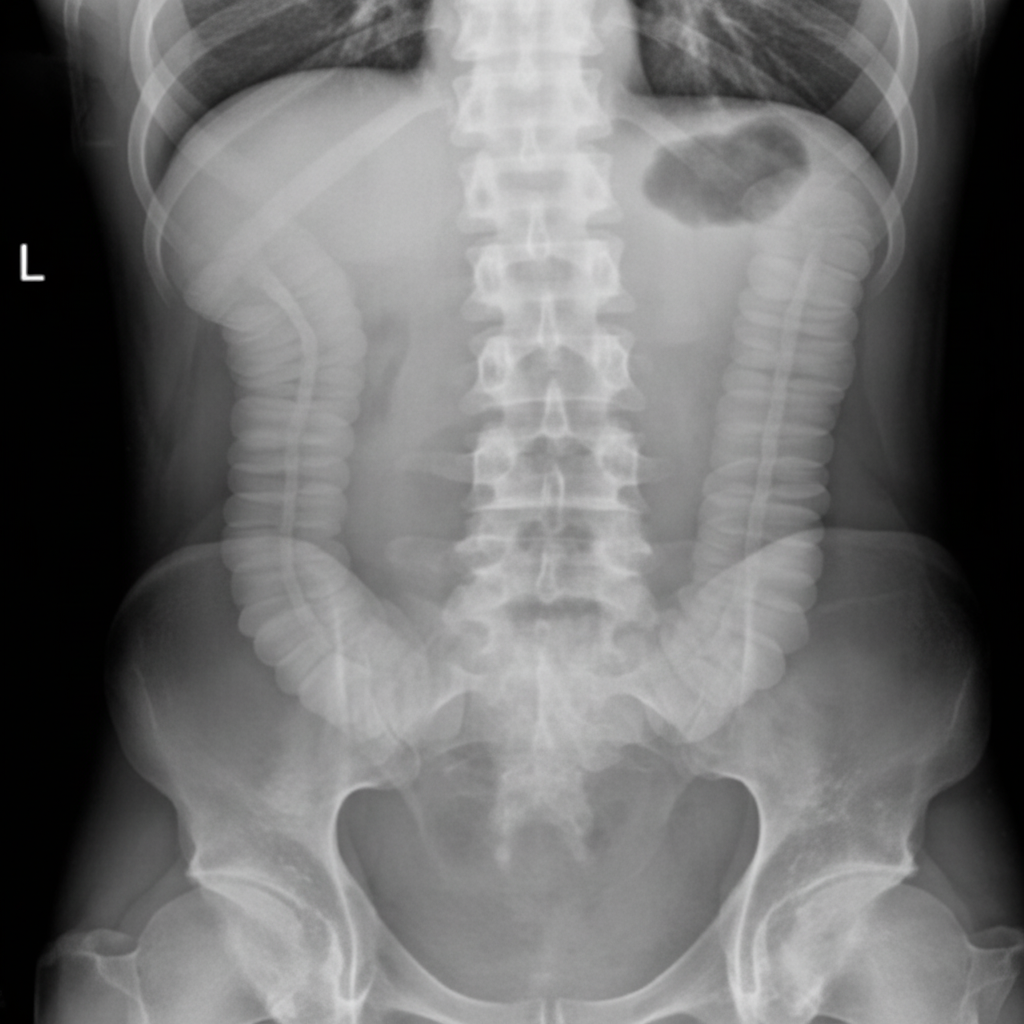
A 70-year-old woman underwent hip surgery 2 days prior for a hip fracture following a fall. She has no prior surgical history or regular medications. Over the past 24 hours, she has complained of abdominal discomfort and distension. On examination, she is afebrile with a blood pressure of 140/80 mmHg, heart rate of 110 bpm, and respiratory rate of 16 breaths/min. She has a distended, tympanic abdomen with absent bowel sounds and no rebound tenderness. Her erect abdominal X-ray is shown. What is the most likely diagnosis in this case?
A 50-year-old man with a small-bowel fistula has been receiving total parenteral nutrition (TPN) for the previous 3 weeks through a single-lumen central venous catheter. He is scheduled for exploratory laparotomy and fistula closure. On the morning of the day of surgery, TPN is discontinued and intravenous infusion with balanced salt solution (Ringer's lactate) is started. An hour later, the patient is found to be anxious, sweating, and tachycardic. What is the most likely cause?
A 60-year-old woman who underwent left hemicolectomy for diverticular disease presents with right calf pain and swelling, confirmed to be deep vein thrombosis (DVT). What is the most appropriate management?
Explanation: **Explanation:** The correct answer is **Indirect Laryngoscopy (IDL)**. **Why Indirect Laryngoscopy is Mandatory:** The primary objective of preoperative IDL in thyroid surgery is to assess the **vocal cord mobility**. Even if a patient is asymptomatic (no hoarseness), there is a significant incidence of pre-existing Recurrent Laryngeal Nerve (RLN) palsy due to compression or infiltration by the thyroid mass. 1. **Medicolegal Importance:** It documents the baseline status of the nerves. If a patient has a pre-existing unilateral palsy, they are at high risk for airway compromise if the contralateral nerve is injured during surgery. 2. **Surgical Planning:** Knowing the cord status helps the surgeon exercise extra caution on the functioning side. **Analysis of Incorrect Options:** * **A & B (Serum Calcium/PTH):** While postoperative hypocalcemia is a common complication due to parathyroid injury, routine preoperative calcium or PTH levels are not mandatory unless a parathyroid pathology or medullary thyroid carcinoma is suspected. * **D (Iodine 131 Scan):** Radioisotope scans are used to evaluate the functional status of a nodule (hot vs. cold). They are not a routine preoperative requirement for a patient already scheduled for surgery based on FNA/ultrasound findings. **High-Yield Clinical Pearls for NEET-PG:** * **Most common nerve injured** during thyroidectomy: External branch of the Superior Laryngeal Nerve (leads to loss of high-pitched voice). * **Most serious nerve injury:** Bilateral Recurrent Laryngeal Nerve palsy (leads to acute airway obstruction). * **Gold Standard for cord assessment:** Fiberoptic Laryngoscopy (though IDL remains the classic exam answer). * **Post-op monitoring:** Always check for "Chvostek’s sign" and "Trousseau’s sign" to screen for hypocalcemia.
Explanation: **Explanation:** The management of nutrition in chronic pancreatitis, especially post-surgery, follows the principle: **"If the gut works, use it."** **1. Why Feeding Jejunostomy (FJ) is the Correct Answer:** In complicated pancreatic surgeries (like a Whipple’s procedure or Frey’s procedure), there is a high risk of postoperative gastric stasis and delayed gastric emptying. A **Feeding Jejunostomy** is preferred because it bypasses the stomach and the pancreaticobiliary anastomosis. This allows for early enteral nutrition without stimulating pancreatic secretions (pancreatic rest) and avoids the complications associated with gastric distension. Enteral nutrition also maintains the gut mucosal barrier, reducing the risk of bacterial translocation and sepsis. **2. Why Other Options are Incorrect:** * **Total Parenteral Nutrition (TPN):** While useful if the gut is non-functional, TPN is associated with higher rates of infection (catheter-related sepsis), metabolic derangements, and gut atrophy. It is a second-line option. * **Feeding Gastrostomy:** This is contraindicated in the immediate postoperative period of pancreatic surgery due to the high incidence of gastroparesis. Feeding into the stomach would increase the risk of aspiration. * **Oral Feeding:** In "complicated" surgery, oral intake is often delayed due to ileus or the risk of anastomotic leak. It is usually insufficient to meet the high caloric demands of a catabolic surgical patient. **Clinical Pearls for NEET-PG:** * **Standard of Care:** Enteral nutrition is always superior to parenteral nutrition in surgical patients unless contraindicated. * **Site of FJ:** Usually placed 15–20 cm distal to the Ligament of Treitz. * **Needle Catheter Jejunostomy (NCJ):** Often used for short-term postoperative enteral access. * **Pancreatic Rest:** Distal enteral feeding (Jejunostomy) minimizes the cephalic and gastric phases of pancreatic secretion.
Explanation: **Explanation:** The distinction between **immediate** and **delayed** complications is a high-yield concept in thyroid surgery. **Why Thyroid Insufficiency is the Correct Answer:** Thyroid insufficiency (hypothyroidism) is a **late/delayed complication**, not an immediate one. After a total or subtotal thyroidectomy, it takes weeks for the circulating thyroid hormones (T3 and T4) to deplete due to their relatively long half-lives (T4 has a half-life of about 7 days). Clinical symptoms of hypothyroidism typically manifest weeks to months post-surgery. **Analysis of Incorrect Options (Immediate Complications):** * **Thyroid Crisis (Storm):** This is a life-threatening, immediate postoperative complication occurring within the first 24 hours. It is triggered by the intraoperative release of thyroid hormones into the circulation, especially in patients with inadequately prepared Graves' disease. * **Recurrent Laryngeal Nerve (RLN) Palsy:** This occurs **intraoperatively** due to accidental trauma, ligation, or traction of the nerve. It manifests immediately upon extubation as hoarseness (unilateral) or respiratory distress/stridor (bilateral). * **Respiratory Obstruction:** This is a critical immediate complication. Causes include a **tension hematoma** (most common cause in the first 24 hours), laryngeal edema, or bilateral RLN injury. **NEET-PG High-Yield Pearls:** 1. **Most common cause of immediate postoperative respiratory distress:** Deep tension hematoma (requires immediate bedside suture removal). 2. **Hypocalcemia (Hypoparathyroidism):** Usually manifests 24–72 hours post-surgery (Intermediate complication). 3. **Preparation for Surgery:** Lugol’s iodine is used preoperatively in thyrotoxicosis to decrease the vascularity of the gland and reduce the risk of thyroid storm.
Explanation: **Explanation:** The core principle of nutritional support is: **"If the gut works, use it."** Total Parenteral Nutrition (TPN) is indicated only when the gastrointestinal tract is non-functional, inaccessible, or requires complete rest for a prolonged period (typically >7 days). **Why "None of the above" is correct:** All three listed conditions are classic indications where TPN may be necessary because enteral feeding is either impossible or contraindicated: * **Post-operative ileus (Option A):** In cases of prolonged ileus, the lack of peristalsis prevents the absorption of nutrients and increases the risk of aspiration. If the ileus persists beyond a week, TPN becomes mandatory to prevent a catabolic state. * **Enterocolic fistula (Option B):** High-output fistulae (>500ml/day) often require "bowel rest" to reduce secretion volume and allow the fistula tract to close spontaneously. TPN provides complete nutrition while bypassing the GI tract entirely. * **Acute pancreatitis (Option C):** While enteral nutrition (via nasojejunal tube) is now preferred in mild-to-moderate cases, TPN remains a vital indication in severe necrotizing pancreatitis where the patient cannot tolerate enteral feeds or when ileus is present. Since all options (A, B, and C) are valid indications for TPN, the correct answer is **None of the above.** **High-Yield Clinical Pearls for NEET-PG:** * **Most common complication of TPN:** Catheter-related bloodstream infection (CRBSI), usually caused by *Staphylococcus aureus* or *Candida*. * **Most common metabolic complication:** Hyperglycemia. * **Refeeding Syndrome:** Characterized by **Hypophosphatemia** (most common), hypokalemia, and hypomagnesemia upon restarting nutrition in a starved patient. * **Long-term TPN complication:** Acalculous cholecystitis and cholestasis due to lack of CCK-mediated gallbladder contraction.
Explanation: **Explanation:** **Thyroid storm** is a life-threatening exacerbation of hyperthyroidism characterized by hyperpyrexia, tachycardia, and altered mental status. In the context of surgery, the primary cause is the **inadequate preoperative control of hyperthyroidism**. When a patient with uncontrolled Graves' disease or toxic multinodular goiter undergoes surgery, the physical stress and surgical manipulation of the gland trigger a massive release of pre-formed thyroid hormones ($T_3$ and $T_4$) into the circulation, leading to a hypermetabolic crisis. **Analysis of Options:** * **Option A (Correct):** Achieving a **euthyroid state** before surgery is the gold standard for prevention. This is typically done using Antithyroid drugs (Propylthiouracil/Methimazole) and Lugol’s iodine (to decrease vascularity). * **Option B:** Massive bleeding leads to hypovolemic shock, not a hypermetabolic thyroid crisis. * **Option C:** Recurrent laryngeal nerve injury causes hoarseness (unilateral) or airway obstruction (bilateral), but does not trigger hormonal surges. * **Option D:** While systemic infection can *precipitate* a thyroid storm in a medical setting, the specific "post-thyroidectomy" storm is almost always attributed to poor preoperative preparation. **Clinical Pearls for NEET-PG:** * **Timing:** Thyroid storm typically occurs **6–18 hours** postoperatively. * **Management:** Treatment includes **Beta-blockers** (Propranolol to control symptoms and inhibit peripheral $T_4$ to $T_3$ conversion), **PTU**, **IV Sodium Iodide** (given 1 hour after PTU), and **Corticosteroids** (to prevent adrenal exhaustion and inhibit $T_4 \to T_3$ conversion). * **Aspirin is contraindicated** in thyroid storm as it displaces thyroid hormones from thyroid-binding globulin (TBG), increasing free hormone levels. Use Paracetamol for fever instead.
Explanation: ### Explanation **Correct Answer: C. Dumping Syndrome** **Mechanism:** Dumping syndrome is a common complication following gastric surgeries like **antrectomy and vagotomy** (which destroy the pyloric sphincter mechanism). The symptoms described—lightheadedness, cramping, and diarrhea occurring within 1 hour of a large meal—are classic for **Early Dumping Syndrome**. The underlying pathophysiology involves the rapid "dumping" of hypertonic chyme into the small intestine. This leads to a massive fluid shift from the intravascular space into the intestinal lumen to achieve isotonicity. This causes: 1. **Gastrointestinal symptoms:** Distension, cramping, and diarrhea. 2. **Vasomotor symptoms:** Lightheadedness, tachycardia, and palpitations due to decreased intravascular volume. --- **Why the other options are incorrect:** * **A. Anemia:** While post-gastrectomy patients can develop iron or B12 deficiency anemia, it presents chronically with fatigue and pallor, not as an acute postprandial episode of diarrhea and cramping. * **B. Jejunogastric Intussusception:** This is a rare, life-threatening complication where the efferent limb prolapses into the stomach. It typically presents with sudden, severe epigastric pain and a palpable mass, often with hematemesis. * **D. Afferent Loop Syndrome:** This occurs due to partial obstruction of the afferent limb (in Billroth II). It is characterized by **bilious vomiting** (without food) that typically relieves the abdominal pain. It does not cause the vasomotor symptoms seen here. --- **High-Yield Clinical Pearls for NEET-PG:** * **Early Dumping:** Occurs 15–30 minutes post-meal; primarily a **vasomotor/osmotic** problem. * **Late Dumping:** Occurs 1–3 hours post-meal; caused by **reactive hypoglycemia** due to an exaggerated insulin surge. * **Management:** First-line treatment is **dietary modification** (small, frequent, low-carb meals; avoid liquids during meals). If refractory, **Octreotide** (somatostatin analogue) is the drug of choice. * **Surgical Procedure:** The most common surgery associated with dumping is Billroth II reconstruction.
Explanation: ### Explanation **Correct Answer: C. Urinary tract infection** In the postoperative setting, **Urinary Tract Infection (UTI)** is statistically the most common nosocomial (hospital-acquired) infection. This is primarily attributed to the frequent use of indwelling urinary catheters (Foley catheters) during and after major surgeries like a partial hepatectomy. Catheter-associated UTI (CAUTI) accounts for approximately 40% of all hospital-acquired infections. **Analysis of Options:** * **A. Wound Infection (Surgical Site Infection - SSI):** While common, SSIs typically manifest between postoperative days 5 and 7. Although a major cause of morbidity, they occur less frequently than UTIs across general surgical populations. * **B. Pneumonia:** This is a significant cause of postoperative fever, especially in patients with upper abdominal incisions (due to splinting and atelectasis). However, it ranks behind UTI in overall incidence. * **D. Intra-abdominal Abscess:** This is a specific complication of abdominal surgery (like hepatectomy) and usually presents later (postoperative day 7–10) with spiking fevers and localized symptoms. **NEET-PG High-Yield Pearls:** * **The "5 W’s" of Postoperative Fever:** 1. **Wonder** (0-24 hrs): Malignant hyperthermia, pre-existing infection. 2. **Wind** (Days 1-2): Atelectasis (most common cause of early fever), Pneumonia. 3. **Water** (Days 3-5): **UTI** (Most common nosocomial infection overall). 4. **Walking** (Days 5-7): DVT/Pulmonary Embolism. 5. **Wound** (Days 7+): Surgical Site Infection (SSI). 6. **Wonder drugs:** Drug-induced fever (anytime). * **Gold Standard for UTI Diagnosis:** Urine culture showing >10⁵ colony-forming units (CFU)/mL. * **Prevention:** The most effective way to reduce the incidence of the most common nosocomial infection is the **early removal of the urinary catheter** (ideally within 24–48 hours).
Explanation: ***Colonic pseudo-obstruction*** - Classic presentation in a **post-operative orthopedic patient** with **massive abdominal distension**, **absent bowel sounds**, and **tympanic abdomen** without peritoneal signs. - **Ogilvie's syndrome** commonly occurs after **hip surgery** in elderly patients, causing functional colonic obstruction without mechanical cause on imaging. *Acalculous cholecystitis* - Typically occurs in **critically ill ICU patients** with **right upper quadrant pain** and **fever**, which are absent here. - Would show **gallbladder wall thickening** and **pericholecystic fluid** on imaging, not generalized colonic distension. *Perforated duodenal ulcer* - Would present with **severe abdominal pain**, **rebound tenderness**, and **free air under diaphragm** on erect X-ray. - Patient would typically be **systemically unwell** with signs of **peritonitis**, not just distended abdomen. *Small bowel obstruction* - X-ray would show **dilated small bowel loops** with **air-fluid levels** and **absence of gas in colon**. - Clinical presentation includes **colicky pain**, **vomiting**, and **high-pitched bowel sounds**, unlike the absent sounds here.
Explanation: **Explanation:** The correct answer is **Hypoglycemia**. **1. Why Hypoglycemia is the correct answer:** Total Parenteral Nutrition (TPN) contains high concentrations of glucose (dextrose). To maintain normoglycemia during TPN administration, the patient’s pancreas undergoes compensatory **hyperinsulinemia** (increased insulin secretion). When TPN is abruptly discontinued, the exogenous glucose supply stops immediately, but the high levels of circulating insulin and the suppressed gluconeogenesis persist for a short period. This leads to **rebound hypoglycemia**. The clinical presentation of anxiety, sweating (diaphoresis), and tachycardia are classic sympathetic responses to low blood sugar. **2. Why the other options are incorrect:** * **Anxiety:** While the patient is anxious, the presence of objective signs like tachycardia and diaphoresis in the context of stopping TPN points toward a metabolic derangement rather than simple preoperative stress. * **Hypovolemia:** The patient was started on Ringer’s Lactate (a balanced salt solution) immediately after stopping TPN. An hour is too short a duration for significant dehydration to manifest this acutely unless there was massive fluid loss. * **Unexplained hemorrhage:** There is no clinical evidence of bleeding (e.g., trauma, active surgical site) provided in the history. Hemorrhage would typically cause hypotension alongside tachycardia. **Clinical Pearls for NEET-PG:** * **Management:** TPN should never be stopped abruptly. It must be tapered over 24 hours or replaced with a 10% Dextrose infusion to prevent rebound hypoglycemia. * **Monitoring:** Blood glucose monitoring is mandatory for at least 1–2 hours after discontinuing TPN. * **Complications of TPN:** The most common metabolic complication is hyperglycemia; however, the most common complication upon *cessation* is hypoglycemia. Catheter-related sepsis remains the most common overall complication.
Explanation: ### Explanation **Correct Option: B. Heparin** The patient has a confirmed diagnosis of Deep Vein Thrombosis (DVT) following major abdominal surgery. The standard of care for an established DVT is **therapeutic anticoagulation**. Heparin (either Unfractionated Heparin or Low Molecular Weight Heparin) is the initial treatment of choice because it prevents further clot propagation and reduces the risk of Pulmonary Embolism (PE). In the postoperative period, anticoagulation is started once the risk of surgical site bleeding is minimized. **Analysis of Incorrect Options:** * **A. Pneumatic compression stockings:** These are **prophylactic** measures used to prevent DVT in the perioperative period. Once a thrombus has already formed, they are insufficient as a primary treatment and carry a theoretical risk of dislodging the clot if used alone in the acute phase. * **C. Thrombolysis:** This is reserved for "massive" or "provoked" DVT (e.g., Phlegmasia cerulea dolens) or hemodynamically unstable PE. It carries a high risk of bleeding, making it contraindicated in the immediate postoperative period unless the condition is life-threatening. * **D. Inferior vena cava (IVC) filter:** This is indicated only when there is a **strict contraindication to anticoagulation** (e.g., active major bleeding) or if a patient develops a recurrent PE despite being on adequate therapeutic anticoagulation. **High-Yield Clinical Pearls for NEET-PG:** * **Virchow’s Triad:** Stasis, endothelial injury, and hypercoagulability (all present in major pelvic/abdominal surgery). * **Gold Standard Investigation:** Contrast Venography (rarely used now); **Investigation of Choice:** Duplex Ultrasonography. * **LMWH vs. UFH:** LMWH (e.g., Enoxaparin) is generally preferred due to a more predictable bioavailability and lower risk of Heparin-Induced Thrombocytopenia (HIT). * **Caprini Score:** Used for VTE risk stratification to decide the type of prophylaxis needed.
Preoperative Risk Assessment
Practice Questions
Perioperative Management of Comorbidities
Practice Questions
Preparation of Patient for Surgery
Practice Questions
Informed Consent Process
Practice Questions
Post-Anesthesia Care
Practice Questions
Pain Management
Practice Questions
Wound Care and Dressings
Practice Questions
Drain Management
Practice Questions
Postoperative Complications Detection
Practice Questions
Early Ambulation and Rehabilitation
Practice Questions
Enhanced Recovery After Surgery (ERAS) Protocols
Practice Questions
Discharge Planning and Follow-up
Practice Questions
Get full access to all questions, explanations, and performance tracking.
Start For Free